ISO 27001 and DORA Compliance: Strategic Guide for 2026

Michael Iyiola
Co-Founder, CWORT
Master ISO 27001 and DORA compliance integration for 2026. Our guide helps you replace spreadsheets with a single, audit-defensible operating model.

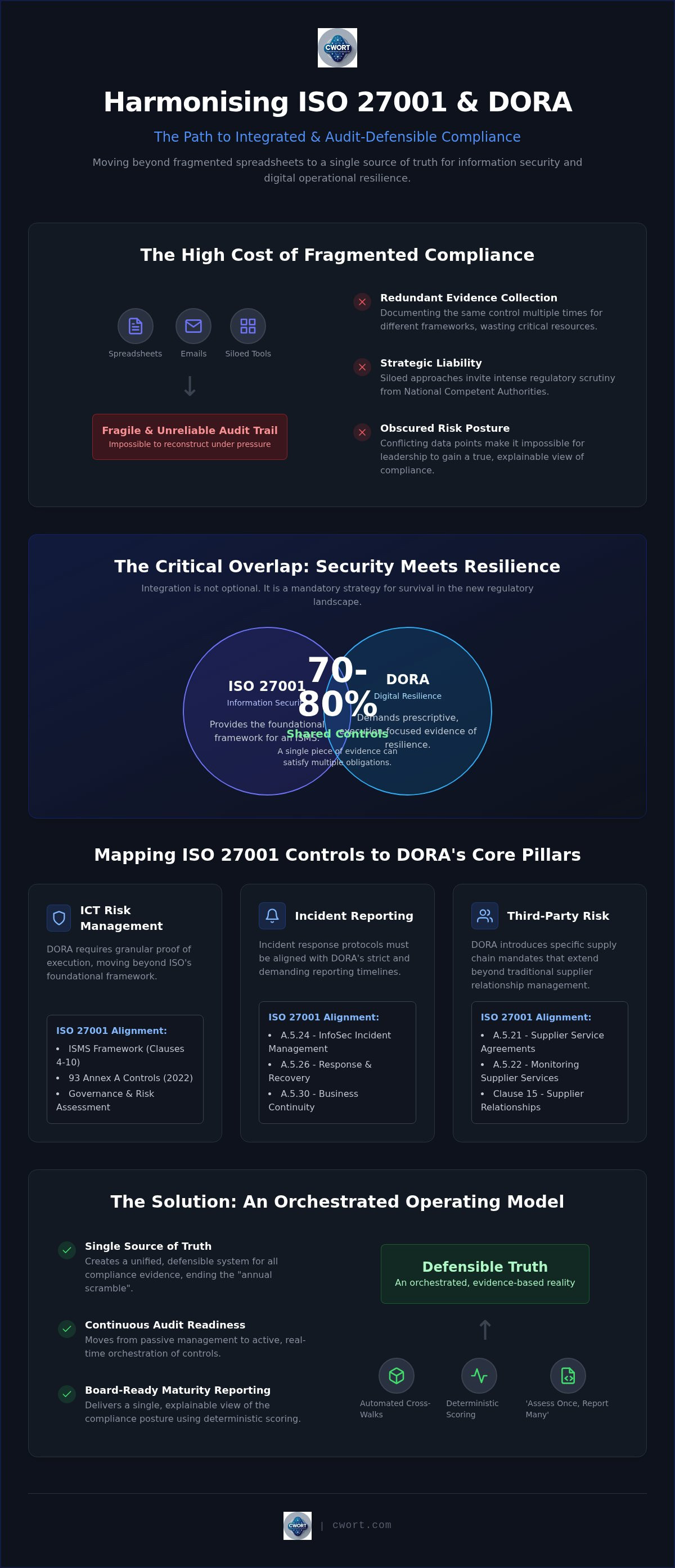
Maintaining separate silos for ISO 27001 and DORA is no longer just an administrative burden; it's a strategic liability that invites regulatory scrutiny. With National Competent Authorities now conducting active enforcement reviews, the grace period for "best-effort" documentation has officially ended. You're likely exhausted by the spreadsheet fatigue that comes from manual framework mapping, especially as you navigate the 93 controls of ISO 27001:2022 alongside DORA's rigid ICT risk management pillars. Achieving seamless ISO 27001 and DORA compliance integration is the only way to replace the anxiety of potential audit failure with the certainty of a defensible truth.
You understand that fragmented evidence across Jira, Excel, and email creates a fragile audit trail that's nearly impossible to reconstruct under the pressure of a regulator-level ICT risk audit. This guide shows you how to harmonise these requirements into a single, orchestrated operating model that eliminates redundant tasks. We'll outline a definitive path to a single source of truth for all compliance evidence, reducing manual reconstruction and delivering board-ready maturity reporting. Discover how to move beyond mere administrative tracking into a state of total operational assurance for 2026 and beyond.
Key Takeaways
- Identify the 70-80% overlap between information security and digital resilience to eliminate redundant controls and streamline your compliance framework.
- Execute a strategic ISO 27001 and DORA compliance integration to replace fragmented spreadsheets with an orchestrated, audit-defensible operating model.
- Align ISO 27001 incident management protocols with DORA's strict reporting timelines to ensure seamless execution during high-pressure regulatory events.
- Adopt deterministic scoring and automated cross-walks to transform abstract requirements into concrete, evidence-based proof for National Competent Authorities.
- Utilise an "assess once, report many" philosophy to deliver board-ready maturity reporting across multiple frameworks, including UK NIS and DORA.
Table of Contents
- The Intersection of ISO 27001 and DORA: Why Integration is Mandatory
- Mapping ISO 27001 Controls to the Five Pillars of DORA
- Manual Spreadsheets vs. Orchestrated Compliance Validation
- A 5-Step Roadmap for ISO 27001 and DORA Integration
- CWORT: The Orchestration Engine for Integrated Compliance
The Intersection of ISO 27001 and DORA: Why Integration is Mandatory
The transition from information security to digital operational resilience marks a fundamental pivot in regulatory oversight. While the ISO/IEC 27001 standard has long served as the global benchmark for managing information risk, the Digital Operational Resilience Act (DORA) introduces a more prescriptive, execution-focused mandate. You cannot treat these as separate projects; doing so creates a 70-80% overlap in control requirements that wastes resources and obscures your true risk posture. Effective ISO 27001 and DORA compliance integration isn't merely an efficiency gain; it's a prerequisite for surviving the active enforcement reviews now conducted by National Competent Authorities in 2026.
From Information Security to Operational Resilience
ISO 27001 provides the structural foundation, yet DORA demands granular evidence of execution. For UK financial entities, managing ICT risk whilst transitioning from the 2013 to the 2022 version of ISO 27001 has already proven complex. DORA amplifies this by requiring proof that your resilience strategies actually work under stress. You must move beyond the "annual scramble" for certification and adopt a state of continuous audit readiness. This shift ensures that your organisation doesn't just look secure on paper but remains operationally resilient during real-world disruptions. It forces a move from passive management to active orchestration of controls across the entire supply chain.
The Cost of Fragmented Compliance
Relying on manual tracking in Jira or Excel is a high-risk strategy that regulators increasingly reject. These fragmented tools create "audit gaps" where evidence becomes lost in email chains or outdated spreadsheets. The hidden operational cost of redundant evidence collection is staggering, often requiring teams to document the same control multiple times for different frameworks. Boards in 2026 demand a single, explainable view of the compliance posture. Without a unified system, your reporting remains subjective and prone to contradiction, leaving leadership exposed during high-stakes audits. Compliance silos lead to conflicting data points that can trigger deeper regulatory investigations. Transitioning to an orchestrated model via CWORT replaces this administrative chaos with a disciplined, evidence-based reality that provides board-level assurance through deterministic scoring.
Mapping ISO 27001 Controls to the Five Pillars of DORA
Mapping ISO 27001:2022 clauses to the Digital Operational Resilience Act (DORA) requirements is not a one-time exercise; it's a structural realignment. Most organisations fail here because they treat mapping as a static spreadsheet task rather than an active orchestration of evidence. To achieve a successful ISO 27001 and DORA compliance integration, you must move beyond high-level alignment and begin binding specific Annex A controls to DORA's five core pillars. This ensures that a single piece of evidence, such as a penetration test report or a supplier risk assessment, satisfies multiple regulatory obligations simultaneously.
ICT Risk Management and Annex A Alignment
DORA's ICT Risk Management pillar requires a level of prescriptive detail that ISO 27001:2022 doesn't always mandate. While ISO provides the framework for an Information Security Management System (ISMS), DORA demands proof of its execution. Organising your 93 Annex A controls into CWORT’s 217 domains allows for granular validation that bridges this gap. You can use a single assessment to satisfy both ISO governance and DORA's ICT risk mandates. This approach eliminates the redundant work of assessing the same control twice, providing a streamlined path to compliance that regulators can easily verify. It transforms your risk management from a theoretical exercise into a defensible reality.
Third-Party Risk and Incident Reporting
Third-party risk management is where many integration efforts collapse. ISO 27001 Clause 5.21 and 5.22 address supplier relationships, but they lack the specific supply chain mandates found in DORA Pillar 4. You must bind supplier evidence directly to DORA requirements to avoid the manual reconstruction of audit trails during an inspection. Similarly, your incident response protocols must evolve. Integrating ISO 27001 incident management with DORA’s strict reporting orchestration ensures you meet the rigorous 24-hour and 72-hour notification windows. Replacing manual spreadsheets with a unified evidence-based compliance management system is the only way to maintain control over these timelines. This level of discipline ensures that when a major incident occurs, your reporting is already automated and accurate. If you want to see how this orchestration works in practice, you can explore our orchestration platform to see the framework cross-walks in action.
The cross-walk between ISO 27001 business continuity (Annex A 5.29 and 5.30) and DORA’s Pillar 3 (Resilience Testing) is equally critical. ISO mandates that security is maintained during disruptions, whilst DORA requires proactive threat-led penetration testing (TLPT). By aligning these schedules, you ensure that your ISO-mandated testing provides the raw data needed for DORA's more aggressive resilience validation. This integrated approach doesn't just save time; it builds a more robust, battle-tested organisation that's ready for the scrutiny of 2026.
Manual Spreadsheets vs. Orchestrated Compliance Validation
Manual spreadsheets are the primary driver of regulatory friction in 2026. Whilst they offer a low barrier to entry, they fail the fundamental test of audit integrity required by European Supervisory Authorities (ESAs) and UK regulators. Static trackers cannot capture the dynamic nature of a modern ICT environment. They rely on manual updates that inevitably lead to stale evidence, creating a dangerous gap between your reported status and your actual risk posture. Transitioning to a model of ISO 27001 and DORA compliance integration requires moving away from these fragmented files and into a system of record that enforces accountability by design.
The Myth of the Compliance Spreadsheet
Manual trackers are often the first point of failure during regulator-led ICT risk audits. They lack a verifiable audit trail, making it impossible to prove when a control was actually validated or by whom. This lack of transparency is a red flag for auditors. CWORT replaces these fragile trackers with an orchestrated system that binds evidence directly to control outcomes. Instead of a person claiming a control is "green," the system requires specific, time-stamped evidence to trigger a status change. This orchestration enforces a strict separation of duties, ensuring that those responsible for execution aren't the ones marking their own homework. It replaces administrative hope with structural discipline.
Deterministic Results and Audit Defensibility
Subjective Red-Amber-Green (RAG) reporting is too vague for the high-stakes environment of 2026. It introduces human bias that undermines board-level assurance. CWORT utilises deterministic scoring to ensure that identical evidence always yields identical results, regardless of who performs the assessment. This level of consistency is vital for building a reproducible assurance system that survives the scrutiny of a deep-dive audit. AI acts as a sophisticated advisor within this framework, identifying gaps and suggesting remediations, but it never modifies the deterministic outcome. This ensures that your compliance posture is based on hard evidence, not algorithmic guesswork.
The result is a board-ready maturity report based on definitive data rather than optimistic estimates. By replacing manual reconstruction with automated validation, you ensure your ISO 27001 and DORA compliance integration remains defensible under the most intense scrutiny. You move from a state of perpetual administrative tracking to one of definitive proof. This transition is not just about efficiency; it's about establishing a single source of truth that binds your regulatory obligations to your operational reality. It provides the calm of auditable certainty in a landscape of fragmented tools.
A 5-Step Roadmap for ISO 27001 and DORA Integration
Transitioning from a fragmented compliance posture to an orchestrated model requires a disciplined, step-by-step approach. You can't rely on consultants who leave behind static documents; you need a digital workflow that sustains itself. A successful ISO 27001 and DORA compliance integration involves five specific phases that move your organisation from abstract policy to definitive, evidence-based proof. This roadmap ensures that every action taken contributes to a single source of truth, satisfying both ISO auditors and DORA regulators simultaneously.
- Step 1: Conduct a Multi-Framework Gap Analysis. Utilise the CWORT control library, which features a taxonomy of 1,355 controls across 42 frameworks, to identify exactly where your existing ISO 27001 ISMS falls short of DORA's prescriptive mandates.
- Step 2: Execute Framework Cross-walks. Map existing ISO 27001 evidence to DORA obligations. This "assess once, report many" strategy eliminates redundant data collection and ensures that 98.6% of active controls carry precise framework references.
- Step 3: Configure Execution Activities. Translate regulatory obligations into structured tasks. This step moves compliance out of the boardroom and into the daily operations of the cyber-security function.
- Step 4: Centralise Evidence Gathering. Connect your SIEM, EDR, and IAM point tools to the orchestration engine. This provides a real-time stream of data that validates control effectiveness without manual intervention.
- Step 5: Generate Board-Ready Reporting. Produce deterministic maturity reports and regulator-ready audit trails. These reports provide leadership with the auditable certainty required to sign off on ICT risk statements.
Configuring the Integrated Workflow
Translating regulatory obligations into structured execution activities is the only way to ensure accountability. You must assign clear ownership and participant roles across the cyber-security function to avoid the "compliance vacuum" where tasks remain unassigned. Utilising ensuring compliance evidence integrity is vital to protect the audit trail from tampering or accidental deletion. This structured workflow ensures that evidence is captured at the moment of execution, rather than being reconstructed months later during an audit. It replaces administrative hope with a rigorous, time-stamped record of compliance.
Enforcing Separation of Duties
DORA demands strict isolation between those who operate a control and those who validate its effectiveness. This prevents the inherent conflict of interest found in many manual systems where teams effectively mark their own homework. CWORT enforces these rules by design within the digital environment, ensuring that validation only occurs when the operator has provided sufficient, deterministic evidence. You can learn more about Enforcing Separation of Duties Under DORA Requirements to understand how this protects your organisation from internal oversight and regulatory rejection. To see how these steps can be automated for your specific environment, request a demonstration of our orchestration platform today.
CWORT: The Orchestration Engine for Integrated Compliance
CWORT functions as the definitive orchestration engine that transforms regulatory mandates into operational reality. It rejects the limitations of point tools, offering instead a comprehensive system that enforces discipline by design. At the core of the platform is an "Assess Once, Report Many" philosophy, powered by a rigorous taxonomy of 1,355 controls across 42 frameworks. This structure ensures that your ISO 27001 and DORA compliance integration is not a fragile mapping exercise but a robust, audit-defensible operating model. The platform guides you through a disciplined lifecycle: Diagnose your gaps, Design your controls, Deliver execution activities, and Demonstrate your maturity with deterministic proof.
Operating Model Intelligence for Senior Leadership
Senior leadership requires more than just a list of completed tasks; they need to understand the structural integrity of the organisation. CWORT provides real-time intelligence by measuring both capability maturity and team capacity. This visibility allows you to identify where resource constraints might jeopardise your resilience posture before a regulator does. The system generates board-ready heat-maps and remediation designs that replace subjective RAG reporting with evidence-based certainty. For a deeper analysis of these requirements, consult our pillar guide on DORA Compliance Validation: A Guide for Financial Institutions. This level of oversight ensures that accountability is maintained across the entire cyber-security function.
Future-Proofing with Framework Cross-Walks
The regulatory landscape is in a state of constant evolution, with NIS2, UK NIS, and the NCSC CAF adding layers of complexity to existing ISO and DORA obligations. CWORT provides the architectural flexibility to manage these overlapping requirements through automated framework cross-walks. If your organisation maintains proprietary standards, the Bring Your Own Content (BYOC) capability allows you to integrate custom models into the same orchestrated environment. This ensures that your compliance engine remains relevant regardless of future legislative shifts. To begin architecting your unified framework, explore our ISO 27001 Control Mapping Tool: A Strategic Guide. It is time to move beyond static toolkits and adopt a governed compliance operating model that delivers auditable certainty in 2026.
Securing Your Regulatory Future Through Orchestrated Resilience
The transition from simple information security to comprehensive digital operational resilience is now a mandatory requirement for financial entities. Relying on fragmented spreadsheets or disconnected point tools creates a level of risk that boards can no longer tolerate. By executing a disciplined ISO 27001 and DORA compliance integration, you eliminate redundant work and establish a definitive, evidence-based reality. You've seen how a structured roadmap and deterministic scoring replace the anxiety of audits with the calm of auditable certainty.
CWORT provides the structural integrity needed for this transition. With 1,355 pre-mapped controls and an audit-defensible evidence register, the platform ensures your reporting is always board-ready. You can move from mere administrative tracking to a state of total operational assurance. Request a CWORT Pilot to Orchestrate Your DORA and ISO 27001 Integration and gain access to board-ready maturity dashboards today. You have the framework and the tools to transform your compliance posture; it's time to lead your organisation toward a more resilient 2026.
Frequently Asked Questions
Can ISO 27001 certification prove DORA compliance?
ISO 27001 certification cannot prove DORA compliance because the former is a management system standard whilst the latter is a prescriptive legal regulation. While ISO provides a robust foundation for information security, DORA mandates specific operational execution and resilience testing. You must provide granular evidence of execution that goes beyond the high-level risk management processes typically audited during an ISO certification. Certification is the baseline; DORA is the enforceable reality of operational resilience.
What are the main gaps between ISO 27001 and DORA requirements?
The primary gaps lie in DORA's prescriptive mandates for ICT incident reporting and threat-led penetration testing. ISO 27001 allows organisations to define their own risk appetite and control selection. In contrast, DORA requires strict notification windows, such as 24-hour initial reports, and mandates specific supply chain risk assessments. These requirements demand a level of technical evidence and execution speed that many traditional ISO-based management systems aren't designed to deliver in 2026.
How does CWORT handle framework cross-walks for ISO and DORA?
CWORT utilises an "assess once, report many" philosophy to manage framework cross-walks. The platform features a taxonomy of 1,355 controls pre-mapped across 42 frameworks, including ISO 27001 and DORA. When you validate a control once, the system automatically updates every relevant regulatory obligation. This deterministic approach ensures that 98.6% of active controls carry precise framework references, providing a single, explainable view for auditors and senior leadership without the need for manual mapping.
Why should we integrate ISO 27001 and DORA instead of keeping them separate?
Integrating these frameworks eliminates the 70-80% overlap in control requirements that typically causes administrative fatigue. Separate silos lead to redundant evidence collection and the risk of contradictory reporting during an audit. Achieving a successful ISO 27001 and DORA compliance integration creates a single source of truth. This orchestration replaces the chaos of manual spreadsheets with a disciplined operating model that provides board-level assurance and reduces the overall cost of compliance activities.
What evidence is required to prove DORA ICT risk management effectiveness?
Proving effectiveness requires deterministic evidence rather than subjective self-assessments. You must provide time-stamped logs from SIEM or EDR tools, validated third-party risk registers, and records of resilience testing. Regulators reject manual trackers that lack a verifiable audit trail. Every piece of evidence must be bound directly to a specific control outcome within a governed digital environment. This ensures that the results are reproducible and survive the scrutiny of a deep-dive regulatory inspection.
How does CWORT enforce separation of duties for integrated compliance?
CWORT enforces separation of duties through role-based and attribute-based access controls. The platform's digital workflow isolates the individuals responsible for executing a control from those tasked with validating its effectiveness. This prevents the conflict of interest inherent in manual systems where teams effectively mark their own work. By design, the system requires an independent validator to sign off on evidence before a control is marked as compliant, ensuring total audit integrity and regulatory defensibility.
Can we import our own custom maturity models into the CWORT platform?
Organisations can import proprietary maturity models using the Bring Your Own Content (BYOC) capability. This feature allows you to leverage your existing intellectual property whilst benefiting from CWORT’s governed workflow and immutable audit history. The platform is content-agnostic, supporting any criteria, weighting, or evidence requirements you define. It turns your custom model into a repeatable management system, providing portfolio-level visibility and actionable improvement roadmaps without losing the specific details of your unique operating model.
How does DORA affect UK-based financial firms post-Brexit in 2026?
UK financial firms operating within the European Union must comply with DORA directly. For domestic-only firms, UK regulators such as the FCA have increasingly aligned their operational resilience mandates with DORA’s core pillars to ensure international equivalence. By 2026, the distinction between EU and UK resilience standards has narrowed significantly. Implementing a unified compliance engine ensures your organisation remains resilient across both jurisdictions, protecting you from evolving regulatory pressures and ensuring your operating model meets global standards.
Disclaimer
The content on this site is provided for general information and educational purposes only. It does not constitute legal, regulatory, financial, or professional advice. CWORT provides AI-assisted insights and workflow automation, but all compliance decisions remain the responsibility of your organisation and its management. Always seek qualified legal or regulatory guidance for decisions relating to the UK NIS Regulations, CAF, DORA, NIS2, ISO 27001, or other obligations.
Related posts
Streamlining Regulatory Compliance Processes: From Manual Tracking to Orchestrated Validation
Stop wasting money on manual compliance. Learn about streamlining regulatory compliance processes to reduce personal liability under DORA & NIS2 and gain aud...
CISO Guide to DORA Operational Resilience: Orchestrating Validated Compliance
Master validated compliance with our CISO guide to DORA operational resilience. Swap manual evidence gathering for an orchestrated, audit-ready security post...
Common NIS2 Compliance Mistakes: A Strategic Guide to Avoiding Audit Failure in 2026
Avoid costly NIS2 audit failure in 2026. This guide reveals common NIS2 compliance mistakes and shows how to build a defensible, audit-ready strategy.
Article by
Michael Iyiola
Co-Founder, CWORT
Michael Iyiola is a co-founder of CWORT and a Cyber and AI Security Engineer with deep experience in vulnerability management, detection engineering and operational resilience across UK critical national infrastructure, including rail, energy and financial services. At CWORT, he designs scalable, evidence-driven workflows that help teams meet modern regulatory and security demands.
Build Your Foundation of Auditable Certainty
Take control of your regulatory obligations and secure your infrastructure with CWORT.