ISO 27001 Evidence Management: From Collected Records to Audit-Ready Proof

Michael Iyiola
Co-Founder, CWORT
Discover how ISO 27001 evidence management turns scattered records into audit-ready proof. Organise controls, verify currency, and close key assurance gaps.

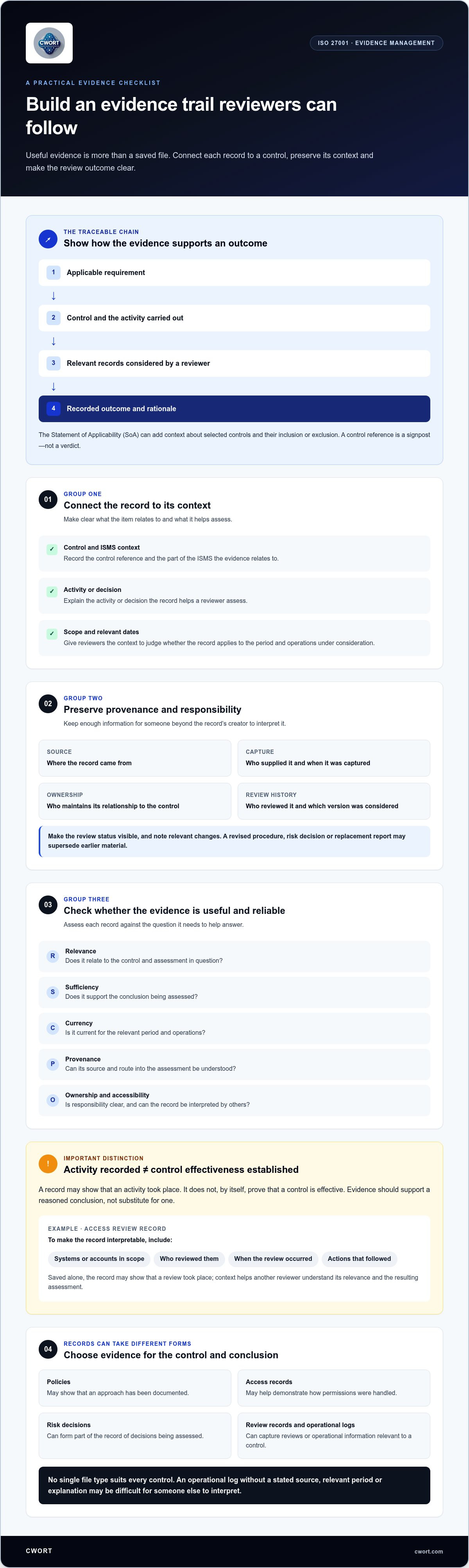
A folder full of files isn’t audit-ready proof. ISO 27001 evidence management only works when each record has clear provenance, a link to the relevant control and an understood review status. Yet evidence often sits across teams, platforms and file stores, leaving owners to assemble the story when an audit is already approaching. The key question isn’t simply whether a document exists, but whether it supports a defined outcome when reviewed.
That pressure is understandable: controls may be in place, but scattered or outdated records make it difficult to show what’s working, what remains incomplete and who needs to act. Collecting more files won’t solve the problem. Evidence needs to be assessed, connected to control outcomes and governed over time.
This article explains how to organise evidence into a consistent, traceable record; assess whether it’s current and complete; and make gaps, owners and review needs visible before audit activity begins. It also shows how well-governed evidence can support reporting across mapped frameworks without losing the context that makes each record meaningful. The result is a clearer, more defensible view of assurance, not just a fuller folder.
Key Takeaways
- Make each evidence record traceable from the relevant control through review to a recorded outcome.
- Use ISO 27001 evidence management to assess relevance, sufficiency, currency, provenance, ownership and accessibility.
- Distinguish proof that an activity took place from evidence that helps assess whether the control is effective.
- Establish a repeatable workflow with clear responsibilities for collecting, reviewing and resolving evidence gaps.
- Reuse evidence across mapped frameworks while preserving the context behind each control assessment.
Table of Contents
- What ISO 27001 evidence management means, and why a folder of files is not enough
- How ISO 27001 evidence connects to controls, decisions and assurance
- How to assess whether ISO 27001 evidence is useful and reliable
- A repeatable ISO 27001 evidence management workflow
- How CWORT supports governed ISO 27001 evidence management
What ISO 27001 evidence management means, and why a folder of files is not enough
ISO 27001 evidence management is the disciplined governance of records used to assess an Information Security Management System (ISMS) and its controls. It connects each record to the activity or decision it relates to, identifies who is responsible for it and makes its review status visible. The aim isn’t to accumulate documents. It’s to make the basis for an assessment understandable and traceable.
Quotable definition: ISO 27001 evidence management is the process of organising, contextualising and reviewing records so they can support a clear assessment of relevant ISMS controls.
A file’s existence doesn’t establish that it’s relevant, current or sufficient to support a particular conclusion. A folder may contain useful records, but without clear ownership and links to controls, reviewers must work out what each item means, whether it is still valid and how it informs an assessment. That can delay reviews, obscure gaps and make the evidence trail harder to follow. It doesn’t determine an audit outcome, but it can make assurance more difficult to explain.
What counts as evidence in an ISO 27001 ISMS?
Evidence can take different forms, depending on the control, the ISMS scope and the conclusion being assessed. Examples include policies, access records, risk decisions, review records and operational logs. A policy might show that an approach has been documented; access records may help demonstrate how permissions were handled; a review record can show that a decision was revisited.
No single file type is suitable for every control. Assess the record against the question it needs to help answer, and consider its context. An operational log without a stated source, relevant period or explanation may be difficult for someone else to interpret. ISO/IEC 27001’s ISMS and risk-based approach provide useful context; see the ISO/IEC 27001 Wikipedia article for an overview.
Evidence collection versus evidence management
Collection gathers records. Management adds the information and review needed to make them usable: their source, owner, relationship to a control, review status and any relevant changes. Make the relationship explicit rather than relying on a filename or folder location. A practical ISO 27001 control mapping guide can help explain how controls are identified and related to evidence.
Consider an access review record. Saved alone, it may show that a review took place, but not which systems or accounts were in scope, who reviewed them, when the review occurred or what actions followed. Adding that context helps another reviewer interpret its relevance and understand the resulting assessment. It also separates evidence that an activity occurred from evidence that supports a judgement about how a control operated.
Keep the record interpretable beyond its creator. Record enough context to establish what it relates to, who maintains it and whether it needs review. When that information is missing, teams may have to retrace decisions or locate contributors to explain the file. A governed record reduces ambiguity and gives the next stage of assurance a clear starting point.
How ISO 27001 evidence connects to controls, decisions and assurance
A useful evidence record forms part of a traceable chain: an applicable requirement informs a control; the control is carried out through an activity; records capture relevant information; a reviewer considers those records; and an outcome is recorded with its rationale. This chain helps someone understand not only what evidence exists, but why it matters to the assessment and what decision followed.
Evidence supports a control assessment, but it does not, by itself, prove that a control is effective. A record can show that an activity occurred without demonstrating that it achieved its intended result. For example, a completed review may document that a risk was considered. To assess the decision further, a reviewer may need to understand the risk, the options considered, the action taken and whether that action was followed up. Evidence should support a reasoned conclusion, not substitute for one.
Link evidence to the applicable control and ISMS context
For each item, record the control reference, the part of the ISMS it relates to, its source and the activity or decision it helps assess. Include scope and relevant dates so a reviewer can judge whether it applies to the period and operations under consideration. A control reference is a signpost, not a verdict: attaching a document to a control doesn’t establish that the control is implemented or effective.
The Statement of Applicability (SoA) helps explain which controls have been selected and provides context for their inclusion or exclusion. Read evidence alongside that context rather than treating a control reference as self-explanatory. IBM’s explanation of ISO 27001 discusses the standard and the role of documented information and the SoA in demonstrating how an ISMS is structured.
Preserve provenance, ownership and review history
Provenance answers where a record came from and how it reached the assessment. Capture who supplied it, when it was captured, who reviewed it and which version was considered. Assign an owner responsible for maintaining the relationship between the record and the control, even if another person performs the activity or provides the evidence.
Change history matters. A revised procedure, updated risk decision or replacement report may supersede earlier material, but the earlier version can still explain a past assessment. Mark superseded records clearly and retain enough history to distinguish what was current at the time from what applies now. Without this distinction, a reviewer may rely on an outdated version or be unable to reconstruct why an outcome was recorded.
Make the outcome explicit: record the reviewer’s conclusion, its basis, any limitation and any follow-up needed. If the evidence is incomplete or outside the relevant scope, say so rather than implying stronger assurance than the record supports. This gives control owners a defined point to resolve and helps later reviews understand what changed. In disciplined ISO 27001 evidence management, traceability connects the control, evidence and decision without confusing documentation with proof of performance.
How to assess whether ISO 27001 evidence is useful and reliable
Judge evidence by what it helps you conclude, not by how much you have collected. A large repository can still leave a control assessment unsupported if records are out of scope, unclear or difficult to verify. The Official ISO/IEC 27001 Standard provides the requirements against which an organisation establishes its ISMS; assess each record in relation to the applicable control and the assurance question being asked.
Use six checks. They don’t make evidence automatically valid or invalid, but they help reviewers identify what is clear, what needs context and what requires follow-up:
- Relevance: Does the record relate to the control activity and the defined ISMS scope?
- Sufficiency: Does it provide enough information to support the intended assessment, or is important context missing?
- Currency: Does its date or review status make it appropriate for the period being assessed?
- Provenance: Is its source clear, and can the record be traced to where it came from?
- Ownership: Is a person or role accountable for maintaining or reviewing it?
- Accessibility: Can authorised reviewers locate and interpret it without relying on undocumented explanations?
Apply the checks to the assurance question. A current policy may be relevant to whether an approach is defined, but it may not show how that approach was applied. Conversely, an operational record may show activity but leave its scope or significance unclear. Record the gap precisely; don’t treat a missing detail as proof that the control failed, or assume that a polished document proves it worked.
A practical evidence quality test
Ask what control activity the record relates to, which ISMS scope it covers and what conclusion it is intended to support. Then check whether the source, relevant period, owner and review status are clear. If information is ambiguous or appears stale, flag it for clarification or review. Its age alone doesn’t determine whether it remains useful; assess it in context.
The stronger example is more interpretable, not automatically conclusive. Reviewers still need to assess whether it supports the control question.
Repository, spreadsheet or governed workflow?
Storage, traceability, ownership, version history and status visibility are separate capabilities. A shared folder can store files; a spreadsheet can track owners and dates. Both can support evidence work, but relationships and review history may become fragmented as records are copied, updated or managed by different teams.
Match ISO 27001 evidence management to the scale and coordination needs of the ISMS. A governed workflow is useful where multiple contributors need consistent accountability, visible review status and repeatable reporting. Assess the process first: can it preserve context, show who is responsible and make unresolved gaps visible? The tool matters only insofar as it supports those controls throughout the evidence lifecycle.
A repeatable ISO 27001 evidence management workflow
A repeatable lifecycle turns evidence requests into accountable work, not a last-minute search for documents. Start with the ISMS scope and applicable controls, then define what each assessment needs to establish. Assign responsibility before requesting records, and keep review findings connected to actions through to reassessment.
- Set the scope. Confirm which parts of the ISMS and which controls are in scope for the review. This prevents teams gathering material that cannot support the assessment.
- Assign owners and contributors. Name an accountable control owner and identify who can provide relevant records. The roles may sit in different teams, but each request needs a clear route and responsible person.
- Define the evidence need. State the question the evidence should help answer, its expected context and the review cadence appropriate to the control. Avoid generic requests such as “send the latest documents”.
- Collect and record. Capture the evidence source, relevant period, scope and owner alongside the record. Note any limitations or dependencies that may affect interpretation.
- Review against the question. Assess whether the material is relevant and sufficiently clear to support a conclusion. Record who reviewed it, when and the outcome, including any uncertainty.
- Resolve exceptions. Turn missing, outdated or inconclusive evidence into an owned action. Set a priority, status and review date so the gap remains visible until it is addressed.
- Reassess and retain history. Review the updated evidence and action outcome, then preserve the decision and relevant changes for future assessment.
Set scope, owners and evidence requirements
Begin with the control and the assurance question, then request only records that can help answer it. A control owner is accountable for the control’s assessment and follow-up; contributors supply records or operational context; reviewers examine the material and document their conclusion. One person may hold more than one role, but responsibilities should remain explicit. Set review frequency according to the control’s context and the need to revisit its evidence.
Review records, address gaps and retain history
Make each review decision actionable. If a record is missing, assign someone to locate or produce relevant evidence. If it is outdated, set a date to obtain or review current material. If it is inconclusive, state what remains uncertain and what would help resolve it. Track the action’s owner, priority, status and due or review date; don’t leave exceptions as informal notes.
Retain the decision, updated evidence and action history together, so a later reviewer can see what changed and why. Close an action only after the agreed follow-up has been reviewed, and record any remaining limitation. Capture evidence, review its connection to the control, then track remediation until the outcome can be reassessed.
To see how a governed workflow can organise control-level evidence and follow-up, request a CWORT demonstration.
How CWORT supports governed ISO 27001 evidence management
CWORT is a compliance validation platform that connects evidence with the control outcomes it supports. Rather than treating evidence as a collection of files, it provides a governed view of control relationships, assessment status and review activity. Teams can see which controls have supporting evidence, where attention is needed and how an assessment reached its recorded outcome.
Turn control-level evidence into a governed assurance view
CWORT’s assurance evidence register supports control-by-control status tracking. Evidence can be bound to control outcomes, making the relationship between a record and its assessment visible. This helps authorised owners and reviewers understand the basis for the assessment and follow status across the control set, rather than reconstructing the picture from separate repositories.
The platform sits above operational security tools. Those tools continue to support security activities; CWORT provides an explainable evidence view for assessment and reporting. Its mapped controls can support reuse across applicable frameworks, while each evidence item remains connected to the control and assessment context that gives it meaning. Reuse should not strip away scope, review status or the reasoning behind an outcome.
In the June 2026 library snapshot, CWORT’s taxonomy contained 1,355 controls across 217 domains linked to 42 frameworks or standards. This mapping can help organisations relate evidence-led assessments across frameworks while retaining the context needed to interpret each control relationship.
Governance features support accountability around that workflow. CWORT includes role-based and attribute-based access, separation of duties and immutable audit history. Together, these capabilities support controlled participation and a record of activity. They don’t remove the need for organisational judgement: people remain responsible for evaluating evidence, considering limitations and deciding what conclusions are justified.
Assess fit through a focused demonstration
A focused demonstration makes the workflow tangible. Use a relevant control from your organisation’s context and follow how an owner, evidence relationship, status and review history appear together. This helps teams assess how the approach fits their existing evidence process and reporting needs, without assuming that every organisation has the same structure or workflow.
For ISO 27001 evidence management, the practical question is whether a governed view makes the route from evidence to control assessment clearer, while keeping decisions traceable and review needs visible. CWORT supports that process with control-level tracking and mapped relationships; your organisation retains responsibility for interpreting evidence and acting on the assessment.
Request a CWORT demonstration to explore a relevant evidence workflow against your control context.
Make your next evidence review a point of control
Use your next review to test whether evidence can be followed from its source to a control decision, and whether unresolved issues have a clear owner and next step. That gives you a practical starting point for improving ISO 27001 evidence management: focus first on one area where fragmented records or unclear review status make assurance harder to establish.
Where assessment results inform reporting, consistency matters. CWORT uses deterministic, reproducible scoring, whilst AI advisory does not alter those results. This keeps the assessment outcome distinct from advisory input and helps teams understand the basis of their reporting.
Consider how this approach could fit your existing programme, roles and evidence process. A focused demonstration lets you examine a relevant workflow and decide what would make control evidence easier to govern in practice.
Explore a CWORT demonstration and take a clear next step towards more accountable, traceable assurance.
Frequently Asked Questions
Is a screenshot sufficient evidence for ISO 27001?
Sometimes, but a screenshot’s usefulness depends on the control and the question being assessed. For example, an image of a settings page may capture a configuration at a particular moment, but won’t necessarily show how it was maintained over time. Record its source, capture date, relevant system or activity and reviewer. Check that it hasn’t been cropped in a way that removes important context, and don’t treat the image format itself as proof of effectiveness.
Can one evidence item support more than one ISO 27001 control?
Yes, if the record genuinely relates to each control being assessed. For example, an access review record might inform more than one assessment, but the register should explain the relationship separately for each control. Check whether the same systems, users and period are in scope. A shared record can reduce repeated requests, but it doesn’t automatically answer every control question or support the same conclusion in each context.
How often should ISO 27001 evidence be reviewed?
Set review timing based on how quickly the underlying control or process can change and what assurance the organisation needs. A record tied to frequent system changes may warrant review after a change, whilst a stable document may follow a planned review cycle. Name an owner and define triggers, such as a process change, a new system or a previously identified gap. One blanket interval may miss important changes or create unnecessary reviews.
What information should an ISO 27001 evidence record contain?
Include enough information for someone unfamiliar with the record to understand its origin and purpose. Useful details can include its source, owner, capture or review date, relevant ISMS scope, control relationship and current status. For a report, a version identifier or the period it covers may also help. Treat these as practical fields, not a universal format mandated by the standard; tailor the record to the evidence and assessment.
Does ISO 27001 require an evidence management platform?
Don’t assume that ISO 27001 requires a particular software product or repository. The organisation needs a workable way to manage documented information in the context of its ISMS, and that may involve existing tools or a governed platform. Software can make relationships, responsibilities and review history easier to oversee, but it cannot establish conformity on its own. Check interpretations against the applicable ISO/IEC 27001 edition and the organisation’s defined scope.
How should sensitive ISO 27001 evidence be protected?
Limit access to people who need the record for a defined role, and handle it in line with organisational policies. For instance, a screenshot or log extract may contain unrelated account details; consider whether those can be removed before sharing without weakening the evidence. Apply appropriate controls during collection, storage, transfer, retention and disposal. Keep necessary review history, while avoiding wider exposure of personal or operational information than the assessment requires.
Can ISO 27001 evidence be reused for other frameworks?
It can be reused where the underlying activity, scope and relevant period align with the other framework’s requirement. For example, a risk review may inform multiple assessments, but each mapping should state what it supports and note any difference in intent or coverage. Don’t infer that one record satisfies every mapped requirement. Preserve the reasoning and assessment context for each framework so reviewers can understand how each conclusion was reached.
Disclaimer
The content on this site is provided for general information and educational purposes only. It does not constitute legal, regulatory, financial, or professional advice. CWORT provides AI-assisted insights and workflow automation, but all compliance decisions remain the responsibility of your organisation and its management. Always seek qualified legal or regulatory guidance for decisions relating to the UK NIS Regulations, CAF, DORA, NIS2, ISO 27001, or other obligations.
Related posts
ISO 27001 Control Effectiveness Proof: Moving Beyond Static Certification to Defensible Validation
Move beyond static ISO 27001 certification. Discover how an ISO 27001 compliance validation tool delivers continuous, defensible proof for UK regulators.
Reducing Audit Preparation Time and Costs: A Strategic Guide for UK Enterprises
Tired of costly audit seasons? Our guide for UK enterprises shows you how to stop the manual scramble, reducing audit preparation time and costs with automat...
ISO 27001 Control Mapping Software: Orchestrating Evidence-Based Compliance in 2026
Ditch spreadsheets. Discover how ISO 27001 control mapping software orchestrates evidence-based compliance for a defensible, audit-ready posture in 2026.
Article by
Michael Iyiola
Co-Founder, CWORT
Michael Iyiola is a co-founder of CWORT and a Cyber and AI Security Engineer with deep experience in vulnerability management, detection engineering and operational resilience across UK critical national infrastructure, including rail, energy and financial services. At CWORT, he designs scalable, evidence-driven workflows that help teams meet modern regulatory and security demands.
Build Your Foundation of Auditable Certainty
Take control of your regulatory obligations and secure your infrastructure with CWORT.