ISO 27001 statement of applicability tool

Michael Iyiola
Co-Founder, CWORT
Choose an ISO 27001 statement of applicability tool to map Annex A controls, explain risk-based decisions, link clear evidence and keep your SoA ready for au...
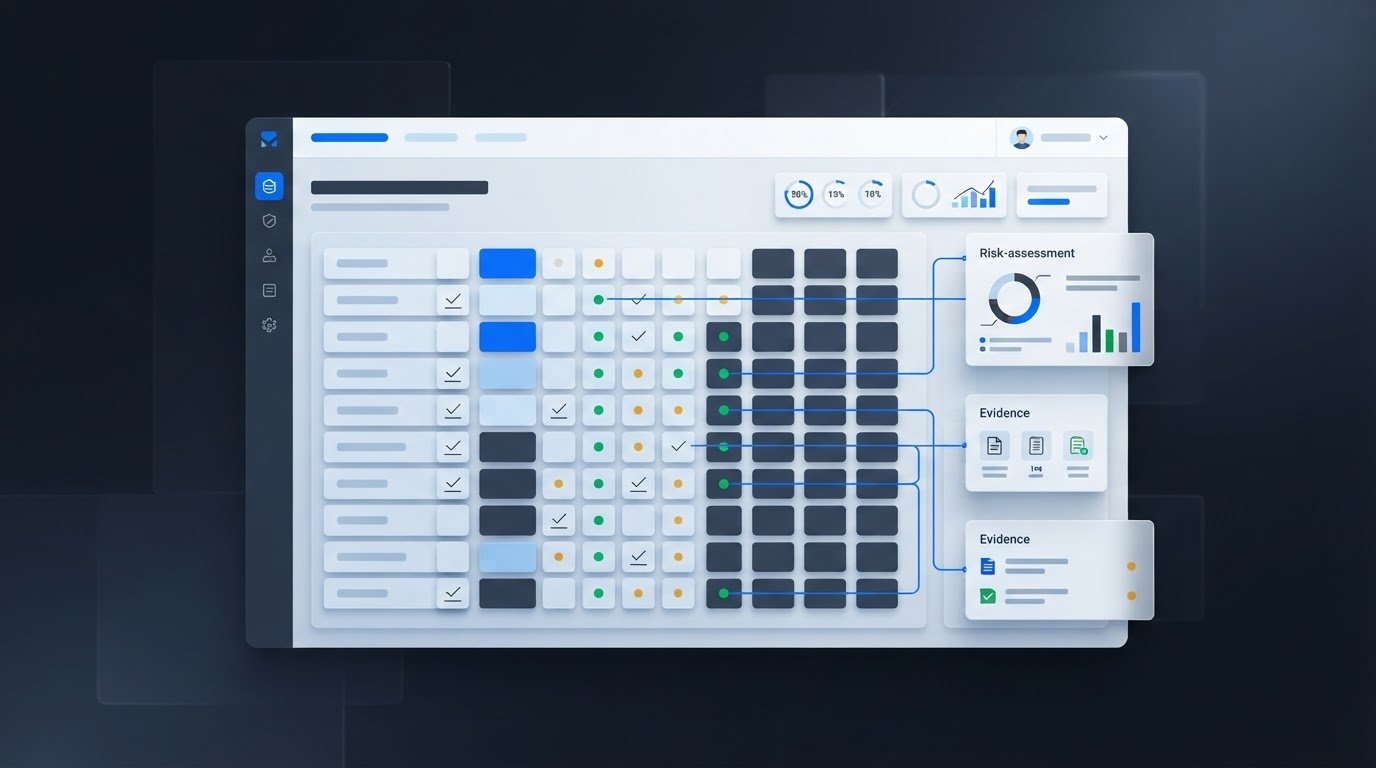
A control checklist alone isn’t a defensible Statement of Applicability. The ISO 27001 statement of applicability tool should help organise a document that identifies which of the 93 Annex A controls apply, which don’t, and why. ISO 27001 places this requirement in clause 6.1.3, linking control decisions to the organisation’s information security risks.
It’s easy to treat the SoA as a form to complete and file. Its value lies in showing the reasoning behind control decisions and the implementation status of applicable controls. This article explains what the SoA must communicate, how it relates to risk assessment, and what to look for in a tool that supports clear, traceable control mapping.
Key Takeaways
- Use the SoA as an audit document that makes control decisions clear and reviewable.
- Keep the risk assessment report focused on identifying and evaluating risks; use the SoA to show the resulting control decisions.
- Make each control entry traceable to relevant ISMS policies, procedures or other implementation records.
- Review the SoA when risks, technologies or processes change, so it continues to reflect the organisation’s security position.
- ISO 27001 readiness and control mapping can help structure the work when decisions and evidence need stronger alignment.
Table of Contents
- What about mandatory clauses?
- What is a Statement of Applicability?
- Relationship between risk assessment and selected controls
- Difference between the SoA and risk assessment report
- Definition and contents of the Statement of Applicability
- CWORT: DORA Compliance Readiness and Assessment
What about mandatory clauses?
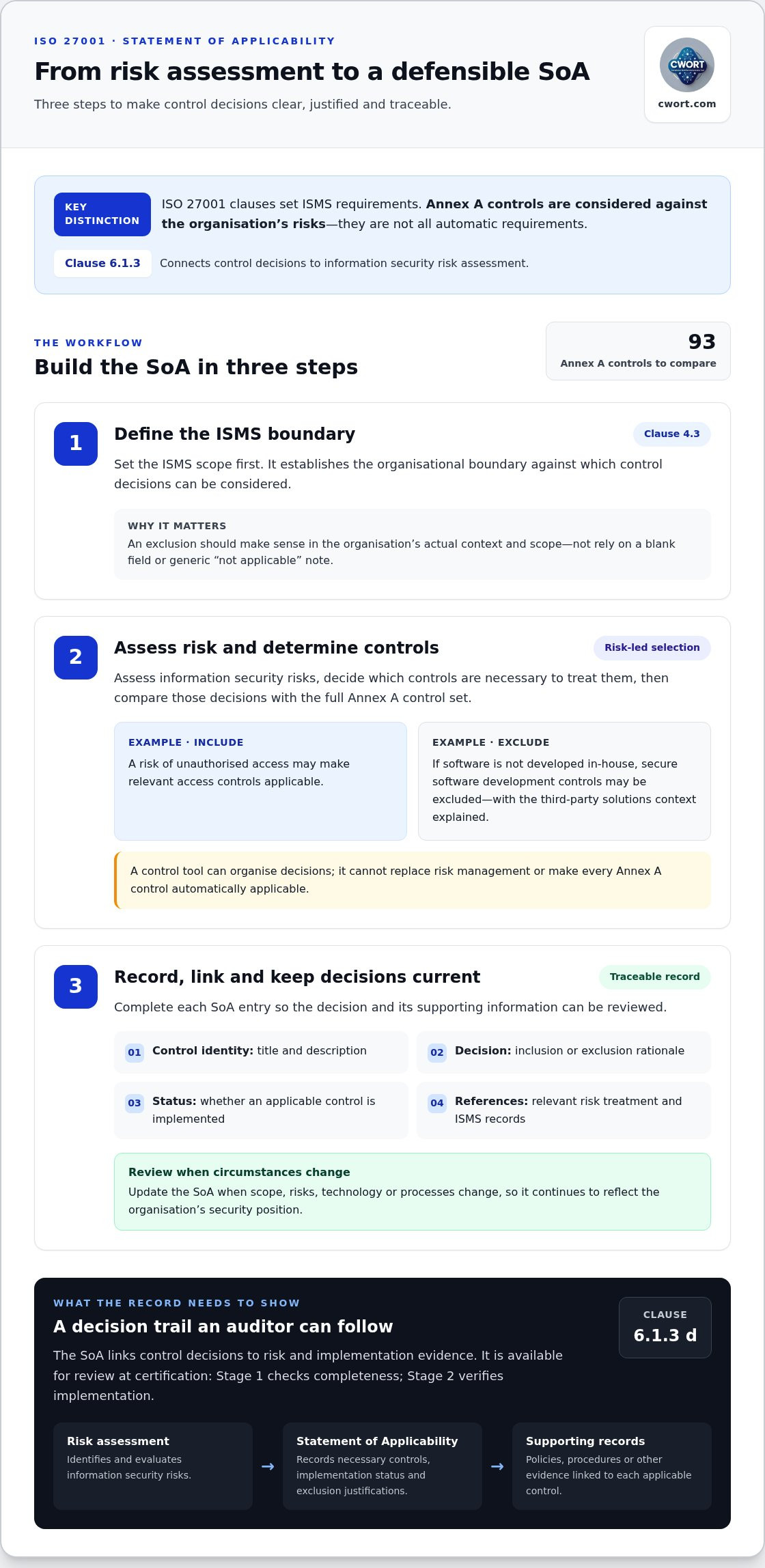
To create and maintain an SoA, define the ISMS scope, assess information security risks, then select and document relevant controls. Record each inclusion decision, implementation status and exclusion rationale. Review the SoA when risks, technology or processes change.
Annex A controls and mandatory clauses
ISO 27001 clauses set requirements for the information security management system, whilst Annex A provides a set of controls to consider when treating risks. The distinction matters: an organisation must address the standard’s requirements, but its Annex A control decisions should reflect its own risk assessment.
ISO 27001:2022 Annex A contains 93 controls across organisational, people, physical and technological groups. Under clause 6.1.3, organisations determine necessary controls based on risk assessment and compare them with Annex A. This comparison supports governance: it shows that decisions consider the control set, rather than relying only on familiar controls or a generic checklist.
For example, a risk of unauthorised access may make relevant access controls applicable. The SoA should explain the rationale and state the control’s actual implementation status. A tool can organise these decisions, but it should not replace risk management or make every Annex A control an automatic requirement.
Recording control exclusions
An excluded control is an Annex A control the organisation has determined is unnecessary in its context, with the reason recorded in the SoA. That rationale matters: auditors can assess it against the ISMS scope and risk treatment, rather than treating a blank field as a considered decision.
For instance, an organisation that doesn’t develop software in-house may exclude secure software development controls, explaining that it uses third-party solutions. The explanation should reflect the organisation’s actual environment. The control’s relevance may change if activities or external dependencies change. Avoid generic entries such as “not applicable” without context.
Keep each SoA row complete and traceable. ISO 27001:2022 clause 6.1.3 d requires the document to identify necessary controls, whether they’re implemented, and the justification for excluding Annex A controls. Include each control’s title and description, its inclusion or exclusion rationale, and implementation status where applicable. Link the decision to relevant risk treatment and ISMS records.
- Set the ISMS scope under clause 4.3, so control decisions have a defined organisational boundary.
- Assess information security risks, determine necessary controls, and compare them with all 93 Annex A controls.
- Document each decision, its reason and implementation status, then update the SoA when scope, risks or processes change.
What is a Statement of Applicability?
A Statement of Applicability (SoA) is the audit document that connects an organisation’s control decisions with its information security management system. It records necessary controls, whether they’re implemented, and why Annex A controls have been excluded. For an auditor, it provides a structured view of how the organisation has translated security risk and ISO 27001 obligations into decisions.
The SoA supports certification by making those decisions reviewable at defined audit stages. ISO 27001 requires it to be available during the Stage 1 certification audit. Auditors review it at Stage 1 for completeness, then at Stage 2 to verify implementation. A coherent record helps them trace the organisation’s stated approach against the arrangements in operation.
Who should approve the SoA, and what evidence do UK certification auditors expect? Assign approval to the management role accountable for the ISMS, and have control owners validate their entries. Auditors expect a complete SoA and supporting records that demonstrate implementation. An attachment alone doesn’t prove a control is effective.
Evidence should support the status recorded for each applicable control. A policy, for example, may describe the intended access-management process, while access records or review outputs can show how it operates. The appropriate evidence depends on the control. Keep references precise, current and accessible so auditors can trace an SoA entry to its supporting record.
Organisations may also share the SoA with customers assessing assurance or supplier risk. Treat it as a controlled document: confirm the recipient’s need, follow internal information-handling rules, and share the approved version. A customer-facing copy should describe control status accurately, without implying that a policy or attachment alone establishes effectiveness.
What should an SoA tool provide? It should organise control entries, rationale, implementation status and evidence links in a structure that is easy to review. Look for version history, ownership fields and clear change records, so updates don’t erase the decision trail.
What do SoA tools cost in the UK? The price depends on the case and is given after a quote request; relevant factors include required features, user access, implementation support and the organisation’s scope.
What are common tool-related mistakes and risks? Treating a template as a risk decision, using generic exclusion reasons and leaving statuses out of date can make the SoA inconsistent with actual practice. A tool can organise records, but accountable owners must validate decisions and evidence before audit review.
Where control decisions need clearer structure, ISO 27001 readiness and control mapping can help align the SoA with supporting control information.
Relationship between risk assessment and selected controls
The risk assessment identifies information security risks; the SoA records how control decisions address them. Connecting the records makes each selection or exclusion explainable in the organisation’s actual context.
Justifying included controls
For an included control, explain which identified risk or requirement makes it necessary. This creates a traceable rationale instead of a choice based only on a template.
For example, if the risk assessment identifies unauthorised access to sensitive records, the organisation can document relevant access controls and the treatment they support. Record the risk reference, control identifier, decision rationale and implementation status together. Reviewers can then trace the decision from risk identification to control selection and assess whether the chosen treatment addresses the information security concern.
Clause 6.1.3 connects risk assessment and treatment to the selection of controls, including comparison with Annex A. Annex A is a reference set, not a substitute for assessing the organisation’s risks. Compare the controls against identified risks and record the reason for each decision. A relevant Annex A control may support risk treatment, whilst the assessment may also identify necessary controls beyond Annex A.
Documenting exclusions and their reasons
An exclusion records why an Annex A control isn’t necessary for the organisation’s risk treatment. Its justification matters: without it, there is no clear link between the control decision and the assessed risk.
For each excluded control, document its identifier, decision rationale and supporting organisational context. For example, if a particular information-handling activity doesn’t occur within the defined ISMS scope, explain that boundary and link it to the scope record. Avoid relying on a brief “not applicable” entry. The reasoning should show why the control doesn’t address a relevant risk or requirement.
Review exclusions against the organisation’s risk assessment and scope whenever either changes. A new process, supplier relationship or information asset may change the risk treatment and make an earlier rationale obsolete. Record the review outcome and any revised decision in the SoA, showing what changed and why.
Recording implementation details
Implementation details describe how an applicable control operates and where its supporting records are held. They matter because a control marked as implemented needs a traceable connection to actual processes and evidence.
Identify the control owner, relevant policy or procedure, implementation status and evidence reference. An access-control entry, for example, might link to the organisation’s access procedure and access-review records. Distinguish documented design from an implemented process: a policy alone doesn’t show that the control operates as intended.
Keep the risk driver, control decision and implementation record aligned, either in the same document or in linked records. This makes it easier to review whether treatment remains appropriate as risks evolve. Control mapping can help maintain that connection, particularly when reconciling Annex A decisions with the organisation’s risk records.
Difference between the SoA and risk assessment report
The risk assessment records information security risks; the SoA shows the controls selected to address them. Linking these records makes decisions traceable across the information security management process.
SoA and risk assessment report roles
A risk assessment report describes the risks identified within the ISMS scope and their analysis. The SoA records the control response, including applicability, implementation status and rationale. Each document has a distinct purpose, so a copied checklist cannot replace either one.
For example, a risk assessment might identify exposure from a business-critical information system. The SoA then records which controls address that exposure and their implementation status. Under clause 6.1.3, an organisation determines controls based on risk assessment and compares them with Annex A. Cross-referencing both records shows how a risk led to a control decision.
Alignment with the risk treatment plan
The risk treatment plan records how the organisation intends to modify, retain, avoid or share identified risks. The SoA should reflect the controls selected to support that treatment, keeping status and rationale consistent across both records.
For example, if a treatment plan assigns an owner to implement a control, the SoA should identify the corresponding control and its current implementation status. If the plan changes, update the related SoA entry and preserve the decision trail. Otherwise, an auditor may find conflicting records: one showing planned treatment, the other a different control position.
Applicable legislation and contractual obligations can inform an organisation’s risk assessment and control decisions. Where relevant, record the obligation, affected information or process, and resulting treatment. Listing a related Annex A control does not automatically satisfy a legal or contractual requirement; the organisation must assess its own obligations and implementation.
Keep the SoA risk-based, not merely a static checklist. Review it when risks, technologies, processes or the ISMS scope change. For instance, introducing a new external service may change information flows and supplier-related risks, prompting a review of treatment and relevant controls.
Use clear references between each risk and its related treatment and control records. A consistent structure helps owners identify changes and lets reviewers trace decisions without confusing the risk report with the SoA.
- Update the risk assessment when the organisation’s context or information assets change.
- Revise the treatment plan when risk decisions or assigned actions change.
- Align SoA rationale and status with the current treatment plan.
- Retain prior versions and record why significant changes were made.
This alignment gives each document a distinct role: the risk assessment explains the exposure, the treatment plan sets the response, and the SoA records the control position. Together, they support consistent governance and make the basis for control decisions easier to review.
Definition and contents of the Statement of Applicability
The Statement of Applicability (SoA) is a controlled record within an ISO 27001 information security management system. It brings control decisions into one place, showing what the organisation considers necessary, what it has implemented, and why any Annex A control is excluded. Its value comes from the reasoning and traceability it preserves, not simply from listing controls.
Clause 6.1.3 d requires the SoA to identify necessary controls, whether they’re implemented, and the justification for excluding Annex A controls. Each entry should also show the control’s title and description. These fields help readers interpret a decision accurately: an identifier alone may be difficult to assess, especially when teams use different terminology in risk treatment records.
Structure the document so each control has a distinct, reviewable entry. An ISO 27001 statement of applicability tool can organise the control identifier, title, description, applicability decision, rationale and implementation status. Add references to relevant policies, procedures or other ISMS records where they support the entry. For example, a control marked implemented could point to the procedure governing the activity and the record demonstrating its operation.
Separate applicability from implementation. A control can be necessary but not yet implemented, so a single “yes” field can hide an important distinction. Record its status clearly and link planned treatment to the relevant action or record. This makes the SoA a useful governance view, rather than a checklist implying that selection alone completes the work.
Make each justification specific to the organisation’s context. For an included control, explain its connection to risk treatment or another relevant requirement. For an exclusion, state the reason and circumstances behind the decision. A generic “not applicable” entry offers little insight; a clear explanation lets reviewers assess whether the decision reflects the organisation’s scope and activities.
Version control strengthens the record. Assign the SoA a document owner, approval status and revision history, then record what changed and why when an entry is updated. For instance, a change to an ISMS process could prompt a revised control rationale. Retaining earlier versions helps reviewers trace how decisions developed.
A useful SoA framework is consistent without forcing identical reasoning across every control. An ISO 27001 statement of applicability tool can help teams apply common fields while preserving control-specific rationale. Review entries against risk treatment records and supporting evidence, so the document remains aligned with current practice.
For structured ISO 27001 control mapping, request a CWORT demonstration and explore how the SoA can connect to control decisions and evidence.
CWORT: DORA Compliance Readiness and Assessment
CWORT’s DORA Compliance Readiness and Assessment supports organisations that need to translate regulatory obligations into structured execution activities. Its compliance validation platform also supports ISO 27001 readiness and control mapping, connecting control outcomes with evidence to create auditable compliance records. Separation of duties helps clarify accountability across the work.
Consider this approach when control decisions, ownership and supporting evidence are spread across disconnected processes, or when teams need a more structured view of readiness. CWORT also offers UK NIS Compliance Management and NIS2 Readiness and Compliance Management for organisations addressing those frameworks. The right next step is to align the assessment with your organisation’s compliance priorities. Contact CWORT to discuss your requirements.
Turn control decisions into accountable action
The next step is to make ownership and evidence part of the same operating process as control decisions. An ISO 27001 statement of applicability tool can support that discipline when it keeps rationale, status and supporting records connected, but accountable owners still need to validate what those records show.
For organisations managing more than one compliance priority, CWORT offers DORA Compliance Readiness and Assessment, UK NIS Compliance Management and NIS2 Readiness and Compliance Management. These offerings support structured compliance work alongside the evidence and control mapping needed for an auditable management system.
Consider whether your current approach gives leadership a clear view of decisions, evidence and outstanding work. If you’re ready to explore a more structured approach, request a CWORT demonstration. A clearer view of control accountability is a practical foundation for your next readiness decision.
Frequently Asked Questions
Why is the SoA important?
The SoA gives decision-makers a consolidated view of how the organisation selected and manages security controls. It helps leaders identify incomplete implementation, action owners and decisions requiring review. If a business process changes, for example, the SoA can help teams identify control entries and evidence references that may need attention. This makes it useful for governance, not just audit preparation.
Can an auditor reject my SoA?
An auditor can identify an SoA that is incomplete, inconsistent or unsupported during an audit. They review it for completeness at Stage 1 and examine implementation at Stage 2. For example, a listed control marked implemented may prompt questions if its supporting records don’t match that status. The auditor’s findings inform the certification process, so accurate entries and accessible evidence matter.
Do You Have to List All 93 Annex A Controls?
Yes. For ISO 27001:2022, include all 93 Annex A controls in the SoA and record whether each applies. An exclusion needs a reason, rather than a blank cell or a bare “not applicable” label. This gives reviewers a complete view of the organisation’s comparison with Annex A. Check that the document uses the control set for the applicable standard version.
How often should the SoA be updated?
Review the SoA at least annually and when significant changes occur. A new system, supplier, business process or change to the ISMS scope can alter the organisation’s risks and control decisions. Record the review outcome even if no entries change. Retain earlier versions and note revisions so reviewers can distinguish the current position from decisions made before a change.
What happens if the SoA is missing?
A missing SoA creates a gap in the required certification documentation. The document must be available for the Stage 1 audit, and an organisation cannot proceed to Stage 2 until its missing SoA is in place. Prepare the record from the organisation’s risk assessment and control decisions, rather than filling a template with unsupported entries. Confirm that owners can explain the recorded status and rationale.
What information needs to be included in the SoA?
Include each control’s identifier, title and description, applicability decision, rationale and implementation status. For an exclusion, explain why the control isn’t necessary in the organisation’s context. For an applicable control, describe how it is implemented and point to relevant ISMS records, such as a policy or procedure. Clear references help reviewers trace an SoA entry to its supporting material.
What is an ISO 27001 Statement of Applicability (SoA)?
An SoA is a controlled document that records an organisation’s decisions about information security controls. It shows which controls are necessary, whether they have been implemented, and why Annex A controls have been excluded. Unlike a general security policy, it sets out decisions control by control. Teams can use it to clarify ownership and direct reviewers to the records supporting each entry.
What information must an ISO 27001:2022 Statement of Applicability include?
ISO 27001:2022 clause 6.1.3 d requires the SoA to identify necessary controls, state whether they’re implemented and justify exclusions from Annex A. Include each control’s title and description so the decision is clear to people outside the control team. For instance, an entry should distinguish a necessary control awaiting implementation from an excluded control, then provide the relevant explanation and record references.
Disclaimer
The content on this site is provided for general information and educational purposes only. It does not constitute legal, regulatory, financial, or professional advice. CWORT provides AI-assisted insights and workflow automation, but all compliance decisions remain the responsibility of your organisation and its management. Always seek qualified legal or regulatory guidance for decisions relating to the UK NIS Regulations, CAF, DORA, NIS2, ISO 27001, or other obligations.
Related posts
ISO 27001 Control Mapping Software: Orchestrating Evidence-Based Compliance in 2026
Ditch spreadsheets. Discover how ISO 27001 control mapping software orchestrates evidence-based compliance for a defensible, audit-ready posture in 2026.
ISO 27001 Control Effectiveness Proof: Moving Beyond Static Certification to Defensible Validation
Move beyond static ISO 27001 certification. Discover how an ISO 27001 compliance validation tool delivers continuous, defensible proof for UK regulators.
Reducing Audit Preparation Time and Costs: A Strategic Guide for UK Enterprises
Tired of costly audit seasons? Our guide for UK enterprises shows you how to stop the manual scramble, reducing audit preparation time and costs with automat...
Article by
Michael Iyiola
Co-Founder, CWORT
Michael Iyiola is a co-founder of CWORT and a Cyber and AI Security Engineer with deep experience in vulnerability management, detection engineering and operational resilience across UK critical national infrastructure, including rail, energy and financial services. At CWORT, he designs scalable, evidence-driven workflows that help teams meet modern regulatory and security demands.
Build Your Foundation of Auditable Certainty
Take control of your regulatory obligations and secure your infrastructure with CWORT.