Justifying Compliance Software Investment to the Board: A Strategic Guide

Michael Iyiola
Co-Founder, CWORT
Struggling with justifying compliance software investment to the board? Learn to prove ROI, automate evidence collection, and turn compliance into a strategi...

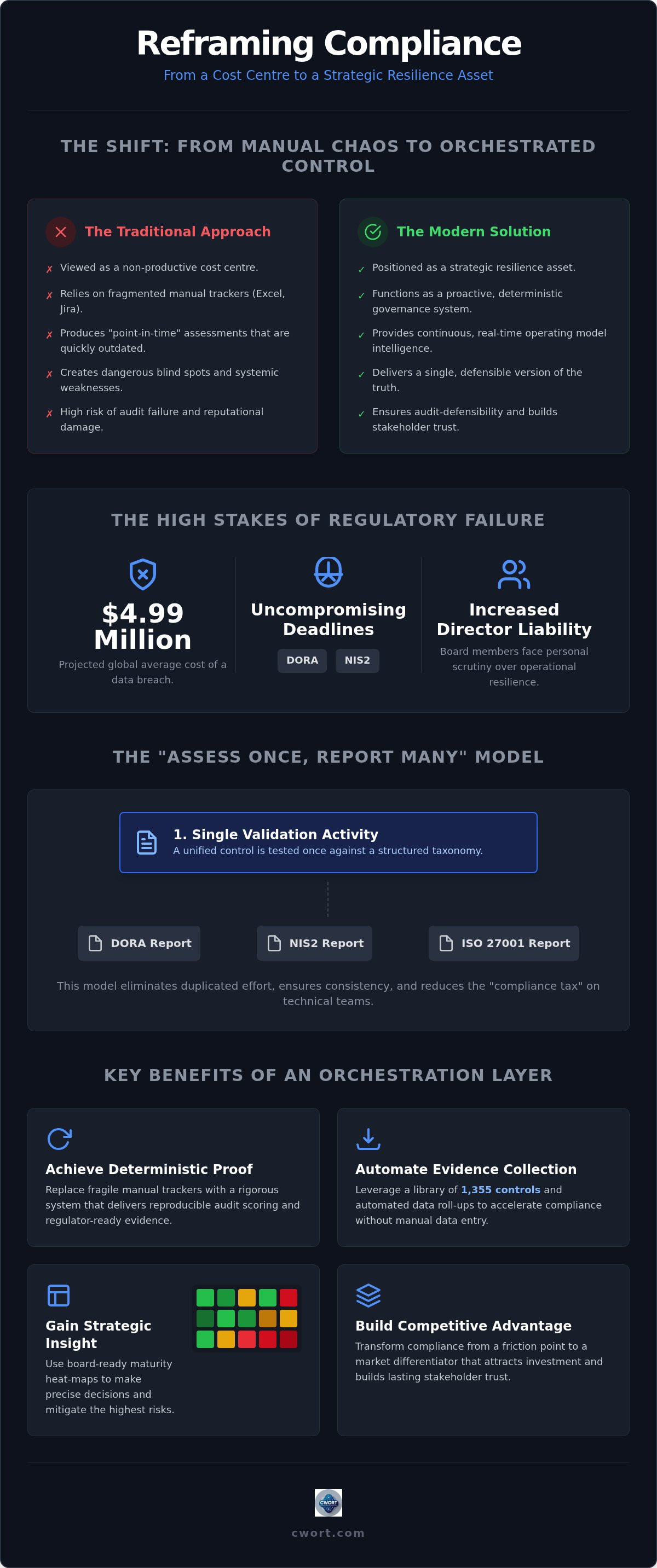
What if the board's perception of compliance as a non-productive cost centre is the single greatest risk to your organisation's resilience? With the global average cost of a data breach reaching $4.99 million in 2026, regulatory failure is no longer a manageable line item; it's a strategic threat. Successfully justifying compliance software investment to the board requires moving beyond abstract promises of "better security" to provide definitive, evidence-based proof of control. You're likely battling fragmented evidence across Excel and Jira whilst facing the uncompromising deadlines of DORA and NIS2, leaving your organisation vulnerable to audit failure and significant reputational damage.
We recognise that leadership often views compliance as a friction point rather than a foundation for growth. This article demonstrates how to reframe compliance technology as a deterministic governance system that reduces operational overhead and ensures audit-defensibility. You'll gain a clear framework for ROI, learn to produce board-ready maturity reports, and discover how to automate the collection of regulator-ready evidence. We will outline the transition from manual tracking to a disciplined orchestration layer that secures your standing with auditors and stakeholders alike.
Key Takeaways
- Transition from viewing compliance as an administrative burden to a core component of operational resilience that provides board-level assurance.
- Implement the "assess once, report many" model to eliminate duplicated effort across multiple frameworks and reduce the burden on subject matter experts.
- Master the strategy for justifying compliance software investment to the board by pivoting from subjective risk avoidance to validated, deterministic proof.
- Replace fragile manual trackers with a rigorous orchestration layer that ensures separation of duties and delivers reproducible audit scoring.
- Identify immediate maturity gaps in DORA and NIS2 by piloting focused sub-functions that demonstrate tangible workflow value to stakeholders.
Table of Contents
- The Strategic Shift: From Cost Centre to Operational Resilience
- Calculating the Real ROI: Efficiency and the "Assess Once" Model
- Risk Mitigation through Deterministic Proof vs. Manual Tracking
- Practical Steps: Building the Business Case for Compliance Software
- The CWORT Advantage: Orchestrating a Regulator-Ready Future
The Strategic Shift: From Cost Centre to Operational Resilience
Justifying compliance software investment to the board requires a fundamental reclassification of technology. For too long, leadership has viewed these tools as mere tracking utilities; digital repositories for fragmented spreadsheets and static documents. This perspective is obsolete. Modern compliance software functions as a proactive governance system that translates abstract obligations into structured, measurable activities. It moves the organisation away from "point-in-time" assessments, which are often outdated before the ink is dry, toward continuous operating model intelligence. By positioning these tools as a strategic resilience asset, you shift the conversation from a necessary expense to a vital component of corporate integrity.
The Board’s Evolving Regulatory Accountability
The regulatory landscape has shifted decisively toward individual director liability. Under frameworks such as DORA, which became enforceable in January 2025, and the UK NIS regulations, board members face increased scrutiny regarding their oversight of operational resilience. Manual tracking through disconnected tools like Excel or Jira creates dangerous blind spots. These gaps don't just lead to audit failure. They increase personal and corporate risk by masking systemic weaknesses that could cause catastrophic service disruptions. Regulators like Ofgem and the NCSC now demand evidence-based validation rather than optimistic assertions. Understanding the broader context of Regulatory compliance is essential for directors to recognise that "good faith" efforts are no longer a sufficient defence. They require a system that enforces discipline by design and provides a single, defensible version of the truth.
Compliance as a Competitive Advantage
A mature, validated operating model is a powerful asset for attracting investment and building stakeholder trust. When a board can demonstrate resilience through maturity assessment heat-maps, they move from a defensive posture to one of strategic confidence. These visualisations allow for precise strategic decision-making, showing exactly where resources should be allocated to mitigate the highest risks. This level of transparency transforms compliance from a friction point into a market differentiator. Organisations that can prove their integrity through data-driven orchestration will outperform those relying on manual guesswork. Deterministic compliance proof is the new currency of corporate trust in the digital age. By adopting an orchestration layer like CWORT, boards can ensure they stay ahead of the regulatory curve whilst maintaining operational velocity. This approach allows the business to assess once and report many times, turning a complex obligation into a streamlined competitive edge.
Calculating the Real ROI: Efficiency and the "Assess Once" Model
Effective resource allocation is central to any board-level discussion. When justifying compliance software investment to the board, you must move beyond abstract risk avoidance and focus on tangible operational efficiency. Traditional compliance is plagued by redundancy; teams often test the same control multiple times to satisfy different frameworks like DORA, NIS2, and ISO 27001. This duplication is a silent profit killer. By adopting an "assess once, report many" philosophy, organisations leverage multi-framework cross-walks to satisfy multiple regulatory obligations through a single validation activity. This approach doesn't just save time. It ensures absolute consistency across the entire governance estate.
Acceleration is achieved through a pre-built, structured taxonomy. With 1,355 controls available in the CWORT library, organisations can rapidly map existing security activities to new frameworks. This eliminates the need for expensive external consultants to build frameworks from scratch. Automated roll-ups further enhance this by aggregating data from existing tools, removing the requirement for manual data entry. This systematic orchestration replaces the chaos of manual reconstruction with a disciplined, reproducible workflow. To understand how this transforms your specific environment, you might explore our maturity assessment capabilities.
Reducing the "Compliance Tax" on Technical Teams
Subject matter experts (SMEs) are frequently redirected from high-value innovation to perform administrative evidence gathering. Industry data suggests that automation can reduce manual audit preparation time by as much as 41%. Binding evidence directly to outcomes through regulatory compliance workflow automation prevents the disruptive "audit fire drills" that typically paralyse technical departments. Instead of reacting to auditor requests, teams maintain a continuous state of readiness. This transition protects your most expensive human capital from burnout whilst ensuring that every piece of evidence remains auditable and defensible.
The Value of Capability + Capacity Insights
Investment justification also rests on the ability to optimise current assets. Maturity assessments often fail because they ignore whether the organisation has the human capacity to sustain controls over the long term. CWORT provides granular insights into both capability and capacity. It identifies where existing security tooling is under-utilised and where human skill sets are insufficient to meet regulatory demands. These metrics prevent over-hiring by ensuring you first maximise the utility of your current infrastructure. By identifying these gaps early, boards can make informed decisions about whether to invest in new technology or targeted training, ensuring every pound spent contributes directly to a more resilient operating model.
Risk Mitigation through Deterministic Proof vs. Manual Tracking
A successful strategy for justifying compliance software investment to the board hinges on the transition from subjective assertions to deterministic proof. Manual trackers rely on human interpretation, which is inherently inconsistent and prone to bias. In contrast, a deterministic system produces reproducible scoring based on objective evidence. If an auditor examines the same data set, the result remains unchanged regardless of who conducts the review. This reliability replaces the anxiety of potential audit failure with the calm of auditable certainty. By implementing a system that enforces this rigour, the organisation moves beyond merely "tracking" risk to actively validating its resilience.
Why Regulators Reject Spreadsheets
Manual spreadsheets are the primary cause of audit friction. They lack the structural integrity required for ensuring compliance evidence integrity, particularly under the stringent requirements of DORA. Regulators increasingly reject these documents because they are susceptible to accidental error or intentional data manipulation. Whilst point-tools such as SIEM or EDR provide raw technical data, they don't offer governed compliance proof. They show that a control exists, but they don't prove it's operating within a governed framework. A dedicated orchestration layer bridges this gap by aggregating technical telemetry into a defensible, immutable audit trail that stands up to regulatory scrutiny.
Enforcing Accountability by Design
Professional governance requires a clear separation of duties. Software enforces this through attribute-based access and role-based permissions, ensuring that those who manage a control are not the same individuals validating its effectiveness. This "accountability by design" creates a "Diagnose to Demonstrate" lifecycle where every action is logged and attributed. It transforms compliance from a passive checklist into a proactive system of checks and balances. Governance is not a policy; it is a system of enforced accountability that produces auditable truth. This systematic approach protects the board by providing a transparent, unalterable history of compliance activities.
Finally, the inclusion of Bring Your Own Content (BYOC) capabilities allows organisations to protect and automate their proprietary methods. Many enterprises have developed unique internal controls that provide a competitive advantage or address specific niche risks. Justifying compliance software investment to the board is easier when you can demonstrate that these bespoke processes are being formalised and scaled rather than replaced. This ensures that your organisation's intellectual property is woven into the fabric of your compliance orchestration, rather than remaining siloed in individual heads or fragile documents.
Practical Steps: Building the Business Case for Compliance Software
Constructing a compelling argument for justifying compliance software investment to the board requires a shift from theory to execution. Begin by identifying specific maturity gaps across critical frameworks like DORA, NIS2, and ISO 27001. A scattergun approach fails; instead, pilot a real sub-function to demonstrate end-to-end workflow value in a controlled environment. This proof-of-concept serves as a tangible model for the broader organisation. It illustrates how the software aligns with your Target Operating Model (TOM) and integrates seamlessly with existing security infrastructure. By demonstrating value in a single domain, you create a repeatable blueprint for enterprise-wide adoption.
Efficiency is driven by a prioritisation engine that ranks remediation actions by both risk and value. This ensures that technical teams focus on the most critical vulnerabilities first, rather than getting bogged down in low-impact administrative tasks. CWORT’s automated dashboards then translate this granular activity into board-ready maturity reports. These visualisations provide leadership with the high-level assurance they require whilst maintaining the ability to drill down into the underlying evidence if questioned. This transparency replaces defensive reporting with proactive governance.
Mapping Obligations to Execution
Abstract regulatory text is often the primary source of operational friction. You must translate these high-level mandates into structured, actionable activities that your teams can execute daily. Demonstrating how DORA compliance validation reduces operational uncertainty provides the board with a clear link between technical activity and regulatory safety. By mapping specific organisational obligations directly into a governed platform, you replace ambiguity with a disciplined roadmap for success. This process ensures that every team member understands their role in maintaining the organisation's resilience posture.
Securing CFO Buy-in with Deterministic Results
Financial leadership demands a single source of truth that is both reproducible and defensible. Focus on how deterministic scoring eliminates the subjective variance found in manual assessments. It's vital to clarify the role of AI in this process; CWORT employs an AI advisory that offers suggestions for efficiency but never alters the deterministic outcomes required for audit. This ensures the integrity of your results remains beyond reproach. Additionally, highlight the reduction in professional implementation fees achieved through the use of reusable templates and pre-mapped framework cross-walks. To see these dashboards in action and begin your gap analysis, request a platform demonstration today.
The CWORT Advantage: Orchestrating a Regulator-Ready Future
CWORT functions as the critical orchestration layer that sits above your existing security stack. Whilst point-tools such as SIEM, EDR, and vulnerability scanners provide essential telemetry, they lack the governance context required for regulatory validation. CWORT aggregates this data, translating technical signals into definitive, evidence-based proof of compliance. This systematic approach ensures that every control is not only active but also aligned with specific regulatory obligations. Justifying compliance software investment to the board becomes an objective exercise when you can demonstrate how this orchestration layer replaces manual guesswork with a disciplined, reproducible operating model.
The "Diagnosis to Demonstration" lifecycle serves as the ultimate board-level pitch. It provides a logical progression from identifying systemic weaknesses to presenting a state of total, auditable assurance. By moving through this structured workflow, the organisation proves its commitment to rigorous standards. This transition from abstract requirements to concrete reality is what regulators now demand. It shifts the focus from mere administrative tracking to a proactive governance system that enforces accountability by design.
First-Class Support for Critical Infrastructure
Critical national infrastructure and industrial environments require more than generic GRC utilities. CWORT provides first-class support for specialised frameworks such as IEC 62443 and NIST SP 800-82, addressing the unique risks associated with OT and ICS environments. These sectors cannot rely on tools designed for standard IT offices; they need a platform that understands the gravity of physical operational resilience. For UK-based organisations, our NCSC CAF assessment software provides the specific rigour needed to meet national resilience standards. Whether you are an internal team or a consulting group, the platform delivers the structured activities required to secure high-stakes infrastructure against evolving threats.
Future-Proofing with BYOC and AI Advisory
Organisational maturity is not a static goal but a continuous evolution. CWORT enables future-proofing through Bring Your Own Content (BYOC) capabilities, allowing your organisation to import and automate its proprietary maturity models whilst retaining vital intellectual property. This ensures that your unique internal controls are formalised within a governed environment. Our AI advisory further accelerates this process by offering intelligent suggestions for control mapping and remediation. Crucially, this AI remains an advisory layer; it never alters the deterministic results required for audit integrity. This balance of innovation and discipline ensures your results remain beyond reproach. Enquire about a CWORT pilot session today to begin justifying compliance software investment to the board through tangible, evidence-based results.
Securing a Defensible Future through Orchestration
The transition from manual tracking to a disciplined orchestration layer isn't just a technical upgrade; it's a strategic necessity. You've seen how reframing compliance as an asset of operational resilience provides the deterministic, reproducible scoring required to satisfy rigorous UK regulators like Ofgem and the NCSC. Successfully justifying compliance software investment to the board requires this pivot toward evidence-based truth, moving away from the fragile spreadsheets that invite audit failure. This shift ensures that every control activity is a measurable contribution to the organisation's security posture.
CWORT delivers the auditable certainty leadership demands. With 98.6% of active controls carrying direct framework references, the platform ensures total traceability from regulatory obligation to technical execution. This disciplined approach protects your directors by enforcing accountability by design and eliminating the blind spots inherent in fragmented systems. You can replace the friction of "point-in-time" assessments with a continuous, mature operating model that supports long-term growth and investor trust.
Request a CWORT working session to map your compliance programme and begin your journey toward a regulator-ready future. You're now equipped to transform compliance from a cost centre into a pillar of corporate integrity.
Frequently Asked Questions
How does compliance software differ from standard GRC tools?
Compliance software like CWORT acts as an orchestration layer that validates evidence, whereas standard GRC tools often serve as passive repositories for documentation. While GRC platforms track risk, orchestration systems translate regulatory obligations into structured activities. This shift from administrative tracking to evidence-based proof ensures that controls are not just recorded but verified against technical reality. It bridges the gap between high-level policy and granular execution.
Can we justify compliance software if we already use Jira or Excel?
Yes, because Jira and Excel lack the structural integrity and immutable audit trails required by modern regulators. Manual trackers are prone to human error and data manipulation, making them indefensible during a high-stakes audit. Justifying compliance software investment to the board is easier when you demonstrate that specialised tools eliminate these "blind spots." Unlike spreadsheets, a dedicated platform provides deterministic results and enforces a strict separation of duties by design.
What are the specific board-level benefits of DORA compliance validation?
DORA compliance validation provides boards with a transparent, data-driven heat-map of their organisation's operational resilience. It moves leadership away from subjective reports toward validated proof of control effectiveness. This level of oversight is critical because DORA introduces individual accountability for directors regarding digital risk. By using a system that produces regulator-ready outputs, the board gains the auditable certainty needed to defend their governance decisions to authorities like the NCSC.
How does deterministic scoring help during a regulatory audit?
Deterministic scoring ensures that audit results are reproducible and objective, regardless of who conducts the review. If an auditor examines the evidence, the system produces the same result every time based on fixed logic. This eliminates the "grey areas" common in manual assessments where results depend on the reviewer's interpretation. This level of rigour provides a robust defence, replacing the anxiety of potential failure with the calm of auditable certainty.
What is the "Assess Once, Report Many" model?
This model allows organisations to map a single control activity to multiple regulatory frameworks simultaneously. For instance, testing a password policy once can satisfy requirements for ISO 27001, DORA, and NIS2. By using a pre-mapped taxonomy of 1,355 controls, teams eliminate redundant data capture and reduce the "compliance tax" on technical staff. It's a key efficiency driver that maximises the utility of every evidence-gathering activity across the entire estate.
Does compliance software replace our existing security tooling?
No, it acts as a proactive orchestration layer that sits above your existing stack. It aggregates data from tools like SIEM, EDR, and vulnerability scanners to produce governed compliance proof. While your security tools detect threats, the compliance platform validates that your controls are functioning according to regulatory standards. It provides the "governance wrapper" that turns technical telemetry into a defensible operating model for leadership and auditors.
How long does it take to see ROI from a compliance orchestration platform?
ROI is often visible within the first audit cycle as manual preparation time is slashed. Automation can reduce manual audit preparation by up to 41%, allowing technical experts to return to innovation projects. By justifying compliance software investment to the board through these efficiency gains, organisations see immediate value in reduced consultant fees and the elimination of duplicated testing. Long-term ROI is sustained through continuous readiness and the avoidance of regulatory fines.
Is AI used in CWORT, and is it safe for regulatory evidence?
CWORT utilises an AI advisory to suggest control mappings and remediation actions, but it never alters deterministic results. This design ensures that the evidence remains reproducible and audit-defensible. The AI functions as a productivity aid for teams, whilst the underlying validation logic remains fixed and transparent. This approach allows organisations to leverage advanced technology for speed without compromising the structural integrity or the "single source of truth" required by regulators.
Disclaimer
The content on this site is provided for general information and educational purposes only. It does not constitute legal, regulatory, financial, or professional advice. CWORT provides AI-assisted insights and workflow automation, but all compliance decisions remain the responsibility of your organisation and its management. Always seek qualified legal or regulatory guidance for decisions relating to the UK NIS Regulations, CAF, DORA, NIS2, ISO 27001, or other obligations.
Related posts
Streamlining Regulatory Compliance Processes: From Manual Tracking to Orchestrated Validation
Stop wasting money on manual compliance. Learn about streamlining regulatory compliance processes to reduce personal liability under DORA & NIS2 and gain aud...
Managing Compliance Evidence in Excel: Comparison and Strategic Risks for 2026
Is managing compliance evidence in excel a risk for 2026? Learn why spreadsheets jeopardise DORA & NIS2 validation and get a roadmap to an audit-ready system.
NIS2 Implementation Software Europe: Beyond Checklists to Orchestrated Validation
Facing a NIS2 audit? Our guide to NIS2 implementation software Europe shows how to move beyond checklists to build a defensible, unified system of proof.
Article by
Michael Iyiola
Co-Founder, CWORT
Michael Iyiola is a co-founder of CWORT and a Cyber and AI Security Engineer with deep experience in vulnerability management, detection engineering and operational resilience across UK critical national infrastructure, including rail, energy and financial services. At CWORT, he designs scalable, evidence-driven workflows that help teams meet modern regulatory and security demands.
Build Your Foundation of Auditable Certainty
Take control of your regulatory obligations and secure your infrastructure with CWORT.