Linking Risk Management to Compliance Activities: A Practical Guide

Michael Iyiola
Co-Founder, CWORT
Master linking risk management to compliance activities with our practical guide. Connect risks to mapped controls, clear ownership, and audit-ready evidence.

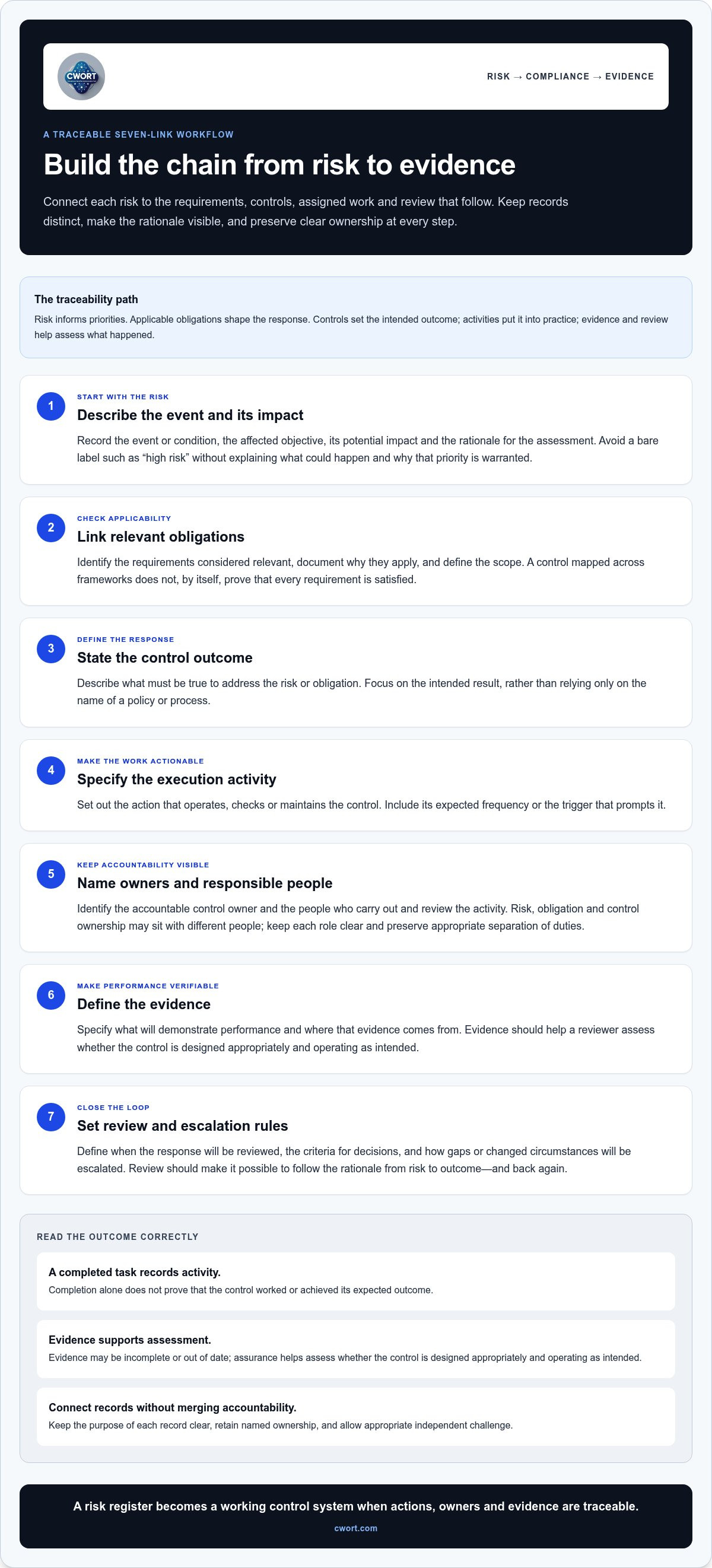
A risk register that can’t point to an owned action and its evidence is a record of concern, not a working control system. The challenge of linking risk management to compliance activities isn’t simply identifying risks or listing obligations. It’s showing how each risk informs the requirements, controls, assigned work and assurance that follow.
Risk registers and compliance trackers often evolve separately. Control ownership can blur, and evidence can be difficult to trace when scrutiny arrives. Closing the gap takes more than cross-referencing spreadsheets. It requires a repeatable chain from risk assessment to relevant obligation, mapped control, accountable action and evidence of outcome, supported by clear separation of duties and review.
This guide shows how to build that chain, keep it current and report progress in a way leaders can act on and auditors can follow. You’ll learn how to assign ownership, map controls across frameworks without assuming one assessment satisfies every requirement, and measure follow-through. An operational layer such as CWORT can connect risk-informed controls, assigned work and evidence above existing security tools, while accountability remains with named owners. The aim is practical: turn risk findings into defensible compliance execution, not another disconnected tracker.
Key Takeaways
- Distinguish risks, obligations, controls, execution activities and assurance evidence so each record has a clear purpose.
- Use a traceable chain to connect each risk to relevant obligations, control outcomes, assigned work, evidence and review.
- When linking risk management to compliance activities, validate framework applicability even when a control maps across multiple frameworks.
- Compare spreadsheets, separate systems and governed orchestration against practical needs such as ownership, version history, access controls and consistent reporting.
- Set approval, evidence and escalation rules before rollout, then report activity completion separately from control operation and assurance conclusions.
Table of Contents
- Why link risk management to compliance activities?
- How to map risks to obligations, controls and evidence
- Manual tracking or governed orchestration: what should you compare?
- How to implement a connected risk-to-compliance workflow
- How connected compliance assurance turns activity into defensible outcomes
Why link risk management to compliance activities?
Risk management and compliance answer different questions, but their decisions need to connect. Risk management considers uncertainty, potential impact and the organisation’s response. Compliance identifies applicable obligations and helps demonstrate how they’re being addressed. Linking risk management to compliance activities makes that relationship traceable: risk informs priorities, while controls and assigned activities put responses into practice and generate evidence for review.
Keep the records distinct, but connect them. Each has a specific role:
- Risk: An uncertain event or condition that could affect objectives.
- Obligation: A requirement the organisation has determined applies to it.
- Control: A measure designed to address a risk or meet an obligation.
- Execution activity: The work performed to operate, test or maintain a control.
- Assurance evidence: Information used to assess whether the control is designed appropriately and operating as intended.
This distinction matters. A completed task records activity; evidence and assurance help establish what that activity achieved. The broader Governance, Risk, and Compliance (GRC) concept brings these disciplines into a connected governance approach without making them interchangeable.
What does linking risk management and compliance mean?
It means creating traceable relationships, not forcing everything into one merged register. For example, if disruption to a critical supplier is assessed as a material risk, that finding can inform which relevant obligations and controls need attention, which resilience activities take priority, and how often the response is reviewed. The risk owner, obligation owner and control operator may be different people, and each role should remain visible.
Risk management weighs uncertainty and impact across organisational objectives. Compliance work addresses applicable requirements and records how they’re met. Risk can therefore influence control selection, effort and review frequency, while compliance activities provide a structured way to implement and evidence the response. Applicability still needs validation: a mapped control does not, by itself, prove that every framework requirement is satisfied.
What breaks when the disciplines remain separate?
Disconnected registers conceal the reasoning behind priorities. A compliance tracker may show a control as complete while the risk register contains a serious exposure with no clear link to that control. Teams then struggle to tell whether the response addresses the material risk or simply closes an administrative task.
Separation also creates operational friction. Compliance, security and risk teams may request the same evidence in different formats, maintain conflicting statuses or rely on different review dates. Staff spend time reconciling records instead of resolving gaps. A marked-complete activity is not proof that a control worked: the action may have been performed without the expected outcome, or the evidence may be incomplete or out of date.
The governing principle is connection without consolidation of accountability. Link records so reviewers can follow the rationale from risk to obligation, control, activity and evidence. Preserve named ownership, appropriate separation of duties and independent challenge. This structure supports consistent reporting while allowing risk owners to assess exposure, compliance teams to track obligations and assurance roles to test outcomes objectively.
How to map risks to obligations, controls and evidence
A useful map shows not only that records are related, but why. Build a traceable chain from the original risk to the evidence used to assess the response. This lets a reviewer follow decisions in both directions: from a risk to the work intended to address it, and from a control result back to its rationale and scope.
Build a risk-to-compliance traceability chain
Record the risk in specific terms, including the affected objective, context, assessment rationale and accountable risk owner. Then work through each link in sequence. Avoid labels such as “high risk” without explaining what could happen and why the assessment warrants that priority.
- Risk: Describe the event or condition, its potential impact and assessment rationale.
- Obligation: Identify relevant requirements, document why they apply and define the scope considered.
- Control outcome: State what must be true to address the risk or obligation. Describe the intended result, not just a policy or process name.
- Execution activity: Specify the action that operates, checks or maintains the control, including its expected frequency or trigger.
- Owner: Name the accountable control owner and the people responsible for carrying out and reviewing the activity.
- Evidence: Define what will demonstrate performance and where the evidence comes from.
- Review: Set a review point, decision criteria and route for escalating gaps or changed circumstances.
Illustrative example, not legal interpretation: An organisation identifies a risk that access to a sensitive internal service could remain active after a role change. It records the relevant obligations within its assessed scope, defines a control outcome requiring access to be reviewed and adjusted when roles change, then assigns the review activity to a designated owner. Evidence might include a dated access review record showing its scope, decisions and unresolved exceptions. A separate reviewer checks whether the evidence supports the control outcome.
Preserve ownership and evidence integrity
One person can perform an activity without being the sole judge of its effectiveness. Assign execution, evidence review and assurance deliberately. Where practical, separate these responsibilities so independent challenge is possible. Risk and control owners remain accountable for decisions. A platform can structure the workflow, but it doesn’t replace their judgement.
For each material evidence item, retain its source, date, scope, status and relevant change history. A document without context may be difficult to interpret later. Record the period it covers, which system or process it relates to, who submitted or reviewed it, and whether exceptions remain open. Keep evidence connected to the control outcome it supports, rather than relying on filenames or unverified links.
One control may support more than one framework, which can reduce duplicated mapping and evidence requests. But shared control does not mean identical requirements. Map each framework reference to the relevant control outcome, record differences in scope or intent, and validate applicability before treating evidence as responsive. Cross-framework control mapping can support an assess-once, report-many approach, but it doesn’t establish that one assessment automatically satisfies every requirement.
For organisations formalising this chain, CWORT’s control mapping and evidence workflow provides an operational layer above existing security tooling.
Manual tracking or governed orchestration: what should you compare?
No single operating approach suits every organisation. A controlled spreadsheet may be sufficient for a small, stable scope with clear ownership. As teams, frameworks, dependencies and evidence sources multiply, the effort of reconciling separate records can outweigh their simplicity. Choose based on the traceability and governance your process needs, not on the assumption that more technology automatically means better control.
Which operating approach fits the organisation?
Assess how many teams maintain records, how often requirements or control scopes change, and whether evidence is repeatedly requested for different assessments. Limited scope and stable requirements can favour disciplined manual tracking. Fragmented ownership, duplicated assessments and cross-framework reporting are signals to consider governed orchestration, which structures connections and workflow without removing human accountability.
How should you assess compliance and risk platforms?
Test the workflow against a real control, not just a product demonstration. Can a reviewer move from the evidence to the control outcome and relevant risk context, then see who acted, who reviewed and what changed? Check whether roles, history and reporting preserve the distinctions your governance model requires.
- Traceability: Can each link be followed and its rationale understood?
- Ownership: Are execution, review and assurance roles visible, with suitable separation of duties?
- Evidence integrity: Are source, scope, date, status and change history retained?
- Access and reporting: Can access be controlled, and can operational owners, executives, auditors and regulators receive consistent views suited to their needs?
For organisations linking risk management to compliance activities across multiple frameworks, governed orchestration can provide a more consistent operational layer above existing security tools. It supports oversight; it doesn’t replace sound risk judgement, validated applicability or accountable owners.
How to implement a connected risk-to-compliance workflow
Build the workflow before moving records. Agree how risks, obligations, controls, activities and evidence will be connected, who can approve changes, and what happens when work is overdue or a control fails review. This prevents a new system from simply reproducing old gaps at greater scale. A practical rollout moves from a defined scope to a tested pilot, then expands using lessons from real execution.
Establish scope, ownership and baseline
Choose a bounded area with meaningful risk and a manageable set of processes, teams and evidence sources. Define organisational boundaries and identify the priority risks, applicable obligations and controls in scope. Record how applicability was assessed, where current records and evidence are held, what is missing, and which operational and leadership reports are needed.
Set responsibilities before configuration or migration. Name the accountable risk owner, control owner, activity performers and independent reviewers. Agree who approves mappings, evidence and status changes, and who receives escalations. These rules should reflect your operating model, not simply the roles a tool makes easiest to assign.
Pilot, validate and scale the workflow
Run a pilot against real work, not an idealised process map. For every selected risk, test whether users can follow the links to relevant obligations, control outcomes, assigned actions and supporting evidence. Check that exceptions have an owner and a route for resolution, and that review dates and approval points are clear.
During the pilot, test permissions, separation of duties, audit history and reporting. Ask an operational owner to complete an activity, a reviewer to assess its evidence, and a decision-maker to interpret the resulting status. Note where people need clarification or resort to offline workarounds. Refine mappings and responsibilities before extending the workflow to other areas.
- 1. Define the scope: Set boundaries, priorities and the criteria for selecting risks and obligations.
- 2. Map the baseline: Record existing controls, owners, activities, evidence sources, gaps and reporting needs.
- 3. Agree governance: Establish ownership, approvals, evidence standards, access rules and escalation routes.
- 4. Pilot end to end: Test traceability, execution, review and reporting in one bounded area.
- 5. Refine and expand: Resolve pilot findings, then roll out in controlled stages with scheduled reviews.
Design workflow automation around meaningful decision points, not task volume. A well-structured regulatory compliance workflow automation approach routes work to accountable people, preserves review and approval steps, and makes exceptions visible. It should support judgement, not automate applicability decisions or imply that a completed task proves a control is effective.
As the process matures, review whether changed risks, obligations, responsibilities or evidence needs require updates to the workflow. CWORT provides an operational layer above existing security tools to map controls, orchestrate assigned work and bind evidence to control outcomes, while accountable owners retain decision-making responsibility. Further information is available through CWORT’s workflow demonstration.
How connected compliance assurance turns activity into defensible outcomes
Reliable assurance distinguishes three different claims. Activity completion means assigned work was recorded as done. Control operation means there is evidence that the control functioned as intended within a defined scope and period. An assurance conclusion is a reasoned assessment of that evidence, including its limitations and any exceptions. Reporting these as separate stages prevents a completed task from being presented as proof of effectiveness.
Measure whether the connection is working
Track indicators that show both workflow progress and control status. Mapping coverage shows whether priority risks and obligations connect to relevant controls. Overdue activities highlight execution delays; evidence freshness shows whether records remain timely for the review period; unresolved control gaps indicate where outcomes still need attention.
Put context beside each status. Report material changes, exceptions, remediation owners and target review points so decision-makers can see what has shifted, who is responding and where escalation may be needed. A green status without scope or evidence context is not a defensible conclusion.
Traceability is a reviewable link from a risk, through relevant obligations and control activity, to the evidence and assurance conclusion used to assess the response.
Operationalise the model with CWORT
CWORT provides a governed operational layer above existing security tooling. It maps controls across frameworks, orchestrates assigned work and binds evidence to control outcomes, while accountable risk and control owners retain responsibility for decisions. As of June 2026, its control taxonomy contains 1,355 controls across 217 domains and 42 frameworks or standards. This cross-framework mapping can help teams reuse relevant assessment work, but each obligation’s applicability and requirements still need validation.
For example, an organisation assessing controls against DORA alongside other relevant frameworks can use shared control mappings to organise evidence and identify where requirements differ. That can support clearer assurance preparation, but it doesn’t mean one assessment automatically satisfies every regulator or obligation.
Deterministic, reproducible scoring helps keep assessment results consistent when the same inputs and rules are applied. Immutable audit history preserves a reviewable record of changes, while separation of duties helps distinguish execution from review. These mechanisms strengthen governance; they don’t establish control effectiveness on their own. People must still assess evidence quality, investigate exceptions and make accountable assurance judgements.
To make reporting useful, present progress alongside substantiation: what was completed, what the evidence demonstrates, what remains unresolved and who owns the next action. This turns linking risk management to compliance activities into a repeatable assurance process rather than a collection of status updates. Apply the same discipline to evidence provenance and review context when evidence is linked across frameworks.
CWORT’s connected workflow brings risk-informed controls, assigned work and evidence into a traceable operating model.
Turn the model into a decision discipline
Choose one upcoming governance review or material risk decision as the starting point. Ask what leaders need to decide, who owns the response and what evidence would support confidence in that decision. Use that test to identify where linking risk management to compliance activities should change day-to-day practice, rather than simply add another layer of reporting.
Keep the first objective focused: make it possible to explain why an activity matters, who is accountable and what the evidence actually demonstrates. As the approach becomes part of routine oversight, teams can address gaps earlier and give decision-makers a clearer basis for action.
CWORT is designed to help organisations operationalise connected compliance and control workflows. Request a CWORT demonstration to see how a traceable process can support your organisation’s governance priorities.
Start with a practical question, test the process against real work, and build from what the evidence shows. That’s how disconnected records become a more confident, accountable way to act.
Frequently Asked Questions
How do you link risk management to compliance activities?
Connect a prioritised risk to the obligations and control outcomes relevant to its context, then assign activities that can address those outcomes. For example, if a risk relates to unauthorised changes, record which systems and processes are in scope, who approves changes, and what records demonstrate that approval. Keep the risk owner accountable for the risk decision, while control and compliance owners maintain their respective records and explain changes.
What is the difference between compliance risk and operational risk?
Compliance risk concerns the possibility that an organisation won’t meet an applicable requirement or demonstrate that it has done so. Operational risk relates to potential loss or disruption arising from processes, people, systems or external events. They can overlap: a process failure might disrupt a service and also affect whether a relevant obligation is met. Record each aspect clearly, rather than assuming that resolving a compliance gap eliminates the underlying operational exposure.
Can one control support compliance with multiple frameworks?
Yes. A control such as reviewing privileged access may contribute to outcomes across several frameworks. However, wording, scope, evidence expectations and applicability may differ. Maintain a separate mapping rationale for each framework reference and note where one control only partially addresses an outcome. This allows teams to reuse relevant evidence while avoiding the assumption that a shared control or assessment automatically fulfils every framework requirement.
How often should risk and compliance mappings be reviewed?
Set a planned review cycle that reflects the organisation’s risk profile, obligations and control arrangements, then review sooner when material changes occur. Triggers might include a new service, a significant process or technology change, a revised risk assessment, an audit finding or a control failure. Record what prompted the review, who approved changes and which evidence or mappings were affected. That creates a rationale for review timing rather than relying on calendar dates alone.
What evidence shows that a compliance activity addresses a risk?
Evidence should show more than that a task was completed. It needs to relate to the control outcome and the risk scenario, cover the relevant scope and period, and show the action or result being assessed. For an access review, for instance, a dated record of accounts examined, decisions made and exceptions assigned is more informative than a completion tick. A reviewer must still assess whether the evidence is sufficient and supports the intended outcome.
Can compliance software replace a risk register?
No. Compliance software can help organise control mappings, activities and evidence, but it shouldn’t erase the distinct purpose of a risk register. Risk owners need to record exposure, assessment rationale, decisions and changes in context. A connected platform can reference that information and show how compliance work relates to it. Retain clear ownership of risk decisions, and ensure the authoritative risk record remains governed and reviewable.
How can an organisation preserve separation of duties in a connected workflow?
Define role permissions so the person completing an activity isn’t automatically the only person who approves its evidence or concludes that a control is effective. For example, an operator can submit a review record, a control owner can check completeness, and an independent assurance reviewer can assess the result. Retain an audit trail of submissions, reviews and changes, and establish an alternative reviewer for conflicts of interest or unavailable owners.
Disclaimer
The content on this site is provided for general information and educational purposes only. It does not constitute legal, regulatory, financial, or professional advice. CWORT provides AI-assisted insights and workflow automation, but all compliance decisions remain the responsibility of your organisation and its management. Always seek qualified legal or regulatory guidance for decisions relating to the UK NIS Regulations, CAF, DORA, NIS2, ISO 27001, or other obligations.
Related posts
How to Demonstrate Control Effectiveness to Regulators: A Strategic Guide
Learn how to demonstrate control effectiveness to regulators with our guide. Shift from chaos to an evidence-based, audit-ready compliance programme today.
Real-Time Compliance Dashboards for Executive Decisions
See how real-time compliance dashboards for executives turn trusted data into clear risk signals, accountable actions and stronger regulatory oversight.
Reducing Audit Preparation Time and Costs: A Strategic Guide for UK Enterprises
Tired of costly audit seasons? Our guide for UK enterprises shows you how to stop the manual scramble, reducing audit preparation time and costs with automat...
Article by
Michael Iyiola
Co-Founder, CWORT
Michael Iyiola is a co-founder of CWORT and a Cyber and AI Security Engineer with deep experience in vulnerability management, detection engineering and operational resilience across UK critical national infrastructure, including rail, energy and financial services. At CWORT, he designs scalable, evidence-driven workflows that help teams meet modern regulatory and security demands.
Build Your Foundation of Auditable Certainty
Take control of your regulatory obligations and secure your infrastructure with CWORT.