Managing Compliance Across Business Units Through Clear Roles and Rules

Michael Iyiola
Co-Founder, CWORT
Learn how managing compliance across different business units assigns ownership, aligns controls and evidence, and strengthens oversight across jurisdictions.

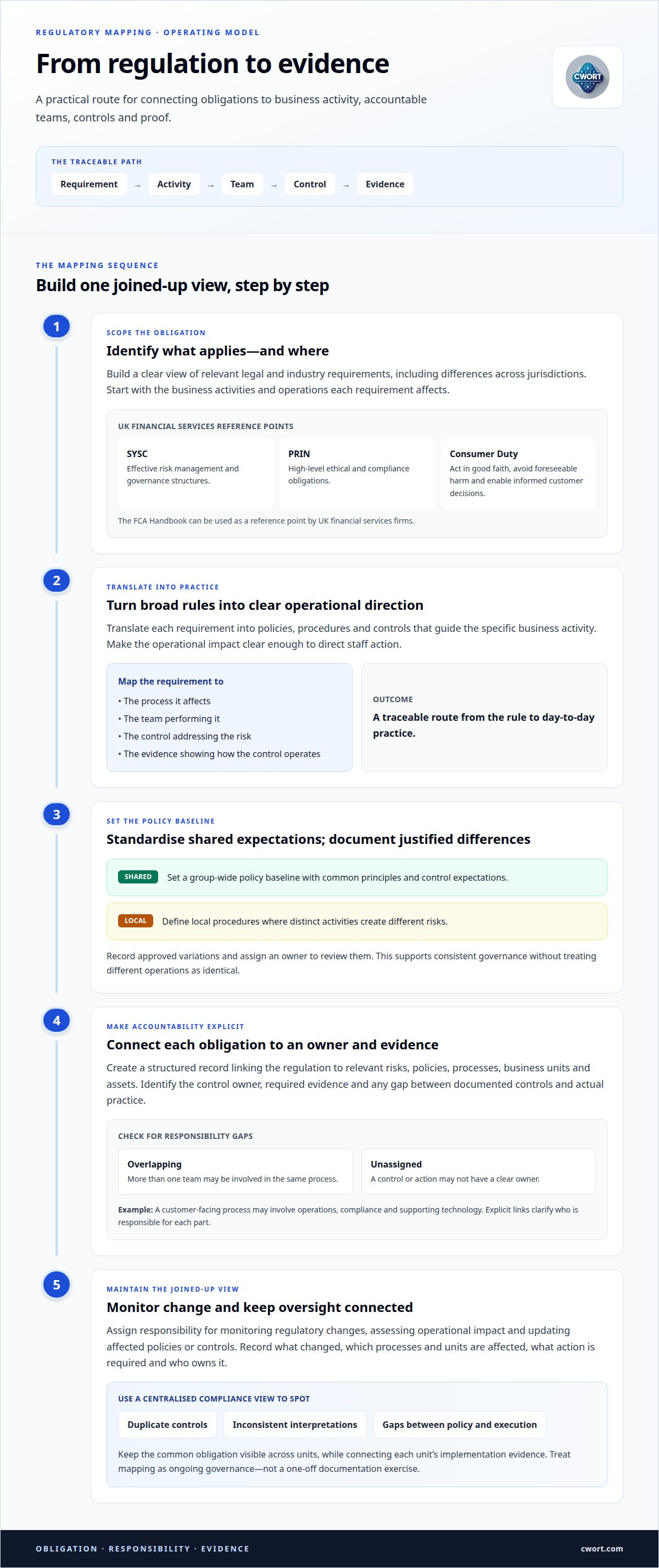
A compliance gap rarely stays within one business unit. Managing compliance across different business units means identifying the requirements that apply to each activity and jurisdiction, assigning control ownership, and retaining evidence of how obligations are met. The goal is a joined-up view of responsibility, not a set of disconnected local checklists.
Compliance is often treated as tracking rules and deadlines. The harder task is translating requirements into clear responsibilities across teams while maintaining oversight when operations span jurisdictions. This article explains what compliance management involves, how to identify relevant legal and industry requirements, and how to allocate responsibility between business units and oversight functions.
You’ll also see why requirements can differ across the UK and how a structured approach connects obligations to business operations, controls and evidence. The focus is practical: establish who owns each action, how teams work together and what makes compliance defensible.
Key Takeaways
- Connect each relevant requirement to the business activity, risk, control and evidence it affects.
- Build a clear view of applicable legal and industry requirements, including those that differ across jurisdictions.
- Give operational teams ownership of day-to-day compliance risks, with independent oversight and challenge from the second line.
- Define responsibilities, escalation routes and corrective actions so issues reach the right people and can be addressed.
- Use structured compliance validation to turn obligations into assigned activities and auditable evidence.
Table of Contents
- Mapping regulatory requirements to business operations
- What Is Compliance Management?
- Sharing compliance responsibilities across business units
- Identifying applicable legal and industry requirements
- Compliance challenges across jurisdictions and business units
- CWORT
Mapping regulatory requirements to business operations
Map regulations to the activities, controls and teams they affect. This turns governance requirements into operational responsibilities backed by evidence.
Translating regulations into policies
Translation means turning regulatory requirements into policies, procedures and controls that guide specific business activities. Broad obligations cannot direct staff action until their operational impact is clear. Link each requirement to the process it affects, the team performing it, the control addressing the risk and the evidence showing how that control operates. This creates a traceable path from rule to practice.
Standardising policies across units
Standardisation means setting a common policy baseline while documenting justified differences between teams, products or operations. Apply shared principles and control expectations, then define local procedures where activities create distinct risks. To balance consistency with unit-level needs, establish a group-wide policy, record approved variations and assign an owner to review them. This supports consistent governance without treating different operations as identical.
For leaders, managing compliance across different business units starts with a structured record for each obligation. Connect the regulation to relevant risks, policies, processes, units and assets. Then identify the control owner, required evidence and any gap between documented controls and actual practice. A customer-facing process, for example, may involve operations, compliance and supporting technology. Explicit links reveal overlapping or unassigned responsibilities.
UK financial services firms can use the FCA Handbook as a reference point. SYSC covers effective risk management and governance structures, while PRIN sets high-level ethical and compliance obligations. The Consumer Duty requires financial firms to act in good faith, avoid foreseeable harm and enable informed customer decisions. Map relevant requirements to the affected customer journey, decision-making process, control and accountable team.
Regulatory expectations can change, so rule mapping needs active maintenance. Assign responsibility for monitoring changes, assessing operational impact and updating affected policies or controls. Record what changed, which processes and units are affected, what action is required and who owns it. This makes managing compliance across different business units an ongoing governance activity, not a one-off documentation exercise.
A centralised compliance view brings regulations, risks, controls and policies together. Use it to spot duplicate controls, inconsistent interpretations and gaps between policy and execution. When a requirement affects several units, keep the common obligation visible and connect each unit’s implementation evidence. This supports consistent oversight while preserving the operational detail needed to assess whether controls work in practice.
What Is Compliance Management?
Compliance management brings obligations, processes, responsibilities and evidence into a coordinated operating model. It helps leaders understand how data protection and cybersecurity requirements apply across business units.
Data protection and cybersecurity standards
Data protection and cybersecurity standards define expectations for handling information and managing security risks. They matter because employees need controls that reflect the information their processes use. According to the UK legislation register, the UK GDPR and Data Protection Act 2018 govern the processing, storage and transfer of personal data in the UK. International standards and cybersecurity schemes can help businesses structure information security practices and demonstrate relevant compliance.
Integrating compliance data and processes
Integration connects compliance information from separate units in a shared structure for oversight. This matters because a risk can cross products, services, legal entities and countries, even when teams record it differently. Compliance technology can aggregate quantitative and qualitative risk-impact data across business units, helping the second line track risks by product or service, line of business, legal entity or country. Link each risk to its relevant control, owner and evidence, then monitor whether updates affect connected processes.
Governance tools and software
Governance tools organise requirements, risks, controls, policies and evidence so leaders can review compliance across business units. Useful tools include a centralised compliance management system, a structured risk register, policy management processes and reporting dashboards. They help answer which obligation applies, who owns the response and what evidence supports it. Choose functionality to match the organisation’s processes, operating structure and oversight needs. Software cannot replace clearly defined responsibilities.
Which governance tools and software help manage compliance across multiple business units? A centralised system can provide an organisation-wide view by bringing regulations, risks, controls and policies together. Its value depends on consistent information: units need shared definitions for risks, control status, ownership and evidence, while retaining the detail needed to understand their distinct operations.
For example, a data protection risk register can connect a personal-data process to the relevant control, responsible team and evidence record. A dashboard can show control status across units while preserving each unit’s context. Monitoring should also capture changes to policies, control ownership and evidence, so an unresolved issue does not disappear when a process or team changes.
Technology supports governance only when employees follow the processes behind it. Define who can update records, who reviews exceptions and how serious issues are escalated. Keep a clear history of decisions and evidence. This gives oversight teams a reliable basis for identifying gaps, challenging incomplete records and tracking corrective actions across the organisation.
Sharing compliance responsibilities across business units
What does compliance management across multiple business units involve? It means assigning operational teams responsibility for identifying and managing compliance risks, while a central oversight function provides independent challenge. Clear ownership connects day-to-day practices to organisation-wide governance, incident response and corrective action.
Set responsibilities according to each unit’s activities and influence. A marketing team, for example, should identify risks in its campaigns and follow relevant approval controls. Operations teams manage risks within their processes, while senior leaders set expectations and allocate oversight. The first line identifies, assesses, measures and manages compliance risks; the second line monitors, challenges and provides independent oversight. This division keeps accountability close to the work without leaving units to assess themselves alone.
Make each responsibility specific. Name the role accountable for a control, the team performing it, the person reviewing evidence and the escalation route. A responsibility matrix can record these roles alongside the relevant policy, process and reporting line. If a customer-facing team owns an approval, for instance, its manager should know what evidence demonstrates completion and which oversight function reviews exceptions. Clear records expose gaps where tasks are shared but nobody owns the final decision.
Employees need training tailored to their roles, not just a general reminder that compliance matters. Explain the policies and procedures relevant to each team, then use work-based examples to test understanding. A marketing employee might practise escalating an approval exception; an operational manager might learn how to report a control failure. Record attendance and follow-up actions so managers can identify where teams need further guidance. These practices make responsibilities usable in routine work.
Incident response must connect unit-level reporting with organisation-wide oversight. Define how employees report a compliance case, who triages it, and how severity and priority guide investigation. A case involving a unit’s process should reach its responsible manager and the appropriate oversight team. Preserve evidence, document decisions and keep relevant stakeholders informed through established reporting routes. This helps prevent isolated incidents from remaining invisible to leaders responsible for broader risk patterns.
After an investigation, the second line can work with the responsible business unit on a corrective action plan. Identify the issue, assign an owner, specify the required change and record evidence of completion. For example, a failed approval control may require revised guidance, employee training or a change to the review process. Track actions through closure, then assess whether the correction addresses the underlying cause.
Use audits and recurring reviews to test whether assigned responsibilities work in practice. Compare documented controls with evidence from the teams performing them, and record exceptions for follow-up. Ethical conduct should also inform day-to-day decisions, including how marketing practices are reviewed and escalated. Findings can reveal unclear ownership, inconsistent practices or training needs. Feed those lessons into policies, role definitions and future training so each business unit strengthens the organisation’s compliance approach.
Identifying applicable legal and industry requirements
Start with the organisation’s activities, customers, locations and operating environment. A UK business handling personal information, processing card payments or providing financial services may face different requirements. Map each activity to its legal entity, business unit and jurisdiction. This prevents a group-wide register from overlooking obligations attached to a particular service, site or customer base.
Maintain a legal register of current legislation relevant to the organisation’s nature and activities, and keep it updated. For each entry, capture the requirement, affected process, accountable owner and review trigger. For example, HMRC and Companies House enforce financial rules covering tax, VAT, payroll, accounting and directors’ duties. Local authorities may set licensing requirements and rules for commercial waste disposal.
Industry and governance requirements need the same structured assessment. The UK Senior Managers and Certification Regime defines clear responsibilities for senior managers in financial institutions. The UK Corporate Governance Code, issued by the Financial Reporting Council, outlines governance best practices for listed companies, including board accountability, risk oversight and shareholder transparency. The PRA Rulebook includes Solvency II capital requirements for insurers and Basel III implementation rules on risk management for UK banks and investment firms.
Identify sector-specific obligations by examining the organisation’s services and operational risks. The Environment Agency, Office of Rail and Road, and Health and Safety Executive set requirements relevant to particular industries. The NIS Regulations address cyber resilience for essential services and critical national infrastructure. Businesses processing card payments must consider PCI DSS requirements for secure financial transactions. Match each framework to the activity it governs instead of applying every standard indiscriminately.
Employment requirements also affect business units differently. The Worker Protection Act 2023 took effect on 26 October 2024 and requires employers to take reasonable steps to prevent sexual harassment. The Allocation of Tips Act 2023 establishes rules on service charges and tips. Map these requirements to relevant policies, employee groups and reporting routes. This helps leaders identify who must act and what evidence supports implementation.
For cross-border operations, assess where customers live and services are delivered. The European Union adopted the General Data Protection Regulation in 2016 and enforced it in EU countries from 2018. The California Consumer Privacy Act concerns data protection for California residents, while NIST is a framework cited for federal agencies. These examples matter when an organisation’s footprint makes them relevant, not simply because they appear in a global register.
Turn the assessment into a controlled reporting process. Record why each requirement applies, which units it affects, the control owner and the expected evidence. Review entries when the organisation launches a service, enters a market or changes its operating model. This gives stakeholders a defensible basis for prioritising compliance effort, protecting reputation and escalating gaps to accountable leaders.
Compliance challenges across jurisdictions and business units
A group-wide policy can create consistency, but it cannot remove differences in legal scope or operational risk. UK businesses may face different regulations in England and Wales, Scotland, and Northern Ireland. The challenge is to preserve national oversight while identifying which rules apply to each entity, location and activity. A single register without that distinction can conceal gaps or assign controls to the wrong team.
Consider a business operating sites across the UK. A central function may set common internal standards for reporting, evidence and escalation, while local teams apply requirements relevant to their operations. Keep the distinction visible by recording the obligation, the territory it covers, the affected process and its accountable owner. This helps leaders see where requirements overlap and where separate controls or local procedures are needed.
Jurisdictional complexity also affects assessment. A group may share technology, suppliers or customer services across business units, yet each unit may face a different combination of duties. Assess the underlying activity and legal entity, not just the department name. For example, a shared service supporting regulated and non-regulated operations needs clear boundaries: identify which processes serve each activity and how evidence demonstrates the relevant controls.
National standards and internal frameworks can help create a common baseline, but applying them without context risks treating different activities as equivalent. Define the baseline, then document justified variations by territory, service or operating model. Each variation should have an accountable owner, a reason and a review trigger. This makes exceptions visible to governance teams instead of leaving local interpretations buried in procedures.
Different responsibilities can also affect how issues are reported and escalated. Set a common route for raising concerns, then specify who assesses cases affecting a particular entity or jurisdiction. If an incident crosses unit boundaries, identify which team coordinates the response and how information reaches senior oversight. Clear hand-offs reduce delays and prevent teams from assuming another function owns the issue.
Penalties make unclear ownership a material governance risk. In the UK, health and safety non-compliance can result in prosecution and custodial sentences for company directors. A robust assessment should connect each relevant obligation to the operating unit, control owner, evidence and escalation route. It should also record unresolved gaps and corrective actions, so leadership can distinguish accepted differences from unmanaged exposure.
The practical takeaway is to standardise visibility, not every local procedure. Maintain a shared view of requirements and controls, while preserving jurisdiction-specific detail and accountable ownership. If fragmented records make those connections difficult to assess, request a demonstration of compliance validation to explore a more structured way to connect obligations, responsibilities and evidence.
CWORT
CWORT helps organisations turn compliance obligations into assigned activities, defined responsibilities and auditable evidence. Its compliance validation platform links evidence, professional judgement and approvals in a governed workflow, with separation of duties enforced. This gives teams a coordinated view across business units, rather than fragmented tracking.
Use it when teams need to bring requirements, ownership and proof into a more structured operating model. Relevant services include DORA Compliance Readiness and Assessment, UK NIS Compliance Management, NIS2 Readiness and Compliance Management, and ISO 27001 Readiness and Control Mapping. These offerings support organisations working to understand requirements, assess readiness and map controls to their compliance objectives.
For a practical discussion about applying this approach to your organisation, contact CWORT.
Make compliance operational
Clear ownership is effective only when it stays aligned with organisational change. New services, reorganisations and shifts in jurisdiction can alter which requirements apply and who controls the relevant evidence. Treat managing compliance across different business units as an ongoing governance capability, with leadership oversight and operational accountability working together.
The next step is to identify where fragmented records or unclear ownership limit your view of compliance. CWORT supports organisations with compliance readiness and management for DORA, UK NIS and NIS2. Its approach helps connect regulatory obligations with structured activities and evidence, giving teams a clearer basis for assessing and demonstrating control outcomes.
Discuss how this could apply to your organisation. Contact CWORT to discuss compliance and consider a more structured route from requirements to accountable action. Clearer coordination can give your teams a stronger foundation for confident, evidence-based oversight.
Frequently Asked Questions
How should organisations set up a group-wide compliance framework with local controls?
Set a common governance baseline, then define how each unit applies it to its services and risks. For example, a group policy can establish approval and reporting expectations, while a unit procedure explains how its customer service team records approvals. Document the reason for each local variation and the approving role. This gives internal reviewers a way to distinguish controlled adaptation from inconsistent practice.
How can businesses assign compliance roles and accountability across business units?
Assign an accountable owner to each obligation and control, then distinguish that role from the people performing and reviewing the work. For example, a service owner may approve a process change, while an operational colleague carries it out and a compliance reviewer challenges the evidence. Record who decides when responsibilities overlap. This clarifies handovers when teams share suppliers, systems or customer processes.
What are the steps to assess and monitor compliance risks in each business unit?
Assess each unit against its activities, services, legal entities and jurisdictions. Record relevant risks, existing controls, accountable owners and evidence, then identify gaps between expected and actual practice. Prioritise actions according to risk and operational impact. Monitor changes to processes, services and requirements, along with corrective-action progress, so leaders can see whether exposure is changing.
How can businesses track compliance performance using audits, KPIs and reporting?
Use audits to test whether controls operate as documented, and report findings alongside ownership and corrective-action status. Select indicators that reflect actual organisational risks, such as overdue actions or recurring control failures, rather than relying on activity counts alone. Define each indicator consistently across units, including its meaning and data source. This lets leadership compare performance without obscuring important differences in operational context.
What are the risks of fragmented compliance management across business units?
Fragmented processes can leave leaders without a reliable view of obligations, control ownership or unresolved issues. One unit may maintain evidence in a spreadsheet while another records similar work elsewhere, making duplication and omissions harder to detect. Inconsistent interpretations can also produce uneven practices across shared services. The practical risk is weak oversight: decision-makers may struggle to establish which controls operated and who addressed identified gaps.
How should organisations investigate and escalate compliance breaches across business units?
Give employees a clear reporting route and send each case to a triage function that assesses severity and priority. The investigation should preserve relevant records, establish which processes and units were affected, and document decisions and findings. Involve the responsible unit in corrective action, while oversight teams track progress and challenge the response. Escalation criteria should make clear when senior leaders need to review an issue.
What UK laws and regulations should businesses consider when managing compliance across business units?
Requirements depend on the organisation’s activities, customers and sector. Relevant examples include the UK GDPR and Data Protection Act 2018, FCA Handbook requirements such as SYSC and PRIN, and the Consumer Duty for financial firms. Other considerations can include the NIS Regulations, health and safety requirements, and tax, VAT or payroll rules. Map each requirement to the affected legal entity and operation before deciding its relevance.
How can a business implement a centralised versus decentralised compliance operating model?
Choose a model that reflects how the organisation needs to control decisions and understand local risk. A centralised model can set common methods and consolidate reporting; a decentralised model can give business units more responsibility for execution. A practical hybrid keeps shared governance, definitions and oversight central, while local teams manage controls within their operations. Set decision rights and escalation routes clearly, then review whether the model supports effective oversight.
Disclaimer
The content on this site is provided for general information and educational purposes only. It does not constitute legal, regulatory, financial, or professional advice. CWORT provides AI-assisted insights and workflow automation, but all compliance decisions remain the responsibility of your organisation and its management. Always seek qualified legal or regulatory guidance for decisions relating to the UK NIS Regulations, CAF, DORA, NIS2, ISO 27001, or other obligations.
Related posts
Streamlining Regulatory Compliance Processes: From Manual Tracking to Orchestrated Validation
Stop wasting money on manual compliance. Learn about streamlining regulatory compliance processes to reduce personal liability under DORA & NIS2 and gain aud...
Real-Time Compliance Dashboards for Executive Decisions
See how real-time compliance dashboards for executives turn trusted data into clear risk signals, accountable actions and stronger regulatory oversight.
How to Demonstrate Control Effectiveness to Regulators: A Strategic Guide
Learn how to demonstrate control effectiveness to regulators with our guide. Shift from chaos to an evidence-based, audit-ready compliance programme today.
Article by
Michael Iyiola
Co-Founder, CWORT
Michael Iyiola is a co-founder of CWORT and a Cyber and AI Security Engineer with deep experience in vulnerability management, detection engineering and operational resilience across UK critical national infrastructure, including rail, energy and financial services. At CWORT, he designs scalable, evidence-driven workflows that help teams meet modern regulatory and security demands.
Build Your Foundation of Auditable Certainty
Take control of your regulatory obligations and secure your infrastructure with CWORT.