Managing ICT Third-Party Risk under DORA: A Strategic Orchestration Guide

Michael Iyiola
Co-Founder, CWORT
Discover strategic steps for managing ICT third-party risk under DORA. Transform fragile spreadsheets into an auditable, board-ready compliance framework.

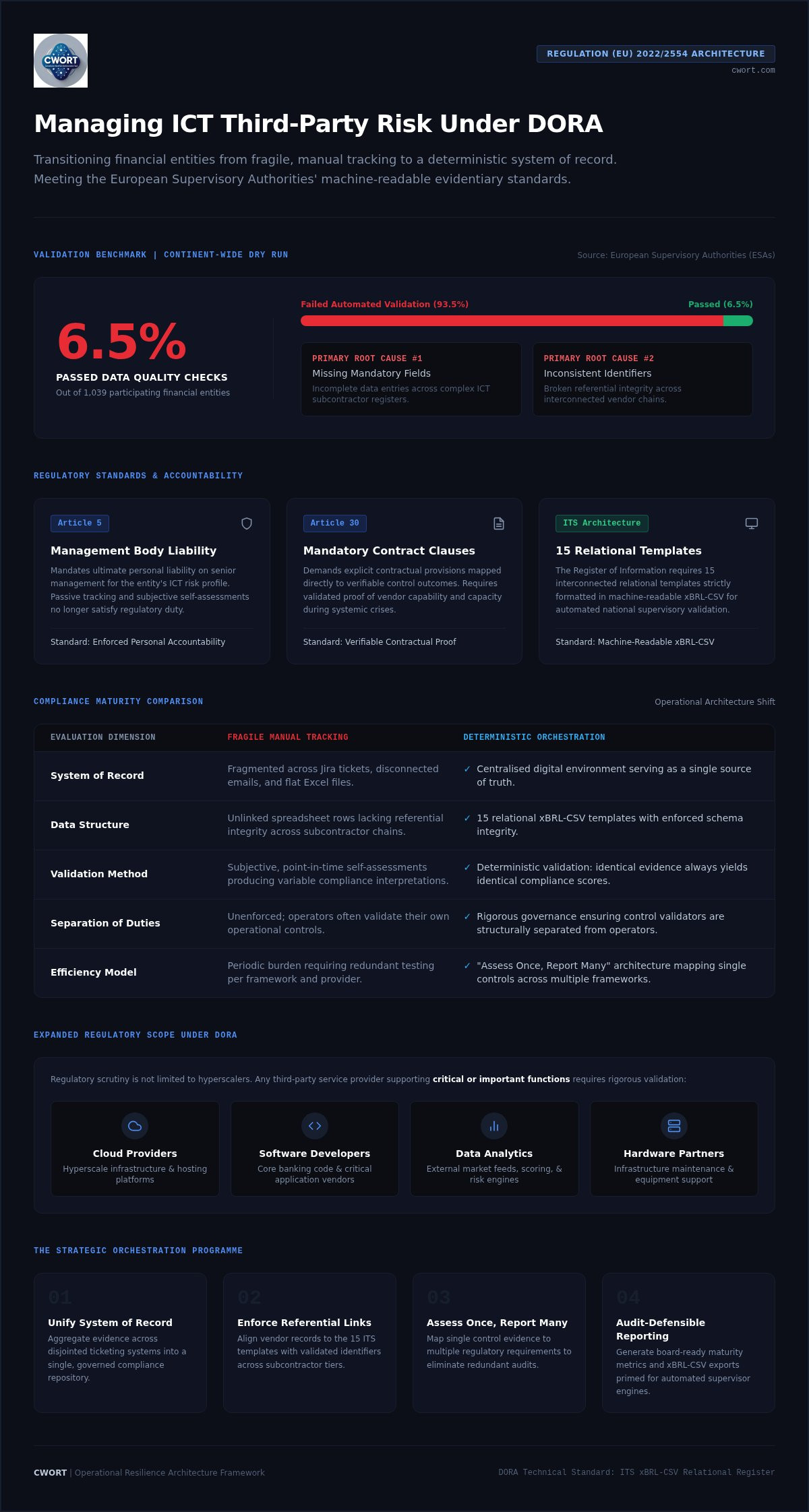
Only 6.5% of financial entities passed the data quality validation checks during the European Supervisory Authorities' recent continent-wide dry run. This staggering failure rate highlights a systemic weakness in how firms currently approach the Register of Information. You likely recognise the frustration of managing ICT third-party risk under DORA whilst trapped in a cycle of fragmented Jira tickets and fragile Excel spreadsheets. This manual approach makes it nearly impossible to prove a clear separation of duties or maintain referential integrity across complex subcontractor chains.
It's time to replace administrative anxiety with auditable certainty. This guide provides a strategic orchestration framework to help you transition from disjointed tracking to a deterministic system of record. You'll discover how to map single controls across multiple providers and aggregate evidence into a single source of truth. We'll outline the path to achieving board-ready maturity reports and a reproducible compliance score that stands up to the most rigorous supervisory scrutiny. By the end of this article, you'll have the blueprint to move from mere obligation to definitive, evidence-based proof.
Key Takeaways
- Transition from fragmented spreadsheet tracking to a deterministic framework that enforces accountability across your entire vendor ecosystem.
- Transform the Register of Information from a static list into a live evidence repository that satisfies the latest machine-readable reporting standards.
- Establish a systematic approach to managing ICT third-party risk under DORA by replacing subjective self-assessments with reproducible, evidence-based validation.
- Optimise compliance operations by mapping single controls to multiple providers, enabling you to assess once and report across multiple regulatory frameworks.
- Generate board-ready maturity reports that provide definitive, auditable proof of control effectiveness and operational resilience to senior leadership and regulators.
Table of Contents
- Beyond the Spreadsheet: The New Reality of Managing ICT Third-Party Risk under DORA
- Deciphering the DORA TPRM Framework: Critical Requirements and Standards
- Evaluating Compliance Maturity: Manual Tracking vs. Deterministic Orchestration
- A Step-by-Step Programme for Validating ICT Third-Party Resilience
- Proving Control Effectiveness: How CWORT Orchestrates Audit-Ready TPRM
Beyond the Spreadsheet: The New Reality of Managing ICT Third-Party Risk under DORA
The era of "best-effort" vendor management has ended. Under the Digital Operational Resilience Act (DORA), financial entities must transition to a model of enforced orchestration. This shift isn't merely administrative; it's a fundamental change in accountability. Article 5 of the regulation places ultimate personal liability on the management body for the institution's ICT risk profile. Relying on subjective assessments or passive tracking no longer suffices. You need deterministic compliance. This means your governance system must ensure that identical evidence always yields identical results, removing the variability that plagues traditional GRC tools. Strategic urgency is no longer optional. You must centre your operating model on resilience to survive the scrutiny of active enforcement.
The Fragility of Manual Compliance Tracking
Traditional spreadsheets are fundamentally incapable of maintaining the relational integrity required by modern standards. Consider the ESAs’ recent dry run, where only 6.5% of 1,039 financial entities passed all data quality validation checks. Most failures stemmed from missing mandatory fields and inconsistent identifiers. When information is fragmented across Jira tickets, emails, and disconnected Excel registers, the audit trail becomes impossible to reconstruct. This fragmentation signals a "lack of confidence" to regulators. Managing ICT third-party risk under DORA requires a rigorous separation of duties. You must ensure that the individuals validating controls aren't the same ones operating them. Manual trackers simply cannot enforce this discipline by design.
DORA as a Catalyst for Operating Model Maturity
DORA demands that institutions look beyond a simple compliance checklist. You must now prove both capability and capacity. It's not enough for a provider to claim they have a recovery process; you must validate that they have the resources to execute it during a systemic crisis. This necessitates a shift toward a governed digital environment where evidence is bound to outcomes. By adopting an "Assess Once, Report Many" philosophy, you can map a single control to multiple regulatory obligations. This approach reduces administrative overhead whilst increasing precision. Transitioning to a platform like CWORT allows you to sit above operational tools, aggregating evidence to produce a single source of truth. It turns compliance from a periodic burden into a continuous, audit-defensible operating model. Effective managing ICT third-party risk under DORA requires this level of structural integrity to move from theoretical readiness to concrete, validated resilience.
Deciphering the DORA TPRM Framework: Critical Requirements and Standards
The regulatory scope of Regulation (EU) 2022/2554 extends far beyond primary hyperscale cloud vendors. It encompasses every ICT service provider that supports a financial entity's operational resilience, including software developers, data analytics firms, and hardware maintenance partners. Effective managing ICT third-party risk under DORA requires an uncompromising focus on 'critical or important' functions. If an ICT service failure would materially impair financial performance or continuity, it triggers the highest level of regulatory scrutiny. You must move beyond surface-level due diligence to ensure that mandatory contractual clauses, as specified in Article 30, are mapped directly to verifiable control outcomes.
The Register of Information Requirements
The Register of Information is the audit-ready heartbeat of TPRM. Under the latest Implementing Technical Standards (ITS), this register requires 15 relational templates formatted in machine-readable xBRL-CSV. It's no longer sufficient to maintain a flat list of vendors in a spreadsheet. Every entry must link to a validated control domain and specify the exact functions supported. This structural integrity ensures that supervisors can cross-reference data across the entire EU financial market. If your register lacks referential integrity, it will fail the automated data quality engines now deployed by National Competent Authorities.
Mapping Controls to ICT Technical Standards
Orchestrating a defensible framework requires a robust control taxonomy. CWORT provides 1,355 controls within its library, allowing you to bridge the gap between high-level regulatory text and granular execution. By cross-walking DORA requirements with ISO 27001 and NIS2, you achieve an "assess once, report many" efficiency. This ensures that 98.6% of your active third-party controls carry direct framework references. This level of precision eliminates ambiguity during audits, providing a deterministic view of your resilience posture. To see how this mapping functions in a live environment, you can explore our compliance orchestration platform. This systematic approach ensures that your third-party monitoring processes are staffed and resourced to be sustainable, satisfying the "Capability + Capacity" requirements demanded by modern supervisors.
Evaluating Compliance Maturity: Manual Tracking vs. Deterministic Orchestration
Effective managing ICT third-party risk under DORA requires a shift from tracking "status" to validating "execution". Most organisations mistake a vendor's survey response for a completed control. Regulators, however, prioritise reproducible results. They expect to see that your assessment logic is consistent and evidence-based. If two different auditors review the same evidence using your framework, they should reach identical conclusions. This is the essence of deterministic compliance. By sitting above your existing security stack, CWORT aggregates data from point tools to provide a single, explainable view of your third-party resilience.
Subjective vs. Deterministic Scoring
Deterministic scoring ensures that identical evidence combined with identical logic always yields an identical result. It eliminates the "opinion-based" variability found in traditional risk assessments. This approach aligns with the NIST SP 800-161 Rev. 1 guidance, which establishes benchmarks for validating supply chain risks across their entire lifecycle. Contrast this with traditional heat-map dashboards that rely on subjective "gut feelings" from consultants. A deterministic model provides board-level visibility into gaps with a level of precision that survives regulatory scrutiny. It replaces the anxiety of potential failure with the calm of auditable certainty.
Orchestrating the Delivery Lifecycle
Moving from diagnosis to demonstration requires a structured workflow. A rigorous 7-step assessment process allows you to evaluate third-party capability maturity systematically:
- Identify the critical function and associated ICT providers.
- Map specific DORA obligations to the provider's service profile.
- Collect and validate evidence through a governed portal.
- Apply deterministic scoring logic to identify gaps.
- Prioritise remediation based on business priority, risk, and effort.
- Execute remediation plans with clear accountability.
- Generate board-ready reports from a single source of truth.
Using regulatory compliance workflow automation removes the friction of manual hand-offs between procurement, IT, and risk teams. It ensures that your operating model remains sustainable and that every action is recorded in an audit-defensible trail. This orchestration transforms managing ICT third-party risk under DORA from a periodic administrative burden into a continuous, proactive resilience strategy.
A Step-by-Step Programme for Validating ICT Third-Party Resilience
Translating the legal text of Regulation (EU) 2022/2554 into a functional operating model requires a disciplined execution programme. Managing ICT third-party risk under DORA is no longer a project with a defined end date; it's a continuous validation cycle. You must move away from the "best-effort" approach of high-level gap analyses and adopt a granular, evidence-based workflow. This programme ensures that your resilience posture is not just a policy on paper but a verified reality.
- Step 1: Define and import your third-party maturity model into a governed environment. Use 'Bring Your Own Content' (BYOC) capabilities to retain proprietary risk methodologies whilst aligning with DORA standards.
- Step 2: Map every provider to specific control domains and regulatory obligations. This ensures that managing ICT third-party risk under DORA remains precise and targeted.
- Step 3: Assign clear ownership and enforce separation of duties for data capture. This prevents the operational conflict of interest that often undermines audit integrity.
- Step 4: Bind automated evidence from operational tools, such as SIEM, IAM, and Asset Registers, directly to control outcomes. This replaces manual sampling with continuous validation.
- Step 5: Generate regulator-ready outputs. Produce the Register of Information and maturity reports instantly without manual reconstruction or spreadsheet manipulation.
Configuring the Assessment Blueprint
Success begins with a clear definition of scope. You must identify every participant across the enterprise and the supply chain who is responsible for control execution. An effective blueprint requires an immutable audit history for every change in the risk profile. This ensures that every modification is tracked, timestamped, and attributed. By using BYOC, you can integrate your existing internal standards with the 1,355 controls in the CWORT taxonomy, ensuring a seamless transition to the new regulatory reality.
Capturing Responses and Evidence Binding
The days of relying on unverified self-attestation are over. Regulators now demand evidence-backed responses that prove a control is functioning as intended. CWORT's integration layer consumes data from your existing security stack to provide real-time status tracking. This binding process ensures that your maturity scores are based on objective facts rather than subjective claims. Maintaining evidence integrity is the foundation of DORA compliance. To see this orchestration in action, you can request a platform demonstration and begin your transition to a deterministic risk framework.
Proving Control Effectiveness: How CWORT Orchestrates Audit-Ready TPRM
The transition from theoretical readiness to continuous validation represents the final stage of operating model maturity. Managing ICT third-party risk under DORA cannot remain a periodic exercise. It requires a system that constantly monitors the effectiveness of third-party controls against a library of 1,355 predefined standards. CWORT provides this essential layer of oversight. It aggregates evidence across your technical stack to ensure that your resilience posture remains defensible every day of the year. This shift allows leadership to replace the anxiety of unknown gaps with the calm of auditable certainty.
Strategic decision-making is further enhanced by CWORT’s AI advisory layer. This component provides intelligent suggestions for remediation and control mapping without compromising the integrity of the deterministic engine. The AI identifies patterns and suggests improvements; however, the final compliance score remains rooted in objective, evidence-based logic. As regulatory requirements evolve through 2026 and beyond, this combination of innovation and rigour ensures your framework remains both agile and uncompromisingly objective. It provides the board with the confidence that their oversight is based on reproducible facts rather than subjective snapshots.
Generating Regulator-Ready Outputs
The "Demonstrate" phase is where orchestration delivers its ultimate value. Regulators from the EBA and National Competent Authorities no longer accept high-level summaries. They demand an explainable view of how every control is validated. CWORT replaces months of manual audit preparation with an automated Assurance Evidence Register. This register serves as a single source of truth, binding every provider to its specific regulatory obligations and supporting evidence. See how we handle DORA compliance validation for the UK's leading institutions to understand the depth of this evidence-based approach. It ensures that when an auditor asks for proof, the answer is immediate, precise, and fully traceable.
The CWORT Differentiator: Strategic Urgency and Control
Maintaining total assurance requires a platform that integrates compliance intelligence with a robust operating model. CWORT eliminates the disconnect between what is documented and what is actually happening within your supply chain. It provides the board with clear, reproducible maturity reports that satisfy both internal oversight and external supervision. Managing ICT third-party risk under DORA is a high-stakes obligation that demands a disciplined, systematic response. You must move beyond administrative tracking to definitive, evidence-based proof. Replace the fragility of the spreadsheet with the certainty of orchestration. Book a discovery session to map CWORT to your DORA programme and secure your path to audit-defensible resilience.
Securing Your Audit-Defensible Future
The landscape of managing ICT third-party risk under DORA has shifted from administrative tracking to definitive, evidence-based validation. You've seen how fragmented spreadsheets fail under supervisory scrutiny and why a deterministic approach is essential for board-level accountability. By implementing a structured orchestration framework, you move beyond theoretical readiness into a state of continuous validation. This transition ensures that your operating model is not just compliant but robust enough to withstand systemic shocks.
CWORT provides the precision required for this high-stakes environment. With 1,355 controls mapped across 42 frameworks, the platform delivers the deterministic scoring and board-ready maturity reports necessary to satisfy modern regulators. It replaces the anxiety of potential failure with the calm of auditable certainty. Don't leave your resilience to chance or manual reconstruction. Take control of your compliance lifecycle today. Orchestrate your DORA TPRM programme with CWORT and secure a future built on reproducible, defensible truth. You have the blueprint; now it's time to execute with confidence.
Frequently Asked Questions
What are the primary ICT third-party risk requirements under DORA?
DORA mandates that financial entities manage the full lifecycle of their ICT third-party arrangements. This includes conducting ex-ante risk assessments, performing due diligence, and maintaining ongoing monitoring of service delivery. You must ensure contracts contain specific clauses regarding audit rights, service levels, and data location. The regulation also requires institutions to identify concentration risks and maintain executable exit strategies for services supporting critical or important functions. These requirements ensure that third-party dependencies don't compromise your operational resilience.
How does DORA define 'Critical or Important' ICT third-party service providers?
A provider is classified as 'critical or important' if a failure in its service would materially impair the financial entity's performance or continuity. This includes services supporting core banking functions, risk management, or regulatory compliance. If the interruption of the ICT service would affect the soundness or the continuity of your activities, it triggers heightened scrutiny. You must apply more rigorous oversight and mandatory contractual protections to these high-impact providers to satisfy supervisory expectations.
What is a DORA Register of Information and why is it mandatory?
The Register of Information is a structured repository of all ICT third-party contractual arrangements. It's mandatory because it allows regulators to monitor systemic concentration risk across the financial sector. Under the latest technical standards, this register must be maintained in a machine-readable xBRL-CSV format with 15 relational templates. It provides a single source of truth for your vendor landscape, ensuring every provider is mapped to the specific functions they support and the subcontractors they employ.
Can we use our existing ISO 27001 evidence for DORA third-party risk compliance?
Yes, you can leverage existing ISO 27001 evidence, provided it's mapped to specific DORA obligations. Whilst ISO 27001 offers a strong foundation for information security, DORA introduces more prescriptive requirements for operational resilience and third-party oversight. CWORT facilitates this by cross-walking 1,355 controls across 42 frameworks. This "assess once, report many" approach ensures that your existing evidence satisfies multiple regulatory bodies without the need for duplicate administrative effort or manual data entry.
How does CWORT enforce separation of duties for ICT risk assessments?
CWORT enforces separation of duties through robust role-based and attribute-based access controls. The platform ensures that the individuals responsible for operating a control are not the same ones conducting the assessment or validating the evidence. This governance layer is essential for managing ICT third-party risk under DORA, as it prevents conflicts of interest and ensures the integrity of your compliance data. Every action is recorded in an immutable audit trail for total transparency during audits.
What happens if an ICT third-party provider fails to meet DORA standards?
Failure to meet standards can lead to significant regulatory consequences for the financial entity and the provider. National Competent Authorities have the power to impose administrative penalties and demand remediation plans. For Critical ICT Third-Party Providers (CTPPs), Lead Overseers can impose daily penalty payments of up to 1% of average daily worldwide turnover. Ultimately, financial entities may be required to terminate contracts if a provider cannot demonstrate compliance with essential resilience requirements or fails to allow audit access.
How often should ICT third-party risk assessments be conducted under DORA?
Assessments must be conducted at least annually, or more frequently if the risk profile of a provider changes significantly. DORA demands continuous monitoring rather than point-in-time checks. You should trigger a reassessment whenever there is a material change in the service, a security incident, or a shift in the provider's corporate structure. Maintaining this cadence is vital for managing ICT third-party risk under DORA and proving ongoing operational resilience to regulators who now deploy automated data quality checks.
Is AI used to determine compliance results in the CWORT platform?
No, AI is not used to determine compliance results within CWORT. The platform relies on a deterministic engine to ensure that identical evidence always yields the same result. This reproducibility is critical for audit-defensible assurance. Whilst CWORT includes an AI advisory layer, its role is limited to providing suggestions and guidance for remediation activities. It never alters the underlying scoring logic, ensuring that your compliance status remains based on objective, verifiable facts that senior leadership can explain.
Disclaimer
The content on this site is provided for general information and educational purposes only. It does not constitute legal, regulatory, financial, or professional advice. CWORT provides AI-assisted insights and workflow automation, but all compliance decisions remain the responsibility of your organisation and its management. Always seek qualified legal or regulatory guidance for decisions relating to the UK NIS Regulations, CAF, DORA, NIS2, ISO 27001, or other obligations.
Related posts
DORA Technical Standards Compliance: Moving from Regulatory Theory to Validated Execution
Struggling with DORA technical standards compliance? Move beyond spreadsheets to a validated framework that provides real-time, auditable evidence for regula...
DORA Compliance Validation Software: Orchestrating Defensible Proof in 2026
Is your DORA strategy audit-ready for 2026? Learn how DORA compliance validation software provides defensible proof and protects board members from liability.
CISO Guide to DORA Operational Resilience: Orchestrating Validated Compliance
Master validated compliance with our CISO guide to DORA operational resilience. Swap manual evidence gathering for an orchestrated, audit-ready security post...
Article by
Michael Iyiola
Co-Founder, CWORT
Michael Iyiola is a co-founder of CWORT and a Cyber and AI Security Engineer with deep experience in vulnerability management, detection engineering and operational resilience across UK critical national infrastructure, including rail, energy and financial services. At CWORT, he designs scalable, evidence-driven workflows that help teams meet modern regulatory and security demands.
Build Your Foundation of Auditable Certainty
Take control of your regulatory obligations and secure your infrastructure with CWORT.