Mapping Regulatory Obligations to Internal Controls Guide

Michael Iyiola
Co-Founder, CWORT
Stop managing compliance with spreadsheets. Our guide to mapping regulatory obligations to internal controls helps you satisfy UK regulators and prove effect...

If your compliance strategy relies on a fragmented patchwork of Jira tickets and Excel spreadsheets, you aren't managing risk; you're merely documenting your eventual failure to satisfy a regulator. In an era where DORA is fully enforceable and ISO 27001:2022 is mandatory, static tracking is no longer defensible. You likely recognise the exhaustion of redundant work whilst struggling to prove control effectiveness during a high-stakes audit. This guide provides the solution by detailing how mapping regulatory obligations to internal controls transforms abstract rules into a deterministic framework built for the scrutiny of UK regulators.
We'll move beyond administrative tracking to establish a repeatable process that binds evidence directly to specific outcomes. You'll learn how to consolidate overlapping requirements from frameworks like NIS2 and NIST CSF 2.0 into a single, orchestrated system. By the end of this guide, you'll possess the methodology required to produce board-ready reporting and reduce the manual burden of audit preparation. It's time to replace fragmented chaos with the calm of auditable certainty and structural integrity.
Key Takeaways
- Transition from passive administrative tracking to a proactive, evidence-based validation model that satisfies the rigorous demands of UK regulators.
- Master a systematic five-step framework for mapping regulatory obligations to internal controls, ensuring every legal requirement is bound to a specific, technical execution activity.
- Abandon the "spreadsheet trap" and fragmented Jira workflows in favour of an orchestration engine that maintains structural integrity and traceability.
- Leverage a pre-mapped library of 1,355 controls to rapidly align your operating model with complex frameworks like DORA, NIS2, and ISO 27001:2022.
- Generate deterministic, board-ready evidence that proves compliance maturity and reduces the manual burden of audit preparation by 2026 standards.
Table of Contents
- The Strategic Necessity of Mapping Regulatory Obligations to Internal Controls
- Deconstructing the Mapping Lifecycle: From Legal Text to Technical Execution
- Beyond Spreadsheets: Why Traditional Mapping Fails Regulatory Scrutiny
- A Five-Step Framework for Orchestrating Regulatory Control Mapping
- CWORT: Orchestrating Deterministic Compliance Validation
The Strategic Necessity of Mapping Regulatory Obligations to Internal Controls
In the current high-stakes environment, the distance between a regulatory requirement and an operational action determines an organisation's resilience. Many leadership teams mistake administrative tracking for compliance, yet the two are fundamentally different. Regulatory obligations represent the "what", the non-negotiable mandates set by law. Conversely, internal controls represent the "how", the specific processes and safeguards deployed to meet those mandates. Without a precise method for mapping regulatory obligations to internal controls, this gap becomes a liability that auditors will inevitably exploit.
The transition from "box-ticking" to "evidence-based validation" is no longer optional. Under regimes like DORA and NIS2, regulators demand more than a statement of intent; they require proof of execution. Misalignment leads to more than just fines. It results in operational resilience gaps that can paralyse a business during a crisis. UK enterprises must shift from static mapping, which decays the moment it is created, to dynamic orchestration that ensures every obligation is matched to a functioning control.
The Regulatory Landscape in 2026
As of 2026, the grace period for DORA has ended, and National Competent Authorities are actively enforcing its rigorous standards. In the UK, the NCSC CAF has become the definitive benchmark for cyber resilience, moving the goalposts for what constitutes "adequate" security. Boards can no longer rely on "reasonable endeavour" as a sufficient defence. Regulators now expect granular traceability that links every high-level obligation to a specific technical or administrative action. If you cannot produce a deterministic chain of evidence, you are, by definition, non-compliant.
Defining High-Integrity Mapping
There is a critical distinction between a simple "crosswalk" and a deterministic map. A crosswalk merely suggests a relationship between two documents; a deterministic map enforces it. For mapping to be effective, it must reach the level of individual execution activities. This ensures that when a regulator asks for proof, the response is a specific data point rather than a vague policy document. We define regulatory mapping as the process of binding legal requirements to auditable evidence. This high-integrity approach replaces the ambiguity of manual trackers with a disciplined system of record that stands up to the most intense scrutiny.
Deconstructing the Mapping Lifecycle: From Legal Text to Technical Execution
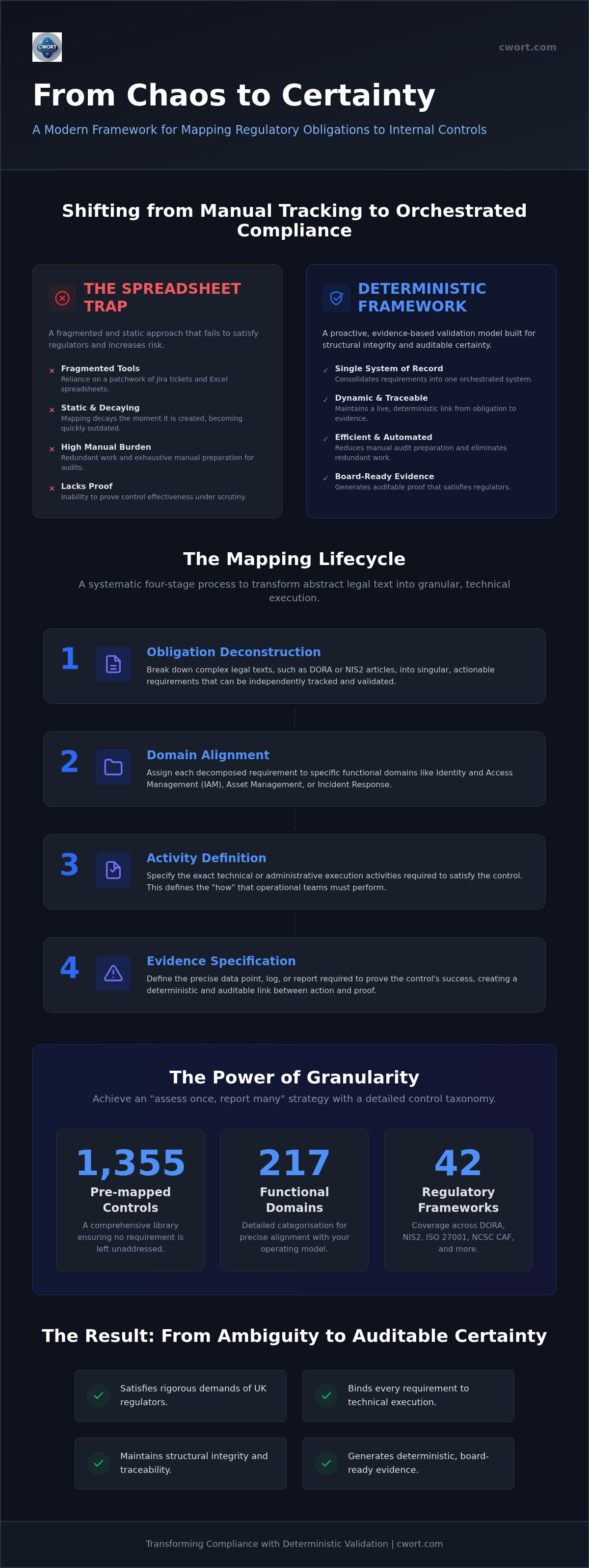
Turning abstract legal mandates into functional security operations is a rigorous engineering challenge. It requires a transition from high-level prose to granular, technical reality. Effective mapping regulatory obligations to internal controls follows a disciplined four-stage lifecycle that ensures nothing is left to interpretation.
- Obligation Deconstruction: Break down complex legal texts, such as DORA or NIS2 articles, into singular, actionable requirements.
- Domain Alignment: Assign these requirements to specific functional domains like Identity and Access Management (IAM), Asset Management, or Incident Response.
- Activity Definition: Specify the exact execution activities required to satisfy the control. This is the "how" that technical teams must perform.
- Evidence Specification: Define the precise output required to prove the control's success, creating a deterministic link between action and audit proof.
Granularity: The Key to Audit-Defensible Proof
Vague control statements are the primary cause of audit failure. If a control is too broad, it becomes impossible to validate. High-integrity mapping relies on a detailed control taxonomy, such as CWORT’s library of 1,355 controls across 217 domains. This level of detail allows organisations to map a single technical activity to multiple frameworks simultaneously. By adopting an "assess once, report many" strategy, you eliminate redundant work whilst ensuring total coverage across 42 different frameworks, including ISO 27001:2022 and the NCSC CAF. You can explore this taxonomy in detail to see how granular mapping accelerates compliance timelines.
The Role of Evidence Binding
A policy document is not proof of compliance; it is merely a statement of intent. Modern regulators demand validated outputs. Evidence binding is the process of attaching direct data from your technical stack, such as SIEM logs, EDR telemetry, or IAM reports, to specific control outcomes. This creates an immutable audit trail that proves a control was functioning at a specific point in time. When evidence is bound directly to the control, the audit process shifts from a manual search for documentation to a streamlined verification of existing data. This methodology ensures evidence integrity and provides the auditable certainty required for board-level reporting in 2026.
Beyond Spreadsheets: Why Traditional Mapping Fails Regulatory Scrutiny
Static spreadsheets are the death knell of audit readiness. Whilst they are familiar, they are fundamentally incapable of maintaining the structural integrity required for modern governance. A manual tracker is a snapshot of the past; it decays the moment it is saved. When mapping regulatory obligations to internal controls, relying on Excel creates a "spreadsheet trap" where version control is non-existent and evidence becomes disconnected from the requirement it is meant to satisfy.
Generic task managers like Jira often compound the problem. These platforms are designed for productivity, not for the rigorous orchestration of compliance validation. They lack the necessary governance features, such as strict separation of duties and immutable audit trails. When data is fragmented across various tickets and workbooks, inconsistent scoring becomes inevitable. This leads to "compliance debt", a state where teams must manually reconstruct evidence during an audit, wasting hundreds of hours and increasing the risk of a catastrophic finding.
The Problem with Non-Deterministic Systems
A non-deterministic system is one where the same evidence might yield different results depending on who reviews it. This "expert bias" is a significant liability for senior leadership. If your maturity assessments rely on subjective interpretation rather than structured validation, your compliance posture is an opinion, not a fact. Regulators in 2026 demand a reproducible model where identical evidence always yields the same compliance result. CWORT replaces this subjectivity with a deterministic engine, providing the board with a defensible truth that is entirely independent of individual bias.
Spreadsheets vs. Orchestration Engines
The difference between a spreadsheet and an orchestration engine lies in the ability to enforce discipline by design. An orchestration engine provides an immutable history of every control activity, ensuring that evidence is protected from tampering or accidental deletion. This level of traceability is essential for satisfying UK regulators who now expect to see a continuous chain of custody for all compliance data. By moving to a Regulatory Compliance Workflow Automation for UK Enterprise, you replace manual guesswork with a systematic workflow that ensures every obligation is mapped, validated, and reported with total precision.
A Five-Step Framework for Orchestrating Regulatory Control Mapping
Successfully mapping regulatory obligations to internal controls requires a transition from abstract documentation to a disciplined, five-phase orchestration framework. This process ensures that compliance is not a point-in-time achievement but a continuous state of readiness. By following a structured methodology, organisations can replace manual guesswork with a repeatable, audit-defensible workflow that satisfies even the most rigorous regulatory scrutiny.
Step 1 & 2: Building the Foundation
The framework begins with Phase 1: Obligation Ingestion. This involves centralising requirements from diverse frameworks such as DORA, NIS2, and ISO 27001 into a unified repository. By using "cross-walks" at this stage, you can identify overlapping requirements, allowing you to satisfy multiple regulators with a single set of actions. Phase 2: Control Selection follows, where you identify the specific domains amongst the 217+ available that are relevant to your operating model. Utilising a dedicated ISO 27001 Control Mapping Tool accelerates this foundation by providing pre-mapped relationships between standard clauses and technical controls. This ensures your maturity model aligns perfectly with your organisation’s actual risk profile rather than a generic template.
Step 3, 4 & 5: Moving to Execution
Execution begins with Phase 3: Activity Design. This stage defines the precise "who, what, and when" of control execution. It moves beyond high-level policy by creating specific, repeatable tasks for technical teams. Phase 4: Evidence Orchestration then automates the collection and binding of proof directly to these activities. This technical binding completes the process of mapping regulatory obligations to internal controls by replacing manual assertions with immutable data. Finally, Phase 5: Continuous Validation provides real-time monitoring of control effectiveness. This phase is critical because continuous validation prevents compliance drift by ensuring that control failures are identified and remediated immediately, rather than remaining hidden until the next audit cycle.
- Enforce Separation of Duties: Ensure the workflow requires independent validation of all control activities to maintain governance integrity.
- Automated Evidence Binding: Connect SIEM and IAM outputs directly to control requirements to eliminate the burden of manual data entry.
- Board-Ready Reporting: Generate real-time maturity assessments directly from validated evidence to provide leadership with definitive, auditable proof.
To see this framework in action and secure your compliance posture, you can request a demo of our orchestration engine.
CWORT: Orchestrating Deterministic Compliance Validation
CWORT functions as the definitive orchestration engine that bridges the gap between static legal mandates and technical reality. It replaces the inherent instability of manual trackers with a disciplined, reproducible system. By mapping regulatory obligations to internal controls through a library of 1,355 pre-configured controls, the platform ensures that 98.6% of active controls carry direct framework references. This level of structural integrity allows organisations to move away from fragmented toolsets. You gain a single, explainable view that satisfies the most demanding auditors. The platform doesn't merely track tasks; it enforces a rigorous standard of evidence that stands up to the scrutiny of UK regulators.
The CWORT Advantage: Assess Once, Report Many
Efficiency in 2026 requires a multi-framework approach to governance. CWORT enables organisations to conduct a single assessment that simultaneously satisfies the requirements of DORA, NIS2, and ISO 27001:2022. This capability is powered by 217 distinct domains that cross-reference 42 international frameworks. Firms with unique requirements can utilise the Bring Your Own Content (BYOC) feature. This allows for the seamless ingestion of custom frameworks whilst maintaining a deterministic, reproducible scoring model. The platform streamlines the process of mapping regulatory obligations to internal controls, ensuring that your compliance posture is a reflection of operational reality rather than a curated administrative narrative.
Board-Level Assurance and Audit Readiness
Leadership requires certainty. CWORT generates regulator-ready outputs that eliminate the need for manual evidence reconstruction during an audit. This transition from abstract policy to validated reality is supported by an AI advisory function. This tool provides strategic context and supports remediation planning without altering the underlying compliance results. The final result is a state of total assurance where every obligation is bound to a specific, auditable outcome. It replaces the "compliance debt" of manual systems with a proactive engine designed for long-term resilience. You can now present your compliance status to the board with absolute confidence in its accuracy and traceability. Replace fragmented chaos with an orchestrated system of record that guarantees defensible truth.
Discover how CWORT orchestrates your compliance journey.
Transitioning to a Defensible Compliance Reality
The shift from static spreadsheets to dynamic orchestration is the only viable path to surviving the regulatory scrutiny of 2026. By mapping regulatory obligations to internal controls through a structured framework, you replace manual anxiety with auditable certainty. This guide has detailed how high-integrity mapping requires granular activities and immutable evidence binding to satisfy the rigorous demands of UK regulators.
Utilising a deterministic, reproducible assurance system allows your organisation to assess once and report many. With a taxonomy library of 1,355 controls, you can rapidly align your operating model with DORA, NIS2, and UK NIS requirements. This approach eliminates expert bias and ensures that your compliance posture is based on definitive truth rather than subjective interpretation. It's time to move beyond fragmented tracking and embrace a system built for structural integrity.
Request a CWORT Pilot to Orchestrate Your Compliance Mapping and secure your organisation's future with a framework that is auditable, explainable, and resilient by design.
Frequently Asked Questions
What is the difference between regulatory mapping and a compliance checklist?
A compliance checklist is a static, point-in-time verification of intent, whilst regulatory mapping is a structural relationship between a mandate and an operational action. Mapping ensures that every requirement is bound to a specific control and technical evidence. This creates a traceable path that proves not just that a task was completed, but that the underlying regulatory obligation was satisfied through a functioning and governed operating model.
How does mapping obligations to controls help with DORA compliance?
DORA requires financial entities to demonstrate digital operational resilience through rigorous ICT risk management and third-party oversight. By mapping DORA articles directly to internal controls, organisations can produce the specific evidence regulators demand, such as proof of separation of duties or incident response efficacy. This structured approach ensures that compliance is a validated outcome of daily operations rather than a manual, retrospective documentation exercise conducted under pressure.
Can I use Jira for mapping regulatory obligations to internal controls?
Whilst Jira is effective for task management, it lacks the governance, immutable audit trails, and deterministic scoring required for mapping regulatory obligations to internal controls. Jira tickets can be edited or moved without the rigorous oversight needed for an audit. Relying on generic tools creates fragmented data and compliance debt, as auditors cannot easily verify the integrity, continuity, or structural relationship of the evidence provided.
What are the benefits of a deterministic compliance scoring model?
A deterministic model ensures that identical evidence always yields the same compliance result, removing the expert bias common in manual assessments. This reproducibility provides senior leadership with a defensible truth that stands up to regulatory scrutiny. By using structured logic rather than subjective interpretation, organisations can generate board-ready reports that accurately reflect their maturity and risk posture without the variability of individual auditor or consultant opinions.
How often should regulatory control mappings be reviewed and updated?
Control mappings should be reviewed continuously to prevent compliance drift, though a formal validation usually occurs quarterly or following significant architectural changes. Since regulations like NIS2 or framework updates like ISO 27001:2022 introduce new requirements, your mapping must remain dynamic. CWORT facilitates this by providing a single orchestrated system where updates to the 1,355-control taxonomy library automatically reflect across all mapped frameworks and reporting dashboards.
How do you map one internal control to multiple regulatory frameworks?
This is achieved through a cross-walk methodology where a single internal activity is tagged with references to multiple standards. For example, a robust Identity and Access Management control can satisfy requirements in DORA, NIST CSF 2.0, and ISO 27001 simultaneously. This "assess once, report many" strategy reduces redundant work and ensures that 98.6% of active controls in the CWORT library maintain direct references to 42 different frameworks.
What role does evidence binding play in the mapping process?
Evidence binding is the technical process of attaching validated data from operational tools directly to a control outcome. It moves the conversation from a statement of intent to a demonstration of reality. By binding SIEM logs or vulnerability reports to a specific requirement, you create an immutable audit trail. This ensures that the evidence used to prove compliance is both relevant and protected from retrospective alteration or accidental deletion.
How does CWORT handle the mapping of custom internal frameworks (BYOC)?
The Bring Your Own Content (BYOC) capability allows organisations to import proprietary maturity models into a governed digital workflow. CWORT applies the same rigorous standards of tenant isolation and immutable audit history to custom content as it does to standard frameworks. This enables enterprises to retain their intellectual property whilst leveraging the platform’s deterministic scoring and automated roll-up reporting for mapping regulatory obligations to internal controls.
Disclaimer
The content on this site is provided for general information and educational purposes only. It does not constitute legal, regulatory, financial, or professional advice. CWORT provides AI-assisted insights and workflow automation, but all compliance decisions remain the responsibility of your organisation and its management. Always seek qualified legal or regulatory guidance for decisions relating to the UK NIS Regulations, CAF, DORA, NIS2, ISO 27001, or other obligations.
Related posts
Separation of Duties Compliance Software: Orchestrating Defensible Governance in 2026
Move beyond manual tracking. See how separation of duties compliance software orchestrates defensible governance and ensures you're ready for DORA & NIS2.
Streamlining Regulatory Compliance Processes: From Manual Tracking to Orchestrated Validation
Stop wasting money on manual compliance. Learn about streamlining regulatory compliance processes to reduce personal liability under DORA & NIS2 and gain aud...
Regulatory Scrutiny Management Tool: Orchestrating Defensible Compliance in 2026
Facing DORA & NIS2? A regulatory scrutiny management tool orchestrates defensible compliance, ending manual evidence chaos for permanent audit-readiness in 2...
Article by
Michael Iyiola
Co-Founder, CWORT
Michael Iyiola is a co-founder of CWORT and a Cyber and AI Security Engineer with deep experience in vulnerability management, detection engineering and operational resilience across UK critical national infrastructure, including rail, energy and financial services. At CWORT, he designs scalable, evidence-driven workflows that help teams meet modern regulatory and security demands.
Build Your Foundation of Auditable Certainty
Take control of your regulatory obligations and secure your infrastructure with CWORT.