Mastering Evidence-Driven Compliance for UK Enterprises

Michael Iyiola
Co-Founder, CWORT
Master UK regulations like DORA & NIS2. Build a robust evidence-driven compliance framework to replace administrative anxiety with auditable certainty.

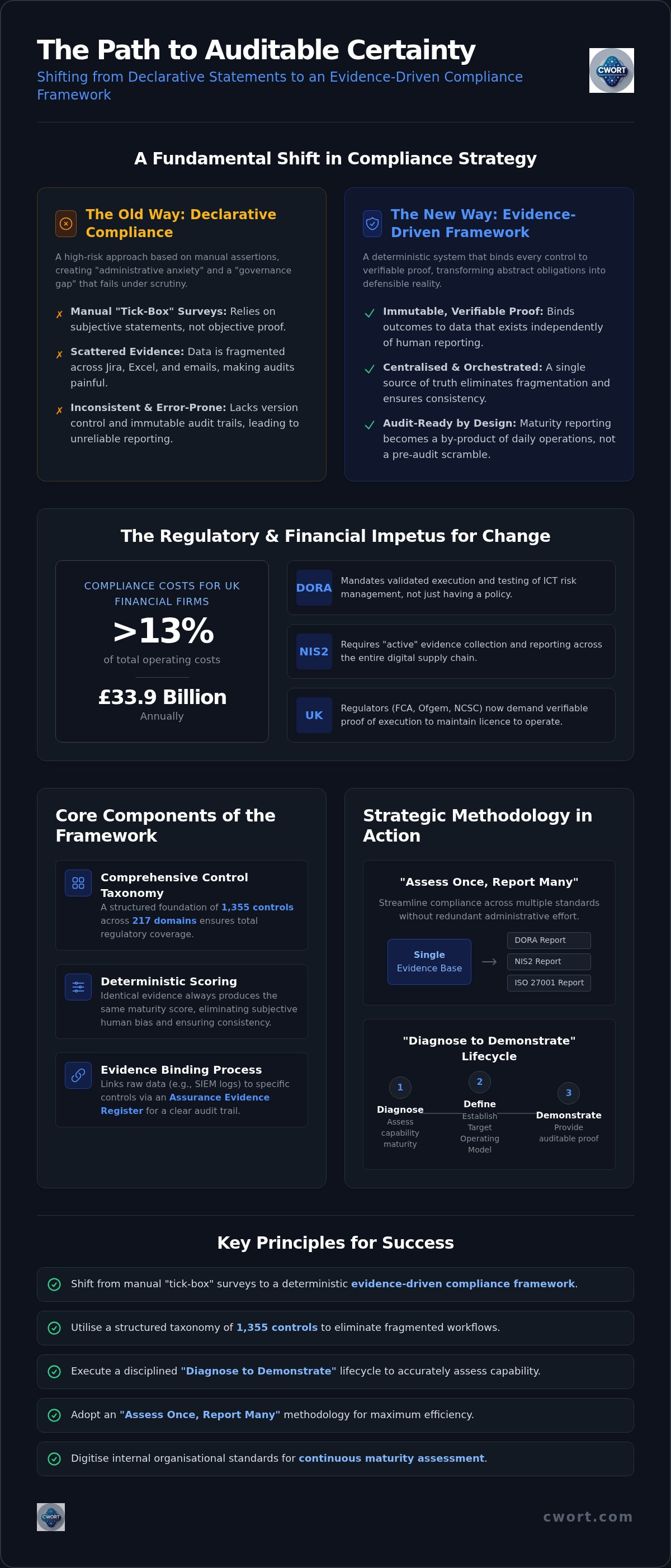
Declarative compliance is no longer a defensible strategy when UK financial services firms are spending over 13% of their total operating costs just to meet regulatory demands. If your evidence is currently scattered across Jira tickets, Excel spreadsheets, and disparate emails, you're not managing risk; you're merely documenting its potential. Transitioning to a deterministic evidence-driven compliance framework is the only way to replace this administrative anxiety with auditable certainty. It's time to stop treating DORA, NIS2, and ISO 27001 as separate hurdles and start viewing them as outputs of a single, rigorous orchestration system.
You understand that manual tracking fails the moment an auditor demands proof of separation of duties or real-time control effectiveness. This guide provides a blueprint for building a reproducible governance system that satisfies the most stringent regulatory scrutiny. We will examine how to implement an "assess once, report many" methodology that eliminates redundant work whilst providing automated, board-level maturity reporting. By the end, you'll have the framework needed to transform abstract obligations into concrete, defensible reality.
Key Takeaways
- Shift from manual "tick-box" surveys to a deterministic evidence-driven compliance framework that binds control outcomes to immutable, verifiable proof.
- Utilise a structured taxonomy of 1,355 controls to eliminate fragmented workflows and ensure identical evidence always yields consistent, audit-defensible results.
- Execute a disciplined "Diagnose to Demonstrate" lifecycle to accurately assess capability maturity and establish a robust Target Operating Model.
- Adopt an "Assess Once, Report Many" methodology to streamline compliance across DORA, NIS2, and ISO 27001 without redundant administrative effort.
- Digitise internal organisational standards by integrating custom content into a governed, automated workflow for continuous maturity assessment.
Table of Contents
- The Shift from Declarative to Evidence-Driven Compliance
- Core Components of a Robust Evidence-Driven Framework
- Orchestrating the Compliance Lifecycle: Diagnose to Demonstrate
- Implementing Your Own Content (BYOC) Maturity Assessment
- CWORT: The Strategic Platform for Evidence-Driven Validation
The Shift from Declarative to Evidence-Driven Compliance
The traditional approach to The Shift from Declarative to Evidence-Driven Compliance has reached a critical breaking point. For years, UK enterprises relied on declarative compliance, which is a system of manual assertions where control owners simply "tick a box" to confirm a policy was followed. This model is inherently flawed because it lacks objective validation. In contrast, an evidence-driven compliance framework binds every control outcome to immutable proof. It shifts the burden of proof from a subjective statement to a deterministic data point that exists independently of the person reporting it.
UK regulators, including the FCA, Ofgem, and the NCSC, now demand more than just policy documents. They require verifiable proof of execution. With the annual cost of compliance for UK financial services surpassing £33.9 billion, the inefficiency of manual tracking is a structural liability. Relying on "trust me" surveys creates a governance gap that auditors are increasingly unwilling to ignore. Organisations must move beyond administrative tracking to definitive, evidence-based proof to maintain their licence to operate.
Why Spreadsheets Fail the Audit Test
Excel and Jira weren't designed for high-stakes regulatory rigour. These tools lack the version control and immutable audit trails required to satisfy a modern inspector. When you use flat files, you risk inconsistent governance because data reconstruction becomes a manual, error-prone task. Proving "separation of duties" is nearly impossible when the same user can edit both the task and the evidence without a governed oversight layer. This fragmentation fuels "audit anxiety" as deadlines approach, leaving leadership unable to guarantee the integrity of their reporting. A spreadsheet cannot prove that a control was active at a specific point in time; it can only record that someone claimed it was.
The Regulatory Pressure of DORA and NIS2
The arrival of DORA and the anticipated Cyber Security and Resilience Bill have fundamentally changed the stakes for 2026. DORA ICT risk management mandates validated execution. It's not enough to have a disaster recovery policy; you must provide evidence that the recovery process was tested and validated. Similarly, NIS2 requires "active" evidence collection and reporting across the digital supply chain. Given that 82.4% of UK organisations experienced a supply chain incident in the last year, regulators are focused on systemic resilience. Enterprises can't meet these requirements through fragmented manual processes. They need a centralised, orchestrated framework that enforces discipline by design. Moving to an evidence-driven model ensures that maturity reporting is a byproduct of daily operations, not a frantic manual exercise conducted weeks before an audit.
Core Components of a Robust Evidence-Driven Framework
A robust evidence-driven compliance framework requires a granular architecture to survive the scrutiny of modern auditors. At its foundation sits a comprehensive Control Taxonomy. In high-stakes environments, this involves a massive scale of oversight, specifically mapping 1,355 controls organised across 217 domains. This level of detail ensures that every regulatory requirement is mapped to a tangible action. By using a proprietary "Assess Once, Report Many" methodology, enterprises can satisfy multiple standards, such as DORA and ISO 27001, without duplicating effort. This efficiency is critical for UK firms where compliance costs continue to escalate.
The framework must enforce Deterministic Scoring. This means that identical sets of evidence must always produce the same maturity score, regardless of who conducts the assessment. This eliminates the variability inherent in human judgment and ensures that your compliance posture is a reflection of reality rather than an optimistic estimate. When building an evidence-driven compliance framework, you must ensure that maturity scores are derived from facts rather than feelings.
The Evidence Binding Process
Effective governance requires a clear lineage from technical telemetry to regulatory obligation. You must bind raw data, such as logs from SIEM or EDR tools, directly to specific control outcomes. This transition from "raw data" to "validated compliance proof" is managed through an Assurance Evidence Register. This register acts as a single source of truth, ensuring that every claim of maturity is backed by verifiable documentation. It transforms fragmented security signals into a coherent, audit-ready narrative that demonstrates exactly how an operating model meets its legal duties. To see how this orchestration works in practice, you can explore a live environment.
Deterministic vs. Subjective Validation
The Core Components of a Robust Evidence-Driven Framework rely on the replacement of "expert opinion" with "evidence-backed validation". Subjective assessments are prone to bias and inconsistency, making them a significant risk during a regulatory enquiry. A deterministic approach ensures reproducibility, which is the hallmark of professional standards. Whilst AI can play a supportive role, it should remain strictly "advisory". AI must never be permitted to alter deterministic outcomes or override the logic of the framework. Its value lies in identifying gaps and suggesting remediations, whilst the final validation remains rooted in immutable, data-driven proof.
Orchestrating the Compliance Lifecycle: Diagnose to Demonstrate
Transitioning from a passive posture to an evidence-driven compliance framework requires a disciplined four-stage orchestration lifecycle. This process ensures that your governance isn't just a collection of documents, but a living system of validated execution. You must move beyond static policies into a dynamic model that produces defensible proof of resilience at every stage of the journey.
The lifecycle begins with Phase 1: Diagnose. You assess current capability maturity by looking past the mere presence of security tools to evaluate their actual effectiveness. Phase 2: Design follows, where you establish a Target Operating Model (TOM) and define the remediation action plans required to reach your goals. In Phase 3: Deliver, you track execution within a single, governed environment, ensuring that every control is active and verified. Finally, Phase 4: Demonstrate allows you to produce regulator-ready, board-level maturity reports instantly. This replaces the traditional end-of-quarter panic with a state of constant, auditable certainty.
Assessing Capability and Capacity
Knowing that a control exists is secondary to understanding how well it works. Modern audit readiness requires you to look beneath the surface of your operations. Heat-map dashboards provide the visibility needed to identify operational gaps before they manifest as regulatory breaches. This level of scrutiny ensures your organisation aligns with a structured Evidence Capacity Framework, which is essential for scaling governance. Capacity is the ability to sustain a control with existing skills and tooling. If your team lacks the necessary expertise or bandwidth to manage a security tool, the control is effectively non-existent in the eyes of a rigorous auditor.
Remediation and Progress Tracking
Remediation must be a risk-led exercise. You don't have the resources to fix every vulnerability simultaneously, so you must prioritise based on business risk, effort, and expected value. A professional system ensures that every remediation step is recorded in an immutable audit history. This prevents the "governance drift" that occurs when old issues resurface because the original fix wasn't properly documented. Implementing Regulatory Compliance Workflow Automation allows you to track these improvements in real-time. It replaces fragmented email chains and spreadsheets with a definitive record of progress, ensuring you can always prove your trajectory towards full maturity.
Implementing Your Own Content (BYOC) Maturity Assessment
Whilst standard regulations provide a necessary baseline, they rarely capture the unique operational nuances of a complex enterprise. You must turn your organisation's internal standards into a governed digital workflow to maintain a truly comprehensive evidence-driven compliance framework. This process, known as Bring Your Own Content (BYOC), allows you to digitise proprietary controls and internal "best practices" without losing the rigour of deterministic scoring. It ensures that your internal governance is enforced with the same discipline as international standards like DORA or ISO 27001.
Protecting your intellectual property is a critical component of this transition. Consultancies and large enterprises often have proprietary assessment methods that provide a competitive edge. BYOC allows you to orchestrate these methods within a secure environment, preserving portfolio-level visibility whilst maintaining granular component detail. This approach shifts internal audits from subjective interviews to objective, data-backed validations that are instantly reportable to the board.
The 7-Step Digital Assessment Workflow
Integrating custom content requires a structured path to ensure data integrity and accountability. The workflow begins with defining the specific models and blueprints that represent your internal standards. You then assign ownership and scope to ensure every control has a responsible party. Once the foundation is established, the focus shifts to execution:
- Steps 1-3: Define your models and blueprints, then assign ownership and scope across the business.
- Steps 4-5: Capture immutable evidence and calculate maturity scores against confidence levels.
- Steps 6-7: Prioritise improvements based on risk and establish a recurring reassessment cycle.
This systematic progression ensures that custom controls aren't just "tracked" but are actively managed within a reproducible governance system.
Governance and Access Controls
Security is paramount when handling custom frameworks and sensitive internal data. You must implement Role-Based and Attribute-Based Access Control (RBAC/ABAC) to ensure that only authorised personnel can interact with specific control domains. Tenant Isolation provides an additional layer of security, keeping proprietary data strictly segregated between different business units or client portfolios. Ensuring Compliance Evidence Integrity remains the primary objective, as any custom framework is only as defensible as the data supporting it. By enforcing these strict access protocols, you maintain a secure environment that auditors can trust implicitly.
Stop managing your internal standards in fragmented documents and spreadsheets. Request a demo to see how to digitise your internal standards.
CWORT: The Strategic Platform for Evidence-Driven Validation
CWORT serves as the definitive orchestration engine, positioned strategically above your existing security stack. Whilst tools like SIEM and EDR provide essential telemetry, they don't offer the governance layer required to satisfy a rigorous auditor. CWORT bridges this gap by mapping 1,355 controls across 217 domains, ensuring that 98.6% of active controls carry direct regulatory references. This structure allows enterprises to implement a truly evidence-driven compliance framework that converts technical functions into a measurable, auditable operating model.
The proprietary "Assess Once, Report Many" methodology is the core of this efficiency. Instead of conducting separate assessments for DORA, NIS2, and ISO 27001, you validate a control once and propagate that evidence across every relevant standard. This approach eliminates the administrative redundancy that often paralyses large organisations. It ensures that your compliance posture is a constant state of readiness rather than a periodic reaction to a looming deadline. By enforcing a disciplined workflow, CWORT ensures that every piece of evidence is bound to a specific control outcome, making your governance impossible to ignore.
Board-Ready Reporting and Regulator Defence
Executive leadership requires clarity, not technical jargon. CWORT provides a common language for maturity that resonates at both the operational and board levels. You can produce audit-ready outputs instantly, removing the need for weeks of manual data reconstruction before an inspection. This transparency builds trust with regulators by proving that your governance is active and evidence-backed. For organisations focusing on national standards, using dedicated NCSC CAF Assessment Software ensures that your maturity reporting aligns perfectly with government expectations.
Getting Started: The Governed Pilot
Transitioning your entire enterprise at once is unnecessary. We recommend a governed pilot focusing on 3-5 critical components to validate the end-to-end workflow. This low-friction entry point allows you to test the "Diagnose to Demonstrate" lifecycle in a controlled environment. You'll see first-hand how deterministic scoring replaces subjective guesswork with auditable truth. Once validated, this model can be scaled across the entire organisation, providing a unified view of risk and resilience. It's time to move beyond fragmented trackers and spreadsheets. Contact CWORT to orchestrate your evidence-driven compliance framework and secure your regulatory future.
Securing Your Regulatory Future Through Orchestration
The 2026 regulatory landscape leaves no room for declarative guesswork or fragmented spreadsheets. Transitioning to an evidence-driven compliance framework is the only way to replace administrative anxiety with auditable certainty. You've seen how a deterministic scoring engine eliminates subjectivity, whilst an "assess once, report many" methodology removes the burden of redundant framework mapping. By orchestrating 1,355 controls across 42 frameworks, you transform cyber-security from a technical cost centre into a reproducible, board-ready operating model.
Don't wait for an audit failure to reveal the gaps in your manual tracking. Secure your posture with a UK-based orchestration system designed to satisfy DORA, NIS2, and ISO 27001 auditors by design. It's time to enforce discipline and accountability through immutable proof. Request a CWORT Platform Demonstration to see how deterministic validation can future-proof your organisation. You can achieve total assurance through orchestrated execution.
Frequently Asked Questions
What is an evidence-driven compliance framework?
An evidence-driven compliance framework is a governed system where every regulatory control is bound to immutable, verifiable proof rather than manual assertions. Unlike traditional models that rely on "tick-box" surveys, this approach uses technical telemetry and validated documentation to prove execution. It ensures that your compliance posture is a reflection of operational reality. This creates a defensible audit trail that satisfies the most stringent inspectors by replacing subjective claims with objective data.
How does an evidence-driven approach differ from traditional GRC?
Traditional GRC platforms often function as passive repositories for policy documents and manual self-assessments. An evidence-driven approach replaces this declarative model with an orchestrated execution system. It enforces discipline by requiring specific evidence before a control is marked as compliant. This shift moves the organisation from administrative tracking to definitive proof. You'll gain real-time visibility into control effectiveness instead of waiting for periodic reviews that often rely on outdated or inaccurate manual data.
Can I use my own proprietary maturity models within an evidence-driven framework?
You can integrate proprietary maturity models through a Bring Your Own Content (BYOC) workflow. This allows enterprises to digitise internal standards and custom blueprints whilst maintaining portfolio-level visibility. The framework applies the same rigour to your custom content as it does to international standards. You'll calculate maturity and confidence levels for unique operational requirements. This ensures that your specific organisational knowledge is preserved and enforced within a secure, governed digital environment.
How does evidence-driven compliance help with DORA and NIS2?
DORA and NIS2 require validated execution and active reporting across the digital supply chain. An evidence-driven compliance framework ensures that ICT risk management is backed by verifiable proof of testing and remediation. It helps you meet the strict deadlines of 2026 by providing a centralised environment for orchestrated evidence collection. You'll demonstrate systemic resilience to regulators instantly. This eliminates the frantic manual reconstruction of data that usually precedes high-stakes audits in the financial sectors.
Why is deterministic scoring important for regulatory audits?
Deterministic scoring is vital because it ensures reproducibility and consistency during an audit. It means that identical sets of evidence will always yield the same maturity score, regardless of who performs the assessment. This removes the "expert bias" and subjectivity that often lead to inconsistent governance. Auditors trust deterministic models because they're rooted in logic and facts. You'll defend your compliance posture with confidence, knowing the results are mathematically sound and verifiable.
Can an evidence-driven framework replace manual spreadsheets and Jira?
It replaces the need for fragmented spreadsheets and basic task managers by providing a governed orchestration layer. Whilst you'll still use technical tools for day-to-day tasks, the framework sits "above" them to enforce separation of duties and immutable audit trails. It eliminates the version control issues and data silos inherent in Excel. You'll move from a flat file environment to a structured system where every action is recorded and mapped to specific obligations.
What kind of evidence is required for a DORA compliance audit?
A DORA audit requires diverse evidence ranging from technical logs and incident reports to disaster recovery test results. You must provide proof of ICT risk management effectiveness and third-party risk assessments. This includes documented evidence of remediation actions and board-level reporting. The framework organises these disparate data points into an Assurance Evidence Register. This ensures that every claim of resilience is supported by documentation that proves the control was active and effective.
How does "Assess Once, Report Many" work in practice?
This methodology works by mapping a single control to multiple regulatory frameworks simultaneously. For example, a specific access control might satisfy requirements for DORA, NIS2, and ISO 27001. When you validate that control with evidence, the system automatically updates your maturity status across all relevant standards. It drastically reduces administrative overhead and prevents redundant work. You'll maintain a unified view of your compliance posture whilst generating specific reports for different regulators with minimal effort.
Disclaimer
The content on this site is provided for general information and educational purposes only. It does not constitute legal, regulatory, financial, or professional advice. CWORT provides AI-assisted insights and workflow automation, but all compliance decisions remain the responsibility of your organisation and its management. Always seek qualified legal or regulatory guidance for decisions relating to the UK NIS Regulations, CAF, DORA, NIS2, ISO 27001, or other obligations.
Related posts
Streamlining Regulatory Compliance Processes: From Manual Tracking to Orchestrated Validation
Stop wasting money on manual compliance. Learn about streamlining regulatory compliance processes to reduce personal liability under DORA & NIS2 and gain aud...
Managing Compliance Evidence in Excel: Comparison and Strategic Risks for 2026
Is managing compliance evidence in excel a risk for 2026? Learn why spreadsheets jeopardise DORA & NIS2 validation and get a roadmap to an audit-ready system.
Separation of Duties Compliance Software: Orchestrating Defensible Governance in 2026
Move beyond manual tracking. See how separation of duties compliance software orchestrates defensible governance and ensures you're ready for DORA & NIS2.
Article by
Michael Iyiola
Co-Founder, CWORT
Michael Iyiola is a co-founder of CWORT and a Cyber and AI Security Engineer with deep experience in vulnerability management, detection engineering and operational resilience across UK critical national infrastructure, including rail, energy and financial services. At CWORT, he designs scalable, evidence-driven workflows that help teams meet modern regulatory and security demands.
Build Your Foundation of Auditable Certainty
Take control of your regulatory obligations and secure your infrastructure with CWORT.