Moving Beyond Tick-Box Compliance: Prove Controls Work in Practice

Michael Iyiola
Co-Founder, CWORT
Start moving beyond tick-box compliance to prove control effectiveness. Discover how to connect ownership and evidence to build robust assurance workflows.

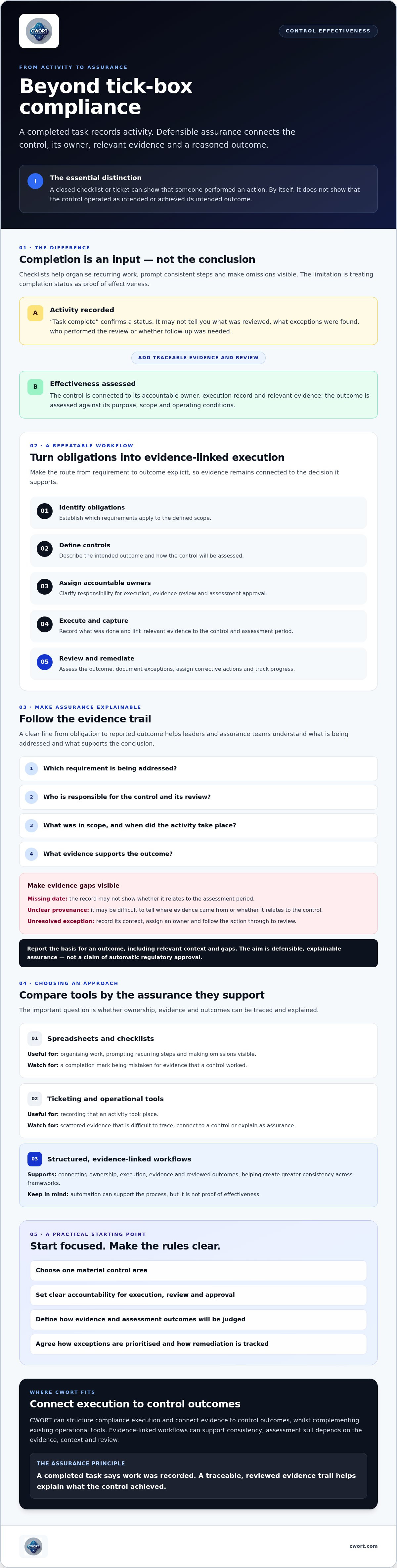
What if a control marked complete still left you unable to show that it worked? That’s the challenge at the heart of moving beyond tick-box compliance: a task recorded in a spreadsheet or ticket shows that activity took place, but not that the control achieved its intended outcome.
When evidence is scattered across operational tools, assurance can be difficult to trace and explain. Teams may complete every checklist while leaders still lack a clear view of who owns each control, what evidence supports it and where gaps remain. Under scrutiny, a completed task is not proof of effectiveness.
This article explains how to build a repeatable approach that connects control ownership, execution and evidence to clear outcomes. You’ll learn how to distinguish completed tasks from demonstrated effectiveness, capture and address evidence gaps, and produce assurance outputs decision-makers can follow. We’ll also look at how structured, evidence-linked workflows can support greater consistency across frameworks, without mistaking automation for proof.
Key Takeaways
- Learn why a completed checklist may not be enough to support a conclusion about control effectiveness.
- Use a repeatable sequence to turn obligations into assigned controls, evidence requirements and reviewed outcomes.
- Compare spreadsheets, ticketing tools and compliance orchestration by how well they support traceability, ownership and reporting.
- Start moving beyond tick-box compliance with one material control area, clear accountability and defined assessment rules.
- See how CWORT can structure execution and connect evidence to control outcomes while complementing existing operational tools.
Table of Contents
- Moving Beyond Tick-Box Compliance: What Checklists Can and Cannot Prove
- How to Turn Compliance Obligations into Evidence-Linked Execution
- Manual Trackers, Point Tools and Orchestrated Compliance: What to Compare
- A Practical Roadmap for Moving Beyond Tick-Box Compliance
- How CWORT Supports a Move from Compliance Activity to Defensible Assurance
Moving Beyond Tick-Box Compliance: What Checklists Can and Cannot Prove
Tick-box compliance records whether a task has been marked complete. It doesn’t necessarily show that a control operated as intended, covered the right scope or produced an effective outcome. A checklist can organise work, prompt consistent steps and make omissions visible. Its limitation is that a completed box records activity, not assurance in itself.
Evidence-backed compliance connects a defined obligation and control to accountable execution, relevant supporting evidence and a reasoned assessment of the outcome. This distinction is central to moving beyond tick-box compliance. A closed ticket may confirm that someone performed an action, but it doesn’t establish what happened or whether the control worked.
Checklists remain useful in a disciplined process. They provide structure and help teams carry out recurring activities. The problem arises when completion is treated as the conclusion rather than one input to an assessment. A more joined-up view reflects the holistic approach to governance, risk management, and regulatory compliance, where obligations, risk decisions and operational controls are considered together.
Why completed tasks are not the same as effective controls
Consider a completed review task. Its status alone doesn’t establish which records were reviewed, what exceptions were found, who performed the review or whether follow-up actions were needed. To assess the result, connect the control to its accountable owner, the execution record and the evidence that supports the conclusion.
Depending on the control and its context, that evidence might include a review record or documented findings. No single indicator proves effectiveness in every organisation. The assessment should consider the control’s purpose, scope and operating conditions. Make limitations and unresolved gaps visible instead of turning a completion status into an automatic pass.
What leaders and assurance teams need to see
Leaders need a traceable line from obligation to control activity, evidence and reported outcome. Each link should help answer a practical question: which requirement is being addressed, who is responsible, what was in scope, when did the activity take place, and what supports the conclusion?
These details affect how evidence should be interpreted. An undated record may not show whether it relates to the assessment period. Unclear provenance can make it hard to understand where evidence came from or whether it relates to the control. Reporting should explain the basis for an outcome, including gaps and relevant context. The goal is defensible, explainable assurance that supports scrutiny and decisions, not a claim of automatic regulatory approval.
How to Turn Compliance Obligations into Evidence-Linked Execution
Make the route from requirement to outcome explicit. A repeatable workflow gives teams a shared method for translating obligations into control activity, assigning responsibility and assessing what the evidence shows. It also helps keep evidence connected to the decision it is meant to support.
Identify obligations, define controls, assign accountable owners, execute the activity, link evidence to the control and assessment period, then review outcomes and track remediation. This sequence makes moving beyond tick-box compliance an operational discipline, not just a change in reporting language.
- Identify obligations: Establish which requirements apply to the defined scope.
- Define controls: Describe the control’s intended outcome and how it will be assessed.
- Assign owners: Identify who is accountable for execution, review and assessment approval.
- Execute and capture: Record what was done and link relevant evidence to the control and period being assessed.
- Review and remediate: Assess the outcome, document exceptions and assign corrective actions with owners and progress tracking.
A gap should not end as a note in a report. Record its context, assign an accountable owner, define the follow-up action and track progress through to review. Set criteria for prioritising exceptions in advance so teams can apply them consistently and explain why actions take precedence. This makes unresolved issues visible and gives decision-makers a clearer basis for directing remediation.
Make ownership, scope and separation of duties explicit
Clarify who performs the control, who reviews the evidence and who approves the resulting assessment. These roles may sit with different people, depending on the organisation’s governance arrangements. Define the scope and approval stages up front, then set out responsibilities to reduce ambiguity between operational teams and assurance reviewers. Document review decisions so the assessment can be traced and explained.
Bind evidence to control outcomes, not just document folders
A file in a repository is not self-explanatory. Link each item to the control outcome it supports and record useful context, such as its source, date, scope, status and accountable owner. Connect it to the relevant assessment period so reviewers can distinguish current evidence from material relating to another cycle.
Evidence still needs human scrutiny. Reviewers must judge whether it is relevant, sufficiently complete and consistent with the stated control outcome. A structured workflow can support that judgement and preserve its rationale, but it cannot make weak evidence conclusive by itself. Teams considering how to organise this process can request a CWORT demonstration.
Manual Trackers, Point Tools and Orchestrated Compliance: What to Compare
Choose tools by the assurance process they support, not by category alone. A spreadsheet, ticketing system or compliance orchestration platform may all contribute to compliance work. The key question is whether your approach gives reviewers a dependable view of control ownership, evidence and outcomes, with enough context to explain how conclusions were reached.
When spreadsheets and task trackers reach their limits
Risks to consider include version drift, duplicated records and manual reconstruction when evidence or decisions are spread across files and systems. These problems aren’t inevitable: a well-governed tracker can work for a defined scope. But a task marked complete may not show the control’s scope, the quality of its evidence or who reviewed the outcome. Focus on how tools are managed, not on whether a particular spreadsheet or ticketing product is inherently unsuitable.
How to evaluate an orchestration approach
Check whether the approach maps obligations to controls, keeps evidence connected to outcomes and records who did what, when and within which scope. Confirm that access controls, separation of duties and change history meet your governance requirements. Existing SIEM, EDR/XDR, vulnerability management and identity tools can remain valuable evidence sources. Orchestration should provide a joined-up assurance view, not imply that operational tools must be replaced.
There’s no universal best fit. The right choice depends on governance needs, framework scope and operating complexity. If you’re moving beyond tick-box compliance, compare approaches against the same criteria, then test whether the resulting assurance can be traced and explained.
A Practical Roadmap for Moving Beyond Tick-Box Compliance
Move in stages. Before digitising a compliance process, establish what it needs to prove, who is accountable and how decisions will be reviewed. Starting with one material control area keeps the work bounded and helps reveal whether the method is repeatable before you apply it more widely.
Start with a controlled pilot and measurable criteria
Select a defined sub-function or control area, then document its boundaries, relevant obligations and accountable owners. Agree what completion means and what credible evidence should demonstrate. Set assessment rules and review responsibilities in advance, so the pilot tests the process rather than simply transferring an unclear checklist into a new tool.
Define how exceptions will be prioritised. Consider business priority, risk, remediation effort and expected value, and assign each accepted gap an owner and a way to track progress. Test whether the outputs make sense to the people who need to use them: operational owners responsible for action, assurance teams reviewing evidence and leaders making decisions. If they interpret the same result differently, refine the criteria before expanding the pilot.
Scale only after validating governance and repeatability
Use the pilot to test governance as well as workflow. Confirm that role access reflects responsibilities, separation of duties is maintained, evidence is appropriately protected and changes can be traced through the audit history. Review a reassessment too: can someone explain what changed, why the outcome changed and which evidence supports the revised conclusion?
Document assessment and scoring rules, including how changes to those rules are approved and recorded. This helps keep reassessments explainable as the process evolves. Capture lessons from the pilot in reusable control templates, evidence expectations and an approval process. Expand only when teams can apply these consistently and reviewers can follow the path from activity to outcome.
That discipline makes moving beyond tick-box compliance a controlled improvement, rather than a technology rollout alone. A clear scope, defined evidence criteria and tested governance give teams a practical basis for scaling with confidence. To see how CWORT could support a structured compliance workflow, request a CWORT demonstration.
How CWORT Supports a Move from Compliance Activity to Defensible Assurance
CWORT is a compliance validation and operating-model intelligence platform designed to structure control execution and connect evidence to assessed outcomes. It sits above existing operational tools, bringing relevant information into a traceable assurance workflow rather than replacing systems such as SIEM, EDR/XDR, vulnerability management or identity tools. Those systems can remain important sources of operational evidence.
For organisations moving beyond tick-box compliance, the distinction matters: a platform can organise work and make relationships between obligations, controls and evidence easier to follow, but the evidence and its context still need to support the conclusion. CWORT’s taxonomy library contains 1,355 controls across 217 domains and 42 frameworks or standards, as stated for June 2026. This mapping can help teams identify shared controls across frameworks while retaining traceability to relevant control detail.
Use governed workflows and reproducible assessment results
Deterministic scoring supports repeatability: when the same defined assessment rules and evidence are applied, the assessment result can be reproduced. That consistency makes it easier to compare assessments and explain how an outcome was reached. It doesn’t make weak, incomplete or out-of-scope evidence sufficient, nor does it guarantee regulatory acceptance.
Governance features support accountability around the process. CWORT supports role-based and attribute-based access, separation of duties and immutable audit history. These capabilities can help record who performed and reviewed work, manage access in line with responsibilities, and retain a history of assessment activity. AI advisory can provide suggestions, but it doesn’t alter deterministic assessment results.
Connect compliance intelligence to operating-model improvement
Assessment findings become more useful when they inform decisions and follow-up. CWORT supports assessment, target operating model design, remediation tracking and board-ready maturity reporting, connecting control insight with improvement planning. Mapped controls can support work across frameworks, while evidence and control outcomes remain available for review. Teams considering cross-framework assurance can use a DORA compliance validation guide as a starting point, while keeping the scope and interpretation tied to their own programme.
The aim is a clearer line from assessment to accountable action and leadership reporting, not an automated declaration of compliance. To assess how CWORT could fit against a real programme, request a CWORT demonstration.
Build Assurance That Stands Up to Scrutiny
Moving beyond tick-box compliance starts with a clear distinction: recording that work was done is not the same as demonstrating what a control achieved. Connect obligations to defined controls, accountable owners, relevant evidence and reviewed outcomes. Then use a controlled pilot to test whether the process is repeatable, traceable and useful to decision-makers before widening its scope.
CWORT supports this approach by structuring execution and linking evidence to control outcomes. Its deterministic assessment results are designed for reproducibility, while evidence-linked outcomes and immutable audit history help make the basis for assurance traceable. The June 2026 taxonomy snapshot maps 1,355 controls across 217 domains and 42 frameworks or standards. These capabilities support assessment, but evidence and organisational context remain essential to interpreting results.
Start with a real control area and assess whether a governed workflow fits your programme. Request a CWORT demonstration to explore that fit. With clear ownership, disciplined evidence and explainable outcomes, your organisation can build assurance that supports stronger decisions and resilience.
Frequently Asked Questions
What does moving beyond tick-box compliance mean?
Moving beyond tick-box compliance means assessing whether controls operate as intended, rather than treating a completed task as proof of success. It connects obligations to defined controls, accountable owners, execution records, relevant evidence and reviewed outcomes. For example, a recorded access review is more informative when its scope, findings, evidence and follow-up actions are clear. The aim is traceable assurance that helps people understand how a conclusion was reached.
Why is tick-box compliance not enough to demonstrate control effectiveness?
A tick can show that someone marked a task complete, but it may not show what they did, what they found or whether the control achieved its purpose. A closed review task, for example, doesn’t explain which items were reviewed or whether exceptions needed action. Assessing effectiveness requires evidence relevant to the control’s scope and period, plus appropriate review. The strength of the conclusion depends on the evidence and organisational context.
How can an organisation measure compliance maturity beyond checklist completion?
Assess maturity against defined criteria, not the proportion of checklist items marked complete. Consider whether controls have clear owners, whether execution is repeatable, whether evidence supports outcomes and whether gaps are assigned and tracked through remediation. Apply consistent assessment rules and scope, then compare results over time to identify progress or recurring weaknesses. Document the basis for each assessment so leaders can understand what improved and where further work is needed.
Can compliance software prove that controls are effective?
Compliance software can structure workflows, link evidence to controls, record decisions and support consistent assessment, but the software alone can’t prove that a control worked. People still need to evaluate whether evidence is relevant, sufficiently complete and appropriate to the control and assessment period. Deterministic scoring can make results reproducible when defined rules and evidence are applied consistently. It doesn’t make weak evidence conclusive or guarantee regulatory acceptance.
What evidence should be linked to a compliance control?
Link evidence that helps demonstrate the control’s intended outcome for the relevant scope and assessment period. Depending on the control, this could include a review record, documented findings or records of follow-up actions. Include context such as the evidence source, date, scope, status and accountable owner. Reviewers should be able to understand what the evidence relates to and assess its relevance. No single evidence type is sufficient for every control or organisation.
How should we start moving beyond tick-box compliance?
Start with one material control area and define its scope, intended outcome and accountable owner. Agree what evidence is needed, who performs the activity, who reviews it and how gaps will be recorded and prioritised. Pilot the process before digitising or expanding it. Check that evidence can be traced, responsibilities are clear and assessment results can be explained. Use the lessons to refine the approach before applying it to other control areas. Request a CWORT demonstration to explore how a governed workflow could fit your programme.
Disclaimer
The content on this site is provided for general information and educational purposes only. It does not constitute legal, regulatory, financial, or professional advice. CWORT provides AI-assisted insights and workflow automation, but all compliance decisions remain the responsibility of your organisation and its management. Always seek qualified legal or regulatory guidance for decisions relating to the UK NIS Regulations, CAF, DORA, NIS2, ISO 27001, or other obligations.
Related posts
How to Demonstrate Control Effectiveness to Regulators: A Strategic Guide
Learn how to demonstrate control effectiveness to regulators with our guide. Shift from chaos to an evidence-based, audit-ready compliance programme today.
Reducing Audit Preparation Time and Costs: A Strategic Guide for UK Enterprises
Tired of costly audit seasons? Our guide for UK enterprises shows you how to stop the manual scramble, reducing audit preparation time and costs with automat...
UK NIS Audit Readiness Tool: Orchestrating Compliance for 2026
Master your 2026 audit with our guide to UK NIS compliance orchestration. Move from fragmented evidence to a single source of truth for NCSC CAF 4.0 readiness.
Article by
Michael Iyiola
Co-Founder, CWORT
Michael Iyiola is a co-founder of CWORT and a Cyber and AI Security Engineer with deep experience in vulnerability management, detection engineering and operational resilience across UK critical national infrastructure, including rail, energy and financial services. At CWORT, he designs scalable, evidence-driven workflows that help teams meet modern regulatory and security demands.
Build Your Foundation of Auditable Certainty
Take control of your regulatory obligations and secure your infrastructure with CWORT.