NIS2 Compliance for Managed Service Providers: 2026 Guide

Michael Iyiola
Co-Founder, CWORT
Master NIS2 directive compliance for managed service providers with our 2026 guide. Learn how to assess scope, assign controls, and build audit-ready evidence.

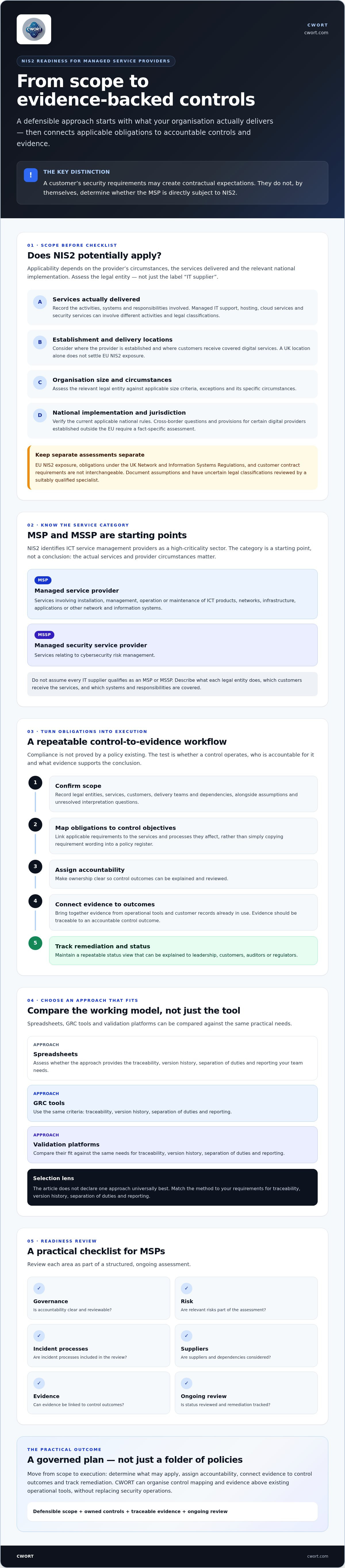
A policy library won’t prove that an MSP can govern cybersecurity across the services it delivers. The harder question is whether NIS2 directive compliance for managed service providers applies to your organisation, your services, or both through customer and supply-chain obligations.
That uncertainty is understandable. NIS2 identifies ICT service management providers as a high-criticality sector, but applicability depends on the relevant national implementation and the organisation’s circumstances. For UK providers, cross-border operations and customer contracts can make the assessment more complex. A broad checklist alone won’t settle it.
This guide explains how to build a defensible scope assessment, translate requirements into owned, testable controls, and assemble evidence from the operational tools and customer records you already use. It also shows how to compare compliance approaches and create a repeatable status view for leadership, customers, auditors or regulators.
Move from scope to execution: determine what may apply, assign accountability, connect evidence to control outcomes and track remediation. The aim is not a folder of policies, but a governed, evidence-backed implementation plan that your team can explain and validate.
Key Takeaways
- Assess whether NIS2 may apply by checking your services, establishment, organisation size and relevant national implementation.
- Turn NIS2 directive compliance for managed service providers into a practical workflow, from mapping obligations to assigning owners and tracking remediation.
- Compare spreadsheets, GRC tools and validation platforms against your needs for traceability, version history, separation of duties and reporting.
- Use a structured readiness checklist to review governance, risk, incident processes, suppliers, evidence and ongoing review.
- See how CWORT can organise control mapping and evidence above existing operational tools, without replacing your security operations.
Table of Contents
- When does NIS2 directive compliance apply to managed service providers?
- How MSPs can turn NIS2 requirements into accountable controls and evidence
- NIS2 compliance approaches for MSPs: spreadsheets, GRC tools, or validation platforms?
- A practical NIS2 readiness checklist for managed service providers
- How CWORT can support NIS2 readiness and auditable MSP compliance
When does NIS2 directive compliance apply to managed service providers?
NIS2 applicability depends on the service type, the provider’s establishment, its size and the national law implementing the Directive. A UK address alone doesn’t settle the question, and a customer’s request for security controls doesn’t automatically make its MSP directly subject to NIS2.
The Directive distinguishes managed service providers (MSPs), which provide services involving the installation, management, operation or maintenance of ICT products, networks, infrastructure, applications or other network and information systems, from managed security service providers (MSSPs), whose services relate to cybersecurity risk management. Both are identified within the digital-service categories in the NIS2 Directive. The category is a starting point, not a conclusion: the services actually delivered and the provider’s circumstances matter.
Which managed services may bring a provider into scope?
Managed IT support, hosting, cloud services and security services can involve different activities and legal classifications. A supplier that maintains a customer’s network, for example, may need a different scope analysis from a company that provides a cloud service or performs cybersecurity risk-management activities. Don’t assume that every IT supplier qualifies as an MSP or MSSP under the Directive.
Record what each legal entity actually delivers, where customers receive those services, and which systems and responsibilities the work covers. Then assess the relevant entity against applicable size criteria, exceptions and national implementation. A customer’s NIS2 obligations may also lead to contractual security requirements for its supplier. Those requirements matter, but they’re distinct from the MSP’s own direct regulatory status.
Does NIS2 apply to a UK-based MSP?
A UK location doesn’t automatically exclude an organisation from EU NIS2 analysis. Relevant considerations may include whether it has an establishment in an EU Member State and whether it provides covered digital services into the EU. The Directive contains jurisdiction provisions for certain digital providers, including rules relevant to providers established outside the EU. How those provisions apply depends on the facts and current national implementation, so verify the applicable wording rather than relying on a general rule of thumb.
Assess EU NIS2 exposure separately from obligations under the UK Network and Information Systems Regulations. The regimes shouldn’t be treated as interchangeable, and customer contracts may create additional expectations without deciding statutory scope.
Practical scope summary: “NIS2 may apply where a provider’s actual services, establishment, size and relevant national rules bring its legal entity within scope; customer security requirements are a separate consideration.” Treat this as a working summary, not a legal test. For a defensible conclusion, document the assessment and have any uncertain classification or cross-border question reviewed by a suitably qualified legal specialist.
How MSPs can turn NIS2 requirements into accountable controls and evidence
Once you’ve assessed scope, turn applicable obligations into work that can be assigned, tested and evidenced. The European Commission’s NIS2 Directive overview provides context. Confirm the requirements relevant to your entity against applicable national law and authoritative guidance. For NIS2 directive compliance for managed service providers, the test isn’t whether a policy exists. It’s whether the control operates, who is accountable for it and what evidence supports that conclusion.
Evidence-backed compliance means traceable evidence linked to an accountable control outcome. Use a repeatable workflow:
- 1. Confirm scope. Record the legal entities, services, customers, delivery teams and dependencies included in the assessment, along with scope assumptions and unresolved interpretation questions.
- 2. Map obligations. Translate applicable requirements into control objectives. Link each objective to the services and processes it affects, rather than copying requirement wording into a policy register.
- 3. Assign owners. Name one accountable owner for each control and identify contributors or reviewers. A control without a responsible person is difficult to validate or improve.
- 4. Collect evidence. Identify suitable records from operational tools, service processes, and customer or supplier records. Capture evidence that shows the control in practice, not just its documented design.
- 5. Assess gaps. Compare the evidence with the control objective. Record whether the control is implemented, operating as intended, partially evidenced or unresolved, and explain the basis for that status.
- 6. Track remediation. Convert gaps into owned actions with a prioritisation rationale, due dates and a defined reassessment step. Keep the original finding and subsequent evidence connected.
Map obligations to services, owners and controls
Start with an inventory of services, service dependencies, customers and delivery teams. Then map each applicable requirement to a control objective and accountable owner. For example, access evidence should show how access is approved and reviewed for the relevant service, while supplier records should connect to the dependencies they support. Document assumptions separately, and refer uncertain legal or regulatory interpretations for specialist review.
Build an evidence and remediation lifecycle
For every evidence item, record its source, date, scope, relationship to the control, reviewer and status. Connect incident records, access reviews, supplier assessments and resilience exercises to the control outcomes they support. A policy describes intent; dated records and review results help demonstrate execution. For more on compliance evidence integrity, see the related strategic guide. Review evidence periodically and reassess controls after remediation or relevant service changes.
If you’re evaluating how to organise this workflow, a CWORT workflow demonstration can help you assess fit for control mapping, evidence and remediation. CWORT supports compliance validation; it doesn’t replace your operational security tools or establish legal compliance.
NIS2 compliance approaches for MSPs: spreadsheets, GRC tools, or validation platforms?
The right approach depends on how many services, customers, frameworks and control owners you need to coordinate. A spreadsheet may be enough to record a small, stable set of controls. But as evidence changes and audit requests multiply, maintaining clear ownership, history and reporting becomes harder. For NIS2 directive compliance for managed service providers, assess the workflow you need to govern, not just the software category.
Compare options against five practical criteria: evidence traceability, control ownership, version history, separation of duties and reporting. Also test whether you can produce a consistent view for a particular service or customer without losing the overall organisational picture.
What should MSPs test in a compliance platform?
Run a representative control through the full workflow. Can you link its evidence directly to the control, assessment, owner and outcome? Check permissions, reviewer independence, audit history and whether reports can be exported for leadership or assurance reviews. Then test how the system handles multiple services, customer contexts, frameworks and changes to control versions. Ask to see how a past assessment remains explainable after an update.
Where does compliance orchestration fit alongside security tools?
Security tools and compliance validation serve different purposes. SIEM systems analyse security events; EDR or XDR tools focus on endpoint or extended detection and response; vulnerability tools identify and help manage weaknesses. A compliance validation layer organises control ownership, assessment, evidence and remediation across these activities. It may consume evidence from existing tools, but verify which sources are supported and how evidence is reviewed. It doesn’t replace security operations.
For a focused discussion of this model, see the NIS2 compliance platform approach. A platform should make control status and supporting evidence easier to validate and report, not create a parallel source of unverified claims. Test the workflow using your own service structure and evidence before deciding whether it addresses gaps your current tools leave.
A practical NIS2 readiness checklist for managed service providers
Build the assessment around the full service boundary, not just the MSP’s internal IT. Include customer-facing services, delivery teams, suppliers and dependencies that could affect service resilience. For NIS2 directive compliance for managed service providers, validate current requirements against the applicable national law and authoritative guidance. Record legal interpretations that need specialist review rather than treating assumptions as settled facts.
What should an MSP establish before implementation?
Set the baseline first. Document the service catalogue, legal entities, relevant establishments, customer dependencies and scope rationale. Assign leadership accountability, operational control owners, compliance reviewers and escalation routes. Preserve the evidence and decisions that support your assessment, including gaps and unresolved questions. This gives the implementation team a clear starting point and makes later changes traceable.
Readiness checklist
- Scope: Record the entities and services assessed, relevant establishments, customer dependencies and any exclusions with their rationale.
- Governance: Name accountable leaders, control owners, reviewers and escalation routes. Confirm how status and material gaps reach decision-makers.
- Risk: Maintain documented risk assessments that reflect service dependencies, business impact and relevant threats.
- Controls: Map applicable requirements to defined controls, owners and evidence. Check that controls cover internal operations as well as customer-facing service delivery.
- Incident processes: Document reporting and escalation responsibilities, decision points, records and how the process is reviewed.
- Suppliers: Identify critical dependencies and keep evidence of how relevant supplier risks and responsibilities are assessed.
- Evidence: Record each item’s source, date, scope, control relationship, reviewer and status. Distinguish documented policies from evidence that a control operates.
- Review: Set a repeatable review cycle for evidence, control status, scope changes and remediation progress.
How can providers evaluate readiness without overclaiming?
Judge readiness by evidence quality, named ownership, repeatability and progress against remediation actions. Separate completed tasks, such as publishing a policy, from demonstrated control effectiveness, such as a reviewed record showing the process was followed. Keep unresolved legal interpretations visible and distinct from operational gaps. A maturity review informed by an NCSC CAF assessment approach can also help structure discussion of cyber resilience without implying that an assessment alone establishes NIS2 compliance.
Run a short pilot on one service or control area before wider rollout. Test whether owners can provide evidence, reviewers can validate it, and gaps can be tracked through reassessment. Use the findings to refine the workflow, not to claim regulatory approval. A CWORT demonstration can help you assess whether its control, evidence and remediation workflow fits your readiness process.
How CWORT can support NIS2 readiness and auditable MSP compliance
NIS2 readiness requires more than a control list. MSPs need a way to connect applicable requirements to services, accountable owners, evidence, assessment outcomes and remediation. CWORT, a compliance validation platform developed by Lapace Services UK Ltd, is designed to structure that work. It supports NIS2 readiness and compliance management, but it doesn’t determine whether a provider is legally in scope or guarantee compliance.
For NIS2 directive compliance for managed service providers, CWORT can sit above existing operational tools as an orchestration and validation layer. It can aggregate evidence from tools such as SIEM, EDR or XDR, vulnerability management, asset registers and IAM or PAM systems, rather than replacing them or performing an MSP’s security operations. Security systems generate operational data, while compliance workflows organise and assess evidence against defined control outcomes.
What CWORT can contribute to a governed compliance workflow
Use mapped controls to relate frameworks and requirements, then associate evidence, assessment outcomes, owners and remediation actions. CWORT provides deterministic, reproducible scoring, helping teams understand how an assessment result was reached and reproduce it when needed. Separation of duties can distinguish control execution from review, while immutable audit history helps preserve the record of decisions and changes.
These capabilities can support consistent internal reporting and assurance discussions. They don’t establish regulator acceptance or replace the judgement of accountable leaders. CWORT provides no legal advice and does not operate as a managed security service provider. Providers remain responsible for validating applicable requirements, operating their controls and addressing legal interpretations with suitably qualified specialists.
What to validate in a CWORT demonstration
Arrive with a defined service scope, one compliance workstream, sample evidence and named control owners. Use that material to test whether the workflow reflects how your MSP actually governs services. Check that evidence can be associated with the right controls and outcomes, and that reviewers can distinguish assessed evidence from unresolved gaps.
Then examine how assessments, remediation actions, evidence history and reporting would fit your existing governance. Ask how the workflow handles changes, who can review or approve outcomes, and how leaders would see progress without losing the underlying evidence trail. A demonstration is a way to assess workflow fit, not a promise of certification, legal compliance or regulator acceptance.
Set your evaluation criteria first, then request a CWORT demonstration to explore whether its control mapping, evidence and remediation workflow supports your readiness objectives.
Turn NIS2 readiness into repeatable assurance
NIS2 directive compliance for managed service providers starts with a defensible scope assessment. From there, translate applicable requirements into owned controls, link evidence to outcomes and track remediation. Policies matter, but they don’t demonstrate on their own that controls operate effectively.
Choose an approach that makes accountability and evidence traceable across services, customers and suppliers. CWORT can structure control mapping, assessment and remediation above existing operational tools. It provides deterministic, reproducible assessment outputs with evidence linked to control outcomes, alongside separation of duties and immutable audit history. These capabilities support assurance work, but don’t guarantee compliance, certification or regulator acceptance.
The platform’s June 2026 snapshot lists 42 mapped frameworks and standards. CWORT doesn’t replace an MSP’s security operations or provide legal advice; your organisation remains responsible for validating applicable requirements and operating its controls.
Define the service scope and workflow you want to assess, then request a CWORT demonstration to discuss whether the platform fits your evidence, assessment and remediation process. With clear ownership and a repeatable approach, your team can move forward with greater control and confidence.
Frequently Asked Questions
Does NIS2 apply to every managed service provider?
No. Being an MSP doesn’t automatically bring every provider into scope. NIS2 identifies managed service providers and managed security service providers within digital-service categories, but applicability depends on the services delivered, the relevant legal entity, size criteria, exceptions and national implementation. Smaller organisations may also be covered in specific circumstances. Document what each entity actually provides, then validate its status against the applicable national law and seek specialist review where interpretation is uncertain.
Does NIS2 apply to a UK-based managed service provider?
Possibly. A UK base alone doesn’t determine whether EU NIS2 requirements are relevant. An MSP’s EU establishments and the digital services it provides across borders may affect the analysis, depending on the Directive’s jurisdiction rules and national implementation. Assess each legal entity and service separately, and verify current requirements in the relevant EU country. Also assess UK NIS obligations independently; the two regimes aren’t interchangeable.
What NIS2 requirements should managed service providers assess first?
Start by confirming scope: identify legal entities, services, relevant establishments, customers and dependencies. Then assess governance and accountability, risk management, operational controls, incident processes, business continuity and supplier relationships against applicable national requirements. Map each relevant obligation to an accountable owner and identify evidence that can demonstrate how its control operates. Prioritise unresolved scope questions and material gaps, rather than assuming a policy register alone demonstrates readiness.
How can an MSP prove NIS2 compliance to customers or regulators?
Build a traceable record connecting each applicable requirement to a defined control, accountable owner, assessment outcome and supporting evidence. Record evidence source, date, scope, reviewer and status, then retain remediation decisions and reassessment results. This helps explain the basis for reported control status. Customer assurance requests may also reflect contractual expectations, which are distinct from regulatory duties. Confirm what evidence the relevant customer or competent authority requires.
Can a compliance platform make an MSP NIS2 compliant?
No. A platform can structure control mapping, ownership, assessments, evidence and remediation, but the MSP remains responsible for its decisions and for operating effective controls. CWORT provides deterministic, reproducible assessment outputs and links evidence to control outcomes, with separation of duties and immutable audit history. It supports compliance validation above existing tools; it doesn’t provide legal advice, operate as an MSSP or guarantee compliance, certification or regulator acceptance.
Is a spreadsheet enough for NIS2 compliance management?
It may be workable for a limited, stable assessment with few contributors and straightforward evidence. As services, customers, frameworks or reviewers multiply, spreadsheets can make it harder to maintain reliable ownership, evidence links, version history, separation of duties and consistent reporting. Assess the actual workflow: can reviewers trace an outcome back to current evidence, and can leaders see open gaps and remediation status without manual reconstruction?
What is the difference between NIS2 and UK NIS for an MSP?
NIS2 is an EU Directive implemented through Member States’ national laws. UK NIS refers to the United Kingdom’s separate Network and Information Systems regulatory regime. An MSP with relevant EU operations may need to assess NIS2 exposure alongside any applicable UK obligations. Don’t assume one regime’s scope, controls or reporting rules automatically satisfy the other. Check current law and authoritative guidance for each relevant jurisdiction.
Disclaimer
The content on this site is provided for general information and educational purposes only. It does not constitute legal, regulatory, financial, or professional advice. CWORT provides AI-assisted insights and workflow automation, but all compliance decisions remain the responsibility of your organisation and its management. Always seek qualified legal or regulatory guidance for decisions relating to the UK NIS Regulations, CAF, DORA, NIS2, ISO 27001, or other obligations.
Related posts
Streamlining Regulatory Compliance Processes: From Manual Tracking to Orchestrated Validation
Stop wasting money on manual compliance. Learn about streamlining regulatory compliance processes to reduce personal liability under DORA & NIS2 and gain aud...
Common NIS2 Compliance Mistakes: A Strategic Guide to Avoiding Audit Failure in 2026
Avoid costly NIS2 audit failure in 2026. This guide reveals common NIS2 compliance mistakes and shows how to build a defensible, audit-ready strategy.
Real-Time Compliance Dashboards for Executive Decisions
See how real-time compliance dashboards for executives turn trusted data into clear risk signals, accountable actions and stronger regulatory oversight.
Article by
Michael Iyiola
Co-Founder, CWORT
Michael Iyiola is a co-founder of CWORT and a Cyber and AI Security Engineer with deep experience in vulnerability management, detection engineering and operational resilience across UK critical national infrastructure, including rail, energy and financial services. At CWORT, he designs scalable, evidence-driven workflows that help teams meet modern regulatory and security demands.
Build Your Foundation of Auditable Certainty
Take control of your regulatory obligations and secure your infrastructure with CWORT.