NIS2 Compliance for the Energy Sector: 2026 Strategic Trends and Requirements

Michael Iyiola
Co-Founder, CWORT
Master NIS2 compliance for the energy sector. Learn 2026 strategic trends, secure OT systems, and build an audit-proof framework to avoid personal liability.

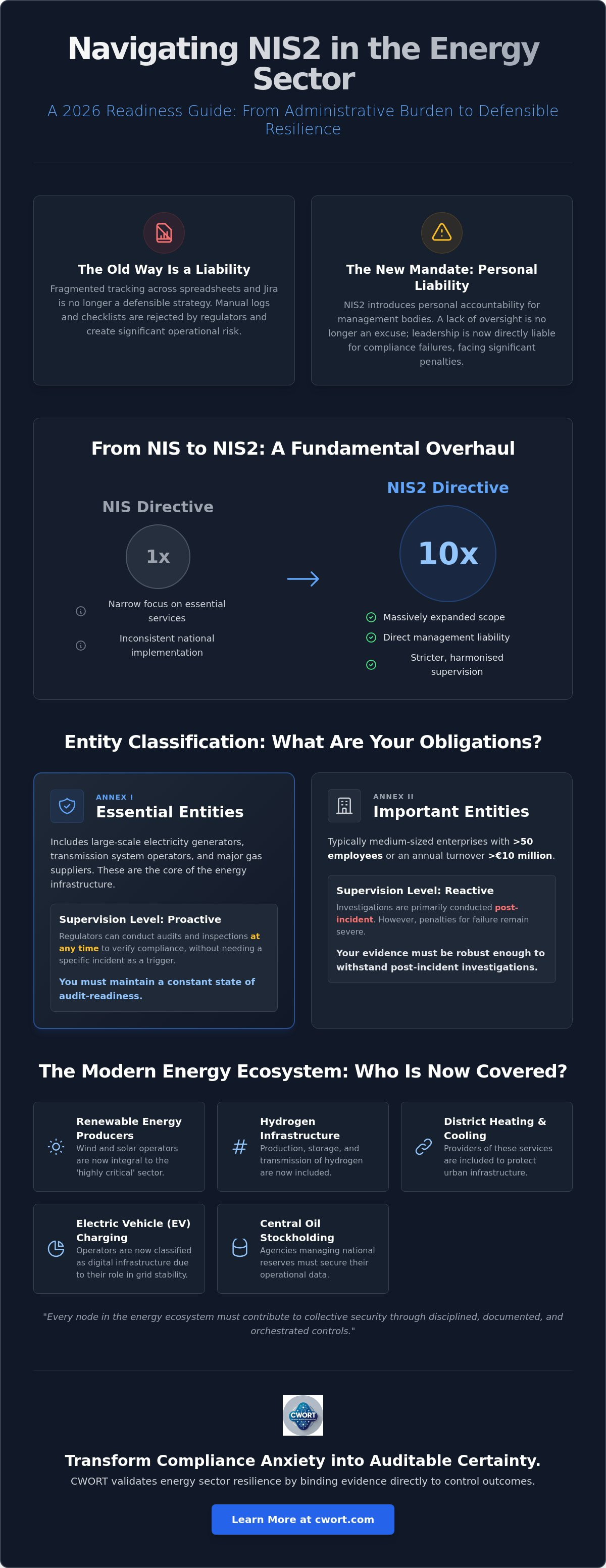
In 2026, a spreadsheet is no longer a shield; it's a liability. For leadership teams navigating NIS2 compliance for the energy sector, the era of administrative box-ticking has ended, replaced by a regime where personal accountability is the new baseline. You are likely struggling with fragmented tracking across Excel and Jira whilst trying to secure legacy OT systems that were never designed for this level of regulatory scrutiny. The fear of personal liability for management bodies isn't just a theoretical risk; it's a pressing operational reality that demands a shift in strategy.
We recognise that the pressure to produce auditable proof without manual reconstruction is immense. This article promises to show you how the energy sector is transitioning from static checklists to dynamic, validated compliance orchestration. We will preview the critical 2026 strategic trends, providing a clear roadmap to help you enforce discipline across your infrastructure and replace regulatory anxiety with the calm of evidence-based certainty. You'll learn exactly how to transform your compliance posture into a defensible, resilient asset that stands up to the most rigorous audits.
Key Takeaways
- Understand the shift from NIS to NIS2 and how the distinction between Essential and Important entities dictates your specific regulatory obligations and audit frequency.
- Identify why traditional IT security tools fail in SCADA environments and how to manage cyber risk across increasingly interconnected energy infrastructure.
- Discover why regulators now reject manual logs and how to transition to NIS2 compliance for energy sector orchestration to ensure absolute data integrity.
- Master the legal requirements of Article 21 to build a defensible framework for managing third-party risks within your energy supply chain.
- Learn how to bind evidence directly to control outcomes, producing a state of auditable certainty that addresses board-level accountability and personal liability.
Table of Contents
- Understanding the Expanded Scope of NIS2 within the Energy Sector
- The Convergence of IT and OT: Managing Cybersecurity Risk in Energy Infrastructure
- Beyond the Spreadsheet: The Shift Towards Compliance Orchestration
- Securing the Energy Supply Chain: Meeting Article 21 Obligations
- Orchestrating Auditable Proof: How CWORT Validates Energy Sector Resilience
Understanding the Expanded Scope of NIS2 within the Energy Sector
The transition from the original NIS Directive to its successor represents a fundamental shift in European cybersecurity policy. Whilst the initial framework focused on a narrow group of operators of essential services, the NIS2 Directive expands this reach tenfold. This expansion is not merely a matter of scale; it's a strategic overhaul of how the energy value chain is protected. For many organisations, achieving NIS2 compliance for energy sector operations is now a legal prerequisite for continued market participation. The year 2026 stands as the definitive threshold for mature implementation. With national transpositions complete and supervisory authorities beginning active inspections, the grace period for "planning" has officially ended. Organisations must now demonstrate active, validated resilience.
Essential vs Important Entities: Where Do You Sit?
Identify your classification immediately to determine your level of regulatory scrutiny. The directive categorises organisations into two tiers based on their criticality and size. Essential entities, listed in Annex I, include large-scale electricity generators, transmission system operators, and major gas suppliers. These firms are subject to proactive supervision, meaning regulators can conduct audits at any time to verify compliance. Important entities, found in Annex II, typically include medium-sized enterprises with more than 50 employees or an annual turnover exceeding €10 million. Whilst these entities face reactive supervision, the penalties for failure remain severe. The distinction is critical. Essential entities must maintain a constant state of audit-readiness, whilst Important entities must ensure their evidence is robust enough to withstand post-incident investigations.
New Sub-sectors Under the NIS2 Umbrella
The scope now extends far beyond traditional power grids and fossil fuel providers. The directive recognises that the modern energy landscape is decentralised and digitally dependent. Specific requirements now apply to:
- Renewable Energy Producers: Wind and solar operators are now integral to the "highly critical" sector.
- Hydrogen Infrastructure: Entities involved in the production, storage, and transmission of hydrogen must meet the same rigorous standards as traditional gas providers.
- District Heating and Cooling: Providers of these services are included to protect urban infrastructure.
- Electric Vehicle (EV) Charging: Operators of charging stations are now classified as digital infrastructure, reflecting their role in grid stability.
- Central Oil Stockholding: Agencies responsible for national reserves are now mandated to secure their operational data.
Establish a clear understanding of these boundaries now. Failure to recognise your status under the new sub-sector definitions does not grant immunity from enforcement. By 2026, the expectation is clear: every node in the energy ecosystem must contribute to collective security through disciplined, documented, and orchestrated controls.
The Convergence of IT and OT: Managing Cybersecurity Risk in Energy Infrastructure
The air-gap is a myth. Modern energy grids rely on the seamless flow of data between back-office IT and field-deployed Operational Technology (OT). This interconnectedness is the primary driver for NIS2 compliance for energy sector entities. Under Article 21, organisations must implement "state-of-the-art" security measures. This isn't a suggestion; it's a mandate to align digital protection with the physical reality of energy distribution. Traditional IT security tools, designed for high-frequency updates and aggressive scanning, often fail in SCADA environments. They risk triggering safety shutdowns or corrupting sensitive industrial protocols. Achieving resilience requires a specialised approach that respects the delicate nature of industrial control systems whilst maintaining rigorous oversight.
Securing Industrial Control Systems (ICS) and SCADA
Maintaining 24/7 availability whilst addressing vulnerabilities in legacy systems is a complex balancing act. You can't simply take a national grid offline for a patch cycle. Strategic network segmentation and "zero trust" architectures are essential. These frameworks isolate critical control loops from general business traffic, ensuring that a breach in one area doesn't lead to a systemic failure. The challenge lies in validation. You must prove that your OT-specific controls are performing as intended without disrupting the flow of electrons. Many forward-thinking firms use orchestrated validation platforms to automate this evidence gathering, replacing manual guesswork with definitive technical proof that satisfies both auditors and engineers.
Risk Management Measures for Energy Resilience
NIS2 mandates a multi-stage incident reporting timeline that leaves no room for hesitation. You must submit an early warning within 24 hours of becoming aware of a significant incident, followed by a detailed notification within 72 hours. This requires a robust crisis management framework that bridges the gap between the control room and the boardroom. Speed is critical. Beyond reporting, the directive emphasises the protection of data at the edge. Smart meter data, which provides granular insight into grid behaviour, must be secured via robust cryptography and encryption. This ensures that the transition to decentralised energy resources (DERs) doesn't introduce unmanageable risk into the core infrastructure. Continuous monitoring is the only way to maintain this state of readiness across a distributed and diverse asset base.
Execution must be disciplined. As energy infrastructure becomes more software-defined, the distinction between a technical glitch and a cyber-attack blurs. Your risk management strategy must account for this ambiguity by design. By 2026, the ability to orchestrate these controls and provide real-time proof of their efficacy will be the hallmark of a compliant and resilient energy provider. This shift from reactive patching to proactive validation is the only way to meet the stringent requirements of the NIS2 compliance for energy sector framework.
Beyond the Spreadsheet: The Shift Towards Compliance Orchestration
Stop relying on static documents to defend your infrastructure. For years, the energy industry has treated regulatory adherence as an administrative exercise, often relegated to disconnected Excel sheets or Jira tickets. This approach is no longer viable. Achieving NIS2 compliance for energy sector operations requires more than a digital paper trail; it demands a transition from manual tracking to orchestrated validation. In 2026, the focus has shifted from "what" you have implemented to "how" you can prove it functioned at a specific point in time. This move towards orchestration ensures that security is an active, enforceable process rather than a passive record.
Why Manual Trackers Fail the Audit Test
Spreadsheets are static. They provide no proof of execution and lack the inherent integrity required for high-stakes audits. When a regulator requests evidence of a control, relying on manual logs often leads to a "reconstruction nightmare." Teams spend weeks or months attempting to retroactively gather proof, often discovering gaps that are impossible to fill after the fact. Consider these critical failures of manual systems:
- Integrity Risks: Manual entries lack non-repudiation. Auditors in 2026 increasingly reject evidence that can be edited without a verifiable audit trail.
- Visibility Blind Spots: Fragmented tools create silos. When IT controls are in Jira and OT controls are in a spreadsheet, leadership loses the ability to see systemic risks across the supply chain.
- Lack of Separation of Duties (SoD): NIS2 emphasises SoD as a core requirement. Manual trackers often fail to enforce the boundary between the individual performing a task and the one validating its success.
The Rise of Compliance Orchestration Platforms
Replace administrative overhead with systematic rigour. Compliance orchestration platforms function as the strategic engine for your security framework, binding evidence directly to control outcomes. Instead of asking a technician if a patch was applied, an orchestrated system captures the technical proof automatically and links it to the specific NIS2 requirement. This creates a state of perpetual audit-readiness. For those seeking a structured execution model, a NIS2 compliance platform UK provides the necessary framework to translate abstract obligations into concrete evidence. These platforms enforce accountability by design, ensuring that every required action is tracked, validated, and archived with total integrity.
Move beyond the limitations of legacy tracking. By adopting an orchestrated approach, energy firms can eliminate the anxiety of "the unknown" and replace it with the calm of auditable certainty. By 2026, the distinction between leaders and laggards is defined by their ability to produce defensible truth on demand. Orchestration isn't just a technical upgrade; it's a fundamental requirement for professional maturity in a regulated landscape.
Securing the Energy Supply Chain: Meeting Article 21 Obligations
Liability now flows upstream. Article 21 of the directive mandates that organisations manage the cybersecurity risks within their supply chains. For those tasked with NIS2 compliance for energy sector infrastructure, this means you are now legally responsible for the security posture of your vendors. A breach at a third-party software provider or a hardware manufacturer is no longer their problem alone; it's yours. You must demonstrate that you've evaluated the security practices of every direct supplier and service provider. This strategic shift transforms procurement from a commercial negotiation into a critical security function.
Supply Chain Risk Assessments in Practice
Evaluating managed service providers (MSPs) and hardware vendors requires a disciplined approach. You must move beyond surface-level reviews and map the specific vulnerabilities of hardware components within the grid. Standardising security requirements in procurement contracts is the first step toward building a defensible framework. To establish a rigorous and repeatable process, follow these five essential steps:
- Inventory Criticality: Identify every supplier with access to your IT or OT environments.
- Benchmark Maturity: Use the NCSC CAF assessment software to establish a baseline for supplier resilience.
- Contractual Enforcement: Embed specific NIS2 obligations into all new and existing vendor agreements.
- Continuous Monitoring: Shift from annual reviews to real-time oversight of third-party access.
- Incident Alignment: Ensure suppliers are capable of meeting the strict multi-stage reporting timelines.
Validating Third-Party Evidence
Stop trusting self-assessment questionnaires. They lack the integrity required for a NIS2 audit. By 2026, regulators expect to see validated proof of controls. This means your suppliers must be able to produce auditable evidence that their security measures are functioning as claimed. For small-scale technology vendors serving the energy sector, this requirement creates a significant barrier to entry, but it's a non-negotiable standard for energy resilience. You must ensure that your third-party risk management (TPRM) process includes the ability to verify evidence in real-time. Relying on "good faith" is a regulatory failure in the making.
Achieving NIS2 compliance for energy sector resilience depends on the weakest link in your chain. If you can't validate your suppliers' security, you can't protect your own. The convergence of IT and OT makes every connected vendor a potential entry point for systemic failure. To see how to automate these validations and secure your entire ecosystem, request a demo of our orchestration platform today. We help you move from abstract requirements to a state of total, defensible assurance across your entire energy supply chain.
Orchestrating Auditable Proof: How CWORT Validates Energy Sector Resilience
Execution is the only measure of success. Whilst previous sections have outlined the regulatory burden and the technical complexities of IT/OT convergence, the final challenge remains: providing definitive, technical proof that your controls are functioning as intended. CWORT serves as the strategic engine for NIS2 compliance for energy sector operators, moving beyond the limitations of manual tracking to create a state of validated reality. It is not enough to claim resilience; you must be able to demonstrate it through a disciplined, orchestrated framework that binds evidence directly to specific control outcomes.
Automating the Evidence Lifecycle
Replace fragmented administrative tools with a single, authoritative system of record. CWORT eliminates the reliance on Jira tickets and Excel spreadsheets, which frequently fail to provide the non-repudiation required by modern auditors. By automating the evidence lifecycle, the platform ensures that every technical validation is captured, timestamped, and archived with total integrity. This process creates a "defensible truth" that survives the most rigorous regulatory scrutiny from both UK NIS and EU NIS2 authorities. Consider how orchestration transforms your audit readiness:
- Evidence Binding: Automatically link technical proof from your grid infrastructure directly to Annex I and Annex II requirements.
- Enforced Separation of Duties: Prevent "mark-your-own-homework" scenarios by ensuring that the individual performing a security task is never the one validating its success.
- Continuous Verification: Shift from periodic checks to a constant stream of validated data that reflects your actual security posture in real-time.
Board-Level Visibility and Governance
Translate technical rigour into strategic assurance. CWORT provides real-time dashboards that offer leadership bodies a clear view of control effectiveness across the entire enterprise. This visibility is essential for management bodies who now face direct personal liability for cybersecurity oversights. By using an orchestrated approach, you reduce the cost of compliance whilst simultaneously increasing the level of security across your distributed energy resources. You no longer need to spend months preparing for a regulator visit; the proof is always ready, always accurate, and always defensible.
Professional maturity in 2026 requires a shift from obligation to evidence. Stop managing your compliance through a lens of anxiety and start leading with the calm of auditable certainty. The path to a resilient, compliant energy infrastructure is built on disciplined execution and transparent validation. To see how your organisation can achieve total oversight and meet every stringent requirement, book a CWORT demonstration to see validated execution in action. Transform your compliance posture from a reactive burden into a proactive, strategic advantage today.
Securing the Future of European Energy Infrastructure
The regulatory landscape for 2026 is uncompromising. You've seen how the expanded scope of the directive now encompasses everything from hydrogen production to EV charging. Achieving NIS2 compliance for energy sector resilience is no longer about maintaining a static list of policies. It requires the seamless integration of IT and OT security with a robust, defensible supply chain framework. By moving beyond the limitations of manual spreadsheets, you eliminate the risk of evidence tampering and ensure that your organisation is perpetually audit-ready. This shift from administrative tracking to validated orchestration is the only way to meet the professional standards expected of essential entities.
Transitioning to a state of total assurance doesn't have to be a reconstruction nightmare. CWORT is specifically designed for NIS2 and DORA validation, providing a strategic engine that replaces fragmented Jira and Excel tracking with definitive proof. Leveraging our UK-based expertise in NCSC CAF and NIS frameworks, we help you bind evidence directly to control outcomes with total integrity. Orchestrate your NIS2 compliance with CWORT today and replace regulatory anxiety with the calm of auditable certainty. You have the tools to lead your organisation toward a more secure and resilient future.
Frequently Asked Questions
What are the specific energy sub-sectors covered by NIS2?
The directive covers a comprehensive range of sub-sectors including electricity generation, transmission, and distribution. It also encompasses oil production and storage, gas supply, and hydrogen infrastructure. Additionally, district heating providers and electric vehicle (EV) charging station operators are now classified as essential or important entities. This expanded scope ensures that every critical node in the energy value chain maintains a baseline of cyber resilience.
How does NIS2 differ from the original NIS Directive for energy firms?
NIS2 significantly expands the number of covered entities and introduces much stricter enforcement mechanisms. It replaces the "Operator of Essential Services" designation with a binary "Essential" or "Important" tiering system. The new directive also mandates a multi-stage incident reporting timeline and places direct legal accountability on management boards. Achieving NIS2 compliance for energy sector operations now requires validated evidence rather than simple policy documentation.
What are the penalties for non-compliance with NIS2 in the energy sector?
Essential entities face administrative fines of up to €10 million or 2% of their total global annual turnover, whichever is higher. Important entities are subject to fines of up to €7 million or 1.4% of global turnover. Beyond financial penalties, national authorities have the power to issue binding instructions and audit mandates. In cases of persistent failure, regulators can even suspend certification or temporarily ban executives from management roles.
Does NIS2 require personal liability for energy sector executives?
Yes, Article 20 explicitly makes management bodies responsible for approving and overseeing cybersecurity risk-management measures. Executives can be held personally liable if they fail to exercise their duty of care in protecting the organisation. National competent authorities have the power to hold individual board members accountable for non-compliance. This ensures that cybersecurity is treated as a core governance issue rather than a peripheral technical concern.
How does the NCSC CAF framework map to NIS2 requirements?
The Cyber Assessment Framework (CAF) provides a structured set of 14 principles that align closely with the risk management mandates of NIS2. It offers a clear methodology for energy firms to assess their resilience across four key objectives: managing security risk, protecting against cyber attack, detecting cyber events, and minimising impact. Using the CAF allows UK-based firms to produce the granular evidence required to demonstrate NIS2 compliance for energy sector standards.
What is the deadline for energy companies to achieve NIS2 compliance?
The formal deadline for EU member states to transpose NIS2 into national law was 17 October 2024. By 2026, most national legislative processes are complete and enforcement activities are in full effect. Organisations must already have their incident response frameworks and supply chain security measures operational. Any entity currently lacking a validated compliance roadmap is at immediate risk of regulatory intervention and significant administrative fines.
How does NIS2 impact renewable energy companies specifically?
Renewable energy producers, including wind and solar operators, are now classified as "highly critical" entities if they meet the size-cap thresholds. They must implement the same level of security orchestration and incident reporting as traditional utilities. This inclusion reflects the vital role renewables play in modern grid stability. These firms must now validate the security of their distributed energy resources and ensure their OT environments are protected against systemic disruption.
Can we use ISO 27001 to satisfy all NIS2 energy sector requirements?
ISO 27001 is an excellent foundation for an Information Security Management System, but it is not a complete solution for NIS2. The directive includes specific mandates that ISO 27001 doesn't cover, such as the strict 24-hour incident reporting window and direct executive liability. Energy firms must supplement their ISO controls with specialised orchestration tools. These tools bind technical evidence to the specific legal requirements of the directive to ensure a state of auditable certainty.
Disclaimer
The content on this site is provided for general information and educational purposes only. It does not constitute legal, regulatory, financial, or professional advice. CWORT provides AI-assisted insights and workflow automation, but all compliance decisions remain the responsibility of your organisation and its management. Always seek qualified legal or regulatory guidance for decisions relating to the UK NIS Regulations, CAF, DORA, NIS2, ISO 27001, or other obligations.
Related posts
UK NIS Audit Readiness Tool: Orchestrating Compliance for 2026
Master your 2026 audit with our guide to UK NIS compliance orchestration. Move from fragmented evidence to a single source of truth for NCSC CAF 4.0 readiness.
Common NIS2 Compliance Mistakes: A Strategic Guide to Avoiding Audit Failure in 2026
Avoid costly NIS2 audit failure in 2026. This guide reveals common NIS2 compliance mistakes and shows how to build a defensible, audit-ready strategy.
NIS2 Audit Readiness Tool: Orchestrating Evidence-Based Validation for 2026
Ditch spreadsheets for the 2026 audit. A NIS2 audit readiness tool provides orchestrated, evidence-based validation for total compliance certainty.
Article by
Michael Iyiola
Co-Founder, CWORT
Michael Iyiola is a co-founder of CWORT and a Cyber and AI Security Engineer with deep experience in vulnerability management, detection engineering and operational resilience across UK critical national infrastructure, including rail, energy and financial services. At CWORT, he designs scalable, evidence-driven workflows that help teams meet modern regulatory and security demands.
Build Your Foundation of Auditable Certainty
Take control of your regulatory obligations and secure your infrastructure with CWORT.