NIS2 Gap Analysis: A Practical Guide for 2026

Michael Iyiola
Co-Founder, CWORT
Learn how to conduct a NIS2 gap analysis for 2026. Assess applicability, map controls to evidence, and build an auditable cyber remediation roadmap today.

A signed policy isn’t proof that a control works. When evidence is spread across teams, documents and operational tools, how to conduct a NIS2 gap analysis becomes a practical governance question: can you show which obligations apply, how controls operate and who owns each weakness?
NIS2 doesn’t automatically apply to every UK organisation. It is a directive implemented through national laws across EU member states, so organisations need to distinguish potential NIS2 obligations from UK NIS requirements and establish which rules are relevant to their activities and jurisdictions. Then they need to test more than documentation: a control may be recorded but not operating consistently.
This guide explains how to assess applicability, map requirements to controls and validate findings against evidence. It covers how to identify gaps, assign accountable owners, prioritise remediation and create a repeatable, auditable improvement plan for governance and audit discussions.
Rather than relying on disconnected trackers or broad maturity scores, connect each assessment result to supporting evidence and a defined next action. That gives teams a clearer view of readiness and control-level detail for turning NIS2 gaps into owned, evidenced remediation.
Key Takeaways
- Establish which requirements apply and define the entities, services, systems, dependencies and jurisdictions in scope before assessing controls.
- To understand how to conduct a NIS2 gap analysis, map obligations to controls, then assess documents, implementation records and evidence of controls operating in practice.
- Choose a checklist, facilitated workshop or governed workflow according to assessment complexity and assurance needs. Combine methods where useful.
- Turn validated findings into prioritised actions with accountable owners, dependencies and review points. Record why each action was prioritised.
- Use evidence-linked control mapping and repeatable tracking to produce outputs that support remediation, governance and audit discussions.
Table of Contents
- How to Conduct a NIS2 Gap Analysis: Define Scope Before Testing Controls
- Build a NIS2 Assessment Method: Map Requirements to Controls and Evidence
- Prioritise NIS2 Gaps: Compare Checklists, Workshops and Governed Workflows
- Turn NIS2 Findings into a Remediation Plan with Owners and Evidence
- Operationalise NIS2 Gap Analysis with a Governed, Evidence-Led Workflow
How to Conduct a NIS2 Gap Analysis: Define Scope Before Testing Controls
A NIS2 gap analysis compares the requirements that apply to an organisation with its current, evidenced practices. It should establish not only which controls are expected, but where they operate, who is responsible and what evidence demonstrates their operation.
Set the boundary before scoring controls. Otherwise, teams may assess the wrong legal entity, overlook a service dependency or assign a maturity rating to a control outside the agreed assessment. Scope determines which obligations and evidence are relevant, giving decision-makers a sound basis for interpreting findings.
The EU NIS2 Directive is implemented through national laws, so applicability and detailed obligations depend on the relevant jurisdiction. It does not automatically apply to every UK organisation. UK NIS requirements are a separate regime. If an organisation operates across borders, assess the relevant regimes and entities separately rather than assuming one replaces the other. The NIS2 Directive Wikipedia overview provides background; use current official sources to verify applicable national legislation and entity classification.
How to determine whether NIS2 is relevant to your organisation
Build an applicability record before testing controls. Capture the organisation’s locations, services, sector and relevant group entities. Identify where services are delivered and which entities provide or support them, then check classification against current official sources for each relevant jurisdiction. Record the source and date reviewed so the decision can be revisited if the organisation or legislation changes.
Flag cross-border operations and significant supply-chain relationships for review. A service delivered by one group company may rely on systems, staff or third parties elsewhere. Record these connections, but distinguish a relationship that needs assessment from a confirmed legal obligation. Escalate unresolved applicability questions to the appropriate internal decision-makers rather than hiding them within control scores.
Set practical boundaries for the NIS2 assessment
Translate the applicability record into an operational boundary. Name the business units, services, systems and third parties included, and explain how shared platforms or group functions will be treated. For example, if a service relies on a centrally managed identity system, record whether that system is in scope and which team will provide evidence about it.
Agree who will lead the assessment, contribute evidence and make decisions about findings. Include people who understand both governance and day-to-day operations: a policy owner can explain intent, while a service or system owner can show how a process works in practice. Document exclusions, assumptions and unresolved applicability questions separately from findings, with a rationale and an owner for review.
A documented control describes what should happen; operational evidence shows whether it happens in practice. Keep that distinction visible from the outset. A policy may establish design intent, but it cannot demonstrate that a process is followed consistently. Clear scope makes the next stage of how to conduct a NIS2 gap analysis more precise: map relevant requirements, then assess controls against evidence tied to the agreed boundary.
Build a NIS2 Assessment Method: Map Requirements to Controls and Evidence
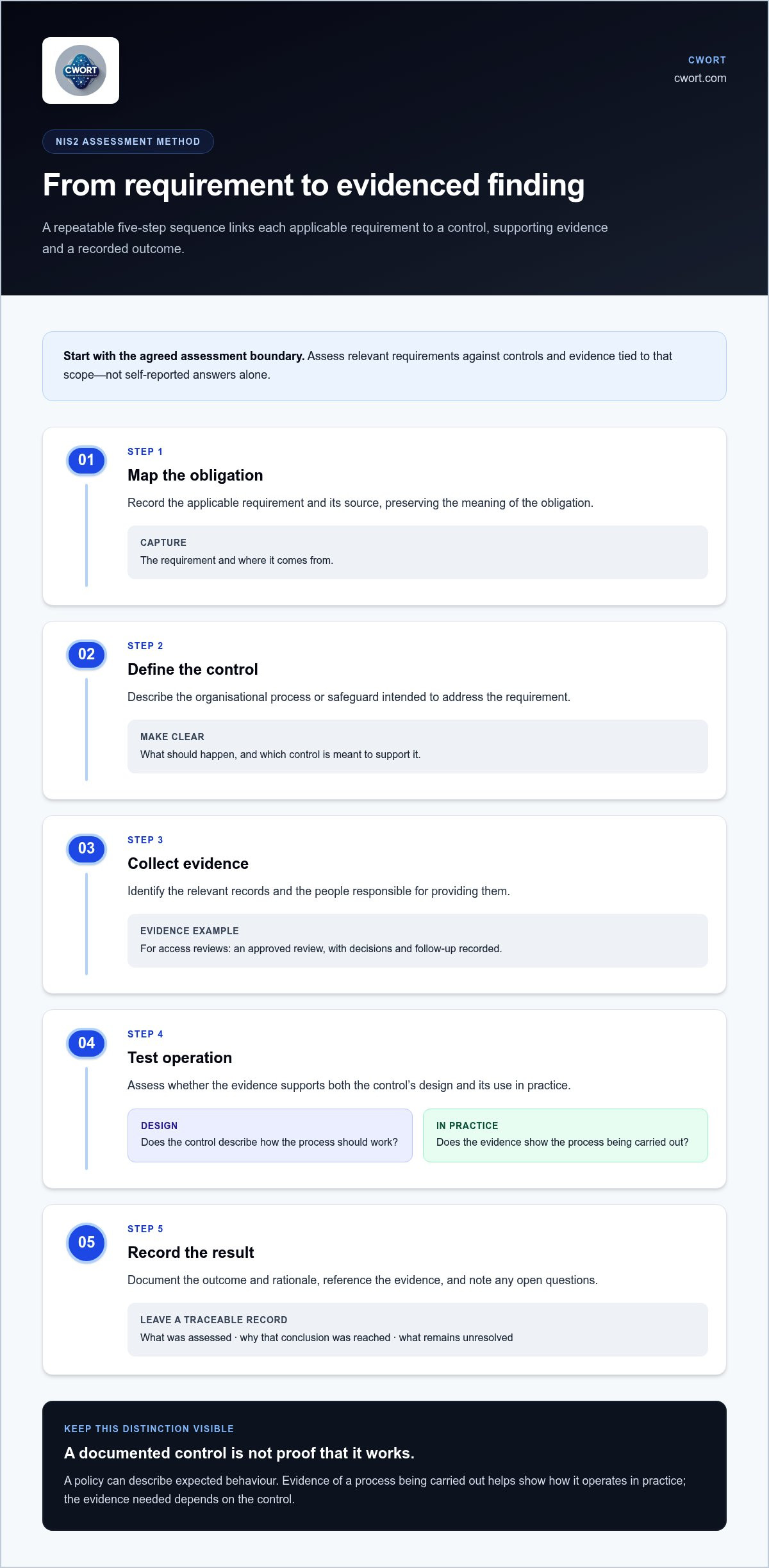
Once the assessment boundary is set, build a repeatable method that connects each applicable requirement to a control, its evidence and a recorded outcome. This makes findings traceable: reviewers can see what was assessed, who was accountable and why a conclusion was reached. A questionnaire or workshop can help gather information, but self-reported answers alone don’t establish that a control works.
Use the same sequence for each requirement:
- Map the obligation. Record the applicable requirement and its source, preserving its meaning.
- Define the control. Describe the organisational process or safeguard intended to address it.
- Collect evidence. Identify relevant records and the people responsible for providing them.
- Test operation. Assess whether the evidence supports both the control’s design and its use in practice.
- Record the result. Document the outcome, rationale, evidence references and open questions.
A control assertion is a claim about what should happen; it is not proof that the control operates effectively. For example, an access policy describes expected behaviour. An approved access review, with a record of decisions and follow-up, can help show how the process was carried out. The evidence needed depends on the control being assessed.
Map NIS2 requirements to accountable controls
Create a traceable link from each in-scope requirement to one or more controls, then assign an accountable owner and relevant operational contributors. A shared control, such as a group-wide process, may support several requirements. Preserve each requirement’s coverage in the record so one broad control description is not treated as proof that every related obligation is addressed.
If a control depends on another team or supplier, record the dependency and who will obtain or validate its evidence. Keep accountability clear even when delivery is shared.
Collect and evaluate evidence consistently
Evidence may include policies, implementation records, technical records, test results, incident processes and approved operational records. Assess each item for currency, scope, provenance and relevance. A procedure from the wrong business unit, or a record that predates a system change, may not support the control being tested.
Separate three evidence types: policy documents show intent; implementation records show that a measure was put in place; operating evidence indicates how it functioned. Record an evidence gap when material is missing, a control failure when evidence shows the measure did not meet its intended outcome, and an unresolved question when the available information is inconclusive.
For each control, use consistent fields: owner, requirement reference, evidence source, assessment date, result and rationale. Add evidence dates or identifiers so another reviewer can locate the material and understand the conclusion without relying on undocumented assumptions. CWORT’s evidence-linked assessment workflow connects records and outcomes across an assessment.
Prioritise NIS2 Gaps: Compare Checklists, Workshops and Governed Workflows
Assessment format affects what you can conclude and what happens next. A checklist can expose unanswered questions quickly. A workshop can surface context and resolve different interpretations. A governed workflow can preserve evidence, decisions, ownership and progress as work continues. These approaches can complement one another; select and combine them according to scope, organisational maturity, complexity and assurance needs.
Prioritisation should be reasoned, not reduced to an invented universal score. For each validated gap, consider potential impact and exposure, dependencies on other controls or teams, effort to address and business priority. A weakness affecting a critical service, for instance, may need attention before a lower-impact documentation improvement, especially if other remediation depends on it. Record why the order was chosen so decision-makers can challenge or revisit it.
What a checklist can and cannot establish
Use a checklist to structure coverage, flag missing topics and identify where deeper examination is needed. It works well as an initial screen or preparation tool, helping teams organise questions before a workshop or evidence review. It cannot, by itself, establish that a control is implemented or operating effectively.
A “yes” answer without supporting evidence is an assertion, not a validated result. Likewise, a broad maturity claim can conceal differences between teams, services or systems. Treat checklist responses as leads for verification, then examine relevant evidence and record the basis for each conclusion.
When to use a workshop or governed workflow
A facilitated workshop is useful when stakeholders need to agree scope, explain how processes work or resolve differing interpretations. It can reveal dependencies that a written response misses. Record its findings clearly and assign follow-up actions so they remain useful after participants leave.
A governed workflow is suited to repeatable assessment and ongoing remediation. It keeps control outcomes connected to evidence, decisions, responsible owners and action status, making changes easier to review over time. CWORT links assessment and remediation information in a governed workflow, rather than leaving it in disconnected trackers.
Fast screening helps find questions; repeatable assurance depends on traceable evidence, recorded decisions and follow-through. Use a checklist to identify areas of concern, convene a workshop to resolve material uncertainties, then carry confirmed findings into a governed process. This gives each method a defined role instead of expecting one format to do everything.
As you decide how to conduct a NIS2 gap analysis, make the prioritisation record useful to delivery teams and governance. Capture the gap, its evidence basis, impact and exposure, dependencies, effort considerations, business priority, owner and decision rationale. Revisit priorities when assumptions, evidence or operational conditions change. See how CWORT supports evidence-linked assessment and remediation tracking.
Turn NIS2 Findings into a Remediation Plan with Owners and Evidence
A gap becomes manageable when it is converted into a decision and an owned action. For each validated finding, record the control affected, evidence behind the conclusion, reason for the priority, accountable owner, dependencies and a target review point. Define the evidence needed to close the action before work starts. Otherwise, a status marked “complete” may show progress without demonstrating that the control now works.
Keep the plan useful for delivery and governance. An action record should make clear what will change, who will deliver it, who will validate the outcome and how the decision will be reviewed. Distinguish immediate risk treatment, which addresses current exposure, from longer-term capability improvements, which strengthen processes over time. Both matter, but they may need different decision-makers and review points.
Sequence actions without losing risk context
Group findings when they share a root cause or depend on the same change, such as several weaknesses arising from unclear process ownership. Keep each affected control visible within the grouped work so the relationship between action and finding remains traceable. Make prioritisation criteria clear to risk owners and governance decision-makers, including impact, exposure, dependencies, effort and business priorities.
If an action is delayed, constrained or not taken, record the rationale and accountable approval. An accepted risk should not disappear from the plan: retain its decision history, owner and review point so it can be reconsidered if circumstances change.
Validate remediation and schedule reassessment
Agree closure evidence in advance. Depending on the control, this might include an approved procedure, implementation records and evidence of operation. A configuration change can demonstrate implementation, for example, but may not show that the revised process is followed consistently. Validate the evidence against the original finding before marking it resolved.
Retest affected controls after material changes, relevant incidents or agreed remediation milestones. Preserve the link between the original assessment, action, submitted evidence, validation decision and revised outcome. A defensible evidence history lets reviewers understand what changed, when it changed and why the finding was closed, rather than relying on a series of status updates.
Use status reporting to show what requires attention, not simply to count completed actions. Include open gaps, accountable owners, evidence state, dependencies and overdue decisions. This gives leaders a clear view of delivery barriers and outstanding risk, while giving control owners a practical basis for follow-up.
To strengthen how to conduct a NIS2 gap analysis, treat closure as a validation decision, not an administrative milestone. CWORT links evidence to control outcomes and tracks remediation through repeatable assessment workflows, supporting a traceable record from finding to action and review. Explore CWORT’s evidence-linked remediation tracking.
Operationalise NIS2 Gap Analysis with a Governed, Evidence-Led Workflow
A point-in-time assessment shows what was found; a governed workflow helps maintain that view as controls, evidence and remediation change. Choose an approach that preserves control mapping, evidence traceability, accountable ownership, role separation, action tracking and repeatable assessment. Without these foundations, findings can become disconnected records, making it difficult to tell whether a weakness has been resolved or simply marked complete.
CWORT provides a platform for mapping controls to frameworks, linking evidence to control outcomes and tracking remediation. Its control taxonomy contains 1,355 controls across 217 domains linked to 42 frameworks and standards, and 98.6% of active controls have framework references, as of June 2026. This supports a structured view across frameworks while retaining control-level detail for assessment and follow-up.
What a governed NIS2 workflow should preserve
Keep each control’s status, accountable owner and evidence references connected to its assessment history. Immutable audit history preserves a record of changes and decisions, rather than leaving teams to reconstruct the sequence from separate trackers. Role-based and attribute-based access, alongside separation of duties, supports defined responsibilities for contributors, reviewers and decision-makers.
Assessment outcomes should also be reproducible. CWORT’s AI advisory can provide suggestions, but it does not alter deterministic assessment results. This keeps recommendations separate from recorded outcomes, so reviewers can understand what was assessed and on what basis.
Move from assessment findings to a repeatable assurance cycle
Operationalise the process as a cycle: assess controls against evidence, record validated findings, track remediation, review closure evidence and reassess when changes or agreed milestones make it appropriate. Keep the relationship between each requirement, control outcome and action intact. That continuity helps teams report progress to leadership without losing the detail needed to examine an individual control.
This is the practical value of workflow automation for regulatory compliance: it connects work that might otherwise be spread across spreadsheets, documents and operational tools. Use the same governed process to maintain evidence, make decisions visible and prepare consistent assurance outputs, while retaining human accountability for assessment and remediation decisions.
If you’re evaluating how to conduct a NIS2 gap analysis as a repeatable governance process, focus on whether the workflow preserves traceability from requirement to evidence, finding, action and reassessment. Explore how CWORT supports evidence-linked assessment and remediation tracking.
Make Your Next Assessment a Stronger Assurance Cycle
Make the assessment a repeatable management discipline, not a one-off exercise. Set a review cadence, keep decision-making accountable and use changes in evidence or operations to trigger reassessment. This helps leaders see whether remediation is advancing and where attention is still needed.
As you determine how to conduct a NIS2 gap analysis, prioritise a process that preserves evidence-to-control links, maintains an immutable history and separates assessment responsibilities. CWORT supports deterministic assessment results with separation-of-duties controls, helping teams maintain a clear record as findings move into remediation and review.
Request a CWORT demonstration to explore how an evidence-led workflow can support your assessment and assurance process. Build from clear decisions, strengthen accountability and move forward with greater confidence.
Frequently Asked Questions
What is a NIS2 gap analysis?
A NIS2 gap analysis is a structured assessment of how an organisation’s current cyber security arrangements compare with the requirements that apply to it. Its purpose is to identify and explain areas needing attention, not to award a certification. For example, the analysis might find that a process exists but isn’t consistently followed across business units. A useful output helps leaders understand the finding, its significance and the decision or action that should follow.
Does NIS2 apply to UK organisations?
It can be relevant to some UK organisations, but being based in the UK doesn’t by itself establish whether NIS2 applies. The Directive is implemented through national laws in EU member states, so assess the organisation’s activities, entities and relevant jurisdictions against current official sources. UK NIS is a separate regime. If a group operates in both the UK and EU, consider the applicable requirements for each relevant entity rather than assuming one regime covers all.
How do you start a NIS2 gap analysis?
Start by establishing which entities, services and jurisdictions need to be considered, then document the basis for that scope decision. To understand how to conduct a NIS2 gap analysis, identify applicable requirements before rating controls; otherwise, teams may assess irrelevant obligations or miss an in-scope activity. Name the decision-makers and subject-matter contributors, then agree how findings and supporting records will be captured. Keep unresolved scope questions visible until they’re addressed.
What evidence is needed for a NIS2 gap analysis?
Evidence should relate directly to the control being assessed and the part of the organisation in scope. For example, a sample of completed access approvals may help demonstrate how an access process operated, while a policy describes the intended process. Record where each item came from and the period it covers. Protect sensitive material, restrict access to appropriate people and avoid collecting more personal or confidential information than the assessment needs.
How often should an organisation repeat a NIS2 gap analysis?
Set a review schedule that reflects the organisation’s risk, operating environment and governance needs; don’t assume a single interval suits every organisation. Reassess relevant areas after material changes, such as a new service, a significant system change, an acquisition or an incident that alters the risk picture. A scheduled review can also help determine whether previous actions remain effective. Record why the chosen cadence is appropriate and who is responsible for initiating reviews.
Can a NIS2 gap analysis be completed with a checklist?
A checklist can help organise an initial review, especially when a team needs to identify unanswered questions or prepare for a more detailed assessment. Treat responses as screening indicators, not final evidence of control effectiveness. For instance, a “yes” may prompt a request for a current record or operational sample. Checklists are most useful when each response is tied to an owner, evidence request or follow-up decision.
What should a NIS2 gap analysis report include?
A report should let different readers act on the same assessment without losing important context. Include an executive view of material themes and decisions, alongside detailed findings that show the relevant requirement, control outcome, evidence references and assessment rationale. Distinguish confirmed gaps from open questions. A concise action register helps delivery teams follow progress, while an evidence index gives reviewers a route back to source material.
How do you prioritise NIS2 gaps?
Compare each validated gap’s potential impact and exposure with dependencies, remediation effort and business priorities. Consider whether one underlying weakness affects several services or blocks other corrective work. For example, a shared process issue may call for coordinated action across teams, while a finding with limited exposure may be scheduled differently. Document the reasoning and any accepted risk or constraint so accountable decision-makers can review priorities when circumstances change.
Disclaimer
The content on this site is provided for general information and educational purposes only. It does not constitute legal, regulatory, financial, or professional advice. CWORT provides AI-assisted insights and workflow automation, but all compliance decisions remain the responsibility of your organisation and its management. Always seek qualified legal or regulatory guidance for decisions relating to the UK NIS Regulations, CAF, DORA, NIS2, ISO 27001, or other obligations.
Related posts
Separation of Duties Compliance Software: Orchestrating Defensible Governance in 2026
Move beyond manual tracking. See how separation of duties compliance software orchestrates defensible governance and ensures you're ready for DORA & NIS2.
Common NIS2 Compliance Mistakes: A Strategic Guide to Avoiding Audit Failure in 2026
Avoid costly NIS2 audit failure in 2026. This guide reveals common NIS2 compliance mistakes and shows how to build a defensible, audit-ready strategy.
NIS2 Audit Readiness Tool: Orchestrating Evidence-Based Validation for 2026
Ditch spreadsheets for the 2026 audit. A NIS2 audit readiness tool provides orchestrated, evidence-based validation for total compliance certainty.
Article by
Michael Iyiola
Co-Founder, CWORT
Michael Iyiola is a co-founder of CWORT and a Cyber and AI Security Engineer with deep experience in vulnerability management, detection engineering and operational resilience across UK critical national infrastructure, including rail, energy and financial services. At CWORT, he designs scalable, evidence-driven workflows that help teams meet modern regulatory and security demands.
Build Your Foundation of Auditable Certainty
Take control of your regulatory obligations and secure your infrastructure with CWORT.