NIS2 management body accountability: who is responsible

Michael Iyiola
Co-Founder, CWORT
Learn who carries NIS2 management body accountability, what boards must approve and oversee, and how UK organisations can document decisions and evidence.

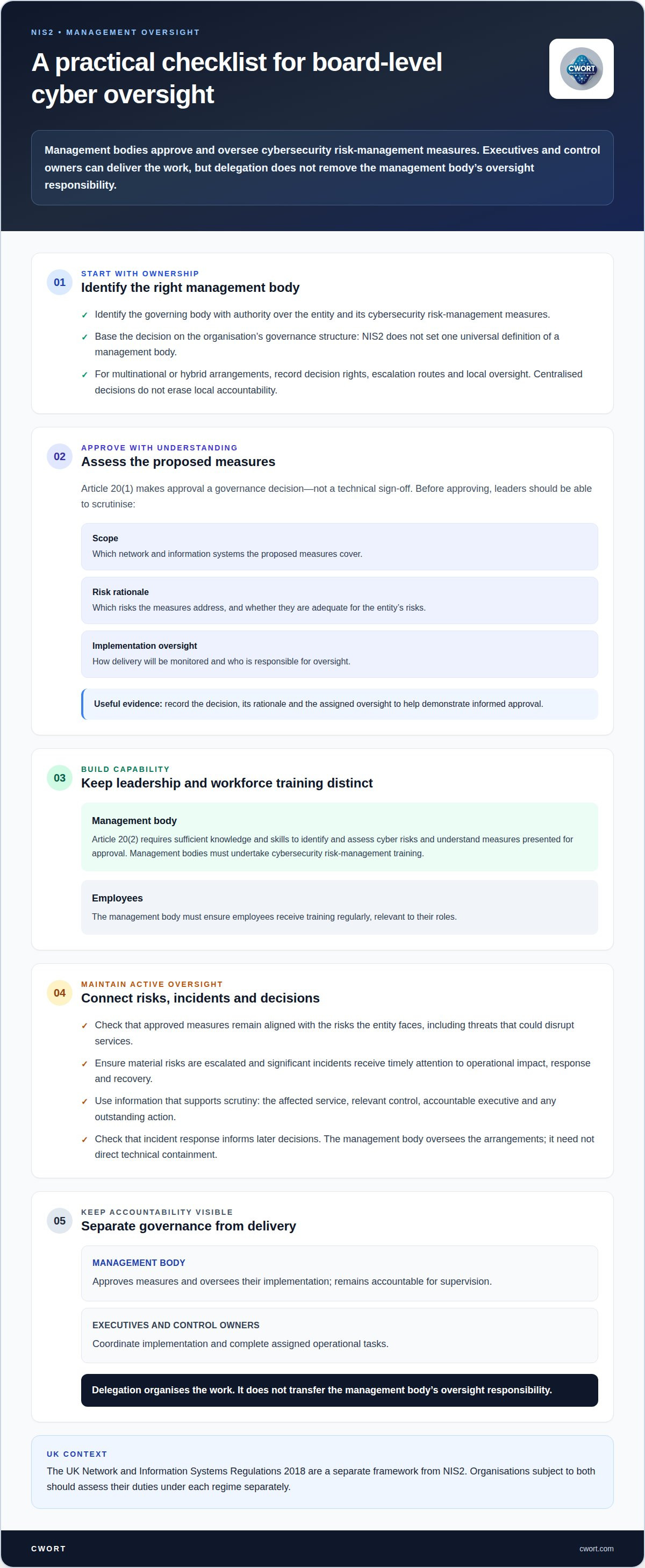
NIS2 puts cybersecurity oversight at board level. Under Article 20(1), management bodies of essential and important entities must approve and oversee the implementation of cybersecurity risk-management measures. NIS2 management body accountability therefore rests with the organisation’s senior governing body, even when executives delegate day-to-day control work.
That raises a practical question for UK organisations with NIS2 obligations: who counts as the management body when the Directive doesn’t set a single definition? The answer depends on how the organisation’s governance is structured, so clear ownership matters. This article explains who may qualify, what senior leaders must oversee and approve, and how to distinguish executive accountability from operational control ownership. It also covers the training and evidence that help turn board oversight into a demonstrable process.
Key Takeaways
- Identify the governing body with authority over the entity, then record how it approves and oversees cybersecurity risk-management measures.
- Keep senior leadership’s accountability distinct from the operational work assigned to executives and control owners.
- Give the management body enough cybersecurity knowledge to assess risk and make informed decisions.
- Make oversight demonstrable through clear ownership, documented decisions and evidence of control implementation.
- Use a structured compliance approach to connect regulatory obligations, assigned actions and evidence of outcomes.
Table of Contents
- What is a management body under NIS2?
- Personal accountability and liability of senior management
- Oversight and accountability for NIS 2 infringements
- Management bodies and direct board responsibilities
- Assigning accountable executives and control owners
- CWORT: DORA Compliance Readiness and Assessment
What is a management body under NIS2?
The NIS2 Directive does not define one universal management body; its composition depends on the entity’s governance structure. NIS2 management body accountability begins with identifying the body that can approve and oversee cybersecurity risk-management measures. The UK Network and Information Systems Regulations 2018 are a separate framework, in force since 10 May 2018, so organisations subject to both should assess their duties under each regime separately.
Approval of Cybersecurity Risk Measures
Management-body approval means formally accepting the entity’s cybersecurity risk-management measures and overseeing their implementation. Article 20(1) applies this requirement to essential and important entities, making approval a governance decision rather than a technical sign-off.
That distinction matters. A security team may design controls, but the management body must assess whether those measures are adequate for the entity’s risks. When reviewing a proposal, for example, leaders should understand which network and information systems it covers, which risks it addresses, and how implementation will be monitored. Recording the decision, its rationale and the assigned oversight helps show that approval was informed, not merely procedural.
Approval does not transfer the board’s oversight responsibility to a technical specialist. Executives can coordinate implementation and control owners can complete assigned tasks, but the management body remains responsible for supervising delivery. This division gives leaders a clear basis for challenging delays, gaps and changes in risk assumptions.
Management Training and Cyber-Risk Duties
Management cybersecurity training equips the management body to identify and assess cyber risks and understand the measures presented for approval. Article 20(2) requires the body to ensure it has sufficient knowledge and skills for that work.
NIS2 also requires management bodies to undertake cybersecurity risk-management training and ensure employees receive training regularly. These are distinct responsibilities: leaders need capability to govern risk, while the wider workforce needs recurring training relevant to its role. A board considering a proposed security measure, for instance, should be able to question its risk rationale and understand the consequences of implementation gaps.
Decision-making can be centralised or hybrid. A multinational group may assign some cybersecurity decisions to a central body, while local management bodies retain ultimate accountability for compliance in their national entities. Effective NIS2 management body accountability therefore depends on documenting decision rights, escalation routes and local oversight. Delegation can organise work; it does not erase accountability attached to each entity’s management body.
Risks and Incidents Under Management Oversight
Management oversight covers cybersecurity risks addressed by the entity’s risk-management measures. These include threats to network and information systems and risks that could disrupt services. Significant incidents are those that could cause significant disruption or damage.
An incident affecting service provision or recipients, for example, requires timely attention to its operational impact, response and recovery. The management body need not direct technical containment. It should oversee whether responsibilities and measures are in place, material risks are escalated, and the response informs later decisions. This keeps incident handling connected to governance rather than isolated within operational teams.
Cyber-risk oversight also means checking that approved measures remain aligned with the risks the entity faces. Management should receive information that supports scrutiny and decisions, such as the affected service, relevant control, accountable executive and any outstanding action. This gives the management body a practical view of risk and implementation, rather than a technical report with no clear ownership.
Personal accountability and liability of senior management
NIS2 requires national laws to make senior management of essential and important entities accountable for breaches of their duties. The UK has its own NIS framework, alongside legislation proposed to strengthen cyber regulation.
Personal Liability and Enforcement
Personal liability means senior managers may face consequences under national law for failing to meet duties imposed by NIS2. The Directive requires Member States to ensure management can be held personally liable for breaches of those duties.
For UK organisations, the distinction between regimes matters. NIS2 is an EU Directive transposed through EU Member States’ national laws; the UK’s domestic framework is the Network and Information Systems Regulations 2018. A UK digital provider offering in-scope services in the EU without an EU establishment must appoint a representative in a Member State where it offers services, under Article 26(3).
That representative requirement does not, by itself, establish personal liability for UK directors. The relevant legal duties depend on the regime that applies to the entity and the role of its leaders. Keep these questions distinct when assessing exposure: identify the entity’s applicable obligations, the management duties attached to them, and the evidence of decisions or omissions.
Penalties, Sanctions and Temporary Bans
Sanctions are consequences imposed under applicable national legislation when an entity or its management breaches relevant duties. For essential entities, NIS2 enables temporary bans on management functions under Article 32(5)(b).
A ban is distinct from an administrative fine imposed on an entity. It can affect an individual’s ability to perform management functions, so leaders should understand which decisions they own and how oversight is recorded. NIS2’s enforcement provisions are implemented through national law; the consequences therefore depend on the applicable jurisdiction and breach.
In the UK, the government introduced the Cyber Security and Resilience Bill on 12 November 2025. The proposed Bill would require an initial incident notification within 24 hours and a fuller report within 72 hours. These are proposed UK measures, not a transposition of NIS2, and should not be confused with the Directive’s rules for EU entities.
For management teams, the practical step is to link each obligation to a named executive, an operational owner and an escalation route. If a threat or incident arises, the record should show who assessed its significance, who made decisions and how outstanding actions were escalated. This evidence helps distinguish controlled delegation from an oversight failure.
Personal consequences do not follow simply because a cyber incident occurred. The relevant question is whether leaders met duties imposed by the applicable law, including their oversight responsibilities. An entity’s incident records, risk decisions and follow-up actions can help show how management responded to the threat and discharged its obligations.
Oversight and accountability for NIS 2 infringements
Oversight helps close the gap between approved risk management and controls operating across the entity. For essential and important entities, board review should examine the evidence, ownership and outstanding risks behind implementation.
Training and Oversight Responsibilities
Management-body training builds the knowledge needed to challenge cybersecurity decisions and oversee their implementation. NIS2 requires management bodies to undertake risk-management training and ensure employees receive training regularly.
Training matters because leaders need to assess whether risk controls remain relevant as threats and business functions change. When reviewing an incident, for example, the board can consider whether existing measures covered the affected service and whether follow-up actions have owners. This links management knowledge to active oversight, rather than treating training as a record-keeping exercise.
Supplier risk requires the same governance discipline. Organisations should assess suppliers’ overall security level and choose measures suited to the vulnerabilities of each direct supplier. Access, dependencies and disruption can expose an entity to supply-chain risks. Board reporting should therefore identify relevant suppliers, the services they support and the status of risk treatments.
ISO 27002 controls 5.19-5.23 provide a mapping reference for supplier risk tracking. Use the mapping to connect supplier assessments with ownership and evidence, not as a substitute for assessing the actual supplier relationship. For example, a critical service dependency should have a recorded risk assessment, an accountable owner and a route for escalating unresolved weaknesses.
Board Review Cadence and Reporting
A review cadence defines when the board receives risk information and challenges progress. Quarterly cybersecurity risk reporting to the full board and monthly cybersecurity steering committee meetings are recommended practices.
These intervals are governance recommendations, not frequencies specified as NIS2 duties. They help important entities maintain visibility between formal board decisions. A steering committee can review control progress and escalations; the full board can consider material risks, decisions required and evidence that measures are operating.
Keep reporting focused on decisions. Each update should identify the risk, affected function, control owner, current evidence and any overdue action. For an incident, include the impact on services, response status and lessons that may require control changes. This gives directors a traceable basis for challenge and connects operational facts to board oversight.
Quarterly board reviews are also recommended as part of a NIS 2 compliance routine, alongside biannual supplier reviews. Treat these as a structured rhythm, not a substitute for escalation when a material issue arises. The board should be able to see whether actions from earlier reviews closed, what evidence supports closure and which risks still require a decision.
Compliance plans and audits should cover Articles 20-23. Linking each relevant requirement to a responsible function, review record and supporting evidence helps expose gaps before they become persistent failures. It also makes clear where the board’s challenge, further resources or revised controls are needed.
Management bodies and direct board responsibilities
For essential and important entities, board governance must connect cybersecurity decisions with continuing oversight. The NIS2 Directive requires sufficient expertise, clear responsibilities and informed management attention.
Board Governance and Regular Audits
Board governance defines how directors make, record and review cybersecurity decisions. ISO 27001 clause 5.3 maps to roles, responsibilities and authorities, helping organisations clarify who owns each decision.
Use this structure to distinguish board oversight from operational delivery. The board might approve a measure, an executive coordinate its implementation, and control owners provide evidence. An audit can then test whether assigned responsibilities reflect actual practice, controls are operating, and identified gaps have owners and follow-up actions.
Link the audit trail to the decisions it supports. Minutes should record the issue considered, the decision, the accountable executive and any conditions attached to approval. This gives directors a clear basis for revisiting outstanding risks instead of relying on an undifferentiated status report.
Continuous Board Engagement
Continuous engagement means directors keep cybersecurity risk visible between formal approval points. The NIS2 Directive requires management bodies to ensure they have sufficient knowledge and skills to identify and assess cybersecurity risks.
Directors and senior management should make cybersecurity a standing item at regular board meetings and formally approve cybersecurity measures. A CISO briefing, for example, can explain a changed threat, the controls affected and the decision required. The board can challenge assumptions, assign an executive owner or request further evidence before accepting residual risk.
Engagement also requires follow-through. Compare new updates with previous decisions, then record whether agreed actions are complete or remain open. This preserves continuity across board discussions and helps prevent important risks from disappearing between meetings.
Reporting Cadence and Escalation
Reporting cadence sets how often executives bring cybersecurity information to decision-makers; escalation identifies issues that need earlier attention. A guide recommends fortnightly or monthly CISO reporting to the CEO.
Use each report to identify the risk, affected service, accountable executive and evidence of control performance. The CEO can escalate material issues to the board when they require approval, resources or a change in risk tolerance. For example, a delayed remediation should show its impact, owner and next decision point.
Agree escalation triggers between the board, CEO and CISO. A material change in cybersecurity risk, an unresolved control weakness or an incident affecting a critical function may warrant prompt escalation. Record who was informed, when the decision was made and what actions followed. This makes board oversight traceable without requiring directors to direct the technical response.
Assigning accountable executives and control owners
Separate executive accountability from control ownership. A named executive should coordinate implementation and report progress, while each control owner performs and evidences assigned work. Management bodies retain oversight; delegation clarifies responsibility but does not transfer it. NIS2 management body accountability becomes operational when each obligation has a clear owner and a route for reporting delivery.
Start with the entity’s applicable national obligations and map each requirement to an accountable role. ISO 27002 control 5.2 addresses information security roles and responsibilities, providing a reference for recording ownership. For each requirement, capture the accountable executive, operational control owner, approval route and evidence expected. This lets teams assess gaps without confusing who performs a control with who answers for its delivery.
Make ownership specific to the control, not just the department. For example, a security team may operate access controls, but an executive responsible for the relevant service should receive material exceptions and unresolved risks. Name a deputy or escalation route where an owner cannot act. A sound NIS2 management body accountability model makes these links visible across functions and prevents controls becoming orphaned when responsibilities overlap.
For each control, define its intended outcome, implementation activity, evidence and review responsibility. An incident-response control, for example, could identify who owns response records and which executive receives escalations about outstanding weaknesses. Evidence should demonstrate that the control operates in practice, not merely that it appears in a policy. This distinction helps management bodies judge whether approved measures are being implemented as intended.
Multinational groups need a clear division of decision rights between central and local teams. A central function may coordinate standards or shared controls, while local management bodies retain ultimate accountability for compliance in their national entities. Record which decisions are central, which require local approval and how issues reach the relevant authorities. This prevents a group-wide structure from obscuring each entity’s accountability.
- Accountable executive: owns coordination, resources and reporting for the obligation.
- Control owner: performs the defined activity and provides evidence of operation.
- Management body: oversees implementation and challenges gaps or delayed actions.
Review assignments when a service, supplier, system or organisational structure changes. A changed supplier dependency, for example, may alter the control owner or escalation path. Keep the role mapping alongside evidence and open actions, so a board can trace responsibility from requirement to implementation. A structured compliance validation approach can connect obligations, owners and control evidence; explore a compliance validation approach.
CWORT: DORA Compliance Readiness and Assessment
CWORT’s DORA Compliance Readiness and Assessment helps organisations structure regulatory obligations as execution activities, with evidence linked to control outcomes. For teams addressing the responsibilities in this guide, NIS2 Readiness and Compliance Management can support the work of mapping obligations, ownership and implementation evidence. UK NIS Compliance Management and ISO 27001 Readiness and Control Mapping are also available for organisations working across those frameworks.
Consider this approach when board decisions, executive ownership and control evidence are fragmented across separate processes. CWORT is designed to bring compliance validation into a structured system, including separation of duties and traceable evidence for control outcomes. Contact CWORT to discuss how its compliance readiness and management offerings relate to your organisation’s requirements.
Make governance ownership durable
NIS2 management body accountability needs to hold through organisational change, not just at the point of formal approval. As services, systems and reporting lines evolve, revisit who can make decisions, who carries out controls and how emerging risks reach senior leaders. Treat ownership as part of the operating model, so a change in personnel or structure doesn’t leave a control without an accountable owner.
A practical next step is to test whether your governance records let leaders trace an obligation from decision through implementation to supporting evidence. Where that chain breaks, assign an owner and define the escalation route before the next review. This turns accountability from a policy statement into a working management discipline.
If you’re ready to examine how executive responsibility and control ownership fit together, discuss your NIS2 accountability approach with CWORT. Clear ownership gives your leadership a stronger foundation for acting with confidence.
Frequently Asked Questions
Who is subject to direct responsibilities?
Direct responsibilities under NIS2 fall on management bodies of essential and important entities. Senior management holds ultimate responsibility for cybersecurity risk management, while the specific governing body depends on the entity’s governance structure. The Directive covers specified entity types providing services or carrying out activities in the EU. Being based in the UK alone does not determine whether an organisation is in scope; assess its activities and the jurisdictions where it provides services.
What do directors and senior management need to do?
Directors and senior management need to understand the entity’s cybersecurity risks, approve suitable measures and oversee their implementation. They must also ensure the management body has sufficient knowledge and skills to identify and assess cyber risks. In practice, leaders should be able to challenge a proposal’s risk rationale, ask what services it protects and identify how progress will be evidenced. NIS2 also requires management-body training and regular employee training.
Are there implications for non-compliance?
Yes. NIS2 requires Member States to ensure senior management can be held personally liable for breaches of their duties under the Directive. National implementing laws determine how enforcement operates. For essential entities, NIS2 also enables temporary bans on management functions under Article 32(5)(b). An incident alone does not establish a breach; relevant questions include whether duties were met and how leaders responded to risks, escalations and required actions.
How does continuous, board-level readiness move you beyond compliance fatigue?
Continuous readiness makes compliance part of routine governance, rather than a scramble before an audit. A board can track whether agreed actions remain open, whether evidence supports reported progress and whether service changes affect the risk profile. This gives leaders a working view of readiness between formal assessments. The aim is not more reporting for its own sake, but timely information that helps leaders make and record decisions.
How does NIS 2 shift liability and role ownership, and who feels it most?
NIS2 places formal cybersecurity duties on management bodies and requires national laws to provide for senior-management personal liability for breaches of those duties. Directors and senior executives therefore face direct governance implications. Operational specialists still own assigned controls and implementation tasks, but that allocation does not remove the management body’s oversight role. A clear responsibility map helps distinguish who performs an activity from who must oversee its delivery.
How does NIS 2 transform cybersecurity from niche risk to boardroom priority?
NIS2 makes cybersecurity risk management a management-body responsibility, bringing it into governance and executive decision-making. Boards must approve and oversee measures, so cybersecurity can no longer sit solely with technical teams. For example, a proposed control affecting a critical service may require leadership to weigh risk, implementation and evidence before approving it. This gives directors a defined role in challenging whether the organisation’s response matches its risks.
How does NIS2 affect UK organisations?
NIS2 is an EU Directive, while the UK has the Network and Information Systems Regulations 2018. A UK organisation may also need to consider NIS2 if it provides in-scope services in the EU. Under Article 26(3), a UK digital provider offering in-scope services in the EU without an EU establishment must appoint a representative in a Member State where it offers services. Assess each entity and service separately.
What are the key NIS2 security requirements?
Article 21 requires essential and important entities to implement cybersecurity risk-management measures addressing likely threats to their network and information systems. These measures combine technical and organisational proof, so organisations need to show not only that controls exist, but how they address identified risks. Incident handling, business continuity and supplier risk are relevant areas for management oversight. The appropriate measures depend on the entity’s risks and services, rather than a single identical control set.
Disclaimer
The content on this site is provided for general information and educational purposes only. It does not constitute legal, regulatory, financial, or professional advice. CWORT provides AI-assisted insights and workflow automation, but all compliance decisions remain the responsibility of your organisation and its management. Always seek qualified legal or regulatory guidance for decisions relating to the UK NIS Regulations, CAF, DORA, NIS2, ISO 27001, or other obligations.
Related posts
Common NIS2 Compliance Mistakes: A Strategic Guide to Avoiding Audit Failure in 2026
Avoid costly NIS2 audit failure in 2026. This guide reveals common NIS2 compliance mistakes and shows how to build a defensible, audit-ready strategy.
Board Level Cyber Resilience Reporting Software: Bridging the Gap from Technical Control to Governance Proof
Ditch risky spreadsheets. Discover board level cyber resilience reporting software that turns technical data into defensible, real-time proof for UK regulators.
Auditable Compliance Proof Software: A Strategic Guide to Regulatory Validation in 2026
Stop documenting history and start managing risk. Our guide to defensible compliance evidence software prepares your organisation for tough 2026 regulatory a...
Article by
Michael Iyiola
Co-Founder, CWORT
Michael Iyiola is a co-founder of CWORT and a Cyber and AI Security Engineer with deep experience in vulnerability management, detection engineering and operational resilience across UK critical national infrastructure, including rail, energy and financial services. At CWORT, he designs scalable, evidence-driven workflows that help teams meet modern regulatory and security demands.
Build Your Foundation of Auditable Certainty
Take control of your regulatory obligations and secure your infrastructure with CWORT.