NIS2 supply chain security: assess vendor and ICT risks

Michael Iyiola
Co-Founder, CWORT
Learn how securing the ICT supply chain under NIS2 helps assess supplier risks, map critical dependencies, improve contracts and maintain oversight over time.
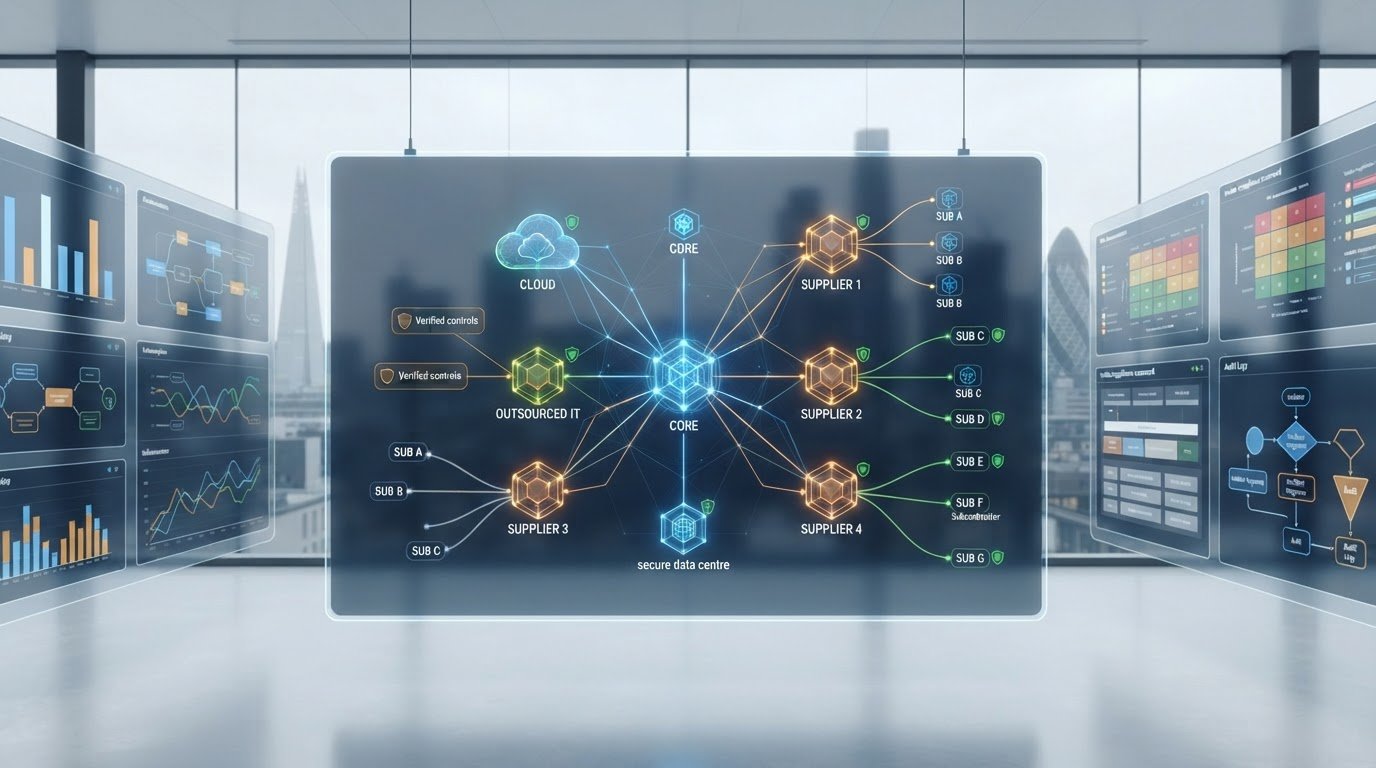
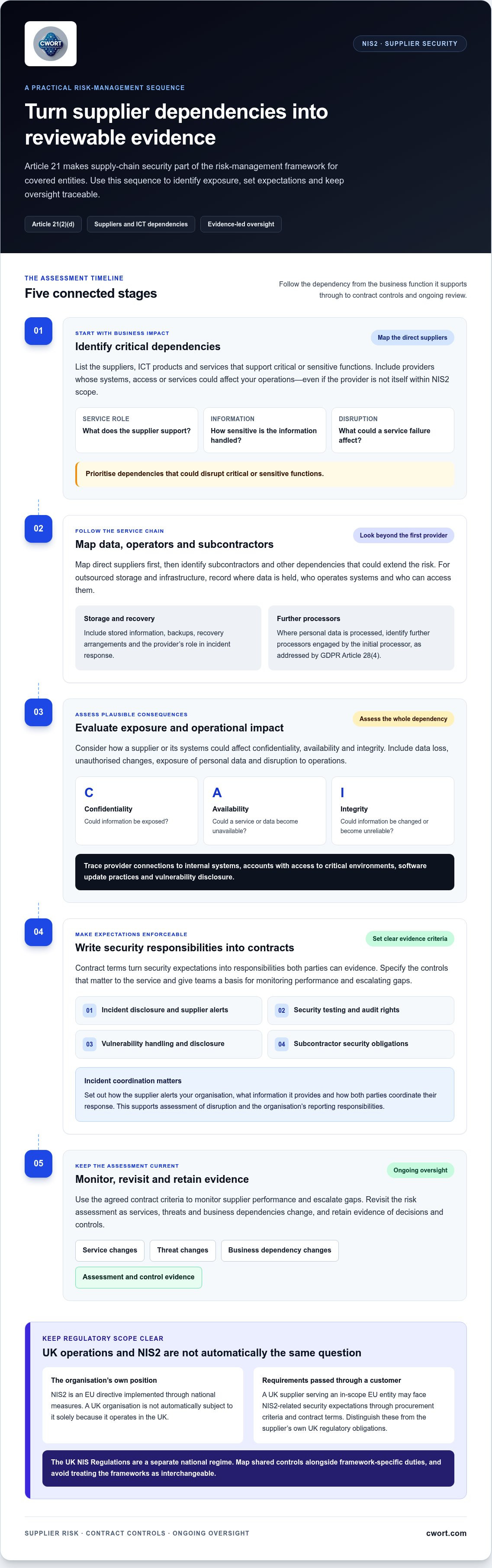
A supplier’s security is part of your NIS2 risk picture. For entities within scope, Article 21 requires supply-chain risk management, and Article 21(2)(d) covers risks associated with suppliers. Securing the ICT supply chain under NIS2 means assessing those dependencies and addressing relevant risks in supplier relationships.
That reaches beyond the organisation’s own systems. Cloud storage, outsourced infrastructure and other ICT services can all affect the security and continuity of your operations, even when a supplier sits outside NIS2’s scope.
This article explains how the requirements affect supplier risk assessments, contracts and ongoing oversight. It also looks at how to map critical ICT dependencies, understand subcontractor exposure and turn security expectations into evidence you can review over time. The aim is a clear, practical view of where responsibility sits and what a defensible approach involves.
Key Takeaways
- Identify which suppliers, ICT services and products support critical or sensitive functions, then prioritise the dependencies that could disrupt them.
- Assess outsourced storage and infrastructure across the full chain, including where data is held, who operates systems and which subcontractors are involved.
- Translate security expectations into supplier contracts, with clear provisions for incident disclosure, vulnerabilities, audit rights and secure termination.
- Make supplier oversight ongoing: revisit risks as services, threats and business dependencies change, and retain evidence of decisions and controls.
- Understand how NIS2 relates to UK organisations and where structured compliance assessment can help turn obligations into traceable actions.
Table of Contents
- NIS2 supply chain security requirements
- Outsourced data storage and IT infrastructure risks
- Due diligence and continuous monitoring
- NIS 2 supply-chain security obligations
- Which UK organisations are subject to NIS2, and how does it apply in the UK?
- CWORT: DORA Compliance Readiness and Assessment
NIS2 supply chain security requirements
The European Union identifies the NIS 2 Directive as Directive (EU) 2022/2555, dated 14 December 2022. Article 21 makes supply-chain security part of the wider risk-management framework for covered entities.
Contractual security requirements
Contractual security requirements are controls written into supplier agreements to manage risks that could affect an entity’s systems or operations. Article 21(2)(d) makes supply-chain security a risk-management concern, so contracts can turn general expectations into responsibilities that both parties can evidence.
Set requirements for incident disclosure, security testing, audit rights, vulnerability handling and subcontractor obligations. For example, a cloud agreement can specify how the provider reports a security incident and how equivalent controls apply to subcontractors. Clear terms give procurement, security and operational teams criteria for monitoring performance and escalating gaps.
Supply-chain risk and ICT suppliers
NIS2 supply-chain risk concerns threats to an entity’s network and information systems that arise through its supplier relationships and the ICT products, services or processes it relies on. Article 21(2)(d) specifically addresses risks associated with suppliers, including direct providers whose systems or access could affect the entity.
Assess the service’s role, the sensitivity of the information it handles and the disruption a failure could cause. A supplier need not be a technology company to create ICT exposure: a provider that stores operational data or administers a critical system may be relevant. Map direct suppliers first, then identify subcontractors and dependencies that could extend the risk.
UK scope and application
NIS2 is an EU directive, so its requirements operate through national measures adopted by EU member states; UK organisations are not automatically subject to it solely because they operate in the UK. A UK supplier may still face NIS2-related security expectations when serving an in-scope EU entity, particularly through procurement criteria and contract terms.
For UK operations, distinguish the organisation’s own regulatory position from customer-imposed requirements. Identify where relevant services are delivered, which entity receives them and whether an EU customer has passed security duties into the agreement. NIS2 non-compliance penalties depend on the applicable national implementation and the entity’s circumstances; there is no single UK NIS2 penalty to apply to every UK supplier.
Comparison with UK rules and guidance
The NIS2 Directive sets an EU framework, while the UK NIS Regulations form a separate national regime. They address cyber security and service resilience, but the frameworks should not be treated as interchangeable: an organisation’s UK obligations and its NIS2-related duties may arise through different routes.
Compare the applicable criteria against the organisation’s services, customers and supplier contracts. UK NIS guidance can inform domestic compliance planning, while NIS2 requirements matter where an EU relationship brings them into scope. Record the distinction in governance documents, then map shared controls alongside framework-specific duties to avoid gaps or unsupported assumptions.
Incident reporting is also part of supply-chain readiness: the EU NIS2 Implementing Regulation requires covered entities to report significant security incidents without delay. Contracts should therefore establish how a supplier alerts the organisation, what information it provides and how the parties coordinate response. This supports timely assessment of disruption and the organisation’s reporting responsibilities.
Outsourced data storage and IT infrastructure risks
Outsourcing does not remove an organisation’s exposure to ICT failures. Assess how external services could affect sensitive functions, data integrity and operational resilience.
Outsourced data storage risks
Outsourced data storage creates risk when an external provider or its systems could affect the confidentiality, availability or integrity of stored information. A storage incident can cause data loss, disrupt operations or expose personal data, so include these potential impacts in supplier assessments.
Map what information is stored, where it is held, who can access it and which services depend on it. Include backups, recovery arrangements and the provider’s role in incident response. Article 28(4) of the GDPR provides for sub-processors hired by an initial processor, so identify further processors handling personal data. A sound approach to securing the ICT supply chain under NIS2 also records which business functions depend on that information.
Assess the consequences of unauthorised changes as well as data loss. If attackers manipulate supply-chain data, decisions based on it may become inaccurate or unreliable. Prioritise safeguards according to the potential impact of exposure, tampering or loss, and retain evidence of the assessment.
IT infrastructure risks
Outsourced IT infrastructure risks arise when external services operate, maintain or connect systems that support business processes. Weak security practices can expose those systems to data loss, operational disruption, shutdowns and financial losses.
Trace connections between provider-managed infrastructure and internal systems. Establish which accounts can access critical environments, how software updates are managed and how vulnerabilities are disclosed. The SolarWinds Orion attack in 2020 compromised software and enabled attackers to infiltrate multiple government and corporate networks. It illustrates why securing the ICT supply chain under NIS2 requires attention to software and update pathways, not just infrastructure ownership.
Malware or ransomware introduced through a supplier can spread to connected systems, interrupt production or make information unavailable. Cyber adversaries may also target suppliers to steal intellectual property, designs or proprietary information. Assess exposed systems and functions, then match technical measures to the potential impact of compromise.
Subcontractor and cascading risks
Cascading supply-chain risk occurs when a provider depends on other organisations whose systems, access or failures affect the service it delivers to you. Exposure can extend beyond the direct supplier if subcontractors handle data, maintain infrastructure or provide connected software.
Map the service chain beyond the main contract. Identify subcontractors that process personal data or support critical systems, and record how each dependency could affect continuity. Require equivalent security obligations to flow down the chain, with clear incident escalation and visibility of material changes.
Resilience also depends on alternatives and lifecycle planning. The EU ICT Supply Chain Security Toolbox recommends diversifying vendors to reduce single points of failure and vendor lock-in. Consider security from procurement through maintenance to decommissioning, and assess whether an alternative service could support critical functions during disruption.
The Toolbox’s 2026 release includes sector-specific risk assessments for connected and automated vehicles and detection equipment. Organisations relying on these technologies should consider how connected products, maintenance practices and access protocols could affect operations. A Cyber Resilience Assessment can help structure the evaluation of dependencies and resilience risks.
Due diligence and continuous monitoring
Secure supplier relationships with risk-based checks before onboarding and recurring oversight once services begin. Map network dependencies, assess evidence, assign owners and record changes that affect cybersecurity risk management.
Supplier due diligence
Supplier due diligence is the pre-onboarding assessment of a provider’s security risks, controls and relevance to your operations. It matters because weaknesses in a supplier’s processes can affect your network, data and service continuity.
Start by documenting the service, information handled, system access and business functions it supports. Assess the supplier against defined security criteria, then record the evidence, gaps, risk owner and approval decision. ENISA guidance emphasises establishing supplier risk-management frameworks and defining security requirements in procurement processes.
Use evidence to test the actual service, not just the supplier’s general credentials. An ISO 27001 or SOC 2 certificate may provide useful context, but neither establishes NIS2 compliance by itself. Compare the certificate’s scope with the service being procured, the systems it covers and the risks your organisation must manage.
Make procurement a control point. Include cybersecurity requirements in tender documents and contract discussions, then assess whether proposed controls address the service’s actual exposure. For example, a software provider with privileged access presents different risks from a supplier with no access to internal systems. Record the rationale for each risk rating so reviewers can trace how the decision was made.
Continuous monitoring and practical security steps
Continuous monitoring means reviewing supplier risk throughout the relationship, rather than treating onboarding as a one-off approval. It matters because service changes, new subcontractors, vulnerabilities or emerging threats can alter the risk profile.
Set a review cadence based on criticality, with quarterly reviews as one practical oversight measure. Reassess high-impact changes sooner, such as a new data-processing location, a major software update or expanded access to production systems. Track findings to closure and retain dated evidence of decisions.
- Maintain a supplier register linked to services, systems and business owners.
- Review security evidence, incidents, vulnerabilities and material service changes.
- Test whether suppliers meet agreed notification and remediation processes.
- Escalate overdue actions and reassess risks when controls or dependencies change.
Use the EU ICT Supply Chain Security Toolbox to inform the evaluation of ICT services, systems and products. It is intended to help public and private actors assess and manage supply-chain risks, and guides organisations on supplier control measures. Apply its risk-based approach alongside your organisation’s own framework, rather than treating any single document as a substitute for oversight.
A practical monitoring record connects each obligation to an owner, evidence and review outcome. For example, when a supplier reports a security incident, log its effect on your service, the response taken and any control changes required. This creates a traceable risk-management process and helps leaders see whether unresolved supplier issues could threaten operations.
NIS 2 supply-chain security obligations
NIS2 places responsibility for supply-chain cybersecurity risks on each in-scope organisation. Article 21 requires essential and important entities to manage those risks, while Article 21(2)(d) addresses supplier-related risk assessment.
Governance must connect risk decisions to accountable implementation. Assign an internal owner to each critical supplier relationship, document the assessment and escalate unresolved vulnerabilities to the people responsible for oversight. This creates a traceable process: leaders can see which supplier supports a sensitive function, what risks were identified and which measures remain outstanding.
The assessment should reflect how the organisation actually depends on ICT. Article 21 requires consideration of relevant European or internationally accepted security standards. NIS2’s supply-chain provisions also point to factors that shape exposure across a supplier’s lifecycle, including:
- How extensively the entity relies on a specific ICT service, system or product.
- Whether emerging technologies could become important to future operations.
- Whether suitable alternative services, systems or products are available.
- How resilient the supply chain is against disruptive events throughout its lifecycle.
- Whether third-country requirements affect particular ICT services, systems or products.
Recital 90 describes coordinated assessments as identifying critical ICT services, systems or products, alongside their threats and vulnerabilities. Recital 91 adds technical and non-technical factors. For an entity, this means a technical review should sit alongside consideration of supplier dependencies and other circumstances affecting the chain.
Article 22 provides for coordinated risk assessments at Union level. The EU ICT Supply Chain Security Toolbox supports a common, non-binding approach to identifying, assessing and mitigating ICT supply-chain risks. Use these resources to inform the organisation’s own assessment, not to replace its responsibility for decisions and implementation. Sector-specific risks may also change which dependencies warrant closer scrutiny.
Article 21(2)(d) includes collaboration relevant to supply-chain cybersecurity. In practice, organisations need defined channels for sharing risk information with suppliers and relevant partners, particularly where a vulnerability could affect connected services. Set out who receives the information, who assesses its impact and how the response is recorded.
Article 24 allows Member States to require certified ICT products, services or processes under European cybersecurity schemes. Certification may support conformity with certain Article 21 requirements, but it does not transfer responsibility away from the entity. Assess whether certification addresses the specific service and risk, then retain evidence of how that conclusion informed implementation.
Which UK organisations are subject to NIS2, and how does it apply in the UK?
NIS2 is an EU directive, not a UK-wide law that automatically applies to every British organisation. Its requirements are implemented through national measures in EU member states. A UK organisation may still face NIS2-related requirements through an EU customer, its operations in an EU country or a supplier contract.
Start by separating direct regulatory scope from commercial obligations. A UK organisation supplying services, systems or products to an in-scope EU entity may be asked to meet cybersecurity requirements, even if the supplier itself falls outside NIS2’s scope. The EU entity remains responsible for managing its supply-chain risks, and may set security criteria in procurement and contracts.
Assess the relationship, not just the supplier’s registered office. Identify which legal entity delivers the service, where relevant operations take place, which customer receives the service and which EU member state’s national rules may apply. The NIS2 Directive covers essential and important entities, while national risk assessments can support extending its scope to entities otherwise outside it. That makes the applicable national implementation material to the assessment.
The UK’s NIS Regulations are a separate domestic regime. Do not assume that meeting UK requirements automatically satisfies an EU customer’s NIS2 obligations, or that a NIS2 contract makes a UK supplier directly regulated under the Directive. Compare the actual requirements that apply to the UK organisation with the contract terms and the customer’s relevant national implementation.
A practical review can distinguish three exposure routes:
- Direct scope: establish whether the organisation’s activities and relevant national implementation bring it within NIS2.
- Customer flow-down: identify security controls, evidence and reporting terms required by an in-scope EU customer.
- Domestic duties: assess UK NIS obligations separately, rather than treating them as interchangeable with NIS2.
For example, a UK cloud provider might not be directly within NIS2’s scope, yet an EU customer could require evidence of access controls, incident escalation and subcontractor oversight. Map each requirement to the relevant service and contract. Record whether it arises from regulation, customer terms or both, so operational teams know which obligation they must evidence.
Build the assessment around documented facts: customer location, service function, legal entity, applicable national rules and contractual clauses. Revisit it when an EU customer changes the service or passes down new controls. A Bring Your Own Content Maturity Assessment can help evaluate requirements and evidence against an organisation’s chosen compliance criteria.
CWORT: DORA Compliance Readiness and Assessment
CWORT supports organisations that need to translate compliance obligations into structured activities and auditable evidence. Its DORA Compliance Readiness and Assessment is relevant for organisations assessing DORA requirements; for NIS2 supply-chain work, NIS2 Readiness and Compliance Management helps organise requirements, control activities and evidence of outcomes.
Use the assessment when supplier risks, control ownership or evidence are fragmented across teams and tools. CWORT also offers UK NIS Compliance Management and ISO 27001 Readiness and Control Mapping, helping organisations address related frameworks through structured compliance validation. This work supports readiness and evidence management; it does not replace legal advice or operate managed security services.
To discuss how CWORT could support your compliance work, visit CWORT.
Make supplier risk part of ongoing governance
Supplier security is not a procurement task that ends when a contract is signed. Make it part of governance by assigning ownership, linking supplier findings to risk decisions and tracking whether agreed actions are completed. This gives leaders a clearer basis for prioritising attention as services, dependencies and threats change.
A durable approach to securing the ICT supply chain under NIS2 depends on evidence that remains useful after the initial assessment. Bring procurement, technology, security and operational teams around a shared view of supplier exposure, so decisions are traceable and emerging gaps reach the right owners.
CWORT can help structure compliance activities and evidence for organisations working to turn NIS2 requirements into a managed programme. If you’re ready to discuss how that could fit your organisation’s priorities, discuss NIS2 with CWORT.
Frequently Asked Questions
What is NIS2 and how will it affect your organisation?
NIS2 is the EU directive that sets cybersecurity risk-management requirements for essential and important entities. For a UK organisation, the effect depends on its regulatory position and business relationships. For example, a UK technology supplier serving an EU entity may face security requirements through procurement or contract terms, even when the supplier itself is outside the Directive’s direct scope. Separate direct legal duties from customer-imposed obligations.
What does NIS2 require for ICT supply-chain security?
NIS2 requires in-scope entities to manage supply-chain cybersecurity risks as part of their wider risk management. Article 21(2)(d) addresses risks associated with suppliers and collaboration relevant to supply-chain cybersecurity. In practice, assess how a service or product supports operations, then set requirements that match its exposure. A certification scheme may support conformity with certain requirements, but the entity remains responsible for its own risk decisions.
What supplier due diligence and security checks does NIS2 require?
NIS2 requires a risk-based approach, not one identical checklist for every supplier. Examine the service’s access, data handled, operational importance and reliance on subcontractors. Then compare available security evidence with the specific service being procured. For example, a certificate covering a supplier’s general management system may not demonstrate how the particular cloud service is controlled. Record any gaps and their owners for follow-up.
How should organisations assess and manage critical ICT suppliers under NIS2?
Prioritise suppliers according to the organisation’s dependence on their ICT services, systems or products and the consequences of disruption. Consider whether alternatives exist, how the dependency may change and whether risks persist throughout the service lifecycle. For a critical platform, document which business functions rely on it, what an interruption would affect, and who owns mitigation and continuity planning.
What contractual security clauses should ICT supplier agreements include under NIS2?
Agreements should make security expectations operational. Cover incident disclosure, audit rights, security testing, vulnerability and patch handling, subcontractor obligations, resilience and secure termination. For software, consider requesting a Software Bill of Materials and relevant transparency information. Define who receives incident notices, how evidence is shared and how obligations flow down to subcontractors. Tailor clauses to the service’s risks rather than relying on generic wording.
What incident reporting duties apply to supply-chain incidents under NIS2?
Covered entities must report significant security incidents without delay under the NIS2 Implementing Regulation. A supplier incident may therefore require prompt assessment of its effect on the entity’s network, services and operations. Contracts should establish how quickly the supplier alerts the entity, what details it provides and how updates are handled. Keep the supplier notification process distinct from the entity’s own assessment and reporting responsibilities.
Disclaimer
The content on this site is provided for general information and educational purposes only. It does not constitute legal, regulatory, financial, or professional advice. CWORT provides AI-assisted insights and workflow automation, but all compliance decisions remain the responsibility of your organisation and its management. Always seek qualified legal or regulatory guidance for decisions relating to the UK NIS Regulations, CAF, DORA, NIS2, ISO 27001, or other obligations.
Related posts
Managing Compliance Evidence in Excel: Comparison and Strategic Risks for 2026
Is managing compliance evidence in excel a risk for 2026? Learn why spreadsheets jeopardise DORA & NIS2 validation and get a roadmap to an audit-ready system.
Choosing a DORA Operational Resilience Platform: Validation vs Documentation
Move beyond spreadsheets. Discover how a DORA operational resilience platform provides validated proof, not just documentation, for total, defensible assurance.
How to Implement NIS2 Technical Standards: A Guide to Software Orchestration
Move beyond manual NIS2 checklists. Learn how dedicated NIS2 technical standards software can orchestrate compliance, automate evidence, and eliminate audit ...
Article by
Michael Iyiola
Co-Founder, CWORT
Michael Iyiola is a co-founder of CWORT and a Cyber and AI Security Engineer with deep experience in vulnerability management, detection engineering and operational resilience across UK critical national infrastructure, including rail, energy and financial services. At CWORT, he designs scalable, evidence-driven workflows that help teams meet modern regulatory and security demands.
Build Your Foundation of Auditable Certainty
Take control of your regulatory obligations and secure your infrastructure with CWORT.