Presenting Cyber Risk in Clear Business Language for Boards

Michael Iyiola
Co-Founder, CWORT
Learn how presenting cyber risk to non-technical stakeholders helps boards link business impact to decisions, ask better questions and act with confidence.

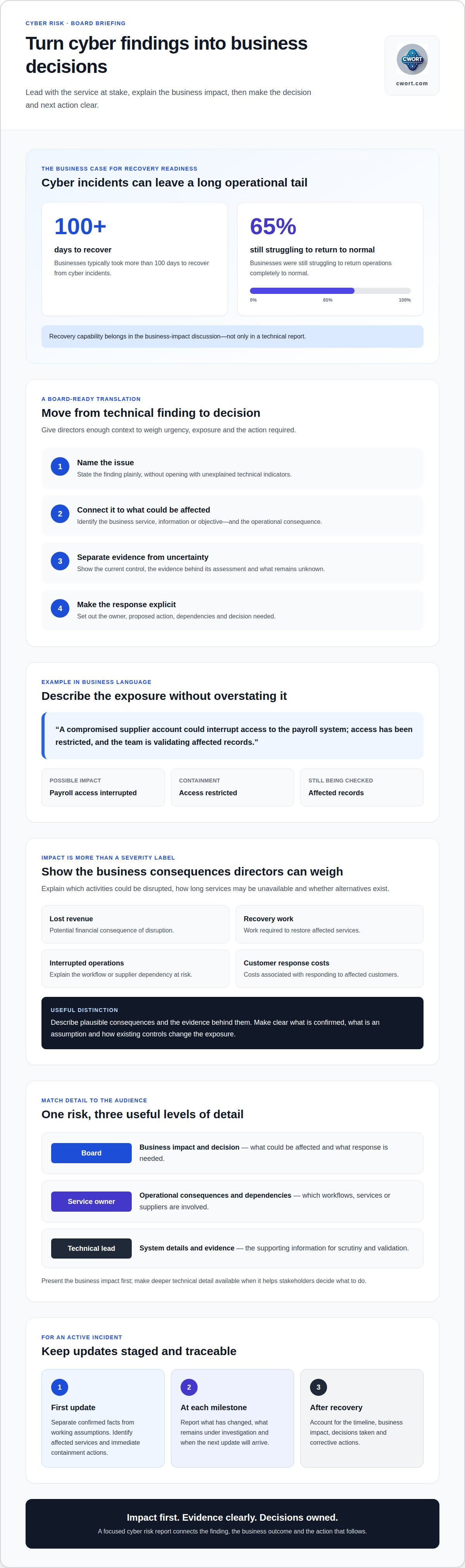
A board doesn’t need a packet capture to make a sound cyber decision. Present cyber risk in terms of the business outcome at stake, the decision required and the action that follows. When presenting cyber risk to non-technical stakeholders, lead with what could be affected, then provide technical detail in layers so each board member can engage at the right level.
It’s easy to assume that more technical detail will make a risk report more convincing. But unexplained terminology can obscure the choice leaders need to make. Clear, proportionate communication helps board members understand why an issue matters, where uncertainty remains and what response is needed.
This article explains how to translate technical findings into business language, use relevant examples and ask questions that clarify complex issues. It also shows how to bring new board members up to speed, keep experienced members informed without overwhelming them, and present evidence in a form that supports focused discussion and accountable decisions.
Key Takeaways
- Lead with the business outcome, the decision required and the action that follows, not a list of technical indicators.
- Connect technical findings to organisational goals and relevant compliance obligations to make their significance clear.
- Use focused follow-up questions to clarify uncertainty, ownership and the evidence behind a risk assessment.
- Bring new board members up to speed with clear context, then tailor reporting to the questions and experience of the board.
- Present the business impact first and make deeper technical detail available when it helps stakeholders decide what to do.
Table of Contents
- 1. How Should You Translate Cyber Risk Into Language the Board Understands?
- 2. How do cyber security threats impact businesses?
- 3. Asking follow-up questions to clarify complex issues
- 4. How to Brief New Board Members on Cyber Security
- 5. Adapting technical detail to stakeholder needs
- CWORT: Cyber Resilience Assessment
1. How Should You Translate Cyber Risk Into Language the Board Understands?
Start with the business consequence, not the technical indicator. Instead of reporting “an exposed administrative account”, explain which service or decision-making process it could affect. A useful board update identifies the issue, its likely business impact, what remains uncertain and the decision or action required. For example: “A compromised supplier account could interrupt access to the payroll system; access has been restricted, and the team is validating affected records.” This communicates impact without presenting an unverified outcome as fact.
How often should cyber risk be reported to a board? Set a regular reporting cadence that aligns with board meetings and the organisation’s risk governance, then report material changes or incidents promptly between meetings. Keep routine updates comparable over time so directors can see whether exposure, mitigation or outstanding decisions have changed.
Prioritise cyber risks by connecting each one to the business services, information or objectives it could affect. Then explain the current control, the remaining exposure and the available remediation options. For example, an access weakness affecting a critical service may need earlier attention than a similar weakness in a low-impact test environment. State the owner, proposed action, dependencies and decision needed so directors can weigh urgency against operational disruption.
Tailor the same security risk to each stakeholder group. A board needs the business impact and decision; a service owner needs operational consequences and dependencies; a technical lead needs system details and evidence. Use a short scenario or diagram to explain how an attack path could affect a service. Provide the technical detail behind that scenario when it supports scrutiny, rather than putting every control identifier into the opening summary.
For an active incident, communicate in stages. The first update should distinguish confirmed facts from working assumptions, identify affected services and record immediate containment actions. At each milestone, report what has changed, what remains under investigation and when the next update will arrive. After recovery, provide a post-incident account covering the timeline, business impact, decisions taken and corrective actions. This sequence gives directors a traceable record rather than a stream of disconnected alerts.
Confidence comes from evidence and clear ownership, not optimistic language. Show whether a control is operating, what evidence supports that assessment and which action remains open. Communicate uncertainty directly: for example, state that the scope of a supplier incident is still being validated. Consult technical leads to test the explanation, then translate their findings into outcomes. A programme manager needn’t be the most technical person in the room; their role is to connect the evidence, business impact and decision-makers. That disciplined approach makes presenting cyber risk to non-technical stakeholders a decision process, not a jargon exercise.
2. How do cyber security threats impact businesses?
A technical finding matters to the board when it changes business exposure. Map each finding to the service, information or objective it could affect, then explain the operational consequence. For example, a weakness in a supplier connection could interrupt a customer-facing service. The board needs to understand the affected process, the dependency involved and the decision required, not just the vulnerability label.
To present cyber risk using likelihood and financial impact, describe how plausible the incident is, which business activities it could disrupt and the financial consequences those activities carry. Separate evidence from assumptions, then explain how existing controls change the exposure. This gives directors a basis for comparing risks without implying that an uncertain loss can be predicted precisely.
Financial consequences can include lost revenue, recovery work, interrupted operations and the cost of responding to affected customers. The impact depends on which services stop, how long they remain unavailable and whether alternatives exist. Businesses typically took more than 100 days to recover from cyber incidents, and 65% were still struggling to return operations completely to normal. These figures show why recovery capability belongs in business-impact discussions, not only technical reports.
Translate findings into the language of the business unit responsible. For a finance team, describe delayed payments or interrupted reporting; for operations, explain which workflow or supplier dependency is affected. State the immediate consequence, the teams involved and the mitigation decision. This helps leaders assess service priorities and coordinate actions without asking them to interpret technical severity scores.
Customer loyalty and market value depend on reliable services and confidence in how an organisation handles information. A customer-facing outage, for example, may prevent customers from completing purchases and create additional support demand. Explain the pathway from threat to business effect while distinguishing a possible consequence from a confirmed incident. That distinction keeps the report credible and helps leaders judge reputational exposure alongside operational impact.
Map each finding to the relevant control, evidence and business objective. A control crosswalk can show how one technical weakness relates to several requirements, including those used in ISO 27001 or UK NIS compliance management. Avoid treating a framework label as proof that a risk is controlled; show the evidence, any gap and the remediation owner. This makes compliance status meaningful to decision-makers.
For each priority risk, present remediation options with their operational trade-offs, dependencies and expected evidence of completion. A supply-chain compromise took an average of 267 days to resolve, highlighting why ownership and supplier dependencies matter in planning. A Cyber Resilience Assessment can help connect technical findings to business exposure and remediation priorities; explore the cyber resilience assessment when that structured view would support your decisions.
3. Asking follow-up questions to clarify complex issues
A technical summary can hide assumptions that change a board’s decision. Ask the presenter to define the affected system, explain the business service it supports and distinguish observed facts from interpretation. If a report says “privileged access is excessive”, clarify which roles are involved, what access they hold and what evidence supports the finding. These questions turn a broad label into a reviewable risk statement.
Use a consistent sequence to clarify complex issues: establish the scope, test the evidence, identify the consequence and agree the next action. For example, ask whether a control applies to the whole service or only one environment. Then ask how the team tested it, when the evidence was collected and who owns any corrective work. This format helps directors follow the reasoning without needing to interpret technical terminology.
Certification evidence needs careful interpretation. Ask which systems, sites or activities fall within the certificate’s scope, and whether the evidence relates to the service under discussion. A certificate can support an assurance conversation, but it doesn’t by itself demonstrate that every relevant control is operating effectively. For an ISO 27001 assessment, ask how the organisation evaluates information security risks against consistent criteria, including the criteria addressed by clause 6.1.2.
When an audit identifies a control gap, clarify the requirement, the observed condition and the evidence behind the difference. For example, if access reviews are incomplete, ask which accounts were examined, what records are missing and whether the issue affects a critical service. Then establish the accountable owner, planned remediation and evidence that will demonstrate completion. This separates a documented gap from an assumed exposure.
Compliance documentation should let a reviewer trace a requirement to a control, its owner and supporting evidence. Ask where the current procedure is documented, which operational records show it is followed, and how exceptions are recorded. If an evidence pack contains a policy but no records of implementation, the gap is between stated intent and demonstrated practice. A control map can make that distinction visible across frameworks such as ISO 27001 and NCSC CAF.
Close each discussion by recording the answer, unresolved point and next action in the same document. If a technical lead can’t explain a finding clearly, ask them to restate it using a concrete example, then confirm the wording with the control owner. Bring Your Own Content Maturity Assessments can help organisations assess existing documentation and content against their maturity needs. The outcome is a clearer trail from question to evidence, assessment and accountable decision.
4. How to Brief New Board Members on Cyber Security
Give new directors a structured introduction to the organisation’s cyber governance, critical services and current risk priorities. Explain who owns cyber security, how decisions reach the board and how risks connect to strategic objectives. In 2024, 30% of UK businesses had a board member explicitly responsible for cyber security as part of their role, while 75% rated cyber security a high priority for senior management. These figures underline the need to make oversight and accountability clear from the outset.
Set each board presentation around a decision, not a catalogue of technical activity. Clarify the objective, such as approving a remediation priority, understanding a control gap or reviewing resilience for a critical service. For new and experienced directors alike, use consistent language and explain unfamiliar terms once. Then connect each finding to its owner, business consequence and next governance milestone.
Three questions help directors test whether cyber risk is being governed effectively: Which important services could be disrupted? How well do current controls reduce that exposure? What decision, investment or action is required from the board? Use these questions to focus discussion, then record the answer and accountable owner in the board’s governance record.
A UK board cyber risk report should summarise material risks, affected services, control effectiveness, significant changes, remediation progress and decisions required. The UK Corporate Governance Code 2024 requires listed company boards to declare on the effectiveness of their material internal controls under Provision 29 for financial years beginning on or after 1 January 2025. Keep evidence supporting any relevant assessment traceable to the controls reported.
Build a useful cyber risk heat map by plotting risks against consistent likelihood and impact criteria. Label each risk with its business service, current control status and accountable owner; explain the scale so directors can distinguish ratings. A heat map is a prioritisation aid, not a substitute for the evidence behind each assessment.
Choose a small set of board-level indicators that show whether controls work and exposure is changing. The NCSC framework advises organisations to develop metrics and performance indicators to measure control effectiveness. Board cyber risk reporting should use 4-6 key indicators across three categories, with metrics condensed to one or two pages. Include a trend, threshold or status explanation so each indicator supports a decision rather than merely displaying activity.
Common mistakes include leading with acronyms, presenting uncontextualised technical scores and reporting activity without showing control effectiveness. Avoid dense reporting that hides the decision or confidence language unsupported by evidence. Give new directors a concise glossary and a service map, then use the same reporting format at later meetings. That consistency helps them recognise changes, challenge assumptions and contribute to cyber risk governance.
5. Adapting technical detail to stakeholder needs
Use one evidence base, but vary its presentation for each audience. A board paper might state the business decision, affected service and control status. An internal technical briefing can add system dependencies, testing method and supporting records. Regulatory reporting may need traceability from an obligation to the control, evidence and accountable owner. Keep these views aligned so leaders receive different levels of detail without contradictory conclusions.
Begin with the audience’s decision. A chief executive deciding whether to delay a product launch needs the likely effect on delivery, customers and unresolved risk. A technical lead assessing the same issue needs the affected components, configuration and test results. Explain the operational effect first, then provide the technical detail that substantiates it. This makes the core message clear without removing the evidence needed for scrutiny.
Layer information rather than compressing everything into a dense summary. Put the decision and key consequence at the start, followed by the relevant control status and evidence. Place technical terms, assumptions and supporting detail in an appendix or linked record. For example, describe an authentication weakness as “some users may gain access without the expected verification”, then define the specific control and test result in the supporting material.
Choose a format that makes the relationship between risk, control and response visible. A simple diagram can show how a supplier connection supports a business service and where a control sits. A trend chart can show whether remediation is progressing between board meetings. Label the time period, source and meaning of each measure; a red status without a defined threshold can create alarm without informing a decision.
Apply a beginner’s mindset when preparing material for people unfamiliar with the system. Define acronyms on first use, explain why the system matters and use a concrete scenario before introducing architecture. For experienced stakeholders, avoid repeating introductory material; focus on changed exposure, control performance and decisions outstanding. Ask technical leads to validate explanations when deeper detail is needed, and separate confirmed evidence from assumptions.
Test the message with a practical check: can a reader identify the issue, its business relevance and the next decision from the summary alone? If not, revise the opening before adding more technical material. Bring Your Own Content Maturity Assessments can help assess whether existing reporting content is structured for its intended audiences. For a practical discussion about adapting compliance content and evidence for different stakeholders, request a demonstration.
CWORT: Cyber Resilience Assessment
CWORT’s Cyber Resilience Assessment helps organisations connect cyber risk findings with business priorities, control outcomes and supporting evidence. It is a natural next step when board reporting identifies gaps but leaders need a structured view of resilience, ownership and remediation. CWORT also supports DORA Compliance Readiness and Assessment, UK NIS Compliance Management, NIS2 Readiness and Compliance Management, and ISO 27001 Readiness and Control Mapping. Its enterprise compliance validation platform translates regulatory obligations into structured activities and links evidence to control outcomes, creating an auditable basis for oversight. This approach can help organisations move from fragmented reporting to clearer, traceable compliance validation. Contact CWORT to discuss how an assessment could support your organisation’s cyber risk governance.
Make board communication part of the governance cycle
Clear cyber reporting is not a one-off presentation. Treat it as a governance practice: decisions should shape follow-up actions, and evidence from those actions should inform the next board discussion. That creates a practical feedback loop between oversight and delivery, helping leaders see whether their direction has translated into accountable progress.
Use presenting cyber risk to non-technical stakeholders as an opportunity to build shared understanding, not simply to simplify technical language. Invite directors to identify which business outcomes matter most, then align future reporting with those priorities. A consistent connection between risk, ownership and evidence gives the board a stronger basis for challenge and informed decisions.
If your organisation needs a more structured way to connect cyber resilience and compliance evidence, speak with CWORT about the next step. Contact CWORT to discuss cyber risk and how clearer validation can support board oversight. A disciplined reporting process can help your organisation move forward with greater clarity and confidence.
Frequently Asked Questions
How Do You Bring New Board Members Up to Speed on Cyber Security?
Give new directors a short induction pack they can revisit between meetings. Include a plain-language map of critical services, key technology dependencies, risk ownership and the route for escalating concerns. A worked example, such as a supplier outage affecting customer access, can show how a technical issue reaches the board agenda. Invite questions after the briefing and record any unfamiliar terms for clearer treatment in future papers.
How Should You Translate Cyber Risk Into Language the Board Understands?
Explain the issue through a familiar business process, then define any technical term needed to understand it. For example, describe a compromised account as a risk of someone acting with another person’s system access. When presenting cyber risk to non-technical stakeholders, distinguish a possible scenario from an event that has actually occurred. This keeps the discussion accessible without overstating the evidence or removing useful detail.
How do cyber security threats impact businesses?
Threats can affect a business by disrupting a service, exposing information or delaying an important activity. The consequences depend on the process involved: a compromised ordering system may prevent customers placing orders, while an unavailable records system may slow staff work. Explain which process could be affected, who relies on it and what workaround exists. That gives decision-makers a practical view of exposure without treating every threat as an inevitable incident.
Invest in impact: Can you afford to leave your reports unheard?
Reports that don’t lead to understanding can leave decisions, ownership and follow-up unclear. Make the opening of each paper useful to its readers: state the business issue, the action already taken and the decision still required. For example, ask the board to endorse a service priority or resolve an ownership gap. Then capture the decision and revisit it at the next appropriate governance discussion so reporting informs action.
What Are the Three Key Questions Every Board Wants Answered on Cyber Risk?
Boards need to know whether the organisation understands its most important exposures, whether accountable owners are addressing them, and whether leaders must make a decision. Apply these questions to a live example, such as a delayed security update: what service depends on it, who owns the response and what is needed to resolve the delay? Clear answers help directors distinguish an operational update from a matter requiring governance attention.
What metrics should a CISO present to the board?
Choose measures that show coverage, control performance and remediation progress. For example, report whether critical services have assigned risk owners, whether scheduled control checks produced exceptions, and whether agreed corrective actions have been completed. Define each measure and its reporting period consistently. A changing figure is useful only when directors can understand what changed, why it matters and whether management needs to act.
Which Sources Do Boards Actually Consider Authoritative on Cyber Risk?
Boards can assess cyber risk using traceable internal evidence alongside relevant external frameworks and regulator communications. Internal sources may include control test results, incident records, service-owner assessments and audit findings. NCSC material and standards such as ISO 27001 can provide reference points when relevant to the organisation. State what each source demonstrates, its scope and its limits, so a framework reference isn’t mistaken for proof that every control works.
Why Does Authenticity Matter When Presenting Cyber Risk to the Board?
Authenticity lets directors distinguish evidence, professional judgement and unresolved uncertainty. If an incident’s scope is still being investigated, say which systems have been examined and which questions remain open. Don’t present an estimate as a confirmed result or describe a planned control as already effective. A transparent account allows the board to challenge assumptions, assign follow-up and understand how confidence in the assessment may change.
Disclaimer
The content on this site is provided for general information and educational purposes only. It does not constitute legal, regulatory, financial, or professional advice. CWORT provides AI-assisted insights and workflow automation, but all compliance decisions remain the responsibility of your organisation and its management. Always seek qualified legal or regulatory guidance for decisions relating to the UK NIS Regulations, CAF, DORA, NIS2, ISO 27001, or other obligations.
Related posts
Board Level Cyber Resilience Reporting Software: Bridging the Gap from Technical Control to Governance Proof
Ditch risky spreadsheets. Discover board level cyber resilience reporting software that turns technical data into defensible, real-time proof for UK regulators.
UK NIS Audit Readiness Tool: Orchestrating Compliance for 2026
Master your 2026 audit with our guide to UK NIS compliance orchestration. Move from fragmented evidence to a single source of truth for NCSC CAF 4.0 readiness.
CISO Guide to DORA Operational Resilience: Orchestrating Validated Compliance
Master validated compliance with our CISO guide to DORA operational resilience. Swap manual evidence gathering for an orchestrated, audit-ready security post...
Article by
Michael Iyiola
Co-Founder, CWORT
Michael Iyiola is a co-founder of CWORT and a Cyber and AI Security Engineer with deep experience in vulnerability management, detection engineering and operational resilience across UK critical national infrastructure, including rail, energy and financial services. At CWORT, he designs scalable, evidence-driven workflows that help teams meet modern regulatory and security demands.
Build Your Foundation of Auditable Certainty
Take control of your regulatory obligations and secure your infrastructure with CWORT.