Real-Time Compliance Validation: Orchestrating Auditable Truth in 2026

Michael Iyiola
Co-Founder, CWORT
Master real-time compliance validation to replace fragile spreadsheets with live auditable evidence. Build defensible proof for DORA, NIS2, and ISO 27001.

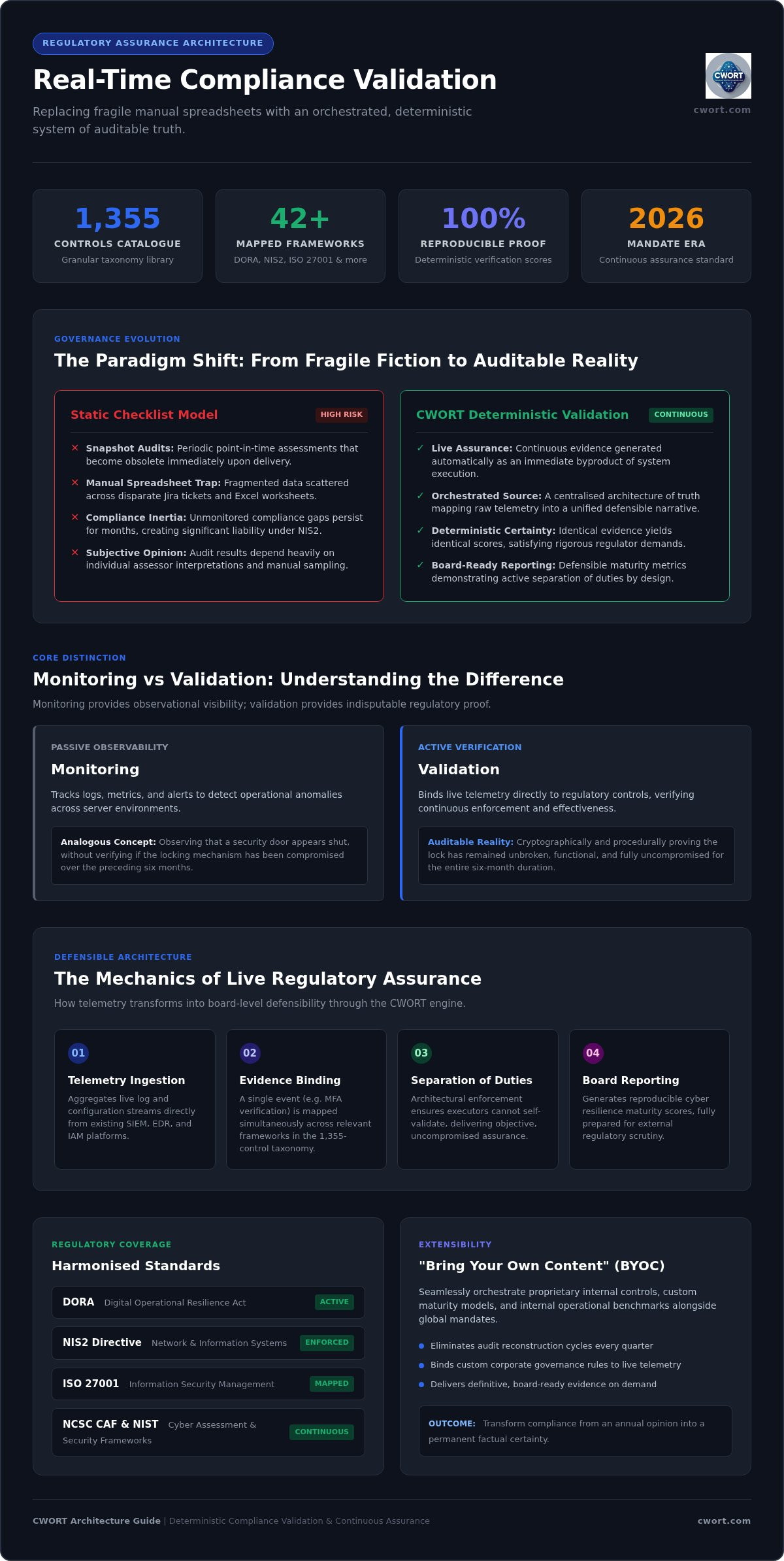
Your current compliance status is likely a fragile fiction maintained by the sheer force of manual labour and fragmented spreadsheets. It's an uncomfortable reality for many executives who realise that their real-time compliance validation efforts are often just a reactive scramble through Jira tickets and Excel tabs. You likely feel the mounting pressure of board-level reporting whilst struggling to prove fundamental controls like separation of duties with any degree of certainty.
Stop relying on static checklists and start building a deterministic architecture that satisfies the most rigorous regulatory scrutiny. This guide demonstrates how to replace administrative tracking with an orchestrated system of truth. We'll examine the transition from fragmented data to a single source of auditable evidence, utilising a taxonomy of 1,355 controls and over 42 mapped frameworks to produce automated, board-ready maturity reports. We'll move from high-level strategic obligations to granular, defensible proof of control effectiveness. By the end, you'll understand how to achieve a state of cyber resilience where compliance is no longer a matter of opinion, but a documented, reproducible fact.
Key Takeaways
- Shift from passive monitoring to active validation by aggregating live evidence from your existing security stack to ensure continuous control effectiveness.
- Implement real-time compliance validation to replace point-in-time audits with a deterministic model that satisfies the most rigorous regulatory scrutiny.
- Eliminate the inherent fragility of manual spreadsheets and Jira trackers by adopting a centralised system designed specifically for regulatory orchestration.
- Utilise a "Bring Your Own Content" approach to seamlessly map proprietary maturity models against established frameworks such as DORA, NIS2, and ISO 27001.
- Generate automated, board-ready reports that provide definitive, auditable proof of your organisation's cyber resilience and adherence to separation of duties.
Table of Contents
- Defining Real-Time Compliance Validation in the 2026 Regulatory Landscape
- Orchestrating Evidence: The Mechanics of Live Regulatory Assurance
- The Spreadsheet Trap: Why Manual Tracking Fails Real-Time Scrutiny
- Building a Defensible Architecture: Five Pillars of Continuous Validation
- Transitioning to CWORT: From Abstract Obligations to Auditable Reality
Defining Real-Time Compliance Validation in the 2026 Regulatory Landscape
By 2026, the era of the snapshot audit is effectively over. Regulators no longer accept annual reports as proof of security; they demand a live pulse of organisational health. Static checklists provide a false sense of security that crumbles under the weight of DORA and NIS2 requirements. Organisations must transition to a model where evidence is generated as a byproduct of execution. Real-time compliance validation is a deterministic governance system that binds live execution data to specific regulatory obligations.
This shift is driven by a global demand for operational resilience. Frameworks like the NCSC CAF and ISO 27001 are evolving to favour continuous assurance over periodic reviews. To survive this landscape, leadership must move beyond administrative tracking. You need a system that doesn't just watch your environment but actively validates that every control is performing as intended. It's the difference between seeing a locked door and proving the lock hasn't been tampered with for the last six months.
Validation vs. Monitoring: A Critical Distinction
Monitoring provides visibility, but validation provides proof. You might monitor server logs to detect anomalies, yet those logs don't prove your access control policy is effective in a regulatory context. Validation requires a continuous auditing methodology to ensure every action aligns with a mandated control. This process eliminates the traditional audit reconstruction phase that typically haunts compliance teams every quarter.
Instead of spending weeks hunting for evidence across Jira tickets and Excel spreadsheets, the evidence is bound to the control at the moment of execution. This creates a definitive trail of auditable truth. Real-time compliance validation ensures that your data is not just collected but is mapped directly to the 1,355 controls in the modern taxonomy library. It transforms raw telemetry into a defensible narrative that satisfies even the most sceptical auditor.
The Cost of Compliance Inertia
Legacy processes are no longer just inefficient; they're a liability. Boards cannot afford the ambiguity of manual reporting when non-compliance with NIS2 carries significant financial penalties and personal accountability for directors. Relying on point-in-time assessments creates a compliance gap where risks go undetected for months. This inertia leaves the organisation vulnerable to both cyber threats and regulatory sanctions.
Static reporting fails because it's inherently retrospective. By the time a board-level report is compiled, the data is already obsolete. Real-time compliance validation closes this gap by providing a constant stream of deterministic results. It replaces the anxiety of potential failure with the calm of auditable certainty. By orchestrating evidence from your existing security stack, you move from a reactive scramble to a proactive state of total assurance.
Orchestrating Evidence: The Mechanics of Live Regulatory Assurance
Transitioning from abstract regulatory language to concrete execution requires a robust integration layer. Real-time compliance validation functions by aggregating telemetry from your existing security stack, including SIEM, EDR, and IAM tools. This orchestration layer sits above your technical tools, translating raw logs into defensible proof of control adherence. By aligning with the NIST Information Security Continuous Monitoring guidelines, organisations can shift from periodic, manual sampling to a state of perpetual readiness.
A critical component of this architecture is the enforcement of separation of duties by design. In a high-stakes regulatory environment, the system must ensure that those who execute a control cannot also be the ones who validate its effectiveness. This prevents internal conflict and provides the objective oversight that auditors demand. The system also ensures reproducibility. When identical evidence is presented, the platform must yield an identical compliance score, removing the subjectivity often found in manual assessments.
The Evidence Binding Process
Effective validation relies on the precise binding of evidence to specific regulatory obligations. A single evidence source, such as a multi-factor authentication report, often supports multiple controls across different domains. The system must maintain an immutable audit history for every control change, ensuring that every modification is traceable and justified. Access to this validation workflow should be governed by role-based and attribute-based controls, ensuring that only authorised personnel can interact with sensitive compliance data. This level of rigour is essential for ensuring compliance evidence integrity throughout the lifecycle of an audit.
Assess Once, Report Many: The Efficiency Multiplier
The most significant efficiency gain comes from a unified control taxonomy. With 1,355 controls already mapped across 42 frameworks, organisations can satisfy the requirements of DORA, NIS2, and ISO 27001 simultaneously. This "assess once, report many" capability eliminates redundant work and ensures consistency across diverse reporting streams. Instead of running separate assessment cycles for each regulation, you manage a single orchestrated environment that provides a real-time view of your global maturity. To see how this orchestration can transform your reporting cycle, you might explore a live demonstration of the architecture in action.
The Spreadsheet Trap: Why Manual Tracking Fails Real-Time Scrutiny
Relying on spreadsheets for high-stakes regulatory reporting is a strategy built on sand. Whilst Excel is a versatile tool for calculation, it lacks the structural integrity required for real-time compliance validation. Manual trackers are inherently fragile; a single accidental cell deletion or an unverified entry can compromise the entire evidence chain. This creates a dangerous capability vs. capacity blind spot where teams believe they have the capability to meet DORA or NIS2 standards, but lack the operational capacity to prove it under the heat of an audit.
Auditors in 2026 are increasingly dismissive of reconstructed truth. This is the desperate process of scrambling to gather evidence months after an event occurred to satisfy a retrospective request. It is a reactive, high-risk behaviour that fails the scrutiny of modern governance. Jira, whilst excellent for task management, is an execution tool, not a compliance orchestration system. It tracks the completion of a work item but rarely captures the deterministic evidence of control effectiveness required for a defensible audit trail.
Excel vs. Orchestrated Validation
Manual maturity assessments often suffer from inconsistent scoring because they rely on human interpretation and subjective self-reporting. Orchestrated validation replaces this subjectivity with reproducible, data-driven results. By adopting a continuous IT auditing and control monitoring approach, organisations ensure that evidence protection and version control are built directly into the workflow. Boards now demand live, interactive dashboards that reflect the current state of security rather than static slide decks that are obsolete the moment they are presented.
Bridging the Gap Between GRC and Execution
Traditional GRC tools often fail because they remain disconnected from live operational data. They act as repositories for policy rather than engines for active validation. Orchestration platforms sit above your point-tools, aggregating telemetry from across the stack to provide a unified view of your entire control landscape. This allows for regulatory compliance workflow automation that binds raw telemetry to strategic obligations. By bridging this gap, you move from a state of administrative tracking to one of definitive, evidence-based proof that satisfies even the most rigorous regulatory scrutiny.
Building a Defensible Architecture: Five Pillars of Continuous Validation
Establishing a defensible architecture requires more than just technical tooling; it demands a systematic orchestration of five core pillars. Real-time compliance validation transforms abstract regulatory requirements into a living, breathing security posture. By shifting focus from administrative tracking to deterministic proof, organisations can achieve a level of assurance that satisfies both internal boards and external regulators. This structured approach ensures that every control is not just monitored, but validated against specific obligations.
Pillar 1 focuses on Structured Obligation Mapping. You must map specific requirements from DORA, NIS2, and ISO 27001 into a unified taxonomy of execution activities. Pillar 2 involves Automated Evidence Collection and Binding. Telemetry from your security stack is automatically bound to these obligations, creating an immutable history. Pillar 3 introduces Deterministic Scoring Models. This ensures that compliance scores are reproducible and based on objective evidence rather than subjective opinion. Pillar 4 provides Real-Time Board and Regulator Reporting. This replaces static slide decks with live maturity dashboards. Finally, Pillar 5 ensures Continuous Remediation and Maturity Tracking. This closes the loop between identifying a gap and proving its resolution through documented execution.
Implementing a Deterministic Scoring Model
Removing subjectivity is the cornerstone of audit-defensibility. A deterministic scoring model ensures that identical evidence always yields identical compliance results, providing a level of consistency that manual assessments lack. Whilst some platforms suggest AI should drive outcomes, true regulatory rigour requires that AI remains in an advisory role. It should suggest improvements and identify gaps based on the 1,355 controls in the taxonomy library, but it must never alter the deterministic results of a real-time compliance validation check. This separation ensures that your maturity and confidence levels are always based on verifiable facts rather than opaque algorithms.
Preparing for UK Specific Regulatory Scrutiny
Organisations operating within the UK, particularly those classified as critical national infrastructure, face unique pressures. You must align your architecture with the NCSC CAF and UK NIS requirements to ensure resilience. This requires board-level visibility into operational maturity that spreadsheets simply cannot provide. Utilising specialised NCSC CAF Assessment Software allows you to map your existing controls against the Cyber Assessment Framework domains with precision. To see how these five pillars can be orchestrated within your environment, schedule a technical walkthrough of the platform.
Transitioning to CWORT: From Abstract Obligations to Auditable Reality
CWORT functions as the definitive orchestration layer that sits above your existing security stack. It translates abstract regulatory requirements into a living, breathing auditable reality. By June 2026, 98.6% of active controls within the CWORT taxonomy already carry direct framework references, ensuring that your real-time compliance validation efforts are grounded in established standards like DORA and NIS2. This architecture allows leadership to move beyond the 'Diagnose' phase, where gaps are merely identified, to a 'Demonstrate' phase, where control effectiveness is proven through deterministic evidence. You're no longer just identifying what is wrong; you're providing the board with reproducible proof that controls are functioning correctly.
The platform also supports a 'Bring Your Own Content' (BYOC) approach. This flexibility allows organisations to integrate proprietary maturity models or industry-specific standards into a single governed environment. You don't have to abandon your existing internal frameworks; you simply orchestrate them within a system designed for high-stakes oversight. This ensures that your unique organisational requirements are validated with the same rigour as international standards, providing a unified view of your entire compliance posture. It creates a bridge between bespoke internal goals and universal regulatory mandates, all whilst maintaining a single source of truth.
The Pilot to Production Roadmap
Successful implementation begins with a governed pilot focused on a specific sub-function or business unit. This initial phase allows you to validate tenant isolation and enforce separation of duties within the platform's workflow before a wider rollout. You can test the automated evidence binding process on a limited set of controls to ensure the data flow is accurate and defensible. Once the architecture is verified, you can scale the system to a multi-framework model. This transition enables the 'Assess Once, Report Many' efficiency, allowing a single set of execution data to satisfy multiple regulatory obligations simultaneously. It's a methodical progression that ensures every stage of the transition is clearly accounted for.
Securing the Future of Enterprise Compliance
Deterministic governance builds long-term cyber resilience by replacing manual ambiguity with automated certainty. It significantly reduces the operational burden on CISO and Risk teams, who no longer need to spend hundreds of hours on manual evidence collection or spreadsheet reconciliation. By orchestrating your compliance activities, you create a sustainable system that adapts to evolving regulations without requiring a linear increase in headcount. This proactive approach enforces discipline and accountability by design, positioning your organisation as a meticulous guardian of standards. Book a working session to map your compliance programme with CWORT and begin the transition to a state of auditable truth.
Establishing the New Standard for Regulatory Assurance
The transition from manual tracking to a deterministic architecture is no longer optional; it's a strategic necessity for organisations facing the 2026 regulatory landscape. By replacing fragile spreadsheets with an orchestrated system, you move from reactive snapshots to a state of total assurance. Implementing real-time compliance validation allows you to leverage 1,355 controls mapped to 42 global frameworks, ensuring that your evidence is always bound to specific regulatory obligations.
This approach doesn't just satisfy auditors; it empowers leadership with automated, board-ready maturity reports. Utilising deterministic, reproducible scoring ensures your results are defensible under the most rigorous scrutiny, whether you're preparing for DORA, NIS2, or ISO 27001 readiness. You can now replace the anxiety of potential failure with the calm of auditable certainty. Stop managing compliance through spreadsheets and embrace a system designed for the demands of modern governance.
Orchestrate your auditable truth with the CWORT compliance validation platform
Frequently Asked Questions
What is real-time compliance validation?
It's a deterministic governance system that turns cyber-security functions into measurable operating models by binding live execution data to regulatory obligations. Unlike point-in-time assessments, it provides a continuous pulse of control effectiveness. It uses a taxonomy of 1,355 controls to ensure that every security activity produces auditable proof. This ensures organisations move from abstract requirements to a concrete, defensible reality that satisfies regulators.
How does real-time validation differ from traditional GRC tools?
Traditional GRC tools often act as static repositories for policies and manual self-assessments, whereas real-time validation orchestrates live execution data. It sits above your technical tools to aggregate evidence directly from the operational environment. This removes the need for manual audit reconstruction phases. By providing a capability and capacity view, it proves not just that a policy exists, but that it's being sustained by existing skills and tooling.
Can real-time validation work with my existing security tools like SIEM or EDR?
Yes, real-time compliance validation is designed to integrate seamlessly with your existing security stack, including SIEM, EDR, IAM, and vulnerability management tools. The platform functions as an orchestration layer that consumes telemetry from these point-tools and maps it to specific framework domains. This allows you to aggregate fragmented evidence into a single, governed environment. It effectively translates raw technical logs into explainable, audit-ready proof for senior leadership and regulators.
Is real-time compliance validation a requirement for DORA or NIS2?
Whilst neither DORA nor NIS2 explicitly mandates a specific software category, they both require continuous operational resilience and the ability to demonstrate control effectiveness under scrutiny. Real-time validation provides the deterministic proof that auditors demand during these assessments. By mapping 98.6% of active controls to framework references, it ensures you can meet the rigorous reporting standards of these regulations without the fragility of manual spreadsheets or fragmented trackers.
How do you ensure evidence integrity in a real-time validation system?
Evidence integrity is maintained through a combination of immutable audit histories, tenant isolation, and strict separation of duties. Every change to a control or evidence binding is recorded in a way that cannot be altered or deleted. The system also employs role-based and attribute-based access controls to prevent unauthorised modifications. This level of rigour ensures that the evidence remains protected and defensible throughout the entire lifecycle of a regulatory audit.
What are the benefits of deterministic scoring in regulatory audits?
Deterministic scoring ensures that identical evidence always yields the same compliance result, removing the subjectivity inherent in manual assessments. This reproducibility is vital for building trust with regulators and boards. It allows auditors to verify that scores are based on objective facts rather than human interpretation. By using a prioritisation engine, the system also helps teams rank remediation actions by business priority, risk, and expected value.
Can we use our own proprietary maturity models for real-time validation?
You can utilise the 'Bring Your Own Content' (BYOC) capability to import and define your own proprietary maturity models. This feature allows organisations to retain their intellectual property whilst leveraging a governed digital workflow for assessment and tracking. The system remains content-agnostic, supporting any criteria, weighting, or evidence requirements you define. This ensures that your internal standards are managed with the same professional rigour as international frameworks.
How does real-time validation help with board-level reporting?
It generates heat-map dashboards and board-ready maturity reports that translate technical telemetry into a common language for executives. Instead of presenting static slide decks, you can provide live visibility into your cyber resilience and operational maturity. This transparency allows the board to make defensible investment decisions backed by transparent scoring. It bridges the gap between granular technical execution and high-level strategic oversight, providing total assurance to risk committees.
Disclaimer
The content on this site is provided for general information and educational purposes only. It does not constitute legal, regulatory, financial, or professional advice. CWORT provides AI-assisted insights and workflow automation, but all compliance decisions remain the responsibility of your organisation and its management. Always seek qualified legal or regulatory guidance for decisions relating to the UK NIS Regulations, CAF, DORA, NIS2, ISO 27001, or other obligations.
Related posts
Reducing Audit Preparation Time and Costs: A Strategic Guide for UK Enterprises
Tired of costly audit seasons? Our guide for UK enterprises shows you how to stop the manual scramble, reducing audit preparation time and costs with automat...
Streamlining Regulatory Compliance Processes: From Manual Tracking to Orchestrated Validation
Stop wasting money on manual compliance. Learn about streamlining regulatory compliance processes to reduce personal liability under DORA & NIS2 and gain aud...
GRC Platform vs Compliance Validation Tool: Choosing the Right Architecture for 2026
GRC platform vs compliance validation tool: Is your GRC ready for 2026? Learn how automated validation provides the defensible proof needed for DORA & NIS2.
Article by
Michael Iyiola
Co-Founder, CWORT
Michael Iyiola is a co-founder of CWORT and a Cyber and AI Security Engineer with deep experience in vulnerability management, detection engineering and operational resilience across UK critical national infrastructure, including rail, energy and financial services. At CWORT, he designs scalable, evidence-driven workflows that help teams meet modern regulatory and security demands.
Build Your Foundation of Auditable Certainty
Take control of your regulatory obligations and secure your infrastructure with CWORT.