Regulatory Change Management: Track Rules and Apply Them

Michael Iyiola
Co-Founder, CWORT
Managing changes in regulatory requirements helps you spot updates, assess impact, assign owners, meet deadlines and keep compliance evidence audit-ready.

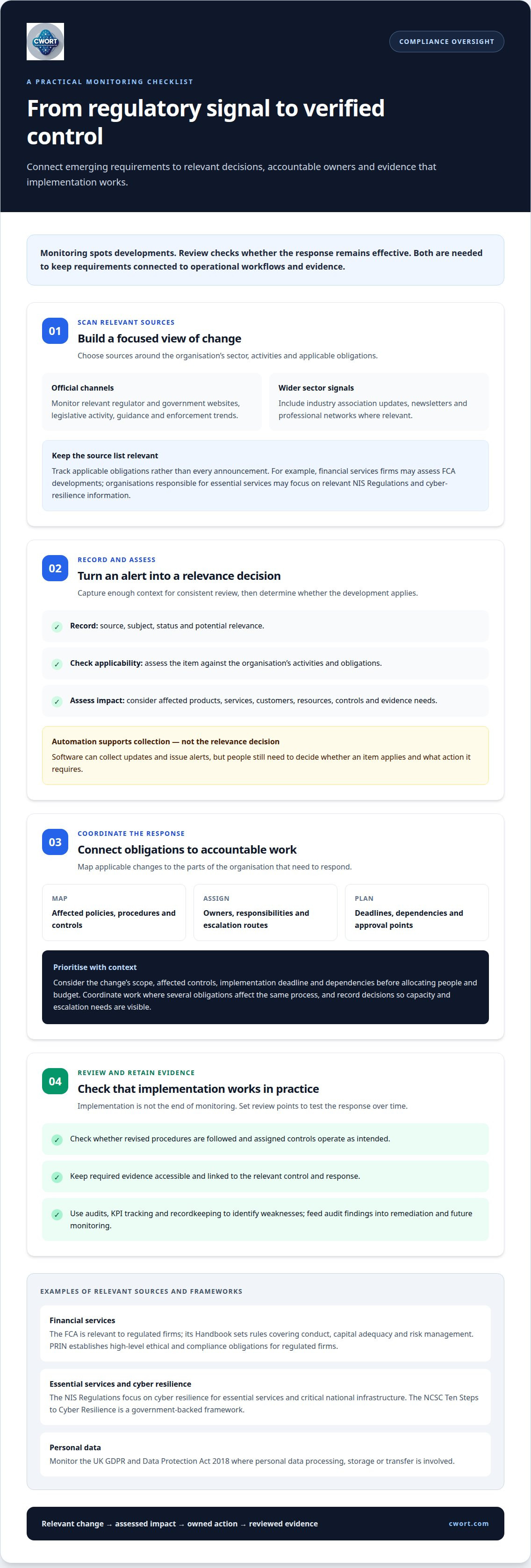
A regulatory update is controlled only when its impact reaches the people, policies and controls responsible for compliance. Managing changes in regulatory requirements means monitoring relevant developments, assessing what they affect, assigning actions and recording evidence of the organisation’s response. A list of new rules is a starting point, not proof that obligations have been implemented.
That distinction matters when requirements evolve across several frameworks or affect multiple parts of an organisation. Without a defined process, changes can be missed, deadlines overlooked and existing controls left out of step with current obligations.
This article explains regulatory change management and how to monitor developments, assess operational impact, coordinate responsibilities and manage implementation deadlines. It also covers aligning policies and controls with applicable requirements, then reviewing whether changes work as intended. The result is a structured approach that connects regulatory updates to accountable action and auditable evidence.
Key Takeaways
- Connect regulatory updates to the policies, processes and controls they may affect.
- Use horizon scanning to spot proposed changes early, then assess their relevance before they take effect.
- Assign clear owners, escalation routes and deadlines so implementation work remains accountable.
- Review implemented changes and retain evidence to support ongoing oversight and auditability.
- Use structured compliance assessment and control mapping to turn applicable requirements into traceable action.
Table of Contents
- What is Regulatory Change Management?
- Monitoring and reviewing implemented changes
- Regulatory uncertainty and implementation deadlines
- Assessing regulatory impact on products and customers
- Aligning policies and controls with applicable regulations
- CWORT
What is Regulatory Change Management?
Regulatory change management connects new or changing obligations to accountable decisions, operational controls and evidence. A disciplined approach to managing changes in regulatory requirements also accounts for sector differences: UK financial services, essential services and data processing each face distinct frameworks.
Organisational Change and Compliance
Organisational change management is the structured process of assessing a change, assigning ownership and implementing the response. It matters because a rule can affect several teams, not just compliance: a policy revision may require new workflows, staff training and control evidence. A proactive process gives each affected team clear accountability and helps prevent regulatory updates from becoming unassigned tasks.
Sector obligations differ in scope and purpose. The FCA Handbook sets rules for UK financial services firms, while PRIN establishes high-level ethical and compliance obligations for regulated firms. Solvency II concerns insurers’ capital requirements; the NIS Regulations focus on cyber resilience for essential services and critical national infrastructure. The UK GDPR and Data Protection Act 2018 govern personal data processing, storage and transfer. Organisations must identify which frameworks apply to their activities before assessing a change.
Assess operational, financial and customer effects. A proposed requirement may affect service delivery, available resources, customer experience or the evidence needed to demonstrate compliance. Where product safety or efficacy is relevant, assess those effects before implementation. This helps teams tailor the response, distinguishing a policy update from a change requiring system configuration, revised procedures or staff education.
Resource constraints make prioritisation essential. Assess the change’s scope, affected controls, implementation deadline and dependencies before allocating people and budget. If several obligations affect the same process, coordinate the work rather than creating duplicate projects. Record decisions, owners and approval points so leaders can see where capacity is committed and where escalation is needed.
Tools for Compliance Oversight
Compliance software, risk assessments and audits help organise obligations, evaluate exposure and test implementation. They matter because manual records can separate a regulatory update from the policy, control owner and evidence needed to respond. Software can link regulations to internal policies and procedures, risk assessments can help prioritise gaps, and audits can examine whether controls operate as intended.
Use those tools as connected oversight, not isolated repositories. Maintain a central record of applicable obligations and updates, then map each change to affected policies, procedures and controls. Automate monitoring or alerts where suitable, but retain human assessment of relevance and impact. An audit can then test implementation evidence against the assigned control, while findings feed remediation and future monitoring. ISO 27001, an international information security risk management standard, can also inform control mapping where relevant.
Monitoring and reviewing implemented changes
Continuous monitoring identifies regulatory developments; review confirms that implemented responses remain effective. Together, these activities connect regulatory compliance to changing requirements, operational workflows and evidence.
Continuous Regulatory Monitoring
Continuous regulatory monitoring is the structured collection and assessment of relevant proposed rules, guidance, legislative activity and enforcement trends. Horizon scanning can surface emerging issues before a change is finalised, giving affected teams time to assess possible impacts. Monitor official regulatory and government websites, industry association updates, newsletters and professional networks. Record each item’s source, subject, status and potential relevance so it can be assessed consistently.
Manual monitoring is challenging when updates arrive through separate channels or concern several jurisdictions. A missed bulletin can leave an obligation outside the organisation’s review workflow; duplicate alerts can consume time without improving oversight. Assign responsibility for reviewing sources, filtering irrelevant notices and escalating potentially significant developments. Software may automate collection and alerts, but people still need to determine whether an item applies and what action it requires.
Relevant Regulator Updates
The relevant sources depend on the organisation’s sector, activities and obligations. The FCA is relevant to regulated financial services firms, and its Handbook sets rules covering conduct, capital adequacy and risk management. For cyber-resilience developments, the NCSC Ten Steps to Cyber Resilience is a government-backed framework. UK legislation, including the UK GDPR and Data Protection Act 2018, is another source to monitor where personal data is involved.
Monitoring needs differ by sector. A financial services firm may assess FCA developments against its regulated activities, while an organisation responsible for essential services may focus on relevant NIS Regulations and cyber-resilience information. Build a source list around applicable obligations rather than tracking every announcement. This keeps monitoring focused and gives reviewers context to decide whether an update needs escalation.
Monitoring does not end when a change is implemented. Set review points to test whether revised procedures are followed, assigned controls operate as intended and required evidence remains accessible. Internal or third-party audits, KPI tracking and recordkeeping can reveal weaknesses between implementation and the next formal review. Assign corrective actions arising from findings, and record progress and approvals for oversight.
Close the loop by comparing the implemented response with the original change assessment. Confirm that affected workflows and controls were addressed, document unresolved issues, and route new developments back through assessment. A structured compliance monitoring workflow can help teams connect updates, decisions and evidence in one traceable process.
Regulatory uncertainty and implementation deadlines
Unclear wording, phased effective dates and dependencies can make implementation difficult to sequence. A formal change framework turns interpretation into assigned decisions, timed actions and recorded evidence.
Assigning and Tracking Implementation Tasks
Task assignment identifies who interprets a change, approves the response and delivers each implementation activity. It matters because cross-functional changes can stall when responsibilities fall between teams. Assign an accountable owner, affected departments, dependencies and target dates, then track progress in a shared workflow. Escalate overdue tasks and unresolved interpretations through a defined internal route instead of leaving them in informal correspondence.
Regulatory uncertainty calls for controlled interpretation. Record the relevant wording, the organisation’s assessment, assumptions and approval, then revisit them when new guidance or clarification emerges. Where ambiguity affects several functions, bring together compliance, operations, technology and other relevant specialists. Collaboration with regulators or experts can help clarify language and anticipate changes, while documented decisions preserve the reasoning behind the chosen response.
Plan implementation around the stated effective date and any phased requirements. Break work into deliverables such as policy revisions, control updates, system changes and staff training. Map dependencies before setting internal milestones: a procedure may need approval before training materials can be finalised. When several departments are affected, coordinate their work under one change record so progress and delays remain visible across the organisation.
Testing and Documenting Changes
Testing and documentation verify that an implemented response works as intended and create a traceable record of decisions. A completed task alone does not demonstrate that a revised workflow or control works. Test changes before full rollout where appropriate, record results and approvals, and retain evidence against the relevant obligation. Document defects and assign corrective actions to named owners.
Best practice includes communicating what is changing, why it matters, who is affected and when the new process applies. Use role-specific training rather than relying on a general announcement: staff handling a revised approval workflow need practical guidance on that workflow. Emails, town halls, open forums and question-and-answer sessions can support communication. Record attendance or completion where it provides useful evidence, and give staff a way to raise implementation issues.
After rollout, review the implementation against the original assessment. Check whether the revised control is operating, staff understand their responsibilities and outstanding actions have owners. Compare test results and audit findings with the intended outcome, then update procedures or training where gaps remain. For phased changes, review each stage before proceeding so defects can be corrected before they carry into later work.
Keep the change record current from interpretation through review. Link approvals, communications, test evidence and corrective actions to the relevant requirement. This gives internal oversight a clear account of what was decided, who acted and how the organisation assessed the outcome.
Assessing regulatory impact on products and customers
An impact assessment connects a regulatory change to affected products, services, customers and operational controls. It helps teams determine exposure, urgency and the response needed before implementation.
Evaluating Regulatory Risks
Regulatory risk assessment evaluates how a change could affect operations, financial capacity and customer experience. The same obligation can have different impacts across products, services and delivery channels. Trace the change to affected activities, then assess potential gaps, dependencies and consequences. For a product, consider whether design, documentation, approvals or customer information need review.
Make tracking specific to the change. Record its source and status, the requirements under assessment, affected products or services, and the teams involved. Then evaluate the likelihood and effect of a control gap alongside the work needed to address it. This supports defensible prioritisation instead of treating every update as equally urgent.
Assess customer impact directly. For example, the FCA’s Consumer Duty requires UK financial firms to act in good faith, avoid foreseeable harm and help customers make informed decisions. When assessing a relevant change, consider whether product features, communications or service processes could affect those outcomes. Document the reasoning and identify customer-facing practices that need adjustment.
Prioritising Changes by Risk and Urgency
Prioritisation ranks changes by exposure, time sensitivity and implementation demands. It helps teams direct available capacity towards work with the greatest potential impact. Consider the obligation’s scope, affected customers, operational dependencies, effective date and effort required. A change affecting a critical customer process and several controls may need earlier coordination than a contained documentation update.
Implementation cost should inform sequencing, not override the obligation. Estimate the work by identifying required expertise, system or process changes, training and assurance activities. Compare those demands with deadlines and dependencies, then escalate resource conflicts to accountable decision-makers. Record the rationale, including why work is staged and how interim risks are managed.
Consequences of Non-Compliance
Non-compliance can damage an organisation’s reputation and jeopardise important contracts. An overlooked change can affect commercial relationships as well as control performance. The applicable regime determines whether enforcement action or penalties may follow; assess the relevant provisions rather than assuming the same consequences apply across UK sectors.
For each material change, document potential customer, operational and contractual consequences alongside compliance exposure. Identify controls that reduce those risks, the owners responsible for action and the evidence needed to demonstrate completion. This helps leaders assess trade-offs and address high-impact gaps before they undermine customer confidence or business relationships.
Review the assessment when guidance, implementation plans or business conditions change. If a product change affects customer outcomes, reassess communications and service delivery as well as technical controls. Record decisions and unresolved risks, then feed review findings into the next assessment cycle. This keeps regulatory impact analysis connected to actual products and customer-facing practices.
Aligning policies and controls with applicable regulations
Regulatory alignment means linking applicable obligations to the processes, policies and controls that put them into practice. A clear mapping helps organisations identify where evolving regulatory updates require operational changes.
Mapping Regulations to Business Processes
Mapping records how each obligation connects to business activities, internal policies, procedures and accountable control owners. A regulation cannot be managed effectively if operational responsibilities are unclear. Start with an obligations register, then connect each requirement to the processes it affects and the controls intended to address it.
For example, the SYSC framework requires UK financial firms to maintain effective risk management and governance structures. Mapping relevant SYSC requirements to governance policies, risk processes and control owners helps reveal gaps and duplicated controls. Include an escalation route for each owner so issues reach the right decision-maker when a control needs revision.
A useful map also shows relationships between requirements. One business process may support several obligations, while one regulation may affect different teams and procedures. Record these links alongside evidence that demonstrates control operation. When an update arrives, reviewers can trace its effect through the map instead of searching disconnected policy files and process documents.
Keep the mapping aligned with actual operations. If a process changes, assess whether its linked controls and policies still reflect current responsibilities. This makes the obligations register useful for future impact assessments, not just a static record of regulatory texts.
Updating Policies, Procedures and Systems
Policy and control updates translate identified gaps into revised requirements for employees, workflows and systems. They matter because a policy amendment alone may not change day-to-day behaviour. Define the practical response for each affected process, including who must act, what changes and which evidence will show completion.
Identify each document and operational component that needs revision. A new control expectation may require updated policy wording, a revised procedure, changed approval steps, staff training or a system configuration change. For example, if a revised workflow adds a review responsibility, update both the procedure and the relevant control description. Assign an owner to each deliverable and record approvals.
Control versions carefully. Link each approved document to the applicable obligation, record its effective date and distinguish superseded instructions from current ones. Communicate changes to affected employees through role-relevant guidance, then capture acknowledgement or training evidence where appropriate. This reduces the risk of teams following inconsistent instructions across locations or functions.
Review linked controls after updates to confirm that policies, procedures and systems remain aligned. A control mapping review can show whether the revised requirement has an owner, an operating process and evidence. Explore a structured approach to regulatory control mapping when your organisation needs clearer links between obligations and execution.
CWORT
CWORT helps organisations turn applicable regulatory obligations into structured activities, assigned responsibilities and evidence linked to control outcomes. Its compliance validation platform supports traceable execution and auditable proof, helping teams manage requirements across a defined framework rather than disconnected records.
Turn to CWORT when regulatory updates affect multiple controls, teams or frameworks and you need clearer oversight of the resulting work. Relevant offerings include DORA Compliance Readiness and Assessment, UK NIS Compliance Management, NIS2 Readiness and Compliance Management, and ISO 27001 Readiness and Control Mapping.
Contact CWORT to discuss how structured compliance validation could support your organisation’s requirements.
Make your next regulatory decision actionable
Make managing changes in regulatory requirements part of how decisions are governed, not a separate exercise triggered by each update. Set a clear point at which emerging obligations enter leadership oversight, and ensure owners can escalate unresolved interpretations, resource constraints or implementation risks. This gives decision-makers a basis for directing attention before competing priorities obscure accountability.
Where your organisation needs structured support, CWORT offers DORA Compliance Readiness and Assessment, UK NIS Compliance Management, and NIS2 Readiness and Compliance Management. These offerings help organisations assess relevant requirements and organise compliance activity around them.
Use the discussion to identify which frameworks matter to your organisation and where clearer validation or control mapping could support oversight. Contact CWORT to discuss your needs, and take the next step towards a more controlled, evidence-based approach.
Frequently Asked Questions
What does managing changes in regulatory requirements involve?
Managing changes in regulatory requirements involves identifying relevant developments, deciding whether they apply, assessing their effects, assigning response work and retaining decision evidence. It goes beyond collecting notices: it connects interpretation to policies, controls, accountable owners and review. For example, a change affecting customer onboarding could prompt a revised procedure, staff guidance and a check that the updated process works consistently across relevant teams.
How can organisations monitor changes to UK laws and regulations?
Organisations can monitor relevant regulator and government websites, legislative updates, industry association bulletins and professional networks. Build a source list around the organisation’s activities: a financial services firm may follow FCA updates, while cyber-resilience teams may monitor NCSC material and relevant legislation. Assign someone to screen each source, record potentially relevant developments and escalate items for assessment. Newsletters can complement direct monitoring, but should not replace it.
What steps should businesses take when a regulatory requirement changes?
Start by recording the change and determining its applicability, then identify affected activities, policies, controls and customers. Assign owners to the required work, set internal milestones against relevant effective dates and identify dependencies such as approvals or system changes. Before rollout, test revised processes where appropriate and provide role-specific guidance. Close the loop by recording approvals and evidence, then reviewing whether the response addresses the identified impact.
How can organisations assess the impact of regulatory changes on operations and compliance?
Assess which services, processes, systems and customer interactions may be affected, then identify controls that may need adjustment. Consider operational disruption, resource demands, financial capacity and customer outcomes. For example, a change affecting data handling may touch both a technical process and the instructions employees follow. Document affected areas, dependencies and gaps, then prioritise actions by exposure and timing so the assessment leads to an accountable response.
How should regulatory changes be assigned, tracked and documented?
Give each change a named owner, clear status, target milestones and an escalation route. Track dependencies and decisions alongside delivery so delayed approvals or unresolved interpretations are visible. Keep a record linking the original notice to the applicability assessment, affected controls, approvals and supporting evidence. This creates a usable audit trail: reviewers can see not only that tasks were completed, but why the organisation chose its response.
What tools and systems help manage regulatory change and compliance obligations?
A central obligations register, workflow system and evidence repository can help teams coordinate regulatory updates. Useful capabilities include linking requirements to controls and owners, tracking actions, recording approvals and preserving supporting evidence. Cross-framework mapping can reveal where one control supports several obligations. Automation may help collect notices or send alerts, while accountable staff assess relevance, interpret requirements and approve the organisation’s response.
Disclaimer
The content on this site is provided for general information and educational purposes only. It does not constitute legal, regulatory, financial, or professional advice. CWORT provides AI-assisted insights and workflow automation, but all compliance decisions remain the responsibility of your organisation and its management. Always seek qualified legal or regulatory guidance for decisions relating to the UK NIS Regulations, CAF, DORA, NIS2, ISO 27001, or other obligations.
Related posts
Four ways to understand and reduce human error in compliance
Discover four ways of reducing the risk of human error in compliance, investigating near misses and improving controls, procedures and cyber risk management.
Automated regulatory reporting software benefits and workflows
Learn how automated regulatory reporting software organises data, approvals and submissions in governed workflows, with ownership and audit-ready evidence.
How to Demonstrate Control Effectiveness to Regulators: A Strategic Guide
Learn how to demonstrate control effectiveness to regulators with our guide. Shift from chaos to an evidence-based, audit-ready compliance programme today.
Article by
Michael Iyiola
Co-Founder, CWORT
Michael Iyiola is a co-founder of CWORT and a Cyber and AI Security Engineer with deep experience in vulnerability management, detection engineering and operational resilience across UK critical national infrastructure, including rail, energy and financial services. At CWORT, he designs scalable, evidence-driven workflows that help teams meet modern regulatory and security demands.
Build Your Foundation of Auditable Certainty
Take control of your regulatory obligations and secure your infrastructure with CWORT.