Regulatory Compliance Audit Software: How to Choose a System That Proves Compliance

Michael Iyiola
Co-Founder, CWORT
Choose regulatory compliance audit software that proves compliance. Discover how to link controls to evidence, ensure accountability, and satisfy auditors.

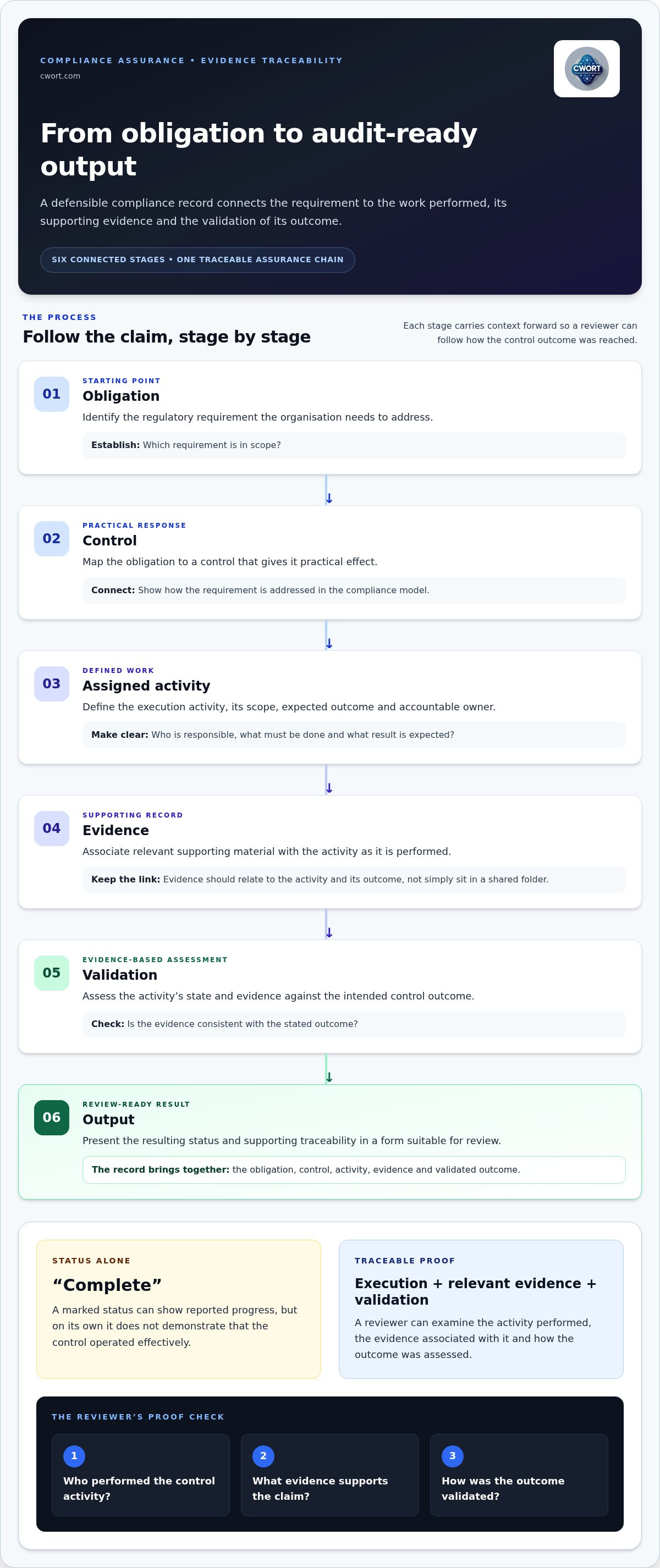
What if an audit status marked “complete” can’t show who performed the control, what evidence supports it or how the outcome was validated? That’s the gap regulatory compliance audit software must close. When obligations, owners and evidence sit across disconnected workflows, a polished report can create confidence without providing defensible proof.
Choosing a system is about more than recording requirements. You need to trace each obligation through accountable ownership and control execution to evidence that supports a clear, auditable outcome. That matters across frameworks such as DORA, NIS2, UK NIS, ISO 27001 and the NCSC Cyber Assessment Framework.
This guide explains how to assess software for evidence quality, execution traceability, role-based accountability and reliable validation. You’ll learn how to distinguish visible progress from demonstrated control effectiveness, establish a dependable basis for readiness and present audit outputs that boards, auditors and regulators can follow. It also shows how CWORT connects obligations, controls, execution activities and evidence through structured checkpoints and automatically generated audit-ready outputs. The aim is a system that proves compliance, not simply another layer of reporting.
Key Takeaways
- Assess regulatory compliance audit software by whether it links obligations to control execution, evidence and defensible outputs, not just status updates.
- Trace each compliance claim through its control, assigned activity, supporting evidence and validation to make reviews more reliable.
- Compare systems on evidence linkage, accountable ownership, separation of duties and the clarity of generated audit outputs.
- Keep a pilot focused on one programme or sub-function. Map responsibilities, evidence checkpoints and approval paths before activity begins.
- See how CWORT connects requirements to controls and execution activities, enforces role-based ownership and separation of duties, and generates audit-ready outputs.
Table of Contents
- What Does Regulatory Compliance Audit Software Actually Need to Prove?
- How Should Compliance Audit Software Connect Controls, Execution and Evidence?
- How to Compare Regulatory Compliance Audit Software Without Buying Another Status Tracker
- How to Pilot Compliance Audit Software and Validate Its Governance
- How CWORT Turns Regulatory Compliance Audit Software into Compliance Proof
What Does Regulatory Compliance Audit Software Actually Need to Prove?
Regulatory compliance audit software helps teams manage obligations, control execution, evidence and audit outputs. Evidence-backed validation connects a compliance claim to who performed the relevant activity, what evidence supports it and how the outcome was assessed. A status tracker can show that a control is marked complete, but that status alone doesn’t demonstrate that the control operated effectively.
That distinction matters because a percentage or tick may reflect reported progress rather than verified execution. To assess a claim, a reviewer needs a clear route from the applicable obligation to the control, its accountable owner, the activity performed and the supporting evidence. The evidence should relate to the activity and its outcome, not simply exist in a shared folder.
Fragmented records make that route harder to follow. If requirements sit in one document, owners in a spreadsheet and evidence in separate folders or email threads, teams must piece the context together during reviews. They may struggle to establish who was responsible, whether the evidence relates to the right control and how the reported status was reached. A connected record makes those relationships easier to examine and challenge.
Which compliance and audit problems should the software address?
Start with the workflow the system needs to support. It should connect relevant regulatory requirements to controls, accountable owners and defined execution activities. It should also preserve traceability from the original obligation through the activity and evidence to the resulting control outcome. That gives compliance and assurance teams a basis for review, rather than an isolated completion field.
For example, reviewers should be able to examine a control marked complete alongside the activity undertaken and the evidence associated with it. If evidence is missing, unclear or inconsistent with the stated outcome, the claim needs further assessment. Software can organise the process and make its records accessible, but it can’t take on the organisation’s responsibilities. Leaders and control owners remain accountable for their decisions and actions. For a broad introduction to the subject, see What is regulatory compliance?
Who benefits from regulatory compliance audit software?
Enterprise compliance, risk, assurance and audit leaders benefit from reviewing obligations and evidence through a consistent structure. Consulting teams coordinating compliance delivery for clients can also use defined activities and checkpoints to organise work and assess progress. The needs differ by role:
- Executives need a credible view of readiness, with enough context to understand what reported status represents.
- Auditors need records that let them trace claims to execution and examine the evidence behind an outcome.
- Control owners need clarity about their responsibilities and the evidence that supports completion.
- Programme leads need visibility across activities, ownership and validation so they can identify where review or follow-up is required.
The right regulatory compliance audit software brings those perspectives into one traceable assurance process. It doesn’t transfer accountability to the system; it helps the organisation demonstrate how its compliance claims were reached.
How Should Compliance Audit Software Connect Controls, Execution and Evidence?
A defensible compliance record needs a traceable chain, not a collection of disconnected features. Regulatory compliance audit software should connect each requirement to the work performed, the evidence associated with that work and the validation of its outcome.
- Obligation: Identify the regulatory requirement the organisation needs to address.
- Control: Map the obligation to a control that gives it practical effect.
- Assigned activity: Define the execution activity, its scope, expected outcome and accountable owner.
- Evidence: Associate relevant supporting material with the activity as it is performed.
- Validation: Assess the activity’s state and evidence against the intended control outcome.
- Output: Present the resulting status and supporting traceability in a form suitable for review.
From regulatory obligation to assigned execution
A mapped control shows how a requirement is addressed in the compliance model. It doesn’t show, on its own, that anyone carried out the control. That takes a defined activity with an owner, clear boundaries and an expected result. For example, an activity might require a named role to complete a specified review and record its outcome. Without that execution detail, a control can appear covered whilst its practical operation remains unclear.
Make ownership explicit rather than relying on a department name or shared inbox. Governance should also distinguish execution and review responsibilities through separation of duties. This makes accountability visible and helps prevent self-reported completion from being mistaken for independent assurance. Software can structure and enforce workflow responsibilities, but the organisation remains accountable for its governance decisions.
Evidence, validation state and defensible outputs
Evidence is most useful when captured through defined checkpoints and linked to the activity it supports. A file stored against a broad control may lack the context a reviewer needs. Linking evidence to an activity state and control outcome makes it easier to understand what was done, what supports the reported result and where further validation is needed.
Evidence binding connects supporting material to the activity state and control outcome it substantiates, giving reviewers a traceable basis for assessing a compliance claim.
A continuing validation view shows how programme execution stands as activities progress, rather than presenting status without supporting context. Generated outputs should preserve the relationship between obligation, control, activity, evidence and outcome so boards, auditors and regulators can follow the basis for reported readiness. CWORT binds evidence to activity state and control outcomes, then automatically generates audit-ready PDF outputs.
To see how a requirement-to-control-to-activity workflow can support this chain, explore CWORT’s compliance validation system.
How to Compare Regulatory Compliance Audit Software Without Buying Another Status Tracker
Compare systems by following a compliance claim back to its source. A completion percentage is easy to scan, but it doesn’t show whether the work was performed, the evidence supports the outcome or the right people validated it. Ask for a demonstration using a real requirement, then follow its record from control to reported result.
The strongest test of audit software is whether a reviewer can trace every reported control outcome to the activity and evidence that support it. Use that test to distinguish systems that record progress from those that support evidence-linked validation.
What evidence and control tests should buyers apply?
Use a sample obligation in the demonstration. Ask the reviewer to move from requirement to control, assigned activity and evidence without relying on a separate explanation. Check whether evidence is linked to a defined activity state and control outcome, rather than merely stored against a general topic. Then examine whether responsibility and changes to the record remain visible in an auditable history.
Test exceptions, too. If evidence is absent or doesn’t support the stated result, can the record make that gap apparent? The system should help reviewers assess the basis for an outcome, not just display its current label.
How to assess accountability, reporting and framework coverage
Confirm that role assignment and separation of duties are part of the workflow, not simply guidance outside it. Check whether outputs are generated from validation records and retain their context, rather than requiring a fresh reporting exercise. Then compare the system’s stated framework coverage with the organisation’s obligations. For example, CWORT supports DORA, NIS2, UK NIS, ISO 27001 and NCSC CAF. The key test is whether that coverage fits the programme you need to evidence.
Keep the comparison anchored to demonstrated outcomes. A dashboard can summarise status; a defensible audit record must show what supports it.
How to Pilot Compliance Audit Software and Validate Its Governance
A bounded pilot tests whether regulatory compliance audit software works in your organisation’s governance context, not just in a polished demonstration. Choose one programme or sub-function, define who will participate and agree what the pilot must prove before activity begins. Set a representative scope that can expose workflow and accountability issues, while remaining narrow enough to assess properly.
Design a controlled pilot with clear acceptance criteria
Set the scope first. Select a compliance area with identifiable obligations, accountable control owners and evidence requirements. Map responsibilities, checkpoints, access needs and approval paths before participants start. This baseline helps distinguish a platform issue from an unclear process or an unassigned responsibility.
Then agree acceptance criteria that can be observed, rather than relying on impressions such as “easy to use”. For example, can a reviewer trace a selected obligation through its control and assigned activity to the evidence and resulting output? Can the appropriate roles carry out their responsibilities whilst separation of duties is maintained? Can the team explain how the reported validation status was reached?
- Access: Test whether participants can access the information needed for their assigned role, and assess tenant isolation against your governance model.
- Responsibility: Check that ownership and approval paths are clear, including how execution and review responsibilities are separated.
- History: Examine whether responsibilities and relevant changes remain visible in the record for later review.
- Outputs: Confirm that generated results retain a traceable connection to the pilot’s activities, evidence and validation decisions.
Use a sample record to test reproducibility. Give a reviewer the obligation and ask them to follow the route to the output without relying on verbal context from the person who completed the activity. Note where they pause, need clarification or can’t establish the basis for a reported result. Those are meaningful findings, not minor presentation issues.
Measure operational fit before wider adoption
During the pilot, observe how existing teams handle the workflow. Do control owners understand their responsibilities? Can programme leads see where evidence or review is outstanding? Does the process preserve accountability rather than shifting it into an administrative step? Record friction and unclear hand-offs as governance findings.
Also examine how evidence from operational tools enters the process. Identify the evidence used, who associates it with an activity and how reviewers establish its relevance to the outcome. Don’t assume that data from an existing tool automatically constitutes suitable evidence. Document workflow gaps, decisions and dependencies before expanding the scope.
Finish with a clear decision record: which acceptance criteria were met, which remain open and what must change before wider adoption. To assess CWORT’s requirement-to-control-to-activity workflow and evidence-linked validation, request a CWORT demonstration.
How CWORT Turns Regulatory Compliance Audit Software into Compliance Proof
CWORT is a compliance validation system developed by Lapace Services UK Ltd. It connects regulatory requirements to controls, execution activities, evidence and control outcomes. Rather than simply recording progress, its workflow links reported status to the activity and evidence behind it.
For organisations assessing regulatory compliance audit software, the distinction is practical. A control can be mapped to an obligation, but the organisation still needs to establish what was done, who was accountable and what supports the outcome. CWORT structures those relationships with role-based ownership and separation of duties enforced by design.
How CWORT structures execution and validation
CWORT translates regulatory requirements into controls and execution activities. Roles are assigned within the workflow, and separation of duties is built into its design. Evidence is bound to activity state and control outcomes, giving reviewers a traceable connection between the work performed and the result recorded. This is the operating principle of a compliance validation system: connect requirements to execution and support the resulting claim with associated evidence.
This approach supports DORA compliance validation with a structured path from requirement to control and activity. A mapped control alone isn’t treated as proof. Evidence binding relates the activity’s state to its control outcome, helping reviewers understand the basis for validation.
What teams can review in the CWORT programme cockpit
The programme cockpit presents execution status alongside a continuous validation state. Teams can review programme activity as it progresses and see validation in context, rather than relying on a standalone completion figure. Structured checkpoints support the capture of delivery evidence as activities move through the workflow.
This view supports different oversight needs. Programme leads can examine execution status, control owners can see activity responsibilities, and assurance reviewers can follow evidence and outcomes. The cockpit provides visibility into the programme’s state, while connected records give reviewers the context to assess what that state represents.
CWORT automatically generates regulator-ready and audit-ready PDF outputs. Generated from the compliance workflow, these outputs present connected records of requirements, controls, activities, evidence and outcomes without requiring teams to reconstruct reports manually. They support audit and regulatory review; the organisation remains responsible for the underlying compliance decisions and execution.
CWORT supports DORA, NIS2, UK NIS, ISO 27001 and NCSC CAF. Teams can assess the system against those frameworks and their programme’s evidence and validation needs. The result is a structured route from obligation to execution, validation and an output that makes the basis for compliance claims reviewable.
Make Your Next Compliance Decision Evidence-Led
Turn your selection criteria into a practical review. Bring compliance, assurance and control owners together around one representative obligation, then assess whether the system gives each role a clear basis for confidence in the outcome. A focused discussion can clarify what matters most to your organisation before a wider evaluation.
CWORT makes that test tangible. It enforces separation of duties by design, binds evidence to activity state and control outcomes, and automatically generates regulator-ready and audit-ready PDF outputs. These capabilities let your team examine how reported readiness is supported, not just how it is displayed.
Choose regulatory compliance audit software that makes your assurance process clear and reviewable. Request a CWORT demonstration to see how the workflow can support your compliance programme and its evidence needs.
With the right system and governance in place, your team can make compliance decisions with a stronger basis for trust.
Frequently Asked Questions
Can regulatory compliance audit software guarantee that an organisation is compliant?
No. Software can’t guarantee that an organisation meets every applicable obligation. The organisation remains responsible for its controls, decisions and execution. Regulatory compliance audit software can structure the work and make validation easier to examine, but a dashboard status alone isn’t proof. A control owner should be able to explain why a status was assigned and identify the records supporting that judgement. The organisation must still determine whether the evidence is sufficient.
Does regulatory compliance audit software replace an internal or external auditor?
No. Software can organise compliance records and make supporting material easier to examine, but it doesn’t replace an auditor’s independent judgement. An auditor may select samples, challenge assumptions or request additional evidence based on the organisation’s circumstances. A generated report can provide a starting point for review, while the auditor determines whether the underlying records are persuasive and whether further testing or remediation is needed.
Can one compliance assessment support more than one regulatory framework?
Yes, where the organisation maps relevant controls and evidence to each framework and defines the assessment scope carefully. Shared evidence may support more than one requirement, but the rationale should be recorded for each mapping. A reviewer should be able to distinguish which requirement an activity addresses under each framework, rather than rely on a combined status that conceals differences in scope or assessment criteria.
What should a team do when regulatory requirements change?
Use a controlled review process to identify affected obligations, accountable owners, controls and evidence expectations. Record the assessment, the decision taken and any resulting updates so the organisation can explain its response later. Don’t assume software interprets a change or determines its legal effect. Compliance, risk and legal functions remain accountable for interpretation and approval; the system can support the governed execution and recording of agreed changes.
How can a buyer tell whether an audit output is genuinely traceable?
Choose one reported outcome and ask a reviewer who wasn’t responsible for it to establish its basis from the output. They should be able to identify the relevant control, activity, accountable role and supporting evidence, then understand how the conclusion was reached. If they need undocumented explanations from the original owner, the output may show a status without enough context for effective scrutiny.
Can regulatory compliance audit software work alongside existing security tools?
Yes. A compliance platform can complement operational tools by bringing relevant evidence into a governed view, rather than replacing every system used by security teams. First identify which sources matter, what information they provide and which controls or activities it may support. For example, an asset record might inform a control review, but the team should still establish its relevance and assign responsibility for assessing it within the compliance process.
Disclaimer
The content on this site is provided for general information and educational purposes only. It does not constitute legal, regulatory, financial, or professional advice. CWORT provides AI-assisted insights and workflow automation, but all compliance decisions remain the responsibility of your organisation and its management. Always seek qualified legal or regulatory guidance for decisions relating to the UK NIS Regulations, CAF, DORA, NIS2, ISO 27001, or other obligations.
Related posts
Streamlining Regulatory Compliance Processes: From Manual Tracking to Orchestrated Validation
Stop wasting money on manual compliance. Learn about streamlining regulatory compliance processes to reduce personal liability under DORA & NIS2 and gain aud...
Regulatory Scrutiny Management Tool: Orchestrating Defensible Compliance in 2026
Facing DORA & NIS2? A regulatory scrutiny management tool orchestrates defensible compliance, ending manual evidence chaos for permanent audit-readiness in 2...
Separation of Duties Compliance Software: Orchestrating Defensible Governance in 2026
Move beyond manual tracking. See how separation of duties compliance software orchestrates defensible governance and ensures you're ready for DORA & NIS2.
Article by
Michael Iyiola
Co-Founder, CWORT
Michael Iyiola is a co-founder of CWORT and a Cyber and AI Security Engineer with deep experience in vulnerability management, detection engineering and operational resilience across UK critical national infrastructure, including rail, energy and financial services. At CWORT, he designs scalable, evidence-driven workflows that help teams meet modern regulatory and security demands.
Build Your Foundation of Auditable Certainty
Take control of your regulatory obligations and secure your infrastructure with CWORT.