Replace Jira for Compliance: A Practical Evaluation Guide

Michael Iyiola
Co-Founder, CWORT
Deciding to replace jira for compliance management? Learn how to evaluate control assurance, map audit evidence, and plan a seamless, defensible transition.
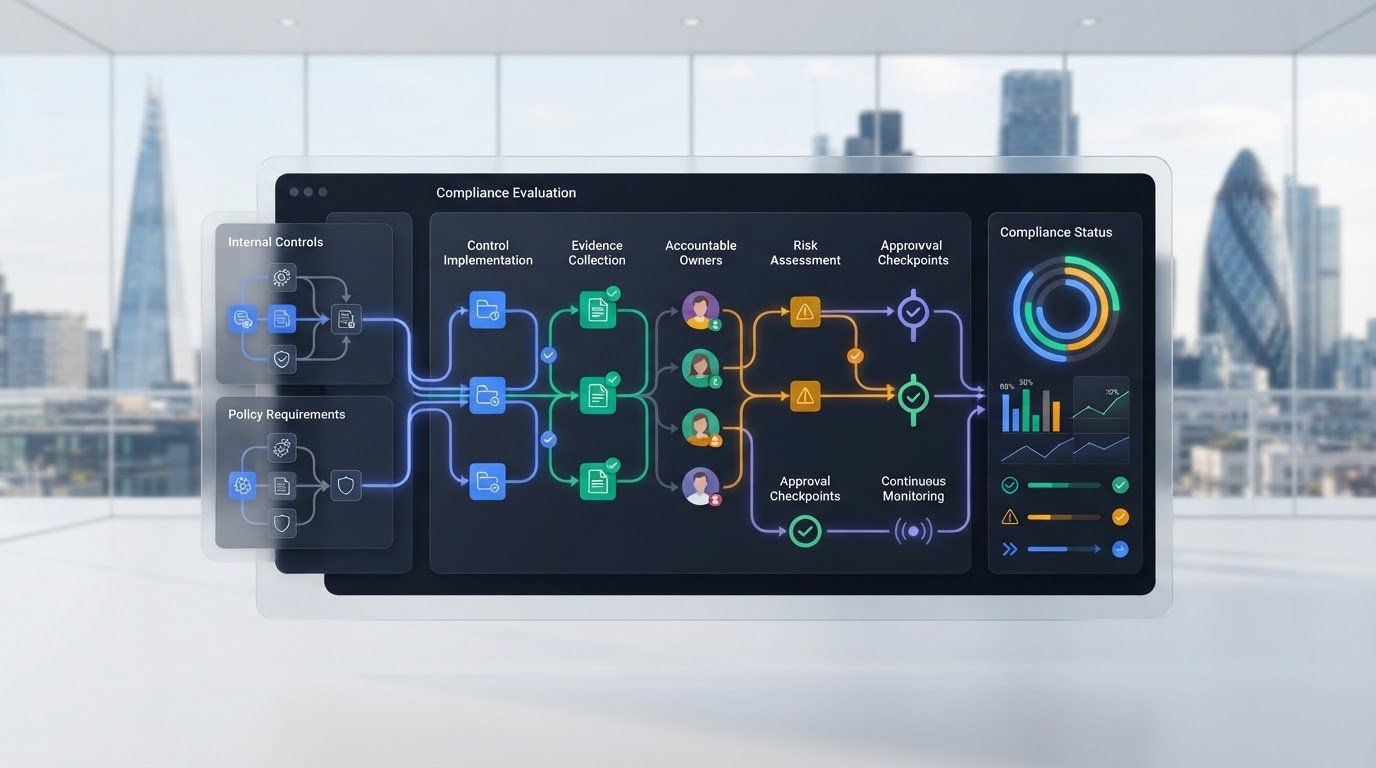
Jira may be the right place to manage compliance tasks, but that doesn’t mean it can prove compliance. If you’re asking whether to replace jira for compliance management, start with the assurance your organisation must demonstrate, not another feature checklist. Jira can remain suitable for assigning work and tracking remediation. The pressure point comes when obligations, control ownership and evidence sit across projects, making it difficult to show how evidence supports a control outcome.
Leadership, auditors and regulators need outputs that are traceable, repeatable and grounded in evidence, without teams rebuilding the story by hand for every framework report. This guide explains when Jira may remain fit for purpose, what a compliance-focused platform should demonstrate, and how to plan a controlled transition that preserves accountability, evidence and operational continuity. It also distinguishes task tracking from compliance validation: an assurance workflow should connect mapped controls, accountable owners, evidence and outcomes. The aim is a decision based on defensible assurance, not a platform swap for its own sake.
Key Takeaways
- Decide whether to replace jira for compliance management by testing whether your current setup can demonstrate control outcomes, not just record tasks.
- Assess potential replacements against control mapping, accountable ownership, evidence linkage and governance requirements.
- Compare a configured Jira environment fairly with a compliance validation platform across tracking, evidence and reporting.
- Plan any transition in controlled stages, preserving identifiers, evidence provenance, ownership and relevant approvals.
- See how a compliance validation approach can connect control diagnosis and remediation to evidence-backed outcomes.
Table of Contents
- When should you replace Jira for compliance management?
- What should a Jira replacement provide for compliance management?
- Jira or a compliance validation platform: how do the approaches compare?
- How can you replace Jira without losing compliance traceability?
- How does CWORT support compliance management beyond Jira tracking?
When should you replace Jira for compliance management?
Replacing Jira for compliance doesn’t necessarily mean removing it from every team. It means moving compliance governance, control validation and evidence management into a system designed to show how obligations are addressed and whether controls achieve their intended outcomes. Jira may still coordinate delivery work. The decision is whether it can also provide the assurance your organisation needs.
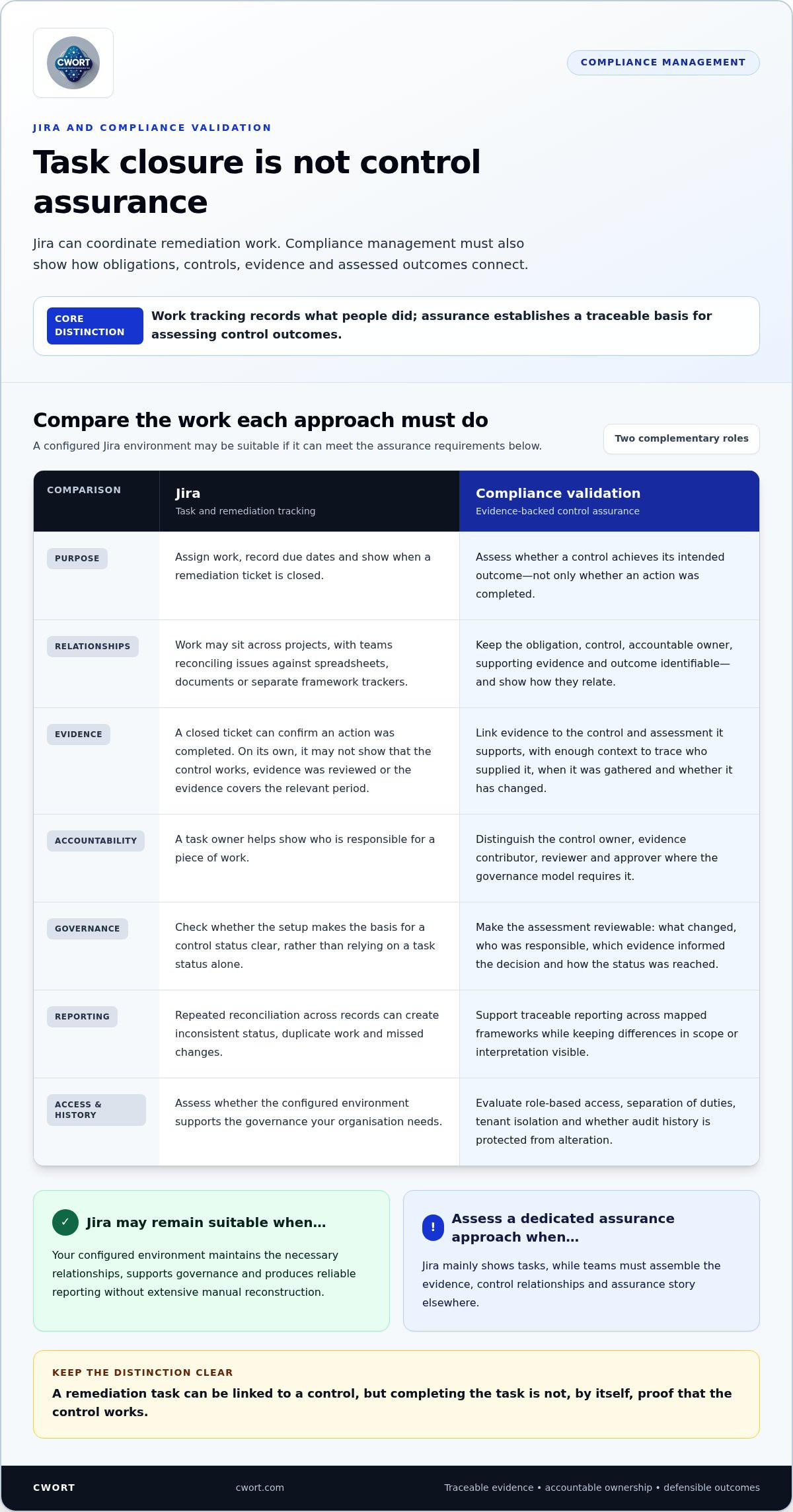
A Jira project can assign an owner, record a due date and show that a remediation ticket is closed. Those details demonstrate activity, not necessarily control effectiveness. To assess a control outcome, teams need a clear connection between the relevant obligation, the control in place, the evidence reviewed and the conclusion reached. Work tracking records what people did; compliance management establishes and maintains a traceable basis for assessing control outcomes.
Which signs show that Jira is no longer enough?
Look for friction in the reporting process, not just complaints about the interface. If teams repeatedly reconcile Jira issues against spreadsheets, documents and separate framework trackers before producing a compliance update, records are fragmented. Reconciliation also creates opportunities for inconsistent status, duplicate work and missed changes.
Check what a closed ticket actually proves. It may confirm that an action was completed, but not that the control is operating effectively, that supporting evidence was reviewed or that the evidence relates to the relevant period. If a reviewer asks why a control was assessed in a particular way, teams should be able to trace the decision back to its evidence and review history.
Unclear provenance is another warning. If staff cannot establish who supplied evidence, when it was gathered, which control it supports or whether it has since changed, audit responses can become a reconstruction exercise. The question is not simply whether a file exists, but whether its context and relationship to the control are clear.
What does compliance management need beyond task tracking?
Keep distinct the elements a task board can otherwise collapse into one issue: the obligation being addressed, the control intended to meet it, the accountable owner, the evidence supporting an assessment and the validated outcome. Each should remain identifiable, with clear relationships between them. A remediation task can then be linked to a control without being mistaken for proof that the control works.
Governance also requires reviewable change. Teams need to understand how a control’s status was reached, what changed, who was responsible and which evidence informed the assessment. Governed access helps ensure responsibilities and information are handled appropriately, while a traceable history supports scrutiny and consistent decision-making. These are central concerns within Governance, Risk, and Compliance (GRC), where oversight, risk and compliance activity need to operate as a coherent whole.
Use a practical threshold: if your configured Jira environment can maintain these relationships, support the necessary governance and produce reliable reporting without extensive manual reconstruction, it may remain suitable. If it mainly shows tasks and teams must assemble the assurance story elsewhere, assess whether to replace jira for compliance management. The goal is not to replace a familiar tool for its own sake. It is to manage validation and evidence as part of the control lifecycle.
What should a Jira replacement provide for compliance management?
Evaluate the assurance workflow, not the size of a feature list. A suitable platform should connect each obligation to mapped controls, accountable owners, supporting evidence and a reviewable outcome. It should also show how that outcome was reached and who had authority to record or approve it. Resources such as NIST cybersecurity and privacy compliance illustrate the breadth of considerations organisations may need to account for. Start your evaluation with your own frameworks, operating model and governance requirements.
Use these criteria to test whether a platform can support assurance from assessment through reporting:
- Control mapping: Can one control be mapped to relevant requirements across frameworks, while keeping differences between those requirements visible?
- Accountability: Can the system distinguish the control owner, evidence contributor, reviewer and approver where your governance model requires it?
- Evidence and outcomes: Is evidence linked to the control and assessment it supports, alongside a clear status and rationale?
- Access and history: Can you assess role-based access, separation of duties, tenant isolation and whether audit history is protected from alteration?
- Operational fit: Can teams use the workflow consistently, govern its configuration and export reports with traceability intact?
Test cross-framework reporting with a real example. If one assessment informs reporting against several mapped frameworks, check that the relationship is explicit and that differences in scope or interpretation aren’t flattened into a single status. Reusing an assessment can reduce duplicated work, but it shouldn’t imply automatic regulatory approval or prove requirements that weren’t assessed.
How should evidence and control outcomes be connected?
Require each evidence record to identify the control it supports, the assessment period or context, its source and the outcome informed by review. Make ownership and status visible, with changes reviewable over time. This helps a reviewer distinguish current evidence from an outdated attachment and understand why a control was assessed as effective, partially effective or requiring remediation.
Evidence-bound control validation connects a defined control outcome to identifiable evidence, accountable review and traceable changes.
Which governance and reporting capabilities should be tested?
Run role-based scenarios, not just a dashboard demonstration. Check whether the platform can separate preparation, review and approval in line with your governance needs, restrict access appropriately and maintain separation between tenants where applicable. Ask how changes to control records, evidence and assessments are recorded, then verify whether that history is protected from unauthorised alteration.
Inspect a sample report from the leadership view back to its source. Can each reported status be traced to a control, owner, evidence record and review? Check whether outputs can be exported in a usable format without losing those relationships. Include usability and implementation governance in the assessment: teams need clear responsibilities for configuring workflows, maintaining mappings and reviewing changes. Explore CWORT’s compliance validation approach to see how these criteria apply in practice.
Jira or a compliance validation platform: how do the approaches compare?
Compare the operating model, not the product label. A configured Jira environment may support well-managed compliance activity, particularly where scope is bounded and teams have established workflows. A compliance validation platform is designed to organise assurance around controls, evidence and outcomes. The right choice depends on the assurance you must demonstrate, the scale of the programme and the complexity of framework overlap.
Use the comparison below to assess both approaches against the same lifecycle, from interpreting obligations to demonstrating assurance. Capabilities depend on configuration, process and governance, so treat the Jira column as questions to test in your own environment, not a verdict on every implementation.
When can configured Jira remain a reasonable choice?
Jira may remain appropriate for a bounded programme with a straightforward workflow, limited framework overlap and a manageable evidence set. Test a real reporting cycle: can the team maintain evidence links, ownership and review history, then produce a reliable view without excessive spreadsheet reconciliation or repeated manual administration? If the process is controlled and proportionate, replacing Jira may add complexity without improving assurance.
When does dedicated compliance validation offer a better fit?
A dedicated platform becomes more relevant when teams need mapped controls, repeatable evidence-backed assessments and consistent outcome evaluation across several frameworks. Crosswalks can help reuse assessment work where controls genuinely overlap, while preserving framework-specific distinctions. CWORT provides deterministic, reproducible scoring, so identical evidence produces the same result. Its control taxonomy library contains 1,355 controls across 217 domains and 42 frameworks or standards, as of June 2026.
For regulated assurance work, compare the platform’s assessment method with the evidence and outcomes your organisation needs to demonstrate. CWORT’s DORA Compliance Readiness and Assessment supports organisations assessing their DORA compliance readiness. Ultimately, replace jira for compliance management when configured work tracking cannot support the required control validation and reporting without fragile workarounds. Keep the decision evidence-led: compare the full lifecycle, identify where governance breaks down, and select the approach that makes assurance repeatable and reviewable.
How can you replace Jira without losing compliance traceability?
Make the transition a controlled assurance exercise, not a bulk transfer of open tickets. Before changing systems, establish what each record means, who is accountable for it and how it supports a compliance decision. Don’t assume Jira data will transfer automatically. Plan how records will be assessed, mapped and validated in the destination process.
Use a staged sequence:
- Inventory: Gather obligations, controls, owners, evidence references, statuses and review history.
- Classify: Identify duplicates, stale records, unresolved actions and evidence without a clear control relationship.
- Map: Agree how source identifiers and framework references relate to the new control structure. Assign an owner to resolve gaps.
- Configure: Set up roles, review steps, status definitions and reporting before moving live activity.
- Validate: Test the records and workflow against documented acceptance criteria, then log exceptions and decisions.
- Transition: Move the agreed scope into operational use and monitor the handover before expanding it.
Preserve source identifiers or maintain a documented cross-reference so teams can trace a new record back to its origin. Retain accountable owners, evidence provenance, status history and relevant approvals. If a record is incomplete, don’t silently convert it into a clean status. Flag the gap, assign responsibility and record the rationale for any decision about how to handle it.
What should the transition inventory capture?
Capture enough context to reconstruct the compliance position at the point of transition: the obligation, mapped control, accountable owner, evidence source, current status and available review or approval history. Record duplicates and outdated material explicitly rather than deleting them without a decision trail. For every unmapped requirement or orphaned evidence item, name an accountable person and define how resolution will be recorded before that item enters the new workflow.
How should teams validate the new workflow?
Pilot one defined scope, such as a control group or assessment cycle. Set acceptance criteria in advance: specified roles can access the right records, separation of duties works as intended, evidence links resolve, scoring is consistent with the approved method and history remains reviewable. Compare sample outputs with approved source records and document discrepancies, their owners and resolution. Workflow automation should follow a documented process, not replace governance decisions.
Agree the boundary if Jira remains in use for delivery work. Decide which system is authoritative for compliance control status and evidence, where remediation tasks are tracked, and how their relationship is referenced. Define who updates each record and how changes are reconciled. Avoid parallel status fields that can diverge. This makes the choice to replace Jira for compliance management a governed operating change, rather than an ambiguous split between tools.
Use a scoped walkthrough to assess how a compliance validation workflow could support your transition and acceptance criteria. Request a CWORT demonstration.
How does CWORT support compliance management beyond Jira tracking?
CWORT is a compliance validation and operating-model platform, not a generic Jira clone. It organises the assurance lifecycle around controls and outcomes: diagnose control maturity, define remediation, track delivery and demonstrate what evidence supports the assessment. Jira can continue to support delivery activity where appropriate; CWORT provides a governed workflow for validation and orchestration beyond task tracking.
The distinction is practical. A remediation action shows that work has been assigned or completed. An assurance assessment also needs to show which control the action relates to, who is accountable, what evidence was considered and how the outcome was determined. CWORT structures these elements so teams can move from identified gaps to evidence-backed assessment outputs, rather than treating a closed task as proof of control effectiveness.
Its control taxonomy library contains 1,355 controls across 217 domains and 42 frameworks or standards. As of June 2026, 98.6% of active controls carry framework references. These references support control mapping and cross-framework visibility; they don’t constitute regulatory approval or guarantee a particular audit outcome. Explore the CWORT platform overview to understand how its compliance validation approach differs from a conventional work board.
How does CWORT connect frameworks, controls and evidence?
CWORT maps controls across frameworks and associates evidence with the control outcomes it supports. Reviewers can trace an assessment result back to its underlying control and evidence. Mapped relationships can inform reporting across frameworks without treating different requirements as identical. CWORT scoring is deterministic and reproducible: identical evidence produces the same result. AI advisory can suggest actions, but it doesn’t alter those results. The assessment remains evidence-led, not an automated declaration of compliance.
Teams can use the workflow to distinguish diagnosis from remediation, and remediation from validation. A gap is assessed, an action is designed and tracked, and evidence is considered against the relevant control outcome. This structure makes responsibilities and progress visible without suggesting that a platform replaces accountable review. CWORT sits above existing security tools, supporting an assurance view of control performance rather than replacing those tools or functioning as a Jira migration service.
What can a CWORT demonstration help a team assess?
Use a demonstration to examine one real sub-function from control mapping through assessment, remediation and reporting. Bring the requirements that matter to your programme: framework relationships, ownership and separation of duties, evidence provenance, outcome status and the traceability leadership or auditors need in reports. A focused walkthrough helps your team judge the workflow against a defined scope before considering a controlled pilot.
To discuss how CWORT could support your programme or a scoped pilot, request a CWORT demonstration.
Make assurance a deliberate operating choice
The decision to replace jira for compliance management is ultimately a decision about how your organisation will establish confidence in its controls. Set the direction before selecting a platform: agree what leadership needs to see, who is accountable for reaching an assessment outcome and how the organisation will respond when evidence reveals a gap. That clarity turns compliance from a periodic reporting exercise into a defined management discipline.
Then test the approach against the way your teams actually work. Examine how assurance responsibilities, evidence and decisions would be governed in practice, including where existing delivery processes still have a role. The objective isn’t change for its own sake. It’s a credible operating model that supports consistent decisions as obligations and organisational needs evolve.
Explore how CWORT could support that next step. Request a CWORT demonstration to start shaping a more deliberate, evidence-led approach to assurance.
Frequently Asked Questions
Can Jira be used for compliance management?
Yes, Jira can support compliance-related tasks, ownership and workflow tracking when configured appropriately. For example, a team might use it to assign remediation actions and monitor deadlines. The key test is whether the resulting records also meet your assurance needs, including showing how evidence supports a control assessment. A completed ticket confirms that work was marked complete; it doesn’t, by itself, establish that a control is effective or that its evidence is sufficient.
What is the difference between Jira and compliance management software?
Jira is commonly used to coordinate work items and workflows, while compliance management software is assessed on how it supports obligations, controls, evidence and assurance outputs. Configurations can overlap, so compare actual results rather than relying on category labels. For instance, check whether a report explains why a control has a particular status, who reviewed it and which evidence informed the decision, rather than showing only task completion.
How do I replace Jira for compliance management?
To replace jira for compliance management, first decide which compliance records are in scope and which Jira projects will remain for other work. Establish a verified source snapshot and map existing references to the new record structure. Then test a limited set of representative records, including an open remediation, a completed action and an item with incomplete evidence. Resolve discrepancies before expanding the transition, and retain access to source records according to your organisation’s record-retention approach.
Will replacing Jira improve audit readiness?
Not automatically. A new platform can support audit readiness only if the operating process produces reliable records that answer reviewers’ questions. Try a tabletop audit exercise: select a reported control status and trace it back to its assessment rationale, supporting material and approval. Record where the explanation depends on undocumented staff knowledge. This reveals whether the process is repeatable, regardless of which software holds the records.
Can one compliance platform support multiple frameworks?
Yes, some platforms map controls across multiple frameworks, helping teams reuse assessment work when requirements genuinely overlap. CWORT provides a multi-framework compliance crosswalk. Assess whether each mapping preserves differences in scope and interpretation, rather than assuming that one control or piece of evidence satisfies every related requirement. A useful test is to trace a shared control into separate framework reports and confirm that each report retains its relevant context.
What should we migrate from Jira first?
Start with records tied to active obligations and upcoming assurance activity, rather than transferring every historical issue by default. Prioritise controls with current owners, evidence that is still relied upon, open remediation and approvals needed to understand status. Keep a decision record for items excluded from the first scope, including obsolete duplicates or closed tasks with no continuing assurance value. This creates a purposeful pilot while preserving a clear rationale for what remains outside it.
Does AI determine compliance scores in CWORT?
No. CWORT’s AI advisory provides suggestions and does not alter deterministic scoring. Treat advisory output as a prompt for consideration, not as an assessment decision: an accountable reviewer should evaluate whether a suggestion is relevant to the control, available evidence and organisational context. During evaluation, distinguish clearly between recorded scoring results and advisory recommendations so leadership can see which conclusions follow the assessment rules.
Disclaimer
The content on this site is provided for general information and educational purposes only. It does not constitute legal, regulatory, financial, or professional advice. CWORT provides AI-assisted insights and workflow automation, but all compliance decisions remain the responsibility of your organisation and its management. Always seek qualified legal or regulatory guidance for decisions relating to the UK NIS Regulations, CAF, DORA, NIS2, ISO 27001, or other obligations.
Related posts
Regulatory Scrutiny Management Tool: Orchestrating Defensible Compliance in 2026
Facing DORA & NIS2? A regulatory scrutiny management tool orchestrates defensible compliance, ending manual evidence chaos for permanent audit-readiness in 2...
How to Demonstrate Control Effectiveness to Regulators: A Strategic Guide
Learn how to demonstrate control effectiveness to regulators with our guide. Shift from chaos to an evidence-based, audit-ready compliance programme today.
Reducing Audit Preparation Time and Costs: A Strategic Guide for UK Enterprises
Tired of costly audit seasons? Our guide for UK enterprises shows you how to stop the manual scramble, reducing audit preparation time and costs with automat...
Article by
Michael Iyiola
Co-Founder, CWORT
Michael Iyiola is a co-founder of CWORT and a Cyber and AI Security Engineer with deep experience in vulnerability management, detection engineering and operational resilience across UK critical national infrastructure, including rail, energy and financial services. At CWORT, he designs scalable, evidence-driven workflows that help teams meet modern regulatory and security demands.
Build Your Foundation of Auditable Certainty
Take control of your regulatory obligations and secure your infrastructure with CWORT.