Simplifying complex regulatory requirements for practical compliance

Michael Iyiola
Co-Founder, CWORT
Discover how simplifying complex regulatory requirements reduces duplication, aligns controls, and creates practical, demonstrable compliance across your firm.

Simplifying complex regulatory requirements means reducing duplication and making obligations easier to apply, not weakening the protections behind them. Organisations can make compliance more practical by identifying shared requirements, aligning controls and linking evidence to the obligations it supports. This creates a clearer, more predictable way to show what is being done and why.
When rules overlap or use different language for similar expectations, tracking each separately can add work without improving oversight. The challenge is not simply the volume of requirements. It is turning them into a coherent model that people can follow and leaders can assess.
This article explains how to simplify requirements across the regulatory lifecycle, identify duplicate obligations and coordinate compliance proportionately. It also shows how to reduce avoidable complexity while preserving accountability, traceability and the evidence needed to demonstrate that controls operate as intended.
Key Takeaways
- Simplification should remove unnecessary complexity without weakening the protections regulation is meant to provide.
- Map obligations across frameworks to find duplication, then align controls and evidence where requirements genuinely overlap.
- Make compliance more predictable by translating broad requirements into clear responsibilities, proportionate activities and reviewable evidence.
- Identify applicable UK regulations by examining your activities, sector, locations, customers and role in relevant supply chains.
- Use structured readiness and control mapping to turn obligations into practical work, particularly for DORA, UK NIS, NIS2 and ISO 27001.
Table of Contents
- Simplification as a principle of good regulation
- Avoiding duplicate and overlapping obligations
- Practical and predictable compliance
- What are the main UK regulators and sources of regulatory guidance?
- How can businesses identify which UK regulations apply to them?
- CWORT: DORA Compliance Readiness and Assessment
Simplification as a principle of good regulation
Good regulatory simplification removes avoidable complexity without weakening protections. It must connect rule design, implementation and review.
Simplification across the regulatory lifecycle
A sound simplification approach looks at how requirements work from design through implementation and review. Rules can become fragmented when authorities develop them separately or fail to assess their cumulative effects.
In Europe, simplification is intended to strengthen the Single Market and support investment, innovation and growth whilst preserving regulatory protections. The EU Council called for a “simplification revolution” in November 2024, putting institutional cooperation and the review of existing rules in focus.
Simplification is not deregulation. Removing duplicate reporting may ease administration, but removing an underlying control could weaken oversight. A stronger approach asks whether aligned requirements, clearer implementation or shared evidence can achieve the same outcome.
The proposed EU simplifications affect chemical products covered by Regulation (EC) No 1272/2008, the Classification, Labelling and Packaging Regulation (CLP), according to the European Union. This example shows why simplification must address how obligations operate, not merely shorten guidance or reduce paperwork.
For UK organisations, distinguish the legal obligation from the process used to demonstrate it. Retain the control and evidence needed to preserve protection, while streamlining duplicated tasks when separate frameworks request equivalent information.
Identifying applicable requirements
To identify applicable requirements, match rules to the organisation’s activities, sector, locations and role in relevant supply chains. A manufacturer, financial services firm and technology supplier may face different obligations, even when they share customers or systems.
Business size can affect the scope or proportionality of obligations, but it does not determine applicability on its own. Map what the organisation does, the services it provides and the data or products it handles, then assess which regulatory frameworks relate to those activities.
UK industries face different requirements because regulators address distinct risks, such as product safety, financial conduct and cyber resilience. Within an industry, size, operational complexity and supply-chain responsibilities can also shape the controls needed to manage those risks.
Compliance costs and failure risks
Compliance costs reflect the resources needed to interpret obligations, operate controls, train staff and retain evidence. The scale depends on the requirements in scope, existing processes and work needed to address gaps, not one universal figure.
Failure to meet UK requirements can lead to regulatory scrutiny, enforcement action, financial consequences or reputational damage. The applicable regime and nature of the failure shape the response, making clear ownership and evidence of control operation important.
Costs can rise when teams create separate processes for overlapping obligations. Map shared controls first, then assign owners and evidence requirements. This can reduce duplicated effort without removing necessary safeguards.
UK government resources include GOV.UK guidance and publications from the regulator responsible for the activity. Start with the organisation’s sector and obligations, then use regulator guidance to interpret expectations and understand how they apply in practice.
Avoiding duplicate and overlapping obligations
Overlapping obligations occur when different frameworks ask organisations to manage similar risks through separate controls, reports or evidence. This can duplicate work without adding protection or legal certainty. A UK business operating across borders may face domestic requirements alongside European frameworks, while teams interpret shared expectations independently.
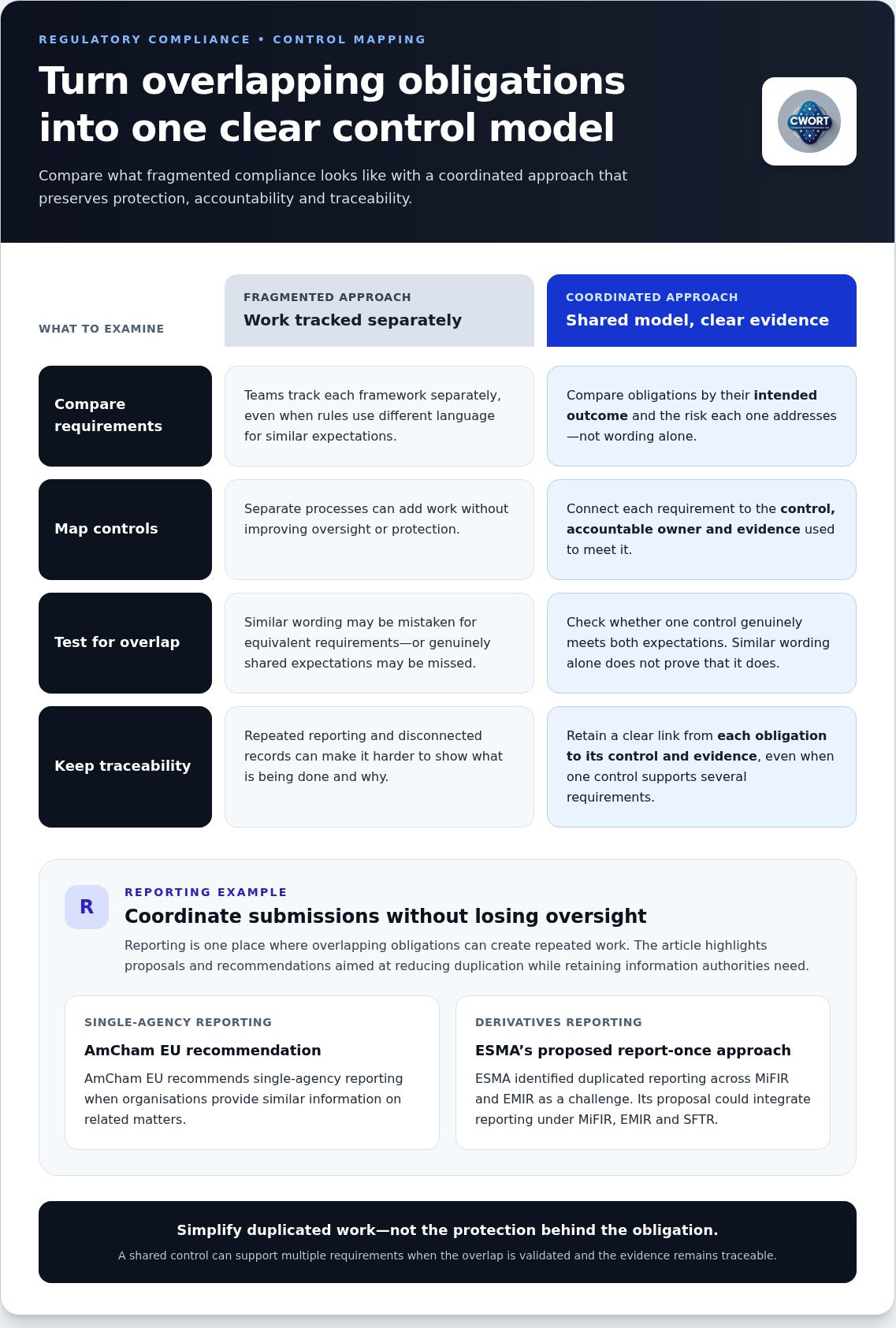
Compare obligations by their intended outcome, not just their wording. Requirements with different terminology may address the same control objective, while similar wording does not prove that one control satisfies both. Record each obligation’s scope, owner, evidence and reporting destination, then validate whether a shared process meets both expectations without reducing assurance.
- Compare outcomes: identify the risk each obligation addresses and the result it expects.
- Map controls: connect each requirement to the process, accountable owner and evidence used.
- Test for genuine overlap: distinguish equivalent controls from obligations that only appear similar.
- Retain traceability: show how each requirement is met, even where one control supports several.
Reporting often creates duplication. AmCham EU recommends single-agency reporting when organisations provide similar information on related matters. ESMA has also identified duplicated derivatives reporting across MiFIR and EMIR as a challenge. Its proposed report-once approach could integrate reporting under MiFIR, EMIR and SFTR. These examples show how coordinated reporting can reduce repeated submissions while preserving the information authorities need.
National additions can create another layer. Different requirements across jurisdictions may lead to parallel compliance systems, duplicate reporting and country-specific product adaptations. Before implementing another process, assess whether an existing framework is properly enforced and already delivers the intended outcome. A centralised decision on a shared issue could avoid 27 separate solutions, but harmonisation must still account for differences in legal scope and operational risk.
For organisations, the test is whether consolidation preserves the control objective, accountability and evidence trail. If one report or control can meet several obligations, document the mapping and its limits. If requirements differ in scope, retain distinct controls and explain why. Simplifying complex regulatory requirements means removing avoidable duplication, not treating every similar obligation as interchangeable.
A structured review can help expose gaps between written requirements and operational practice. A compliance validation demonstration can show how mapped obligations and evidence may be organised for review.
Regulatory simplification should combine proportionate implementation with periodic evaluation of existing regulations, coordination between authorities and jurisdictions, and efforts to avoid divergent or duplicative obligations. Accumulated rules and overlapping or conflicting requirements can add cost and complexity without necessarily increasing protection or legal certainty. Regulators should assess whether new regulations are necessary, consider alternative instruments and cumulative effects, and consult affected sectors early.
The BPFI report recommends reviewing Central Bank guidelines for overlaps with EU directives, regulations, standards and guidelines, and withdrawing national guidance that has been superseded. It identifies supplementary local reporting, including OSII reporting and localised PSD2 issues, as an area where requirements could be aligned with home-regulator or consistent EU requirements. AmCham EU recommends checking whether existing frameworks are properly enforced and implemented before introducing similar or parallel EU rules.
Practical and predictable compliance
Predictability comes from translating obligations into defined activities, accountable ownership and reviewable evidence. A compliance programme should support regulatory objectives while reducing unnecessary operational burden.
Simplifying compliance processes
Simplifying a compliance process means removing avoidable steps while preserving the required control and evidence. Separate spreadsheets, approval routes and reporting cycles can make routine work difficult to oversee.
Start by listing recurring activities, such as policy reviews, access approvals and incident reporting. Group tasks that serve the same objective, assign one accountable owner and remove repeated data entry when a shared record provides adequate evidence.
Then test the revised process against the obligation it supports. A shorter workflow is useful only if staff still perform the control, record its outcome and escalate exceptions to the right decision-maker.
Mapping requirements to internal controls
Control mapping links each regulatory requirement to an internal policy, operational control, owner and evidence record. It helps leaders see how written commitments translate into consistent practice.
Build a traceable crosswalk: record the requirement, identify the relevant policy, name the control owner and specify the evidence that demonstrates operation. For example, a supplier-risk requirement might map to procurement checks, a supplier review procedure and recorded approval.
When one control supports several requirements, document each relationship and any differences in scope. Reviewers can then see what the control achieves, where it falls short and whether additional activity is needed.
Keeping up with regulatory changes
Regulatory change management means identifying new or revised expectations, assessing their impact and updating controls. Without it, outdated policies can leave operational teams working to superseded assumptions.
Assign an owner to monitor relevant UK regulator publications and government guidance. Log each change, assess affected activities, policies and controls, then record decisions, implementation actions and approval evidence.
Review the change log in governance meetings and after material changes to the organisation’s activities. A new service, supplier or market may alter which obligations apply, so connect regulatory monitoring to business planning and change control.
Compliance consultants can provide specialist knowledge and an external perspective to help teams interpret requirements or identify control gaps. Their advice still requires internal validation and ownership: consultants cannot replace management accountability for decisions, implementation or evidence.
For more predictable compliance, maintain a single view of obligations, owners, control status and outstanding actions. Review exceptions at a defined governance meeting, prioritise them against risk and record the rationale for decisions. This connects regulatory objectives to operational action without treating simplification as a reason to weaken safeguards.
What are the main UK regulators and sources of regulatory guidance?
The relevant UK regulator depends on what an organisation does, the risks it manages and the sector it serves. Start with the regulator’s own publications, then use government legislation and guidance to distinguish binding requirements from explanatory material.
GOV.UK brings together government guidance for businesses, including information organised by activity and topic. Legislation.gov.uk provides access to UK legislation, helping teams locate the text behind an obligation. Use these sources to identify the rule and its scope, then consult the relevant regulator for practical expectations and supervisory guidance.
- Financial Conduct Authority (FCA): consult its rules and guidance when the organisation’s activities fall within financial services regulation.
- Information Commissioner’s Office (ICO): use its guidance for data protection and information rights matters.
- Health and Safety Executive (HSE): review its material for workplace health and safety responsibilities.
- Office of Communications (Ofcom): consider its publications where communications services or related sectors are relevant.
- Competition and Markets Authority (CMA): consult its guidance on competition and consumer protection matters.
- National Cyber Security Centre (NCSC): use its cyber security guidance and Cyber Assessment Framework as relevant to organisational resilience.
There is no single compliance authority for every organisation. A financial organisation may need to assess FCA expectations alongside data protection guidance from the ICO. A technology provider may need to consider NCSC cyber security guidance, while its customers’ regulated sectors create additional requirements. The organisation’s activities determine which sources matter.
Distinguish legal obligations from guidance. Legislation establishes the legal text, while regulator rules or statutory instruments may add requirements within their scope. Guidance explains an authority’s expectations or recommended approach, but its status depends on the document and underlying framework. Record the title, issuing organisation, publication or update date, relevant obligation and internal owner to create a traceable basis for interpreting changes.
Assign an owner to review updates from each relevant source and assess their operational effect. A publication from the FCA, ICO or NCSC should prompt a scope check: does it affect the organisation’s services, systems, data, suppliers or existing controls? Document the conclusion and any action, including why a change does not apply. This helps teams avoid treating every new publication as a new obligation.
Use regulator guidance to clarify how requirements apply, not to replace a structured assessment of the underlying rules. If a UK organisation also operates in Europe, the European Commission or ESMA may publish material relevant to its cross-border activities. Keep those sources distinct from UK rules, and record the jurisdiction and business activity linked to each obligation.
How can businesses identify which UK regulations apply to them?
Base the assessment on what the organisation does, where it operates and the risks its activities create. A company name or broad industry label does not establish its full obligations. For example, a software provider may need to consider its own operations, the data it handles and its role in customers’ supply chains.
Start with a clear inventory of business activities. Include products and services, customer groups, locations, staff responsibilities, technology, suppliers and information handled. Assess each activity against relevant regulatory topics, using official UK legislation and regulator guidance to understand scope. Record why a requirement applies, or does not apply, to keep decisions traceable.
Assess the organisation’s scope
Scope assessment matches an organisation’s activities and operating circumstances to potentially relevant obligations. It matters because two businesses in the same sector can have different responsibilities when their services, customers or supply chains differ.
Map each legal entity and business unit separately when their activities differ. For example, a group may provide software, process customer information and operate a support function. Assess each function individually, then identify shared obligations and controls across the group.
Use authoritative sources
Use GOV.UK guidance to locate relevant government information, then read the underlying legislation on legislation.gov.uk. Identify the regulator responsible for the activity and review its guidance on how requirements apply. Keep legislation, regulator material and internal interpretation distinct in your records.
For UK-wide operations, record where each activity takes place. Some policy areas have distinct arrangements across England, Scotland, Wales and Northern Ireland. Assess locations and activities against the relevant national guidance rather than assuming one local interpretation applies at every site.
Record decisions and review triggers
A regulatory applicability register records each relevant requirement, its scope, rationale, accountable owner and linked internal controls. It gives staff and leaders a consistent basis for decisions instead of leaving separate interpretations with individual teams.
For each entry, capture the source, affected activity, required evidence and any dependencies. Review the assessment when the organisation launches a service, changes suppliers, enters a market, restructures or adopts new technology. These events can change the risk profile and make a previously sound assessment incomplete.
Keep the register practical. Separate confirmed obligations from guidance and internal policy choices, and assign an owner to resolve gaps. A compliance mapping approach can help connect requirements with controls and evidence. Explore a structured compliance mapping approach to see how that work can be organised.
For businesses with international operations, compare UK requirements with rules in other markets and document any conflicts or overlapping duties. AmCham EU recommends aligning EU regulation with other countries’ rules to avoid conflicts that create complexity for global businesses. AmCham EU says the revision of the EU Foreign Subsidies Regulation should focus on subsidies with a demonstrable EU nexus and make procedures more workable for businesses and authorities. 84% of American businesses in Europe cite the EU’s regulatory burden as a primary barrier to further investment in the region.
The target year identified for Member States to obtain the defence capabilities discussed in the simplification proposal is 2030. The BPFI report recommends that the Department of Finance transpose EU directives on time and use maximum harmonisation when transposing them into national law. These points underline the value of tracking cross-border rules and national implementation when assessing which requirements may affect an organisation.
CWORT: DORA Compliance Readiness and Assessment
CWORT’s DORA Compliance Readiness and Assessment translates regulatory obligations into structured activities, with evidence linked to control outcomes. It helps teams build a clearer view of readiness, responsibilities and the proof supporting their controls, rather than relying on fragmented tracking across tools.
CWORT also supports UK NIS Compliance Management, NIS2 Readiness and Compliance Management, and ISO 27001 Readiness and Control Mapping. These offerings help organisations map requirements to controls and organise compliance activity around their applicable frameworks. The focus is practical validation and auditable evidence, not legal advice or security operations.
If you’re assessing readiness or bringing regulatory work into a more structured model, visit CWORT to explore the platform.
Turn regulatory clarity into accountable action
Make the next step clear: decide who will maintain the requirements map, validate controls and keep evidence aligned as the organisation changes. Treat simplifying complex regulatory requirements as an ongoing governance discipline, not a one-off documentation exercise. This gives leaders a practical basis for prioritising work and reviewing whether compliance activity still reflects the business.
CWORT supports organisations through DORA Compliance Readiness and Assessment, UK NIS Compliance Management and NIS2 Readiness and Compliance Management. These offerings help translate regulatory obligations into structured activity and evidence linked to control outcomes. Choose the framework relevant to your organisation, then establish a clear view of readiness, gaps and accountable actions.
If you’re ready to bring greater structure to regulatory compliance, contact CWORT to discuss your needs. A clear starting point can help your teams move forward with greater focus and control.
Frequently Asked Questions
What does simplifying complex regulatory requirements mean?
Simplifying complex regulatory requirements means making obligations easier to interpret and apply without removing necessary protections. An organisation might replace separate evidence requests with one controlled record, provided it still demonstrates each relevant outcome. The aim is clarity: staff understand the required action, managers can see who owns it, and reviewers can trace evidence back to the requirement.
Which tools and software help manage complex regulatory requirements?
Useful systems connect obligations to controls, accountable roles, execution activities and supporting evidence. CWORT is a compliance validation system that maps regulations to controls and activities, enforces separation of duties, and binds evidence to control outcomes. It automatically generates regulator-ready and audit-ready PDF outputs. This helps organisations replace disconnected records with a structured view of compliance activity and the evidence behind it.
Disclaimer
The content on this site is provided for general information and educational purposes only. It does not constitute legal, regulatory, financial, or professional advice. CWORT provides AI-assisted insights and workflow automation, but all compliance decisions remain the responsibility of your organisation and its management. Always seek qualified legal or regulatory guidance for decisions relating to the UK NIS Regulations, CAF, DORA, NIS2, ISO 27001, or other obligations.
Related posts
Streamlining Regulatory Compliance Processes: From Manual Tracking to Orchestrated Validation
Stop wasting money on manual compliance. Learn about streamlining regulatory compliance processes to reduce personal liability under DORA & NIS2 and gain aud...
Mastering the Regulatory Obligation Execution Workflow: A Guide to Auditable Certainty
Struggling with UK compliance audits? Learn to build a regulatory obligation execution workflow for auditable certainty and replace risky spreadsheets with t...
The Evolution of the Enterprise GRC Validation Tool: From Tracking to Orchestration in 2026
Stop chasing compliance ghosts in spreadsheets. Create a single source of truth for compliance with GRC orchestration to master NIS2, DORA, and UK audit dema...
Article by
Michael Iyiola
Co-Founder, CWORT
Michael Iyiola is a co-founder of CWORT and a Cyber and AI Security Engineer with deep experience in vulnerability management, detection engineering and operational resilience across UK critical national infrastructure, including rail, energy and financial services. At CWORT, he designs scalable, evidence-driven workflows that help teams meet modern regulatory and security demands.
Build Your Foundation of Auditable Certainty
Take control of your regulatory obligations and secure your infrastructure with CWORT.