Simplifying Compliance: A Guide for UK Enterprises

Michael Iyiola
Co-Founder, CWORT
Struggling with compliance chaos? Learn how to simplify compliance validation for your UK enterprise. Ditch spreadsheets for an auditable system for DORA & N...

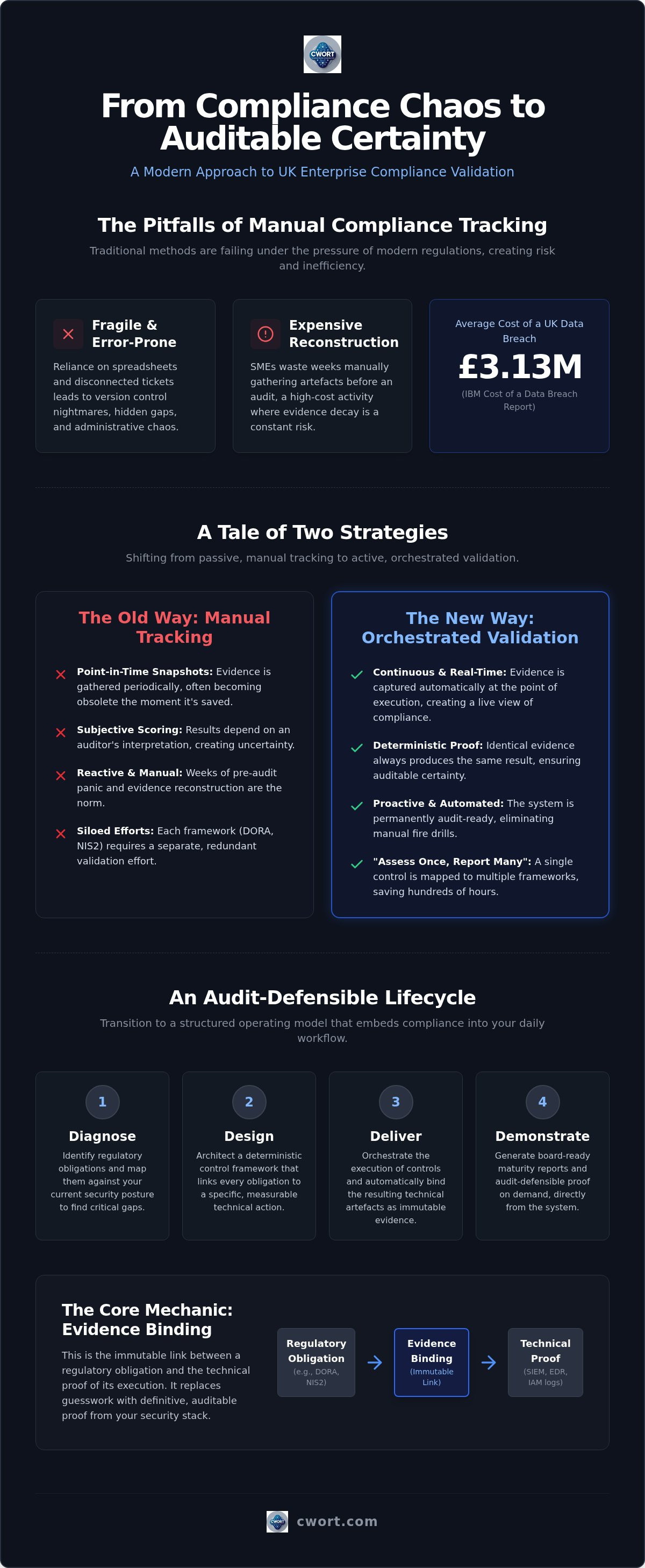
If your compliance evidence is currently scattered across three different spreadsheets and a dozen Jira tickets, you aren't managing risk; you're just managing administrative chaos. Most UK enterprises feel the weight of spreadsheet fatigue and the looming anxiety of an audit discovering a hidden gap. You likely agree that manual tracking is fragile, prone to version control errors, and increasingly insufficient for the rigorous demands of DORA, NIS2, and ISO 27001. Understanding how to simplify compliance validation is no longer a luxury but a strategic necessity, especially as the average cost of a UK data breach reached £3.13 million in 2026.
This guide demonstrates how to transition from fragmented manual processes to a deterministic, orchestrated system that replaces guesswork with auditable certainty. You'll discover how to build a repeatable, audit-defensible assurance framework that satisfies multi-framework requirements through a single point of execution. We will examine the path toward creating board-ready maturity reports without the manual reconstruction that typically drains your team's resources. By shifting the focus from administrative tracking to definitive proof, you can replace regulatory anxiety with the calm of professional maturity.
Key Takeaways
- Stop relying on fragile spreadsheets and start building a deterministic system that replaces administrative tracking with definitive, evidence-bound proof.
- Master the mechanics of evidence binding to establish an immutable link between regulatory obligations and the technical artefacts within your security stack.
- Discover how to simplify compliance validation by adopting an orchestration layer that maps a single control to multiple frameworks, including DORA, NIS2, and ISO 27001.
- Transition to a structured "diagnose, design, deliver, demonstrate" lifecycle to ensure your operating model remains permanently audit-ready and defensible.
- Eliminate the manual reconstruction of data by generating board-ready maturity reports directly from a unified, orchestrated assurance system.
Table of Contents
- Beyond the Spreadsheet: Why Manual Compliance Tracking Fails in 2026
- The Mechanics of Evidence Binding: Turning Obligations into Proof
- Comparing Compliance Strategies: Passive GRC vs. Validation Orchestration
- A 5-Step Framework to Simplify Your Compliance Validation
- Building a Regulator-Ready Operating Model with CWORT
Beyond the Spreadsheet: Why Manual Compliance Tracking Fails in 2026
Many UK enterprises operate under a dangerous illusion of security. They maintain meticulously formatted spreadsheets, believing that a green cell equates to regulatory safety. This is the "Compliance Debt" trap. Manual trackers provide a point-in-time snapshot that is obsolete the moment it's saved. Relying on Excel or Jira for high-stakes regulatory requirements like DORA or NIS2 is a strategy built on hope rather than evidence. These tools lack the necessary control-evidence binding to prove that a specific technical action satisfied a specific regulatory obligation.
Regulators such as Ofgem and the NCSC now require more than just a "yes" on a checklist. They demand an audit-defensible trail that shows exactly who did what, when, and with what result. Traditional GRC systems often fail here because they rely on non-deterministic scoring. If the same evidence yields different results depending on the auditor's interpretation, your assurance system is fundamentally broken. Learning how to simplify compliance validation starts with removing this subjectivity and replacing it with an orchestrated, evidence-bound workflow.
The High Cost of Evidence Reconstruction
The hidden overhead of manual compliance is staggering. Subject Matter Experts (SMEs) often lose weeks of productive time manually gathering artefacts before an audit. This "evidence reconstruction" is not just expensive; it's risky. Evidence decay occurs when data isn't captured at the point of execution, leading to gaps that are impossible to fill retrospectively. Additionally, manual processes struggle to enforce the "Separation of Duties" mandated by DORA. Without a system that orchestrates these roles by design, you risk significant non-compliance and potential fines. Discovering how to simplify compliance validation ensures that evidence is captured automatically, preserving its integrity and saving hundreds of SME hours.
Moving from Passive Tracking to Active Validation
True resilience requires a shift from passive tracking to active validation. Compliance should not be an annual event but a continuous operating model. Instead of merely reporting on past actions, enterprises must focus on orchestrating compliant behaviour in real time. This transition ensures that every technical artefact from your SIEM, EDR, or IAM tools is automatically bound to its relevant control. This shift moves the organisation from a state of reactive anxiety to one of auditable certainty. For a deeper look at this shift, explore Regulatory Compliance Workflow Automation. By automating the link between obligation and proof, you create a system that is defensible by design and resilient to the evolving UK regulatory landscape.
The Mechanics of Evidence Binding: Turning Obligations into Proof
Evidence binding represents the structural bridge between a regulatory obligation and the technical proof of its execution. It moves beyond the passive storage of documents into the realm of active validation. To understand how to simplify compliance validation, one must first look at the integration layer. An effective system aggregates data from various sources to create a definitive record of security posture:
- SIEM logs for real-time event correlation and threat detection.
- EDR telemetry for endpoint integrity and configuration validation.
- IAM records for identity verification and access control audit trails.
This immutable audit history is non-negotiable for 2026 standards, ensuring that evidence cannot be altered after the fact. Deterministic results mean that identical evidence always produces the same score, providing the board with confidence that isn't dependent on manual intervention or subjective interpretation. This level of rigour transforms compliance from a burdensome cost centre into a strategic asset, replacing regulatory anxiety with auditable certainty.
Control Mapping and Cross-walking
UK organisations often struggle with redundant validation when managing multiple frameworks simultaneously. Mapping a single technical control to several requirements, such as ISO 27001 and DORA, eliminates this operational waste. This "Assess Once, Report Many" philosophy is central to reducing the overhead of evidence collection. By using a benchmark like CWORT’s library of 1,355 controls across 42 frameworks, enterprises can cross-walk their existing security activities into new regulatory domains without starting from scratch. This systematic approach ensures that every activity performed by the security team delivers maximum regulatory value across the entire business.
Enforcing Separation of Duties
Regulatory frameworks like DORA and NIS2 explicitly require that validation remains independent of execution. You cannot have the same individual who configures a firewall also be the one who validates its compliance status. Enforcing this requires robust role-based and attribute-based access controls within the validation workflow. This separation ensures that the evidence remains objective and untainted by operational bias or conflict of interest. Maintaining this discipline is vital for Ensuring Compliance Evidence Integrity across the entire lifecycle. To see how these mechanics work in practice, you might explore a live validation workflow.
Comparing Compliance Strategies: Passive GRC vs. Validation Orchestration
Traditional Governance, Risk, and Compliance (GRC) platforms often function as "systems of record", acting as passive repositories for data that is frequently outdated by the time it is reviewed. These tools often become expensive filing cabinets, storing static evidence that lacks a real-time connection to the underlying technical environment. Validation orchestration represents a fundamental shift. Instead of merely recording that a control should exist, an orchestrated system actively enforces its execution and validates the resulting evidence. This distinction is critical for organisations determining how to simplify compliance validation whilst maintaining the rigour required by DORA or NIS2.
A deterministic system ensures that the same evidence always yields the same score. This consistency removes the subjective interpretation often found in manual audits, providing a single source of truth that satisfies the CISO, the auditor, and the board simultaneously. By automating the validation path, orchestration reduces the friction typically associated with evidence collection. It allows security teams to focus on remediation and strategic resilience rather than administrative data entry.
Why Jira is Not a Compliance Tool
Many organisations attempt to use Jira as a makeshift compliance engine, but its task-centric nature is fundamentally at odds with control-centric validation. Jira excels at tracking project milestones, yet it lacks the structural integrity to bind technical artefacts to specific regulatory obligations. Evidence remains unmapped and fragmented across various tickets, creating significant gaps that auditors will inevitably discover. True compliance orchestration requires a specialised operating model designed specifically for the rigorous lifecycle of control validation and evidence binding.
Board-Level Visibility and Maturity Reporting
Strategic leadership requires clarity, not a deluge of technical logs. Orchestration translates granular technical data into board-ready maturity heatmaps that illustrate compliance posture at a glance. These visualisations allow for real-time "Maturity vs. Capacity" views, enabling the board to make informed strategic investment decisions based on actual performance rather than optimistic estimates. Utilising an ISO 27001 Control Mapping Tool further streamlines this process, ensuring that technical execution is always aligned with global standards. This level of transparency replaces the anxiety of potential failure with the calm of auditable certainty.
A 5-Step Framework to Simplify Your Compliance Validation
Transitioning from a state of administrative chaos to auditable certainty requires a disciplined, step-by-step approach. This framework ensures that regulatory obligations are not merely tracked but are actively validated through an orchestrated workflow. By following these five stages, UK enterprises can replace fragmented manual processes with a rigorous system of record that stands up to the most demanding regulatory scrutiny.
- Step 1: Obligation Mapping. Decompose abstract regulations like DORA or UK NIS into structured execution activities. Every technical control must be linked to a specific regulatory requirement to ensure total coverage.
- Step 2: Workflow Configuration. Set up the paths for execution and independent validation. This stage enforces the separation of duties by design, ensuring the validator is always distinct from the operator.
- Step 3: Evidence Integration. Automate the flow of technical artefacts from your existing security stack, including SIEM and EDR tools. This prevents evidence decay and ensures that proof is captured at the point of execution.
- Step 4: Deterministic Assessment. Run the validation engine to produce objective, repeatable scores. Identical evidence must always yield the same result, removing the risk of subjective auditor interpretation.
- Step 5: Automated Reporting. Generate regulator-ready outputs and board-level maturity heatmaps instantly. This eliminates the manual reconstruction of data and provides real-time visibility into your resilience posture.
Selecting Your Entry Point
Attempting to overhaul an entire compliance programme at once often leads to operational paralysis. Start with a pilot sub-function, such as incident response or access control, to demonstrate the value of end-to-end validation. For organisations with unique internal standards, the "Bring Your Own Content" (BYOC) model allows for the ingestion of proprietary maturity frameworks alongside global standards. UK critical infrastructure providers frequently use the NCSC CAF as their primary starting point, as it aligns perfectly with the requirements of the Cyber Security and Resilience Bill. This focused approach allows you to prove the model before scaling it across the enterprise.
Prioritising Remediation
An effective assessment will inevitably reveal gaps, but not all gaps carry equal weight. Use a prioritisation engine to rank remediation actions by risk, effort, and business value. This transforms an overwhelming list of failures into a structured, actionable improvement roadmap that senior leadership can support. This is how to simplify compliance validation; it turns a defensive obligation into a proactive strategy for cyber resilience. By focusing your limited resources on the most critical gaps, you ensure the highest possible return on your security investment. To see this framework in action, you can simplify your validation process with a CWORT demo.
Building a Regulator-Ready Operating Model with CWORT
CWORT functions as a strategic orchestration layer that sits directly above your existing security stack. It doesn't replace your SIEM, EDR, or IAM tools; instead, it integrates their technical artefacts into a unified assurance view. This structural alignment allows leadership to see exactly how technical execution maps to regulatory obligations. By adopting the "Diagnose, Design, Deliver, Demonstrate" lifecycle, organisations move away from the high-risk "compliance as a project" mentality. This transition is essential for 2026 regulations, which demand a permanent, resilient operating model rather than a point-in-time audit response.
Understanding how to simplify compliance validation involves moving beyond administrative tracking. When compliance becomes an integrated part of your daily operations, the burden of evidence collection vanishes. You replace manual spreadsheets with a system that enforces discipline by design. This transformation delivers three primary benefits: absolute audit-defensibility, unwavering board confidence, and significant gains in operational efficiency. It provides the voice of reason in a fragmented landscape, offering a sense of order and professional maturity.
Audit-Defensible Proof by Design
CWORT’s immutable audit history ensures that every action, validation, and result is recorded in a way that satisfies even the most rigorous examiners. This traceability is a core requirement for those following the DORA Compliance Validation Guide. Whilst the platform includes AI advisory features to provide intelligent suggestions, it preserves deterministic outcomes. AI assists the process, but the validation engine remains objective and evidence-bound. This ensures that the final proof is always defensible and free from the risks of subjective human error or AI-generated hallucinations.
Next Steps for Senior Leadership
Senior leadership must act with strategic urgency to address existing compliance gaps. You can conduct a comprehensive compliance gap analysis in weeks, not months, by leveraging an orchestrated framework. This rapid assessment provides the data needed to move toward a "Continuous Assurance" model, which is vital for NIS2 and the expected UK NIS updates. Transitioning to this model ensures that your organisation remains permanently prepared for regulatory scrutiny. To see the platform's capabilities firsthand, you should request a demo to see CWORT’s validation engine in action. This is the definitive path to replacing regulatory anxiety with the calm of auditable certainty.
Transitioning to Auditable Certainty
UK enterprises can no longer afford the administrative debt of manual tracking. Shifting from passive record-keeping to active validation orchestration is the only way to meet the rigorous demands of DORA, NIS2, and UK NIS. You've seen how evidence binding and deterministic scoring eliminate the subjectivity of traditional audits. By adopting a structured framework, you replace fragmented chaos with an immutable history of truth that satisfies both the board and external examiners.
CWORT provides the rigorous discipline required for this transition, orchestrating 1,355 controls across 42 global frameworks. It ensures that identical evidence always yields the same result, providing total defensibility for your assurance system. If you are ready to discover how to simplify compliance validation and build a resilient, regulator-ready operating model, the path forward is clear. Transitioning to an automated system doesn't just reduce overhead; it transforms your compliance posture into a strategic asset.
Request a CWORT Demo to Simplify Your Compliance Validation
Securing your organisation's future starts with replacing the anxiety of potential failure with the calm of auditable certainty.
Frequently Asked Questions
How does compliance validation differ from a standard compliance audit?
Compliance validation is a continuous, orchestrated process that proves a control is functioning as intended, whereas a standard audit is typically a retrospective, point-in-time review. Validation ensures that technical artefacts are bound to obligations in real time, preventing the evidence decay common in manual tracking. This shift to active validation allows enterprises to understand how to simplify compliance validation by making assurance a byproduct of daily operations rather than an annual administrative burden.
Can I use CWORT to manage multiple frameworks like DORA and ISO 27001 simultaneously?
Yes, CWORT is designed specifically for multi-framework management through an "assess once, report many" architecture. The platform features a taxonomy of 1,355 controls across 217 domains, mapped to 42 global frameworks including DORA, NIS2, and ISO 27001. When you validate a single technical control, the system automatically cross-walks that evidence across all relevant regulatory requirements. This reduces redundant activities and ensures a unified assurance view for organisations managing complex, overlapping compliance obligations.
What is deterministic scoring and why is it important for compliance?
Deterministic scoring ensures that identical evidence always yields the same result, removing the risk of subjective interpretation by different auditors. This reproducibility is vital for maintaining an audit-defensible system that regulators like Ofgem or the NCSC can trust. By using fixed scoring rules and a central digital model, CWORT provides a consistent measure of maturity. This level of rigour is essential for senior leadership who require objective, evidence-backed data to make informed strategic investment decisions.
How does the platform ensure separation of duties during the validation process?
The platform enforces the separation of duties through robust role-based and attribute-based access controls hardcoded into the validation workflow. It ensures that the individual responsible for executing a security task cannot be the same person who validates its compliance status. This independence is a mandatory requirement for DORA and NIS2 readiness. By automating these governance boundaries, CWORT prevents conflicts of interest and maintains the integrity of your immutable audit history throughout the entire lifecycle.
Can we import our own custom maturity models into the system?
Organisations can import their proprietary maturity models using the "Bring Your Own Content" (BYOC) capability. This feature allows you to turn custom internal standards into repeatable, evidence-backed digital workflows without losing your unique intellectual property. The system remains content-agnostic, supporting any criteria, weighting, or evidence requirements you define. This ensures that your specific organisational maturity lens is applied consistently across all business components whilst leveraging CWORT’s advanced analytics and governance controls.
What kind of evidence can be bound to controls in an automated workflow?
CWORT binds a wide variety of technical artefacts directly to control outcomes, including logs from SIEM, EDR, and IAM tools. It also consumes data from vulnerability management systems, asset registers, and OT/ICS monitoring tools to provide a comprehensive evidence trail. This automated integration ensures that proof is captured at the point of execution, maintaining an immutable record of compliance. By binding real-world data to regulatory obligations, the platform replaces vague checklists with definitive, defensible reality.
How does CWORT help with board-level reporting for cyber resilience?
CWORT translates granular technical data into sophisticated, board-ready maturity heatmaps and heat-map dashboards. These reports provide a clear "Maturity vs. Capacity" view, illustrating whether your organisation has the skills and tooling to sustain its current security posture. This level of visibility allows boards to oversee cyber risk as a core part of enterprise risk management. It eliminates the need for manual data reconstruction, providing senior leadership with real-time, auditable certainty regarding their resilience.
Is the platform suitable for organisations subject to UK NIS and NCSC CAF?
CWORT is ideally suited for organisations subject to UK NIS and the NCSC CAF, particularly those in critical national infrastructure. The platform includes specific mappings for the Cyber Assessment Framework and supports the unique requirements of OT/ICS environments. By providing a structured path to demonstrate maturity against CAF principles, it helps entities prepare for the increased scrutiny expected under the Cyber Security and Resilience Bill. It ensures that critical operators can prove resilience through a governed, deterministic system.
Disclaimer
The content on this site is provided for general information and educational purposes only. It does not constitute legal, regulatory, financial, or professional advice. CWORT provides AI-assisted insights and workflow automation, but all compliance decisions remain the responsibility of your organisation and its management. Always seek qualified legal or regulatory guidance for decisions relating to the UK NIS Regulations, CAF, DORA, NIS2, ISO 27001, or other obligations.
Related posts
Streamlining Regulatory Compliance Processes: From Manual Tracking to Orchestrated Validation
Stop wasting money on manual compliance. Learn about streamlining regulatory compliance processes to reduce personal liability under DORA & NIS2 and gain aud...
Reducing Audit Preparation Time and Costs: A Strategic Guide for UK Enterprises
Tired of costly audit seasons? Our guide for UK enterprises shows you how to stop the manual scramble, reducing audit preparation time and costs with automat...
Automated IT Audit Preparation: Streamlining Compliance Workflows
Ditch spreadsheets for automated IT audit preparation. Learn how to streamline compliance for DORA & NIS2, and provide your board with total auditable assura...
Article by
Michael Iyiola
Co-Founder, CWORT
Michael Iyiola is a co-founder of CWORT and a Cyber and AI Security Engineer with deep experience in vulnerability management, detection engineering and operational resilience across UK critical national infrastructure, including rail, energy and financial services. At CWORT, he designs scalable, evidence-driven workflows that help teams meet modern regulatory and security demands.
Build Your Foundation of Auditable Certainty
Take control of your regulatory obligations and secure your infrastructure with CWORT.