The Role of Automation in Operational Resilience: A 2026 Guide

Michael Iyiola
Co-Founder, CWORT
Explore the role of automation in operational resilience in 2026. Discover how to balance automated speed with robust governance and vital human judgement.

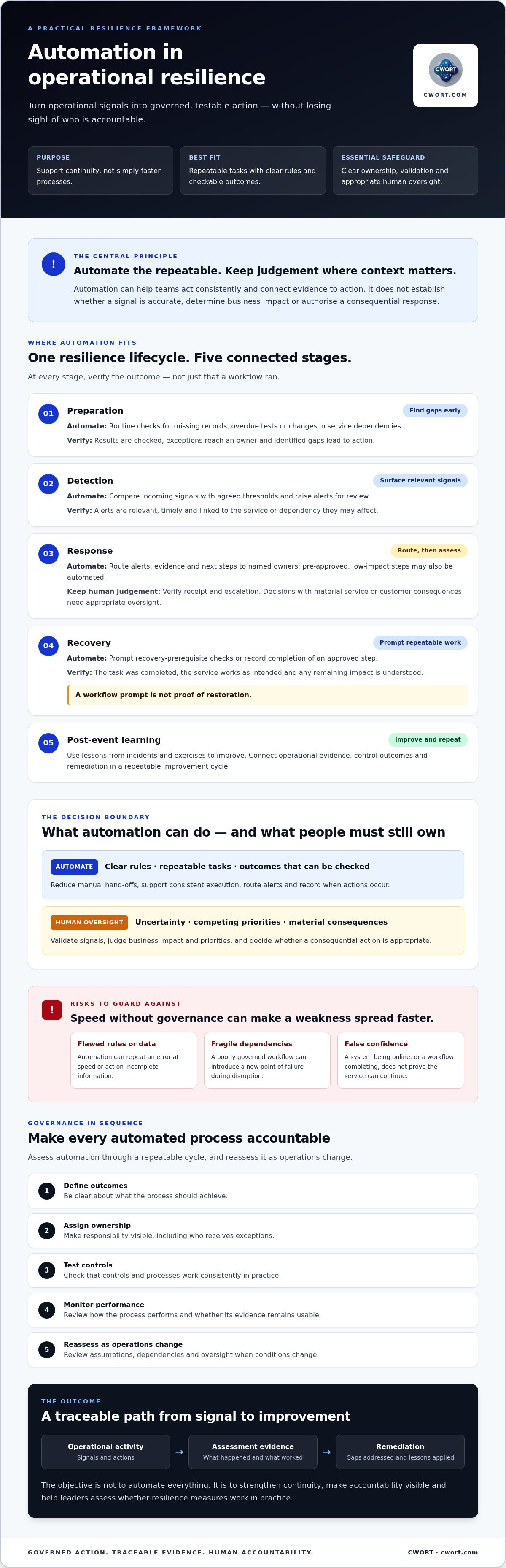
What if the automation designed to keep services running became a new point of failure? The role of automation in operational resilience is not simply to make processes faster. It is to turn scattered operational signals into governed, testable action without obscuring who is accountable when conditions change.
Evidence often sits across disconnected tools and teams, while leaders need confidence that controls and processes work consistently. Automation can improve speed and repeatability, but poorly governed workflows can create fragile dependencies or act on incomplete information. Human judgement remains essential when decisions involve uncertainty, competing priorities or material consequences.
This 2026 guide explains which resilience activities are suited to automation, where human oversight must remain, and how to govern automated processes through clear ownership, validation and traceable evidence. It also shows how to connect operational activity, assessment evidence and remediation in a repeatable improvement cycle. The objective is not to automate everything. It is to build a controlled approach that strengthens continuity, makes accountability visible and helps leaders assess whether resilience measures work in practice.
Key Takeaways
- See how the role of automation in operational resilience changes across preparation, detection, response, recovery and post-event learning.
- Identify repetitive, rules-based tasks that automation can support, and decisions that still require human judgement.
- Compare automated and manual processes for speed, consistency and traceability, while recognising the risks of flawed rules or data.
- Assess automation in sequence: define outcomes, assign ownership, test controls, monitor performance and reassess as operations change.
- Connect operational evidence, control outcomes and remediation to build a more accountable, repeatable approach to resilience.
Table of Contents
- What operational resilience means, and where automation fits
- How automation supports the operational resilience lifecycle
- Automation versus manual processes: resilience benefits, limits and risks
- How to govern and measure automation for operational resilience
- From automated tasks to governed operational resilience
What operational resilience means, and where automation fits
Operational resilience is an organisation’s ability to prepare for, respond to, recover from and adapt to disruption whilst sustaining important operations. That is broader than keeping a system available or following a continuity plan. It focuses on whether the organisation can continue delivering what matters when people, processes, technology or external dependencies are affected.
The role of automation in operational resilience is to support that capability, not create it independently. Automated actions still rely on sound rules, dependable data, clear ownership and appropriate oversight. Without those foundations, automation can repeat an error at speed or introduce a dependency that fails during disruption.
How is operational resilience different from business continuity?
Business continuity planning helps an organisation prepare for disruption and set out how it will maintain or restore activities. Operational resilience takes a wider view: it considers how important operations depend on people, processes, technology, third parties and governance, and how those elements interact under stress. Business continuity planning provides useful context, but a plan alone cannot show that the whole operation will work as intended.
Resilience is not a single tool, control or one-off project. A documented fallback may be ineffective if staff cannot access it, a supplier is unavailable or decision rights are unclear. Organisations need to understand dependencies, test how work proceeds through disruption and use lessons from incidents and exercises to improve. A system being online does not prove that the service relying on it can continue.
What does automation contribute to resilience?
Automation is technology executing or coordinating repeatable tasks under specified rules. It can reduce manual hand-offs and support consistent execution, but faster task completion is only one part of resilience. The organisation also needs to establish whether relevant signals are detected, the right people are informed, decisions are coordinated, recovery steps work and records provide usable evidence.
For example, a monitoring tool could route an alert to the responsible team, record when it was raised and prompt a review against an agreed process. This can shorten the route from signal to assessment. It does not establish that the alert is accurate, determine the business impact or authorise a consequential response. A person with the right context may need to validate the signal, judge priorities and decide what action is appropriate.
Use automation where rules are clear and outcomes can be checked. Retain human oversight where context, uncertainty or material impact calls for judgement. This distinction leads to a practical question: which activities across the resilience lifecycle can be automated, and what evidence will demonstrate that they work?
How automation supports the operational resilience lifecycle
Automation can support resilience at each stage, but teams need to verify outcomes, not just confirm that a workflow ran. Connected signals and records can help decision-makers see which services, dependencies and actions are affected. The role of automation in operational resilience is strongest when tasks, evidence and accountable decisions form a traceable sequence.
- Preparation: Automated routine checks can identify missing records, overdue tests or changes in service dependencies. Verify the results, confirm exceptions reach an owner and ensure identified gaps lead to action.
- Detection: Monitoring tools can compare incoming signals with agreed thresholds and raise alerts when conditions warrant review. Check that alerts are relevant, timely and linked to the service or dependency they may affect.
- Response: Orchestration can route an alert, evidence and next steps to named owners, reducing manual hand-offs. Verify receipt and escalation. Pre-approved, low-impact steps may be automated, but decisions with material service or customer consequences should remain subject to appropriate human judgement.
- Recovery: Workflows can prompt repeatable tasks, such as checking recovery prerequisites or recording completion of an approved step. Verify that the task was completed, the service is functioning as intended and any remaining impact is understood. A workflow prompt is not proof of restoration.
- Post-event learning: Automated timelines and action records can help teams reconstruct what happened and when. Check the records against relevant evidence, assign remediation to an accountable owner, then reassess whether the change addressed the underlying issue.
Make the workflow governable before relying on it. Define its triggers, named owners, authorised actions, evidence of execution, escalation thresholds and route for reviewing exceptions or failures. Without these, an alert can go unanswered, a process can run on outdated information, or teams may be unable to establish who made a consequential decision.
Monitoring, threshold-based alerts and scheduled checks can provide useful signals before disruption escalates, but signals need context. A change affecting one supplier, system or team may have consequences elsewhere. Decision-makers should be able to connect evidence across operational areas and understand the status of related actions. The Bank of England’s overview offers an example of how operational resilience is addressed in a critical industry.
After an incident, don’t stop at producing a report. Compare the recorded sequence with expected performance, identify where hand-offs or decisions stalled, and track corrective actions through to reassessment. If you’re considering how operational evidence and remediation can be brought together, explore CWORT’s approach.
Automation versus manual processes: resilience benefits, limits and risks
The role of automation in operational resilience is not to replace people with faster workflows. It is to reduce repetitive effort where rules are clear, while preserving human judgement, accountability and the ability to respond when circumstances fall outside those rules. Manual processes can be adaptable but inconsistent; automated processes can be repeatable but brittle if their inputs or logic are wrong.
Neither approach is universally superior. Automation can reduce repetitive hand-offs, but it can also spread incorrect rules or data across connected processes. Skilled people remain essential to test assumptions, interpret unusual events and decide when a standard procedure no longer fits.
Which resilience activities are suitable for automation?
Start with frequent, repeatable, rules-based tasks that have defined inputs, outputs and exception paths. Examples include checking whether required evidence fields are present or reconciling records against an agreed rule. Before automating, confirm that data is reliable, access permissions are appropriate, integrations are understood and third-party services are accounted for. Keep human approval for high-impact, ambiguous or context-dependent decisions.
What can go wrong when resilience processes are automated?
Incorrect triggers can start the wrong workflow, and stale information can lead to unsuitable action. Excessive access, failed integrations or an outage in the automation itself can interrupt several processes at once. If separate workflows depend on the same data or service, they may share a common point of failure rather than provide independent safeguards.
Test normal operation and exceptions, including missing data, unavailable integrations and unauthorised requests. Record overrides and who approved them. Maintain a proportionate manual fallback, then exercise it so staff know how to use it when automation is unavailable. Review failures and changes to the process, permissions or dependencies before relying on the workflow again.
How to govern and measure automation for operational resilience
Governance starts with the operation the workflow is meant to protect, not the technology being introduced. The role of automation in operational resilience should be assessed through clear ownership, controlled execution and evidence that important operations can withstand disruption. A high task-completion rate alone does not demonstrate that outcome.
A practical sequence for introducing resilience automation
Use a staged assessment before expanding a workflow. Record decisions and evidence at each stage so owners can review the basis for approval and reassess the process when dependencies or operating conditions change.
- 1. Define the outcome. Identify the important operation, a relevant disruption scenario and the result the workflow should support. Name the accountable owner.
- 2. Map the process. Document data sources, dependencies, access permissions, decision points and exception routes. Confirm who can approve actions and who reviews exceptions.
- 3. Set measures and safeguards. Establish how the organisation will judge service impact, response and recovery performance, control execution and unresolved actions. Define acceptable thresholds and escalation routes.
- 4. Pilot a bounded workflow. Test it against expected conditions and failure scenarios, such as missing information or an unavailable integration. Record outcomes, overrides and issues.
- 5. Approve, monitor and reassess. Obtain documented approval before wider adoption. Monitor performance and dependencies, then repeat the assessment after incidents, exercises or material process changes.
How to demonstrate that automation is working
Separate activity metrics from resilience outcomes. Tasks completed, alerts routed and checks run show what the workflow did. They do not, by themselves, prove that a service remained within its defined tolerance or recovered as intended. Assess activity alongside evidence of impact and performance.
Useful measures include the effect on the important operation, time taken to identify and escalate a disruption, recovery performance against internally defined objectives, whether relevant controls executed as intended, and the number and age of unresolved exceptions or remediation actions. Give each measure a clear definition, evidence source, owner and review cadence. Check that records show what happened, when it happened and who approved any override.
Review results from exercises and incidents together. If a workflow completes its steps but service impact remains unacceptable, investigate the assumptions, dependencies and control design rather than treating completion as success. For related context on connecting evidence and compliance processes, read about regulatory compliance workflow automation.
For organisations assessing how governed evidence and accountable remediation fit into their operating model, request a CWORT demonstration.
From automated tasks to governed operational resilience
Automated tasks can improve speed and consistency, but resilience depends on the operating model around them: accountable ownership, tested decisions and evidence that can be reviewed. A practical next step is to assess one important operation and establish how its controls, dependencies and automation perform together.
How assurance connects operational activity to evidence
Operational and security tools generate signals and records, but those can be difficult to assess when they remain spread across teams and systems. An assurance layer can bring relevant evidence into a more unified view, linking each control to its supporting records, accountable owner and any remediation action. This helps leaders and reviewers examine not only whether an activity occurred, but what it demonstrates and what remains unresolved.
CWORT is a compliance and operating-model intelligence platform that sits above existing tools. It consolidates evidence, maps controls across frameworks and supports deterministic, reproducible assessment and remediation workflows. It does not replace operational security systems or operate them. Instead, it supports oversight by connecting activity to control outcomes and traceable follow-up. For related reading, see compliance evidence integrity and DORA compliance validation.
What to do next: assess one operational workflow
Choose an important operation, then identify plausible disruption scenarios, key dependencies and the controls already in place. Select one repeatable workflow and check whether its triggers and data are reliable, who owns decisions and exceptions, what evidence is retained, and how the process can continue if the automation or an integration is unavailable.
That focused review makes the role of automation in operational resilience tangible. It shows where automation may support dependable execution and where oversight, testing or remediation is needed before wider adoption. Ground the assessment in observable evidence, not task-completion figures alone.
If you’re ready to examine how governed assessment can connect operational evidence, controls and remediation, request a CWORT demo.
Turn automation into measurable resilience
The role of automation in operational resilience is to support reliable execution, not replace accountable people or sound governance. Automate repeatable tasks where rules and outcomes can be tested; retain human judgement for decisions shaped by uncertainty, context or material impact. Then measure more than activity. Confirm that controls work, important operations can withstand disruption and identified weaknesses lead to owned remediation.
That requires a clear line from operational activity to evidence and oversight. CWORT brings together operating-model and compliance intelligence above existing tools. Its assessments use deterministic, reproducible scoring, link control outcomes to evidence and track remediation, helping leaders review what is working and what still needs attention.
Start by assessing one important operation and a workflow that supports it. Identify its dependencies, owners, evidence requirements and fallback arrangements before deciding whether to automate or expand its use. A focused assessment can reveal where action is needed and provide a disciplined basis for improvement.
Request a CWORT demo to explore how governed evidence and remediation workflows can support your operational resilience approach. With clear ownership and testable evidence, your organisation can move forward with greater confidence.
Frequently Asked Questions
How does automation improve operational resilience?
Automation can improve operational resilience by helping teams identify signals, route work and complete repeatable tasks consistently. For example, a workflow might detect a defined threshold, notify an accountable owner and record the action for review. This can reduce manual hand-offs and make activity easier to trace. The benefit depends on reliable data, tested rules, clear ownership and evidence that important operations continue to perform through disruption.
Can automation prevent operational disruptions?
Automation may help identify warning signs or apply approved preventative checks, but it cannot prevent every disruption. Some events originate outside an organisation’s control, and a workflow may miss a signal or rely on inaccurate information. Treat automation as one part of preparation and response, not as a guarantee. Test how the process behaves during failure, and ensure teams can assess impact, escalate concerns and use an appropriate fallback.
Is automation the same as operational resilience?
No. Automation is a way to execute or coordinate tasks under specified rules; operational resilience is the wider organisational ability to prepare for, respond to, recover from and adapt to disruption. Resilience depends on how people, processes, technology, third parties and governance work together. Automation can support that capability, but it does not replace accountable ownership, sound operating arrangements, human judgement or testing of whether important operations can continue.
Which operational resilience tasks should organisations automate first?
Start with frequent, repeatable tasks that have reliable inputs, clear rules, measurable outputs and defined exception routes. Examples include routine evidence checks, threshold-based notifications or routing an alert to a named team for assessment. Before automating, check data quality, permissions, integrations and third-party dependencies. Keep human approval for decisions that are high-impact, ambiguous or dependent on context, and pilot the workflow before expanding its use.
How can an organisation measure whether resilience automation is working?
Measure operational outcomes as well as workflow activity. Tasks completed or alerts routed show that automation ran, but not whether an important service was protected. Review service impact, response and recovery performance against defined objectives, control execution, exceptions and unresolved remediation actions. Confirm that evidence is accurate and attributable, and use exercises and incidents to test assumptions. Reassess the workflow when its rules, dependencies or operating conditions change.
Does automation remove the need for human oversight during an incident?
No. Automation can route alerts, gather relevant records or carry out pre-approved, low-impact steps, but people remain responsible for interpreting context and making decisions that require judgement. An automated trigger may be inaccurate, incomplete or out of date. Define who reviews exceptions, who can approve consequential actions and how overrides are recorded. Test escalation routes so the right decision-makers can act when a workflow reaches its limits.
What risks should organisations assess before automating resilience processes?
Assess the possibility of incorrect triggers, stale or poor-quality data, excessive access permissions, integration or third-party failure, and an outage affecting the automation itself. Consider whether several workflows share a dependency that could cause common-mode failure. Test unusual conditions and exceptions, record approvals and overrides, and maintain a proportionate manual fallback. Assign an owner to review performance and evidence, and reassess the risks after material changes or incidents.
Disclaimer
The content on this site is provided for general information and educational purposes only. It does not constitute legal, regulatory, financial, or professional advice. CWORT provides AI-assisted insights and workflow automation, but all compliance decisions remain the responsibility of your organisation and its management. Always seek qualified legal or regulatory guidance for decisions relating to the UK NIS Regulations, CAF, DORA, NIS2, ISO 27001, or other obligations.
Related posts
ISO 27001 Control Effectiveness Proof: Moving Beyond Static Certification to Defensible Validation
Move beyond static ISO 27001 certification. Discover how an ISO 27001 compliance validation tool delivers continuous, defensible proof for UK regulators.
DORA Technical Standards Compliance: Moving from Regulatory Theory to Validated Execution
Struggling with DORA technical standards compliance? Move beyond spreadsheets to a validated framework that provides real-time, auditable evidence for regula...
DORA Obligation Mapping Tool: Orchestrating Defensible Compliance in 2026
Stop manual DORA tracking. A DORA obligation mapping tool orchestrates compliance, automates reporting, and creates a defensible audit trail for central banks.
Article by
Michael Iyiola
Co-Founder, CWORT
Michael Iyiola is a co-founder of CWORT and a Cyber and AI Security Engineer with deep experience in vulnerability management, detection engineering and operational resilience across UK critical national infrastructure, including rail, energy and financial services. At CWORT, he designs scalable, evidence-driven workflows that help teams meet modern regulatory and security demands.
Build Your Foundation of Auditable Certainty
Take control of your regulatory obligations and secure your infrastructure with CWORT.