Training Your Team on a New Compliance Tool: A Strategic Guide to Orchestration

Michael Iyiola
Co-Founder, CWORT
Master training your team on a new compliance tool. Our guide helps you move from manual spreadsheets to orchestrated, audit-ready validation for DORA & NIS2.

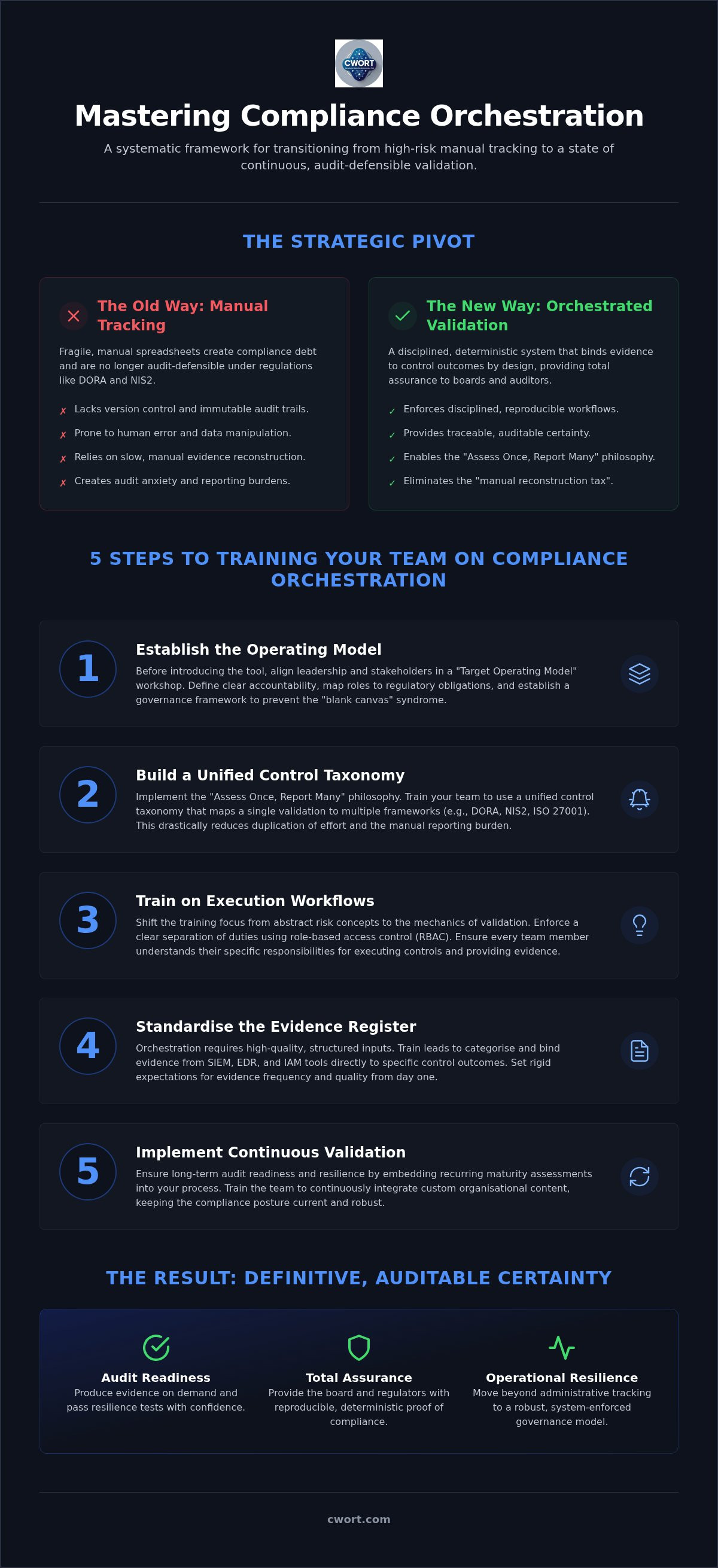
Most compliance failures don't stem from a lack of data; they originate from the fragile, manual spreadsheets used to track it. When you begin training your team on a new compliance tool, you aren't just introducing software. You're enforcing a new, deterministic standard of evidence-based proof. It's common for teams to resist another platform whilst they're already struggling with the complexity of mapping controls to DORA or NIS2 requirements. The anxiety of an upcoming audit often makes any change feel like an additional burden rather than a solution.
This guide demonstrates how to master the transition from fragmented manual tracking to a state of orchestrated compliance validation. You'll learn to implement a systematic training framework that reduces the manual reporting load and establishes a clear, audit-defensible separation of duties. We will examine the precise steps required to move your organisation from administrative tracking to a reproducible governance system that provides total assurance to your board and auditors. Replace the uncertainty of manual processes with a disciplined approach to regulatory maturity.
Key Takeaways
- Transition from fragile manual spreadsheets to orchestrated validation to satisfy the rigorous evidence requirements of DORA and NIS2.
- Align leadership and key stakeholders through a target operating model workshop that defines clear accountability and separation of duties.
- Utilise a systematic five-step framework for training your team on a new compliance tool, focusing on unified control taxonomies and execution workflows.
- Neutralise team resistance by demonstrating how orchestration eliminates the "manual reconstruction tax" and reduces the reporting burden.
- Ensure long-term audit readiness by implementing recurring maturity assessments and training the team to integrate custom organisational content.
Table of Contents
- The Strategic Pivot: Moving from Manual Tracking to Orchestrated Validation
- Preparing Your Organisation for a New Compliance Operating Model
- 5 Steps to Training Your Team on Compliance Orchestration
- Overcoming Resistance: Addressing the #1 Training Objection
- Sustaining Resilience: Continuous Training and Platform Maturity
The Strategic Pivot: Moving from Manual Tracking to Orchestrated Validation
Stop treating software implementation as a secondary administrative task. Traditional Compliance training often fails because it prioritises awareness over execution. When training your team on a new compliance tool, the objective is to move from passive tracking to orchestrated validation. Training must focus on the mechanics of validation rather than just the abstract concepts of risk management. GRC systems often act as glorified filing cabinets; orchestration is different. It enforces a disciplined workflow where evidence is bound to control outcomes by design. This shift replaces the anxiety of potential failure with the calm of auditable certainty.
Why Spreadsheets are No Longer Audit-Defensible
Regulators now reject the ambiguity of manual spreadsheets. Under frameworks like DORA and NIS2, auditors demand proof of structural integrity that Excel cannot provide. Spreadsheets lack version control and immutable audit trails. They rely on manual reconstruction, which is a process prone to human error and deliberate manipulation. If your team can't produce evidence within minutes during an audit, you've already failed the test of operational resilience. Move towards deterministic results. This ensures that every score is reproducible and every piece of evidence is traceable. It eliminates the compliance debt that accumulates when teams rely on fragmented, unverified data.
The "Assess Once, Report Many" Philosophy
Maximise team efficiency by adopting an "assess once, report many" philosophy. Organisations waste hundreds of hours duplicating effort across overlapping frameworks. A unified control taxonomy allows you to map a single technical validation to requirements across multiple frameworks simultaneously. Utilising an ISO 27001 control mapping tool enables your team to see these cross-walks in real time. This approach reduces the manual reporting burden and clarifies the separation of duties across the department. When training your team on a new compliance tool, highlight these productivity gains to secure immediate buy-in. Transitioning from a passive observer to an active orchestrator is the only way to meet modern governance standards.
Preparing Your Organisation for a New Compliance Operating Model
Successful adoption starts with a fundamental shift in how the organisation views its regulatory duties. Before training your team on a new compliance tool, leadership must define a clear target operating model. Organise a "Current State vs. Target Operating Model" workshop to identify where manual processes are failing and where orchestration will take over. This isn't a technical briefing; it's a strategic realignment. It ensures that the system is built on a foundation of professional maturity rather than just digitising existing chaos.
Identify and engage key stakeholders early in the process. You need the CISO to drive the vision, Risk Leads to define the parameters, and Service Owners to take responsibility for execution. Establish the governance framework in isolation before inviting the wider team to the platform. This prevents the "blank canvas" syndrome where users feel overwhelmed by a lack of structure. Communicate the strategic urgency of this transition to all departments. Frame the shift as a move away from the "manual reconstruction tax" toward a state of definitive, auditable certainty.
Mapping Roles to Regulatory Obligations
Assigning ownership is the most critical step in the preparation phase. Every control domain requires a clear lead who is accountable for its validation. Use role-based access control (RBAC) to enforce these boundaries. RBAC doesn't just manage permissions; it protects the integrity of your evidence by ensuring only authorised personnel can alter control mappings. When each team member understands their specific piece of the puzzle, the complexity of frameworks like NIS2 becomes manageable. Discipline is enforced by design, not by constant supervision.
Establishing the Evidence Register
Orchestration requires high-quality, structured inputs to be effective. Train your leads to categorise evidence originating from SIEM, EDR, and IAM tools with precision. It's not enough to simply collect data; the data must be bound to a specific control outcome to remain valid. Set rigid expectations for evidence frequency and quality from the outset. This rigour is essential for ensuring compliance evidence integrity across its entire lifecycle. A robust register transforms an audit from a period of high-stakes panic into a routine validation exercise. If you're ready to see how a structured operating model can simplify your governance, you can request a platform walkthrough to explore these workflows in detail.
5 Steps to Training Your Team on Compliance Orchestration
Orchestration requires a fundamental shift in professional behaviour. When training your team on a new compliance tool, you must follow a structured path to ensure the system is populated with defensible data rather than administrative fluff. This process moves the team from understanding abstract obligations to executing a disciplined, evidence-based workflow. Every stage must reinforce the concept of auditable certainty.
- Step 1: Introduction to the Unified Control Taxonomy and Framework Cross-walks. Teach the team how to leverage a taxonomy of 1,355 controls across 42 frameworks. Show them how 98.6% of active controls carry framework references, enabling the "assess once, report many" strategy.
- Step 2: Training on the Execution Workflow. Shift the focus from "watching a dashboard" to "completing a validation." Every team member must understand how to move a control from an obligation to a state of verified proof.
- Step 3: Mastering Evidence Binding. Demonstrate the mechanics of attaching deterministic proof to specific controls. This ensures that every piece of evidence is directly linked to a regulatory requirement.
- Step 4: Understanding Separation of Duties and the Peer Review Process. Enforce accountability by design. Train the team on the internal review cycle where evidence must be validated by a second party before it's considered final.
- Step 5: Generating Regulator-Ready Reports and Dashboards. Show the team the final output. When they see how their individual actions contribute to a board-level report for DORA or NIS2, the value of the rigour becomes clear.
From Theory to Evidence Binding
Orchestration is only as effective as the data it consumes. Your team must learn how to bind evidence from existing operational tools, such as SIEM, EDR, and IAM platforms, directly to control outcomes. Teach them to write a single, concise sentence that defines the control outcome. This sentence acts as the anchor for the evidence. All proof must be immutable and timestamped to withstand the scrutiny of an external auditor. If the evidence can be altered after the fact, it isn't defensible. Discipline in this phase eliminates the need for manual reconstruction during an audit.
Mastering the Pilot Programme
Don't attempt to roll out the entire platform at once. Select a single, high-impact sub-function, such as Identity and Access Management (IAM), for a controlled pilot programme. Test the end-to-end workflow from the initial assessment through to the generation of a board-level report. Use this pilot to identify "champions" within the department. These individuals will understand the system's nuances and can lead the training your team on a new compliance tool for other departments. A successful pilot provides the concrete proof of efficiency needed to overcome wider organisational resistance.
Overcoming Resistance: Addressing the #1 Training Objection
Resistance to change is rarely a rejection of better standards; it's a defence mechanism against perceived administrative bloat. When training your team on a new compliance tool, you must address the "Jira was fine" myth directly. Teams often view a new platform as an additional layer of bureaucracy rather than a strategic asset. You must pivot the conversation toward the "manual reconstruction tax"—the hundreds of hours your team currently wastes gathering evidence for auditors. Emphasise that this system sits above their existing technical stack. It doesn't replace their tools; it orchestrates their output into a state of definitive, auditable certainty.
Why Jira is Not a Compliance Orchestration Tool
Jira is an excellent engine for task management, but it is not a validation platform. Auditors increasingly struggle with ticket-based evidence because it lacks structured binding and immutable trails. A ticket marked "resolved" is merely a claim; orchestration requires deterministic proof. Contrast this ticket-based tracking with deterministic validation, where evidence is automatically bound to a specific control outcome. This transition is essential for meeting the rigorous demands of modern frameworks. To understand the mechanics of this shift, consult our guide on regulatory compliance workflow automation, which details how to move from manual checklists to systematic execution.
Replacing Manual Reporting with Automated Proof
The most persuasive argument for your team is the total elimination of manual report generation. Research indicates that 74% of enterprise organisations undergo four or more compliance audits annually, according to data from Bright Defense (2026). This frequency creates a permanent state of reporting anxiety. Show the team how the "Assess Once" philosophy removes redundant data entry across multiple frameworks. Use heat-map dashboards to showcase their progress in real time, allowing them to prove their value to leadership without writing a single summary report. This shift replaces the chaos of audit season with the calm of a reproducible governance system. If you want to see how orchestration can remove the reporting burden from your department, you can request a platform demonstration to explore these automated workflows.
Sustaining Resilience: Continuous Training and Platform Maturity
Resilience requires more than a successful initial rollout; it demands a commitment to long-term platform maturity. When training your team on a new compliance tool, you must implement a recurring maturity assessment schedule to track progress against your target operating model. This ensures that the discipline established during the pilot programme does not degrade over time. Establish a Compliance Centre of Excellence to act as a repository for institutional knowledge and to mentor new hires. This internal hub transforms compliance from a periodic project into a sustained organisational capability that reinforces professional standards across the department.
Advanced users should be trained on how to "Bring Your Own Content" (BYOC). This capability allows the team to ingest custom organisational models and proprietary controls into the existing taxonomy of 1,355 controls. By doing so, you bind unique business requirements to the same rigorous validation engine used for DORA or ISO 27001. This level of customisation ensures that the platform evolves alongside your business strategy. It maintains a state of total assurance even as your internal processes shift or expand. Discipline is maintained through a unified workflow that treats every control with the same level of auditable rigour.
Scaling Across Multiple Frameworks
Efficiency grows as you expand your framework coverage. Teach the team to leverage framework cross-walks to map existing evidence to new regulations, such as a NIS2 compliance platform UK. Use the built-in prioritisation engine to rank remediation actions based on their impact across multiple domains simultaneously. This strategy allows your organisation to enter new markets with confidence, knowing that the structural integrity of your governance system is already in place. The ability to "assess once, report many" becomes the primary driver of operational efficiency as the regulatory landscape becomes more complex.
Leveraging AI Advisory for Ongoing Improvement
AI serves as a powerful accelerator for identifying gaps in your evidence register. Train your team to treat the AI advisory as a sophisticated suggestion engine rather than a decision-maker. It can offer suggestions on control improvements or highlight missing links between proof and obligations. The team must remain the final arbiter of truth to preserve the deterministic, reproducible scoring model. AI assists the human expert; it does not alter the underlying logic of the validation. By integrating AI responsibly, you ensure that training your team on a new compliance tool results in a proactive system that anticipates regulatory demands before they become crises. This rhythmic transition from obligation to evidence ensures a path toward total audit certainty.
Securing Auditable Certainty through Orchestration
Establishing a new compliance operating model requires more than a simple software rollout; it demands a shift toward disciplined orchestration. By moving away from fragile spreadsheets and adopting a unified control taxonomy, your organisation can finally eliminate the manual reconstruction tax. This strategic transition ensures that every piece of evidence is bound to a specific outcome, creating an audit-defensible register that withstands the scrutiny of DORA or NIS2.
Effective training your team on a new compliance tool transforms the department from a reactive administrative unit into a proactive centre of excellence. With 1,355 controls organised into 217 domains, you can achieve board-ready maturity reporting with minimal manual intervention. This approach replaces audit anxiety with the calm of auditable certainty. It allows your team to focus on high-value risk management rather than administrative data entry.
Discover how CWORT orchestrates your team’s compliance execution to secure a state of definitive regulatory maturity. It's time to replace fragmented tracking with a system designed for structural integrity and professional assurance. Take control of your governance journey today.
Frequently Asked Questions
How long does it typically take to train a team on a new compliance tool?
Full proficiency in training your team on a new compliance tool typically requires four to eight weeks. The initial technical onboarding and role mapping occur in the first fortnight; whilst the remaining period focuses on mastering the execution workflow. This duration ensures that the team moves beyond basic navigation to achieve deterministic validation. Complex environments requiring custom maturity models may extend this timeline to ensure total structural integrity across all 217 domains.
What is the most common mistake organisations make when training for DORA?
Organisations frequently mistake DORA compliance for a static administrative checklist. Successful training must shift the focus toward operational resilience and continuous validation. Regulators now reject manual spreadsheets because they lack immutable audit trails and version control. Training should prioritise the binding of real-time evidence to control outcomes; ensuring that the organisation can demonstrate its defensive posture at any moment without the need for manual data reconstruction.
Can we use our existing Jira workflows alongside a compliance orchestration platform?
Yes, you should maintain your existing Jira workflows for task management whilst using an orchestration platform for governance. CWORT sits above your technical stack; consuming data from tools like Jira to present a unified, audit-ready view. Whilst Jira tracks what is being done; the orchestration layer proves how those actions satisfy specific regulatory obligations. This separation of duties ensures that task execution remains distinct from compliance validation.
How do we handle team members who are resistant to changing from spreadsheets?
Overcome resistance by highlighting the significant reduction in the manual reporting burden. Team members often cling to spreadsheets because they are familiar; despite the fact they create fragile data and high audit anxiety. Demonstrate how orchestration removes the manual reconstruction tax by automating board-ready reports. When the team experiences the calm of auditable certainty and realises they no longer need to manually gather evidence; their resistance typically evaporates.
What is "evidence binding" and why is it critical for regulatory training?
Evidence binding is the process of permanently linking a specific piece of deterministic proof to a regulatory control outcome. It is the cornerstone of training your team on a new compliance tool because it replaces vague claims with auditable reality. Without this binding; evidence remains fragmented and difficult for auditors to verify. Training ensures that every team member can attach timestamped; immutable proof from SIEM or IAM tools directly to their assigned obligations.
How often should we conduct refresher training for compliance tools?
Refresher training should occur quarterly or whenever significant regulatory updates; such as the implementation of NIS2; are announced. Compliance is a continuous state; not a point-in-time event. Regular sessions ensure that the team remains proficient in using the prioritisation engine and framework cross-walks. This rhythm maintains the structural integrity of your governance system and prevents the degradation of professional standards as the threat landscape evolves.
Is AI-assisted training reliable for high-stakes regulatory audits?
AI-assisted training is highly reliable when used strictly as a suggestion engine rather than a decision-maker. In high-stakes audits; the results must remain deterministic and reproducible. Training should teach the team to leverage AI for identifying evidence gaps or suggesting control improvements whilst maintaining human oversight. This ensures that the AI advisory assists the expert without altering the objective truth required by regulators and boards.
How do we measure the success of our compliance tool training programme?
Success is measured through the reduction in time spent on manual audit preparation and the consistency of maturity scores. Monitor the confidence level of your evidence register; which should show a steady increase as the team masters orchestrated validation. A successful programme results in the generation of regulator-ready reports without manual intervention. Ultimately; the definitive metric is the achievement of total assurance during an external regulatory scrutiny.
Disclaimer
The content on this site is provided for general information and educational purposes only. It does not constitute legal, regulatory, financial, or professional advice. CWORT provides AI-assisted insights and workflow automation, but all compliance decisions remain the responsibility of your organisation and its management. Always seek qualified legal or regulatory guidance for decisions relating to the UK NIS Regulations, CAF, DORA, NIS2, ISO 27001, or other obligations.
Related posts
Streamlining Regulatory Compliance Processes: From Manual Tracking to Orchestrated Validation
Stop wasting money on manual compliance. Learn about streamlining regulatory compliance processes to reduce personal liability under DORA & NIS2 and gain aud...
Regulatory Scrutiny Management Tool: Orchestrating Defensible Compliance in 2026
Facing DORA & NIS2? A regulatory scrutiny management tool orchestrates defensible compliance, ending manual evidence chaos for permanent audit-readiness in 2...
GRC Platform vs Compliance Validation Tool: Choosing the Right Architecture for 2026
GRC platform vs compliance validation tool: Is your GRC ready for 2026? Learn how automated validation provides the defensible proof needed for DORA & NIS2.
Article by
Michael Iyiola
Co-Founder, CWORT
Michael Iyiola is a co-founder of CWORT and a Cyber and AI Security Engineer with deep experience in vulnerability management, detection engineering and operational resilience across UK critical national infrastructure, including rail, energy and financial services. At CWORT, he designs scalable, evidence-driven workflows that help teams meet modern regulatory and security demands.
Build Your Foundation of Auditable Certainty
Take control of your regulatory obligations and secure your infrastructure with CWORT.