UK DORA Implementation Timeline: Key Dates and Actions for 2026

Michael Iyiola
Co-Founder, CWORT
Understand the UK DORA implementation timeline for 2026. Map exposure, separate EU and UK operational resilience rules, and maintain clear compliance evidence.

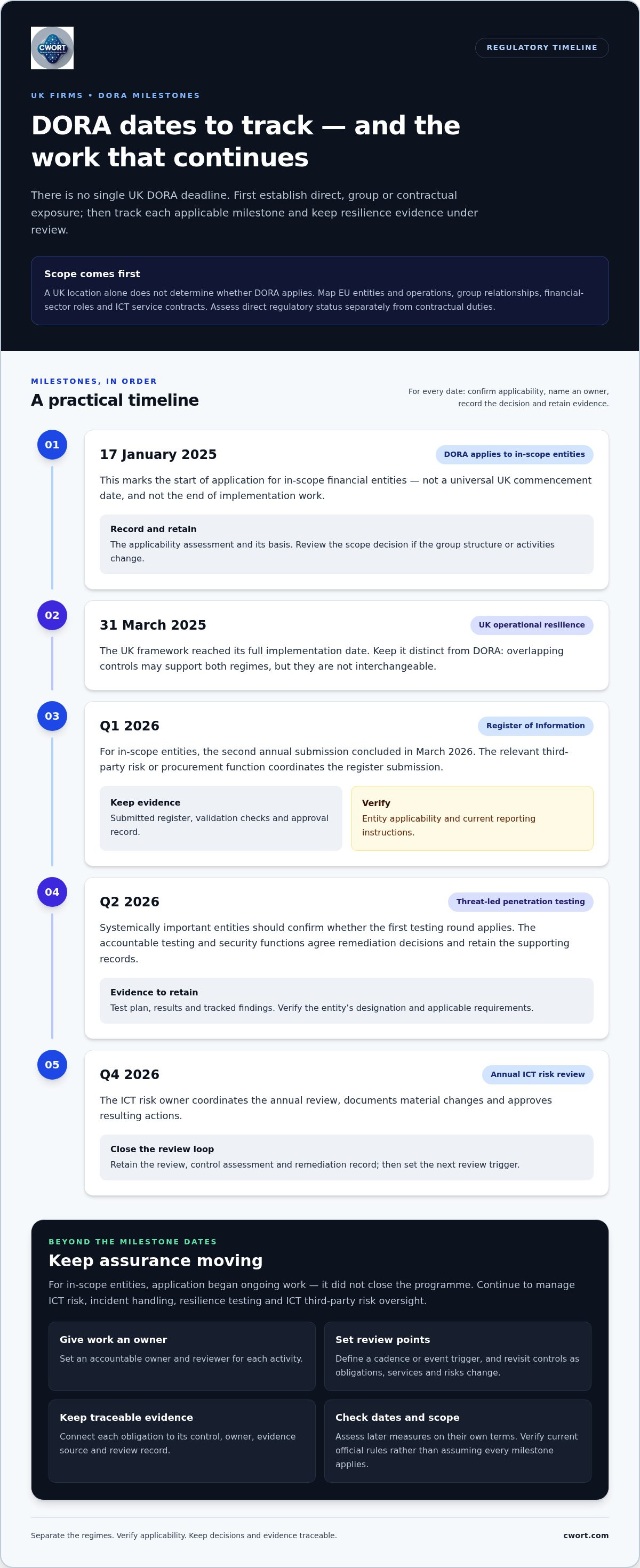
There is no single UK DORA deadline. The UK DORA implementation timeline depends first on whether your organisation has exposure to the EU regime. DORA has applied to in-scope entities since 17 January 2025, but not every UK firm is directly covered. UK businesses with EU subsidiaries or operations, or that provide ICT services to EU financial entities, may have obligations to assess.
If you’re unsure where DORA ends and UK operational resilience requirements begin, start by treating them as separate regimes. The UK framework reached its full implementation date on 31 March 2025. DORA sets distinct requirements for in-scope EU entities and their relevant ICT relationships.
This guide explains how to identify direct, group and contractual exposure, distinguish key dates, and turn applicable obligations into owned actions. It also shows how to maintain a traceable readiness plan, with control evidence and review points that support ongoing assurance in 2026.
Key Takeaways
- Use the UK DORA implementation timeline to distinguish fixed regulatory milestones from the recurring reviews and evidence cycles that continue in 2026.
- Map potential exposure across EU entities, group relationships and ICT contracts before assigning obligations or deadlines.
- Keep DORA and UK operational resilience requirements distinct. Overlapping controls can support both, but the regimes are not interchangeable.
- Turn applicable requirements into owned actions with clear decision points, evidence sources, review triggers and escalation routes.
- Connect obligations, controls, owners and evidence in a governed workflow to strengthen assurance. A platform supports this work but does not provide legal interpretation or guarantee compliance.
Table of Contents
- UK DORA implementation timeline: what the key date means for UK firms
- DORA milestones and continuing obligations to track in 2026
- DORA and UK operational resilience: separate the regimes before setting dates
- A practical UK DORA readiness plan: assess scope, assign owners and validate evidence
- How CWORT can organise DORA implementation evidence and assurance
UK DORA implementation timeline: what the key date means for UK firms
DORA is an EU regulation, not a universal UK implementation programme. The UK DORA implementation timeline therefore starts with a scope question: does your organisation fall within the regulation, or does it have group or contractual exposure to an entity that does? A UK location alone does not settle the question.
Regulation (EU) 2022/2554 became applicable on 17 January 2025. That date marked the start of application, not the start of preparation. Organisations needed to plan ahead for the requirements. Nor should it be treated as a single commencement date for every related technical standard. Track each standard and regulatory milestone on its own terms.
What happened on 17 January 2025?
From 17 January 2025, in-scope financial entities became subject to DORA’s digital operational resilience requirements. The date is set out in the regulation’s application provisions in the official text on EUR-Lex. For a broader overview of the Digital Operational Resilience Act (DORA), readers can also review its scope and core framework.
For implementation teams, this milestone marks the start of ongoing assurance, not the point at which to close the programme. Control effectiveness, ICT risks, third-party arrangements and supporting evidence need continued attention as obligations, services and risks change.
Does DORA apply to UK-based organisations?
Separate direct regulatory scope from indirect exposure. A UK-based organisation may be directly affected where an EU-established entity in its group is in scope. A UK ICT provider may also have DORA-related contractual requirements because it supports an in-scope financial entity. That does not automatically make the provider directly subject to every DORA obligation. Assess contractual duties and direct regulatory status separately.
Start by mapping legal entities, EU operations, financial-sector roles, group relationships and ICT service contracts. For each obligation, record the accountable entity, contractual requirements that flow to suppliers and the location of supporting evidence. For example, a UK technology supplier serving an EU financial entity should identify the resilience, incident or audit provisions required by its contract, rather than assume the client relationship alone determines its regulatory status.
Where scope is uncertain, obtain organisation-specific legal or regulatory interpretation. CWORT helps organise applicable obligations, accountable owners, control execution and evidence in a traceable workflow. A structured DORA readiness and assessment can turn a scope decision into an owned implementation and assurance plan.
DORA milestones and continuing obligations to track in 2026
The UK DORA implementation timeline is not a single countdown. It combines DORA’s application date, later measures and entity-specific milestones with recurring work to maintain and evidence resilience. Treat each date as a controlled action: confirm whether it applies, name the accountable function, record the decision and retain evidence of completion.
How to read DORA dates and technical standards
Distinguish the regulation itself from delegated or implementing measures, supervisory guidance and internal target dates. A measure’s proposal, publication or entry into force is not automatically the same as an organisation’s compliance deadline. Check current European Commission and European Supervisory Authorities publications before setting dates. Mark items dependent on entity scope or supervisory decisions as verify.
- 17 January 2025, application: The regulatory affairs or compliance lead confirms the entity’s applicability assessment and records its basis. Retain the scope decision and review it when the group structure or activities change.
- Q1 2026, Register of Information: For in-scope entities, the relevant third-party risk or procurement function coordinates the annual register submission. The second annual submission concluded in March 2026. Retain the submitted register, validation checks and approval record. Verify entity applicability and current reporting instructions.
- Q2 2026, threat-led penetration testing: Systemically important entities should have the accountable testing and security functions confirm whether the first testing round applies, agree remediation decisions and retain the test plan, results and tracked findings. Verify the entity’s designation and applicable requirements.
- Q4 2026, annual ICT risk review: The ICT risk owner coordinates the annual review, documents material changes and approves resulting actions. Retain the review, control assessment and remediation record, then set the next review trigger.
What continues after the initial implementation date?
Application did not end the work. In-scope entities need continuing ICT risk management, incident handling, resilience testing and oversight of ICT third-party risk. Assign each activity an accountable owner and reviewer, define its cadence or event trigger, and retain evidence showing whether the control operated and what happened when it failed.
For example, an incident process should link the event record to triage, decisions, actions and lessons identified. A supplier review should capture the service assessed, identified risks, approvals and follow-up. Confirm reporting thresholds, submission windows and testing requirements against current official rules rather than copying dates from a generic calendar.
Use a governed workflow to connect milestones, owners, control outcomes and evidence, then review the record when rules, services or risks change. A CWORT workflow demonstration illustrates how an evidence-led process can be organised.
DORA and UK operational resilience: separate the regimes before setting dates
Keep the two regimes in separate rows of your compliance calendar. DORA is EU law for entities within its scope. The UK’s operational resilience framework is a distinct domestic regime, supervised by the FCA and PRA. A UK firm may need to address both, but a UK supervisory milestone is not a UK DORA deadline. The UK DORA implementation timeline applies only where DORA exposure exists.
Which dates belong to DORA and which belong to UK rules?
Label every milestone by regime and cite its source in your internal calendar. The 17 January 2025 date comes from DORA. The 31 March 2025 date belongs to the FCA and PRA operational resilience framework. Before relying on either date for a particular entity, verify current rule status and scope against the relevant official material. Obtain organisation-specific legal interpretation where needed, and do not describe the UK date as a DORA implementation deadline.
Where can evidence and controls overlap?
Risk governance, incident processes, resilience testing and third-party oversight may involve shared policies, records or test results. Reuse evidence where it genuinely supports both regimes, but map it to each regime’s distinct requirements and record any gaps. A scenario-test report, for example, may be relevant to more than one assessment, but its coverage and conclusions still need to be checked against each applicable obligation.
A cross-framework control map preserves that distinction while reducing duplicated evidence gathering. DORA compliance validation can connect obligations, controls, owners and evidence without treating the regimes as interchangeable or assuming shared evidence proves compliance with both.
A practical UK DORA readiness plan: assess scope, assign owners and validate evidence
Turn applicable requirements into a controlled programme, not a list of unowned actions. The UK DORA implementation timeline should reflect your organisation’s scope, dependencies and evidence needs. Use this sequence to move from applicability assessment to continuing assurance.
- Assess applicability. Record the entities, EU activities, group relationships and ICT service contracts considered. Document the scope decision, its rationale, assumptions and the person accountable for approving it. Escalate unresolved legal interpretation rather than treating uncertainty as an implicit exemption.
- Map obligations to controls. For each applicable requirement, identify the control outcome, delivery task and evidence needed to demonstrate operation. Distinguish regulatory obligations from internal improvements, and note overlapping frameworks without assuming they are equivalent.
- Assign owners and dependencies. Name an accountable owner and delivery lead for each action. Map dependencies across risk, technology, legal, compliance, procurement and business teams. Separate control execution from review or validation where practicable, and define who can approve closure.
- Prioritise and schedule remediation. Rank gaps by regulatory relevance, risk, dependencies and delivery effort. Set milestones, decision points and escalation routes. If a dependency blocks progress, record the interim position, accountable decision-maker and next review point rather than leaving the action open-ended.
- Validate control operation. Test whether controls operated as intended. A policy or procedure demonstrates design, not necessarily execution or outcome. Link operational records, approvals, test results or incident actions to the relevant control, and document exceptions, findings and corrective actions.
- Review and refresh. Reassess the programme when regulatory material changes, scope shifts, a control fails or a material incident occurs. Set routine review points so owners can confirm that evidence remains current and remediation is progressing.
Build an organisation-specific implementation sequence
Give every milestone a due point, owner, required decision, evidence source and escalation path. For example, a supplier-control action might depend on procurement obtaining current service information, technology assessing the control and risk approving the residual exposure. Record the dependency and review trigger in the same workflow so slippage is visible and decisions remain traceable.
Validate controls and preserve an audit trail
Maintain a clear line from obligation to control, execution status, evidence, validation result and remediation. Evidence should show what happened, when it happened, who performed or reviewed it, and the outcome. For further detail on evidence governance, see the article on compliance evidence integrity.
A governed workflow helps organise owners, milestones, separation of duties and evidence without replacing regulatory interpretation or guaranteeing compliance. Learn more about structuring DORA readiness execution and assurance.
How CWORT can organise DORA implementation evidence and assurance
Once applicability and obligations are established, execution needs a governed structure. CWORT is a compliance validation and operating-model platform that connects requirements to controls, accountable owners, delivery status and supporting evidence. It helps teams organise the UK DORA implementation timeline and maintain a traceable view of readiness. CWORT supports execution and assurance; it does not provide legal interpretation or guarantee compliance.
From fragmented trackers to traceable execution
Spreadsheets and project tools can each record part of a programme, but disconnected records make it harder to see who owns an action, whether a control has been tested and what evidence supports its status. CWORT sits above existing security tooling, consolidating evidence from operational tools and organising work through a shared control view.
Within that workflow, teams can associate each obligation with its control, owner, task, status and evidence. Separation of duties helps distinguish execution from review, while a traceable history supports reporting and follow-up. This is not a regulator endorsement. It makes programme activity and evidence easier to govern. The same orchestration principles apply to broader regulatory compliance workflow automation, while each framework’s requirements remain distinct.
Use deterministic assessment to support defensible assurance
Evidence supports assurance when the assessment behind it is consistent and reviewable. CWORT’s deterministic scoring is designed to produce reproducible results from identical evidence. AI advisory can offer suggestions, but it does not alter deterministic assessment outcomes. This keeps assessed results distinct from optional recommendations.
The June 2026 control taxonomy contains 1,355 controls across 217 domains and 42 frameworks. In that snapshot, 98.6% of active controls have framework references. A shared control and evidence view can support assurance across applicable frameworks, but one assessment does not prove compliance with every framework.
A working session or scoped pilot can map programme obligations, owners and evidence into a governed workflow. View a DORA readiness demonstration to see how that structure supports execution and assurance.
Turn your DORA obligations into continuing assurance
The UK DORA implementation timeline is useful when it reflects your organisation’s actual exposure. Separate DORA obligations from UK operational resilience requirements, then translate each applicable milestone into an owned action with a clear review point.
Readiness also depends on evidence showing that controls operated and produced their intended outcomes, not simply that policies exist. CWORT’s June 2026 snapshot maps controls across 42 frameworks or standards. Its deterministic assessment, separation of duties and evidence linked to control outcomes support a reproducible assurance process without replacing regulatory interpretation or guaranteeing compliance.
Make your next step practical: map the programme, ownership and evidence into a governed workflow. Request a DORA readiness demonstration to explore how CWORT can support that work.
Frequently Asked Questions
When did DORA come into force, and when did it start applying?
DORA entered into force on 16 January 2023 and started applying on 17 January 2025. These dates mark different stages: entry into force made the regulation part of EU law, while the application date marked when its requirements began to apply to in-scope entities. Preparation began before application. Related technical standards and measures may have their own timelines, so do not assume every DORA-related requirement shares one commencement date.
Does DORA apply to UK financial services firms after Brexit?
Brexit does not make every UK financial services firm subject to DORA, but a UK-based firm can have exposure through its structure or activities. For example, an in-scope EU subsidiary may have direct obligations, while a UK group company may need to support its compliance. Assess the relevant legal entities, locations and services individually. For uncertain cases, obtain organisation-specific legal interpretation and record the rationale for the scope decision.
What is the UK DORA implementation deadline in 2026?
There is no universal UK DORA implementation deadline in 2026. DORA has applied to in-scope entities since 17 January 2025. The UK DORA implementation timeline for a particular organisation depends on its exposure and applicable requirements. In 2026, relevant entities still need to track continuing duties and applicable milestones, such as reporting, reviews or testing. Verify each obligation, deadline and applicability against current official requirements rather than treating one date as universal.
How is DORA different from UK operational resilience requirements?
DORA is an EU regulation applying to entities within its scope. UK operational resilience requirements are a separate domestic regime set by the FCA and PRA. The UK framework’s full implementation date was 31 March 2025, not a UK DORA deadline. The regimes can involve related themes, such as resilience testing and third-party risk, but their populations and requirements differ. Map shared evidence to each regime’s distinct obligations rather than treating them as interchangeable.
Are UK ICT providers in scope of DORA?
Not automatically. A UK ICT provider may face DORA-related requirements through its contracts with in-scope EU financial entities, which may pass relevant obligations down to suppliers. Separately, certain ICT third-party providers can be designated as critical under DORA and become subject to direct oversight. The provider’s location or customer relationship alone does not establish its precise status. Review applicable contracts and obtain legal interpretation where direct regulatory scope is uncertain.
What should a UK firm do if it has not completed DORA readiness work?
First establish whether and how the organisation is exposed, then document the decision and any assumptions. For applicable obligations, identify gaps, accountable owners, dependencies, delivery milestones and escalation routes. Prioritise work by regulatory relevance, risk and delivery dependencies. Validate whether controls operate as intended, retain evidence and track remediation to closure. Set review triggers for changes in scope, regulatory requirements, incidents or control failures. A late start is not a reason to defer action.
What evidence should an organisation retain to demonstrate DORA control effectiveness?
Retain evidence that links each applicable obligation to its control, accountable owner, execution status, review and outcome. Depending on the control, this may include approved procedures, operational records, testing results, incident decisions, supplier reviews and remediation logs. A policy alone shows documented design, not that a control operated effectively. Preserve dates, approvals, exceptions and follow-up actions so reviewers can trace what happened and how findings were addressed.
Disclaimer
The content on this site is provided for general information and educational purposes only. It does not constitute legal, regulatory, financial, or professional advice. CWORT provides AI-assisted insights and workflow automation, but all compliance decisions remain the responsibility of your organisation and its management. Always seek qualified legal or regulatory guidance for decisions relating to the UK NIS Regulations, CAF, DORA, NIS2, ISO 27001, or other obligations.
Related posts
CISO Guide to DORA Operational Resilience: Orchestrating Validated Compliance
Master validated compliance with our CISO guide to DORA operational resilience. Swap manual evidence gathering for an orchestrated, audit-ready security post...
DORA Technical Standards Compliance: Moving from Regulatory Theory to Validated Execution
Struggling with DORA technical standards compliance? Move beyond spreadsheets to a validated framework that provides real-time, auditable evidence for regula...
DORA Obligation Mapping Tool: Orchestrating Defensible Compliance in 2026
Stop manual DORA tracking. A DORA obligation mapping tool orchestrates compliance, automates reporting, and creates a defensible audit trail for central banks.
Article by
Michael Iyiola
Co-Founder, CWORT
Michael Iyiola is a co-founder of CWORT and a Cyber and AI Security Engineer with deep experience in vulnerability management, detection engineering and operational resilience across UK critical national infrastructure, including rail, energy and financial services. At CWORT, he designs scalable, evidence-driven workflows that help teams meet modern regulatory and security demands.
Build Your Foundation of Auditable Certainty
Take control of your regulatory obligations and secure your infrastructure with CWORT.