UK financial services compliance trends 2026: key shifts

Michael Iyiola
Co-Founder, CWORT
Explore UK financial services compliance trends 2026, from Consumer Duty and resilience to AI, cyber risk and key deadlines, with practical priorities for fi...

Compliance in 2026 is shifting from policy ownership to demonstrable control. The UK financial services compliance trends in 2026 centre on Consumer Duty, operational resilience, cyber risk, AI governance and changing market rules. Firms also need to prepare for specific deadlines, including the option to adopt the Consumer Composite Investments regime from 6 April 2026.
For boards and compliance leaders, the challenge is not simply tracking regulatory change. It’s translating each relevant obligation into clear ownership, effective controls and evidence that stands up to scrutiny, while managing technology and market shifts.
This article explains the changes shaping UK priorities, what they mean for different areas of financial services and how to focus compliance work. It covers Consumer Duty and customer outcomes, resilience and cyber risk, AI and digital assets, and key regulatory changes taking effect during 2026, so you can distinguish immediate action from longer-term planning.
Key Takeaways
- Connect cyber, data and third-party risks through an enterprise-wide resilience approach, with clear ownership and evidence of control effectiveness.
- Assess AI use across compliance, onboarding and customer engagement, focusing governance on accountability, data quality and resilience.
- Prepare for closer regulatory attention to digital assets, private markets and emerging technologies by aligning oversight with the risks of your activities.
- Build the July 2026 Buy-Now-Pay-Later change into regulatory planning: according to the Financial Conduct Authority, UK regulation of third-party Buy-Now-Pay-Later lending is scheduled to begin then.
- Translate regulatory obligations into assigned actions and traceable evidence so leadership can see where controls are working and where remediation is needed.
Table of Contents
- Cybersecurity and enterprise-wide resilience
- AI use by criminals and compliance teams
- What are the FCA's key UK financial services regulatory priorities for 2026?
- What changes to UK financial services rules are taking effect in 2026?
- What are the 2026 UK requirements and deadlines for operational resilience and third-party risk?
- CWORT: DORA Compliance Readiness and Assessment
Cybersecurity and enterprise-wide resilience
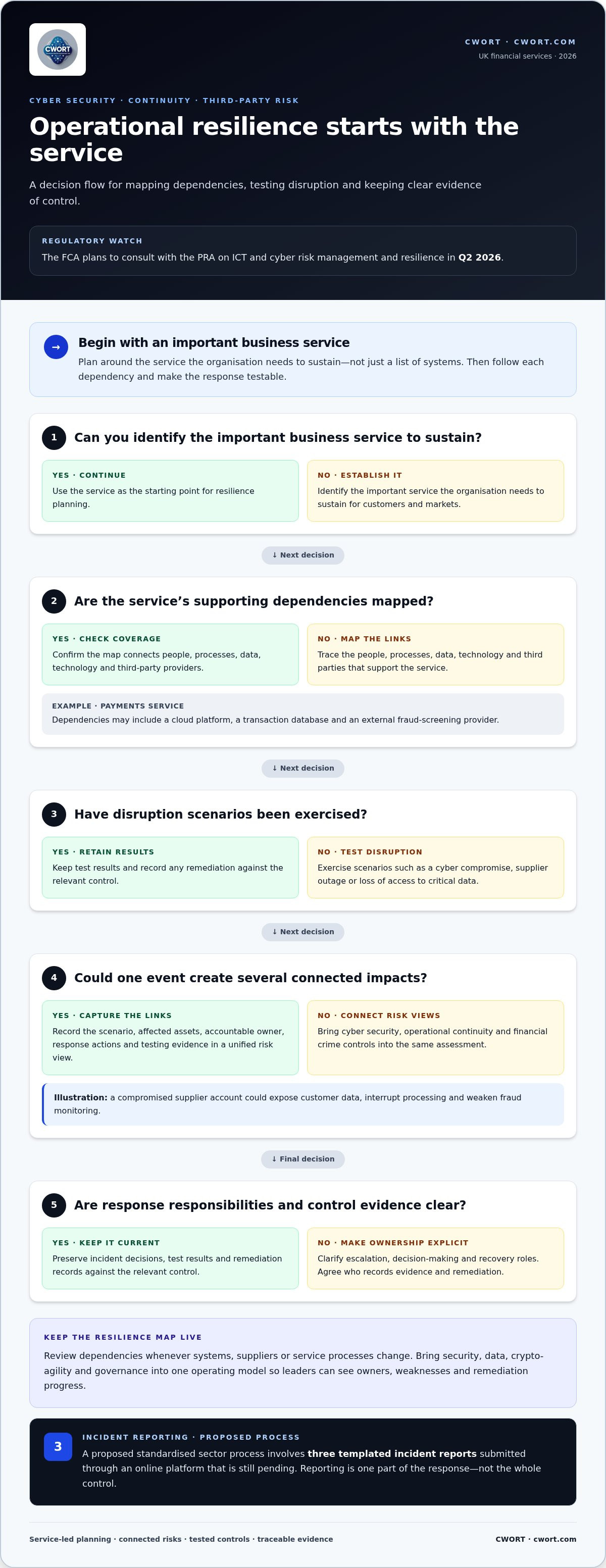
Cybersecurity is becoming inseparable from operational resilience across UK financial services. The FCA plans to consult with the PRA on ICT and cyber risk management and resilience in Q2 2026. That planned work makes it important for firms to connect technology risks with the services customers and markets rely on. Freshfields says advances in technology will raise concerns about operational resilience and cybersecurity for financial services firms.
Resilience planning should start with the service, not a list of systems. Identify the important business services the organisation needs to sustain, then map the people, processes, data, technology and third parties that support each one. For example, a payments service may rely on a cloud platform, a transaction database and an external fraud-screening provider. A failure in any dependency can disrupt the service, even if the firm’s own systems remain available.
Build a unified view of risk across cyber security, operational continuity and financial crime controls. This helps leaders assess how one event could trigger several impacts. A compromised supplier account, for instance, could expose customer data, interrupt processing and weaken fraud monitoring. Record the scenario, affected assets, accountable owner, response actions and testing evidence. Review these links whenever systems, suppliers or service processes change.
- Map dependencies: connect each important service to its technology, data, staff and third-party providers.
- Test disruption scenarios: exercise events such as a cyber compromise, supplier outage or loss of access to critical data.
- Assign response roles: make escalation, decision-making and recovery responsibilities clear across operational teams.
- Preserve evidence: retain test results, incident decisions and remediation records against the relevant control.
A proposed standardised operational-resilience process for the sector involves three templated incident reports submitted through an online platform that is still pending. Treat reporting as one part of the response, not the whole control. Accurate incident records depend on agreed severity criteria, reliable data sources and clear responsibility for preparing submissions. Rehearse these steps so teams can provide consistent accounts when disruption occurs.
Make resilience enterprise-wide. Bring security, data, crypto-agility and governance into one operating model rather than isolating them in technical workstreams. Crypto-agility means planning how cryptographic controls can adapt as technology and threats change. A shared control view helps boards see dependencies, accountable owners, unresolved weaknesses and remediation progress. A Cyber Resilience Assessment can help identify maturity gaps and organise improvements across connected controls.
AI use by criminals and compliance teams
In 2026, UK regulators are expected to assess AI governance through existing frameworks, including accountability, data quality and resilience. The FCA-commissioned Mills Review describes AI as potentially becoming embedded across UK retail financial services by 2030, including customer support, underwriting, compliance, claims and product design.
That creates a dual challenge for institutions. Criminals could use AI-generated messages to impersonate customers or suppliers, while compliance teams use AI to prioritise alerts and identify unusual patterns. Treat these as scenarios to test, not reasons to assume every alert or decision is reliable. A model that flags suspicious activity still requires accountable human oversight.
Start by taking stock of AI use across the organisation, including tools used by professional services teams and functions outside formal technology programmes. For each use, record its purpose, owner, data inputs, decision impact and dependencies. Include third-party models and tools embedded in customer or staff workflows. This gives risk teams a basis for identifying sensitive data, inappropriate access and weak approval routes.
- Set accountability: name the business owner and decision-maker for each AI use, including cases where outputs influence customer outcomes.
- Test data quality: check whether input data is accurate, relevant and governed appropriately for the model’s purpose.
- Validate outputs: compare results against documented criteria and record exceptions, human reviews and corrective action.
- Control changes: reassess models when data, purpose, supplier arrangements or decision pathways change.
The IOSCO supervisory toolkit for AI contains approximately 100 illustrative questions for supervisors examining firms’ AI use. This signals the value of being able to explain governance in operational terms: who approved a model, what controls apply, how exceptions are handled and what evidence supports oversight. Map those answers to existing controls rather than creating a disconnected AI register.
Include criminal misuse in scenario testing. For example, test whether staff can detect a synthetic supplier request changing payment details, and whether escalation steps preserve relevant records. Assess how AI-supported monitoring handles false positives, missed alerts and shifts in customer behaviour. Connect the tests to financial crime controls, customer impact and service resilience.
Economic pressure can encourage rapid automation, but speed without traceability creates new exposure. Give compliance teams defined review thresholds, access to model documentation and a route to challenge outputs. A structured compliance control review can help organise responsibilities, evidence and gaps across these controls.
What are the FCA's key UK financial services regulatory priorities for 2026?
Consumer Duty, digital assets and emerging risks are central to the FCA’s 2026 priorities. Planned Consumer Duty work follows publications issued in September 2025. These UK financial services compliance trends 2026 require firms to connect regulatory priorities with clear owners, relevant controls and evidence of outcomes.
For Consumer Duty, examine how products and services affect customers in practice. Map customer journeys from product design through communications, support and outcomes. For example, identify where someone might misunderstand a product feature or struggle to access support. Link each risk to a control, responsible owner and review evidence. This helps establish whether the firm’s stated standards match customers’ experiences.
Digital assets are another area to prepare for. The UK is expected to introduce legislation for a regulatory regime for digital assets in 2026. Firms with relevant activities should map how these services affect governance, customer communications, custody arrangements and risk oversight. Digital assets, embedded finance and tokenisation also enable always-on cross-border transactions, increasing the need for trust, interoperability and secure digital infrastructure.
Private markets and credit are attracting closer attention as regulators examine the effects of private credit on financial stability. Private-market firms face sharper risk scrutiny and need evidence that they can identify and manage risks and aggregate relevant data. Investment managers and wealth firms pursuing retail and private-market growth should align controls with their activities. Oversight needs to keep pace with products, distribution routes and investor participation.
Supervisory attention also extends to insurers and non-bank financial institutions. KPMG’s analysis of 2026 regulatory drivers highlights potential scrutiny of governance and oversight for emerging technologies. The FCA’s supervisory remit is set to expand in 2026 to cover professional services firms and the payment services sector. Organisations should assess whether governance maps cover new activities, business relationships and decision-makers.
- Map exposure: connect each FCA priority to affected services, customers, controls and accountable owners.
- Test evidence: use customer journeys, risk records and governance decisions to show how controls operate.
- Set review triggers: revisit assessments when products, technology, distribution or regulatory scope changes.
These steps turn regulatory priorities into a sequenced work plan. Record the rationale for each action and escalate gaps that could affect customers, market integrity or oversight. For teams planning against UK financial services compliance trends 2026, the practical test is whether every priority has a clear owner and a defensible record of action.
What changes to UK financial services rules are taking effect in 2026?
The 2026 timetable combines new requirements, transition choices and planned reforms. Separate confirmed start dates from proposals and future deadlines. That distinction helps compliance teams allocate owners, assess affected services and sequence implementation without treating every announcement as an immediate obligation.
Payment firms should prepare for safeguarding changes scheduled for May 2026. These changes require oversight of safeguarding arrangements to be allocated to a named senior manager. Firms must also produce resolution packs covering third-party arrangements, reconciliations and records. Map each requirement to its responsible owner and the information needed to evidence compliance.
Consumer Composite Investments creates a separate implementation track. Firms may adopt its requirements instead of the previous requirements from 6 April 2026. The regime offers manufacturers and distributors more flexibility in customer communications, while requiring some key metrics to help consumers compare products. Firms must comply with its requirements by 8 June 2027. Review affected products, communication templates and approval controls early.
Credit providers also face a defined change: according to the Financial Conduct Authority, UK regulation of third-party Buy-Now-Pay-Later lending is scheduled to begin in July 2026. Identify whether third-party lending activity, customer journeys and oversight arrangements fall within the relevant change. Merchant-provided Buy-Now-Pay-Later loans remain outside the scope of regulation under the changes described.
Other 2026 developments need careful status tracking. The targeted-support regime is planned to start in April, but the legislation was still in draft when the outlook was written. The proposal would create a standalone regulated activity under the Financial Services and Markets Act 2000. Changes to the Senior Managers and Certification Regime are expected to take effect in mid-2026, while the non-financial misconduct rule extension is scheduled for September.
- June: the PRA requires firms to submit a board-approved plan addressing new climate risk management requirements.
- Q4: the FCA’s final rules for bringing ESG ratings providers into its regulatory perimeter are due.
- Across 2026: amendments to the UK Money Laundering Regulations are expected to introduce significant changes.
For each change, record its status, affected business areas, accountable decision-maker and implementation evidence. Don’t confuse a planned regime with an operative rule. Also track the forthcoming T+1 securities settlement shift, because operational readiness can involve systems, reconciliations and counterparties across UK and EU activity.
What are the 2026 UK requirements and deadlines for operational resilience and third-party risk?
For 2026, the clearest resilience milestone in the current outlook is the FCA’s planned consultation with the PRA. It was planned for Q2 2026 and concerns ICT and cyber risk management and resilience. Firms should use this regulatory focus to test whether their operational controls connect to service delivery, dependencies and accountable decision-makers.
A consultation is not itself a new operational requirement. Keep regulatory monitoring separate from implementation planning: record the consultation’s scope, assess its relevance, and update controls when applicable expectations are clear. This avoids treating a proposal as a final rule while allowing teams to prepare evidence about existing arrangements.
The proposed standardised operational-resilience process involves three templated incident reports submitted through an online platform that is still pending. Prepare for consistent reporting by agreeing incident definitions, escalation routes and data owners. For example, an outage affecting a customer-facing service may require input from technology, operations, communications and supplier-management teams. A shared incident record can reconcile their accounts before submission.
Third-party risk starts with mapping dependencies. Link each important service to its critical suppliers, subcontractors, technology, data flows and internal owners. A cloud provider may support transaction processing, while another supplier handles identity checks. Record how each dependency could affect continuity, what fallback arrangements exist and who can authorise a response. Keep assessments current as contracts, services or supplier arrangements change.
Test more than a supplier’s stated continuity plan. Use scenarios to examine the firm’s ability to detect disruption, communicate with affected parties, make decisions and restore service. Record test objectives, participants, observed weaknesses and remediation owners. A test without assigned corrective actions gives leadership limited evidence of control effectiveness.
- Maintain a dependency register: connect suppliers and subcontractors to the services they support.
- Set escalation routes: define who assesses impact and who authorises continuity or recovery actions.
- Validate evidence: retain incident records, test outcomes, supplier reviews and completed remediation.
- Review material changes: reassess dependencies when a service, contract or technology arrangement changes.
For boards, the useful view is a traceable line from service impact to supplier dependency, control owner and evidence. That view helps distinguish documented arrangements from tested capability. To structure resilience evidence and identify control gaps, request a compliance platform demonstration.
Broader capacity planning matters alongside supplier controls. Compliance professionals remain in demand in UK financial services, particularly in financial crime, risk management, ESG oversight and operational resilience. The outlook says life insurers’ success in DC and BPA markets will require robust operations and modelling and renewed focus on customer journeys. The PRA’s initial climate risk management framework dates from 2019. Firms can use these signals to check whether ownership, skills and operational evidence are aligned, while keeping resilience work connected to the services customers rely on.
The outlook says payments compliance deadlines may constrain firms’ capacity to innovate in stablecoins and tokenised deposits. The European Central Bank’s first stress test incorporating geopolitical risk in 2026 targets 110 directly supervised banks in the EU. Freshfields says the Trump administration challenged consensus on climate change and bank capital requirements. For decision-makers, these developments reinforce the value of clear accountability, scenario testing and documented choices about operational priorities. Review capacity and governance as regulatory and market pressures evolve, and ensure material dependencies and customer impacts inform those decisions.
CWORT: DORA Compliance Readiness and Assessment
CWORT provides DORA Compliance Readiness and Assessment for organisations translating regulatory obligations into accountable, evidence-based execution. Use it when teams need to map requirements to controls, assign activities and bind evidence to control outcomes. Its structured validation system supports auditable compliance proof and brings fragmented tracking into a single workflow.
For firms managing overlapping frameworks, CWORT also offers UK NIS Compliance Management, NIS2 Readiness and Compliance Management, and ISO 27001 Readiness and Control Mapping. These offerings can help organise obligations and control evidence across relevant requirements, without treating different frameworks as interchangeable.
Visit cwort.com to discuss how CWORT’s compliance readiness and assessment capabilities may fit your organisation’s needs.
Turn regulatory change into accountable action
The UK financial services compliance trends for 2026 make one leadership priority clear: connect each commitment to an owner, a control and evidence that demonstrates how it works. The next step is to decide which obligations affect your organisation, where responsibilities are unclear and which gaps should shape your compliance plan.
CWORT supports that work through DORA Compliance Readiness and Assessment, UK NIS Compliance Management and NIS2 Readiness and Compliance Management. These offerings help organisations structure regulatory activities and connect controls with auditable evidence. Start with the framework or compliance challenge that matters most to your current operating model, then establish a practical sequence for closing identified gaps.
Contact CWORT to discuss your compliance needs and how a structured approach could support your priorities. Clear ownership and traceable evidence give your teams a stronger foundation for responding to regulatory change with discipline and confidence.
Frequently Asked Questions
How will the FCA's Consumer Duty supervision and enforcement develop in 2026?
The FCA’s planned Consumer Duty work in 2026 follows publications issued in September 2025. Firms should prepare to explain how they assess customer outcomes, identify harm and act on findings. For example, a product review could document customer feedback, recurring complaints, ownership of corrective actions and how changes are evaluated. This creates a practical record for governance and supervisory discussions without assuming a particular enforcement approach.
What UK financial services cybersecurity and incident reporting requirements apply in 2026?
The FCA planned to consult with the PRA in Q2 2026 on ICT and cyber risk management and resilience. A described operational-resilience process involves three templated incident reports submitted through a pending online platform. Firms can prepare by defining incident escalation, assigning responsibility for report information and keeping consistent event records. For a supplier outage, for instance, technology and service teams should capture impacts and decisions in a shared incident record.
What are the likely compliance costs and staffing challenges for UK financial services firms in 2026?
Compliance costs depend on the firm’s regulatory scope, existing controls, remediation needs, technology and available expertise. Permanent compliance hiring was subdued through much of 2024 and 2025, while firms used contractors for time-sensitive Consumer Duty reviews, operational-resilience testing and financial-crime work. Demand remains focused on financial crime, risk management, ESG oversight and resilience. To plan capacity, prioritise obligations by risk and identify specialist work that needs temporary project support.
How do UK financial services compliance trends in 2026 compare with EU requirements?
UK and EU requirements have separate scopes and implementation timetables, so firms operating across both should map obligations by entity and activity. For example, EU CRD6 governance requirements for banks were due to apply in January 2026. The UK’s Consumer Composite Investments regime has its own adoption and compliance dates. Build a cross-jurisdictional obligations register that identifies overlapping controls, distinct requirements, accountable owners and evidence needed for each regulator.
Disclaimer
The content on this site is provided for general information and educational purposes only. It does not constitute legal, regulatory, financial, or professional advice. CWORT provides AI-assisted insights and workflow automation, but all compliance decisions remain the responsibility of your organisation and its management. Always seek qualified legal or regulatory guidance for decisions relating to the UK NIS Regulations, CAF, DORA, NIS2, ISO 27001, or other obligations.
Related posts
DORA Compliance Validation Software: Orchestrating Defensible Proof in 2026
Is your DORA strategy audit-ready for 2026? Learn how DORA compliance validation software provides defensible proof and protects board members from liability.
Choosing a DORA Operational Resilience Platform: Validation vs Documentation
Move beyond spreadsheets. Discover how a DORA operational resilience platform provides validated proof, not just documentation, for total, defensible assurance.
DORA Separation of Duties Enforcement: Moving from Policy to Validated Proof
Achieve effective DORA separation of duties enforcement. This guide shows how to replace manual tracking with an automated system for validated, audit-ready ...
Article by
Michael Iyiola
Co-Founder, CWORT
Michael Iyiola is a co-founder of CWORT and a Cyber and AI Security Engineer with deep experience in vulnerability management, detection engineering and operational resilience across UK critical national infrastructure, including rail, energy and financial services. At CWORT, he designs scalable, evidence-driven workflows that help teams meet modern regulatory and security demands.
Build Your Foundation of Auditable Certainty
Take control of your regulatory obligations and secure your infrastructure with CWORT.