What Auditors Hate in Compliance and How to Fix It

Michael Iyiola
Co-Founder, CWORT
Learn what auditors hate to see in compliance documentation, avoid common evidence pitfalls, and build clear, traceable proof to pass your audits with ease.

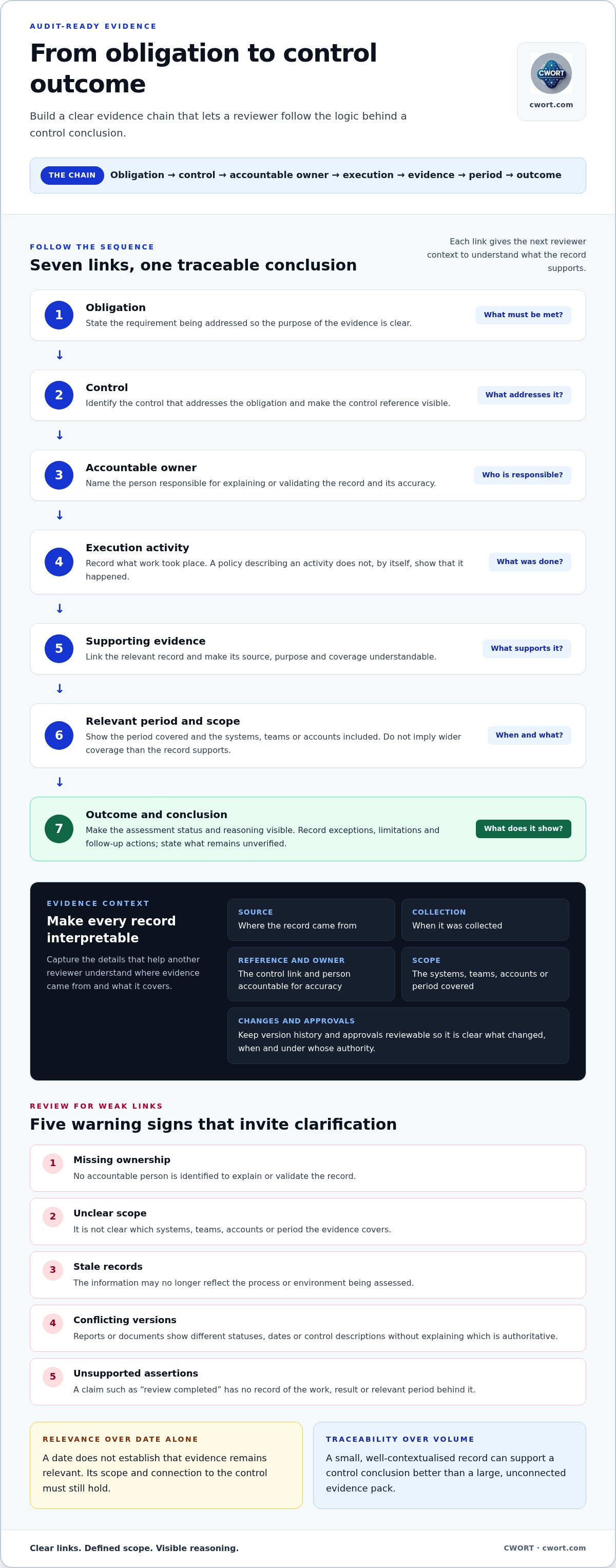
Auditors need traceable control activity, not polished folders of disconnected files. What auditors hate to see in compliance documentation is evidence that looks complete at a glance but cannot be tied to a specific obligation, control, owner or period. When records are spread across spreadsheets, tickets and operational tools, even a well-run control can be difficult to explain and defend.
Teams often discover the problem during audit preparation: they chase evidence, then find stale records, missing context or contradictions between reports. The issue is not simply how much documentation exists. It is whether each item shows what happened, who was responsible, what it covered and which outcome it supports.
This guide shows you how to identify gaps that weaken audit confidence and build evidence that is current, traceable and reproducible. We cover missing ownership, unclear control links, outdated records and fragmented evidence, then set out a practical way to connect requirements, execution and proof. CWORT can bring evidence from existing tools into a unified, control-by-control view without replacing those tools. That gives teams a clearer basis for assurance and reduces last-minute reconstruction.
Key Takeaways
- Spot warning signs that make auditors question whether a control is operating, including unclear scope, missing ownership and unsupported claims.
- Use a clear evidence chain to show how each obligation connects to a control, its owner, execution and recorded outcome.
- Assess evidence for relevance and completeness, not just its date. Outdated, duplicated or out-of-scope records can weaken your case.
- Turn what auditors hate to see in compliance documentation into a practical review checklist, then assign and revalidate corrective actions.
- Build repeatable assurance into normal operations with control-level evidence and accountability. Keep control owners responsible for accurate records and judgements.
Table of Contents
- What auditors hate to see in compliance documentation: five warning signs
- Make compliance documentation traceable from obligation to control outcome
- Spot stale, inconsistent and unsupported evidence before the audit
- Use a repeatable review process to fix documentation weaknesses
- Build audit-ready compliance documentation into normal operations
What auditors hate to see in compliance documentation: five warning signs
Audit friction arises when records cannot support a clear conclusion about whether a control operated. A missing document is not always the central problem. The concern is whether gaps obscure the control’s scope, operation or accountability. A formatting inconsistency may be administrative, while an unexplained status or missing review record can leave it unclear what actually happened.
Expectations vary with the framework, audit scope and evidence requested, so no single checklist guarantees a smooth review. The question behind what auditors hate to see in compliance documentation is consistent: can a reviewer understand what the evidence demonstrates and how it supports the control? The concept of audit evidence is useful here. Records need to provide a basis for evaluating a claim, not simply exist in a folder.
When a document exists but does not prove the control
A policy may state that access is reviewed regularly. On its own, it does not show that a review took place during the period in scope. A dated review record that identifies the accounts checked, the reviewer and the outcome gives a reviewer a clearer basis for assessment.
Context matters. An undated screenshot may show a setting, but not when it applied or whether it covered the relevant systems. A spreadsheet may contain entries without explaining its columns, status labels or the population reviewed. Evidence must support a specific control claim, rather than merely mention the same subject.
The warning signs that create avoidable follow-up
Look for five weaknesses that can prompt reviewers to ask for clarification:
- Missing ownership: No accountable person is identified to explain or validate the record.
- Unclear scope: The evidence does not show which systems, teams, accounts or period it covers.
- Stale records: The information may no longer reflect the process or environment being assessed.
- Conflicting versions: Reports or documents show different statuses, dates or control descriptions, with no explanation of which is authoritative.
- Unsupported assertions: A statement such as “review completed” has no record of the work, result or relevant period behind it.
Also check for unexplained status labels and missing review dates. Terminology matters. If one record refers to “access recertification” and another to “user review”, their relationship may not be obvious unless the organisation defines them as the same activity. A date alone does not establish that evidence remains relevant. Its scope and connection to the control must still hold.
Traceability matters more than document volume. A small, well-contextualised record can support a control conclusion better than a large, unconnected evidence pack.
Make compliance documentation traceable from obligation to control outcome
A defensible evidence chain lets a reviewer follow the logic from the obligation being addressed to the conclusion reached. Record the obligation, control, accountable owner, execution activity, supporting evidence, relevant period and outcome. If a link is missing, the reviewer may have to rely on undocumented team knowledge to understand why a record supports the control.
Traceability is not a matter of attaching more files. Each record needs a clear source and purpose, and another reviewer should be able to follow the reasoning behind the assessment. Evidence should be relevant to the control, cover the period being assessed and provide enough context to interpret its meaning. This helps teams distinguish records that genuinely support a conclusion from those that simply refer to the same topic.
What evidence provenance and scope should make clear
For each item, capture where it came from, when it was collected, the period it covers, its control reference and the owner responsible for its accuracy. Define the scope as well. A report covering one business unit or system should not be presented as proof for a wider estate unless its coverage supports that conclusion.
Keep version history and approvals reviewable. If a record changes, its history should help explain what changed, when and under whose authority. This allows reviewers to distinguish a current, approved record from an earlier draft without relying on someone’s memory.
How to connect evidence to a control conclusion
Start with the control assertion, then identify the record that supports or challenges it. Make the assessment status and reasoning visible, and record any exception, limitation or follow-up action. Do not present partial evidence as complete assurance. State what it covers and what remains unverified.
Generic illustrative example, not a CWORT customer case: An organisation states that privileged access is reviewed for a defined set of systems during a specified period. The control record identifies its owner and review activity. The supporting report names the systems and review date, while the outcome records accounts requiring action and how those actions were tracked. A reviewer can see what was tested, what the evidence supports and where a limitation remains.
Evidence is traceable and reproducible when another reviewer can follow its source, scope and control link to the same recorded conclusion. This is the practical antidote to what auditors hate to see in compliance documentation: assertions that depend on context no one has written down. A governed workflow can connect obligations, execution and evidence. Explore CWORT’s compliance validation approach.
Spot stale, inconsistent and unsupported evidence before the audit
A record can be recent and still be weak evidence. Its date does not prove that it covers the right systems, reflects the process in scope or supports the control conclusion. Documentation quality and control effectiveness are also separate questions. A complete file may show that a control was documented, but not establish that it operated as intended.
Before an audit, compare each record with the control claim it is meant to support. Check that it is relevant, sufficient for that claim, authentic, covers the required period and is clearly linked to the control. Record who produced or reviewed it, and whether the system, process or record changed afterwards. Apply these checks in line with the framework, audit scope and evidence request.
A practical test for evidence quality
Use these characteristics to distinguish evidence that can be assessed from a file that merely exists. Apply them in light of the audit scope and evidence request.
Do not resolve conflicting versions by silently choosing the most favourable one. Identify the authoritative record, explain the discrepancy and retain enough history to show how the decision was reached. A high volume of files will not compensate for uncertainty about which version supports the assessment.
How to handle exceptions and evidence gaps
Record unavailable evidence, sampling limitations and unresolved exceptions plainly. State what was not tested and how that limits the conclusion. Assign each remediation action to an accountable role, with a due date and status, then preserve the original assessment trail so later updates do not erase earlier findings.
This discipline addresses what auditors hate to see in compliance documentation: unsupported certainty. Separate the evidence assessment from the control conclusion, and make limitations visible. Reviewers can then judge what the records establish and what still requires action.
Use a repeatable review process to fix documentation weaknesses
Replace the last-minute evidence chase with a consistent review cycle. Work control by control, record the basis for each assessment and make the next action visible. This helps teams address what auditors hate to see in compliance documentation without treating a missing record as proof that a control has failed.
A control-by-control documentation review
Use the same sequence for each control. A repeatable method makes gaps easier to compare and helps reviewers understand how findings were reached.
- 1. Define the scope. Confirm the framework, requirements, business units, systems and period included in the review.
- 2. Map the controls. Confirm the obligation and control wording before assessing records. Identify the accountable control owner.
- 3. Test the evidence. Check each item’s scope, date, ownership, provenance and connection to the stated control outcome. Confirm that the records support the conclusion being made.
- 4. Record the gap. Use consistent categories, such as missing evidence, incomplete coverage, conflicting records or an identified control failure. These are not interchangeable. A lack of evidence may prevent a conclusion, but does not by itself establish that the control failed.
- 5. Assign corrective actions. Set an accountable owner, priority, target date and clear completion condition for each gap.
- 6. Revalidate. Review new or corrected evidence against the original requirement, update the assessment and keep the outcome and rationale on record.
Turn findings into owned, reviewable remediation
Control owners remain responsible for the accuracy of evidence and status, even when a compliance team coordinates the review. A reviewer should challenge unclear scope, ambiguous labels or conflicting versions rather than choosing an interpretation without support. Record the decision, its rationale and any approval so the assessment can be understood later.
Track actions through to a measurable completion condition, not simply a change of status. For example, “update evidence” is vague. “Provide the approved review record covering the defined systems and period” is testable. Preserve the original finding and assessment history alongside new evidence. That creates a reviewable trail of what was identified, what changed and how the conclusion was revalidated.
A governed workflow can connect requirements, control owners, evidence and follow-up without removing accountability from the people responsible for the controls. To explore how CWORT supports structured compliance validation, request a CWORT demonstration.
Build audit-ready compliance documentation into normal operations
Ad hoc folders and spreadsheets can work for individual tasks, but become harder to manage as a compliance programme grows. Ownership, version history and control-level evidence can be difficult to keep consistent across files. A governed workflow gives each control a defined place for its references, accountable roles, evidence status, assessment decisions and history. The aim is not to create more records. It is to make routine control activity easier to review and explain.
Tools support that discipline; they do not replace sound control design or accountable judgement. Control owners must still confirm that evidence is accurate and recorded statuses reflect what happened. Where responsibilities need to be distinct, separation of duties helps show who performed an activity, who reviewed it and who approved the outcome.
What a governed evidence workflow should preserve
Keep the control reference, evidence and assessment rationale connected, with a history of relevant updates and approvals. This lets a reviewer understand not only the current position, but how it was reached. If an earlier assessment changes after new evidence arrives, retain the prior context rather than silently overwriting it.
CWORT sits above an organisation’s existing security tools. It can consume evidence from operational sources and present a unified view, while structured execution activities and evidence registers link records to control outcomes. Its AI advisory offers suggestions only; it does not alter deterministic results. Human owners and reviewers remain responsible for decisions and the accuracy of the underlying information.
How CWORT supports compliance validation
Control-by-control evidence registers and structured execution tracking help teams organise validation as part of normal operations, rather than reconstructing the story at audit time. Multi-framework mapping can support an assess-once, report-many workflow: shared control activity and evidence can be viewed against relevant framework references, while the organisation retains responsibility for determining applicability and interpreting results.
As of June 2026, CWORT’s platform library includes 1,355 controls across 217 domains and 42 frameworks or standards. These figures describe the breadth of the control taxonomy, not audit results, certification or regulatory outcomes. The platform connects obligations, owners, execution and evidence in a governed, reviewable process, without guaranteeing acceptance by an auditor.
To see how CWORT’s structured compliance validation workflow can support your organisation’s evidence and review process, request a CWORT demonstration.
Make audit confidence part of everyday compliance
Audit confidence comes from a clear, repeatable link between obligations, control activity, accountable owners and evidence. Check records for relevance and consistency, make gaps visible, and assign actions that can be revalidated. That discipline addresses what auditors hate to see in compliance documentation: evidence that cannot support a clear control conclusion.
A governed validation workflow can help teams maintain ownership, history and control-level evidence as part of normal operations. CWORT provides deterministic, reproducible assessment results. Its AI advisory offers suggestions only and does not alter outcomes. As of June 2026, its platform library covers 1,355 controls across 217 domains and 42 frameworks or standards. These figures describe taxonomy coverage, not audit or regulatory outcomes.
Move beyond last-minute reconstruction. Request a CWORT demonstration to explore a structured approach to compliance validation and evidence management. With clear accountability and traceable records, your team can build assurance steadily and approach the next audit with greater control.
Frequently Asked Questions
What do auditors look for in compliance documentation?
Auditors look for records that fit the agreed scope and support a specific control conclusion. They need to understand the obligation, the control activity, who performed or reviewed it, the period covered and the recorded outcome. Clear references, reliable provenance, consistent versions and visible exceptions make evidence easier to assess. The exact evidence requested depends on the framework, audit scope and request, so align documentation with the criteria being assessed.
What is the most common problem with compliance evidence?
A frequent problem is evidence that exists but is not clearly connected to the control it is meant to support. A policy, screenshot or spreadsheet may mention a relevant subject without showing what activity took place, which systems were covered or what the result was. This makes it harder to reach a defensible conclusion. Link each record to a control, owner, relevant period and assessment outcome, and explain any limitations.
Can auditors reject a document because it is out of date?
An auditor may consider an outdated document insufficient for the period or control being assessed, but age alone does not determine whether it is useful. A dated record may still be relevant if its scope and content remain applicable. A recent one may not support the control if it covers the wrong systems or activity. Explain why the evidence remains valid, or replace it with current records and document any gaps.
How do you make compliance documentation audit-ready?
Start by defining the audit scope and mapping each relevant obligation to a control and accountable owner. For every control, record the evidence source, period covered, review or collection date, outcome and any limitations. Check that versions agree, assign actions for gaps, and retain the history of changes and approvals. Revalidate corrected evidence against the original control requirement so the conclusion can be followed and reproduced.
What happens if compliance evidence is missing?
Missing evidence can prevent a reviewer from confirming whether a control operated, but it does not automatically prove the control failed. Record the gap clearly, state what could not be verified and consider whether relevant alternative evidence is available. Assign an accountable owner and target date for follow-up, then update the assessment when new records are reviewed. Keep the original finding and subsequent decisions visible so the audit trail remains clear.
Is a spreadsheet enough to manage compliance documentation?
A spreadsheet may suit a limited register if it clearly records control references, owners, evidence links, statuses and review history. As scope and frameworks expand, multiple files can become difficult to reconcile, with version conflicts and unclear accountability. Assess whether your approach preserves traceability and reviewable decisions. A governed workflow can connect control-level evidence and ownership while aggregating records from existing operational tools rather than replacing them.
Disclaimer
The content on this site is provided for general information and educational purposes only. It does not constitute legal, regulatory, financial, or professional advice. CWORT provides AI-assisted insights and workflow automation, but all compliance decisions remain the responsibility of your organisation and its management. Always seek qualified legal or regulatory guidance for decisions relating to the UK NIS Regulations, CAF, DORA, NIS2, ISO 27001, or other obligations.
Related posts
ISO 27001 Control Effectiveness Proof: Moving Beyond Static Certification to Defensible Validation
Move beyond static ISO 27001 certification. Discover how an ISO 27001 compliance validation tool delivers continuous, defensible proof for UK regulators.
How to Demonstrate Control Effectiveness to Regulators: A Strategic Guide
Learn how to demonstrate control effectiveness to regulators with our guide. Shift from chaos to an evidence-based, audit-ready compliance programme today.
Reducing Audit Preparation Time and Costs: A Strategic Guide for UK Enterprises
Tired of costly audit seasons? Our guide for UK enterprises shows you how to stop the manual scramble, reducing audit preparation time and costs with automat...
Article by
Michael Iyiola
Co-Founder, CWORT
Michael Iyiola is a co-founder of CWORT and a Cyber and AI Security Engineer with deep experience in vulnerability management, detection engineering and operational resilience across UK critical national infrastructure, including rail, energy and financial services. At CWORT, he designs scalable, evidence-driven workflows that help teams meet modern regulatory and security demands.
Build Your Foundation of Auditable Certainty
Take control of your regulatory obligations and secure your infrastructure with CWORT.