What Do Regulators Look for in a DORA Audit? A Strategic 2026 Guide

Michael Iyiola
Co-Founder, CWORT
Wondering what do regulators look for in a DORA audit? Our 2026 guide reveals the evidence and governance needed to pass supervisory inspections with certainty.

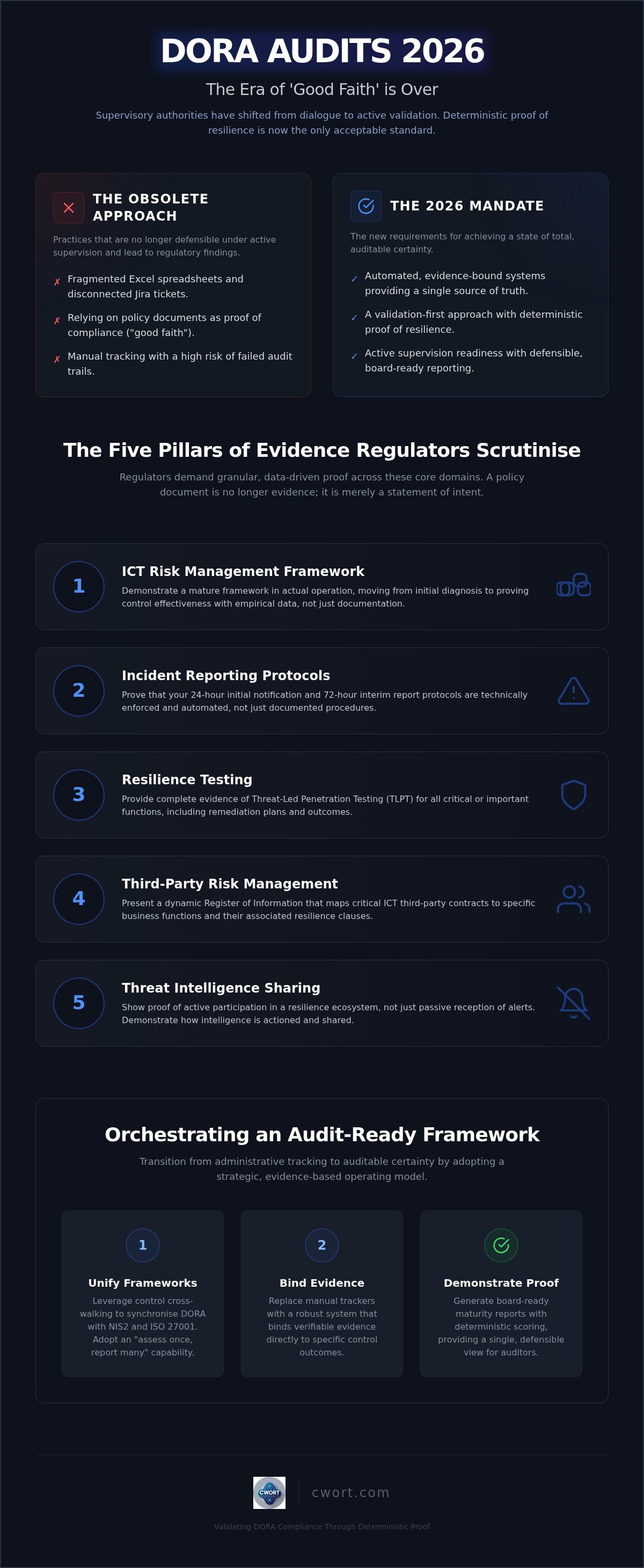
In 2026, the era of regulatory "good faith" is officially over. National Competent Authorities have shifted from dialogue to active validation, leaving many organisations scrambling to justify their resilience posture. If you're still relying on fragmented Excel spreadsheets or disconnected Jira tickets, you're vulnerable. Understanding exactly what do regulators look for in a DORA audit is no longer a matter of administrative curiosity; it's a requirement for corporate survival. You likely feel the pressure of demonstrating a clear separation of duties whilst managing a complex technology supply chain under intense scrutiny.
This guide provides a strategic map of the specific evidence, governance structures, and deterministic proof that auditors demand during a formal supervisory inspection. We'll move beyond the anxiety of potential "Section 166" style scrutiny to establish a state of auditable certainty. You'll discover how to replace manual tracking with a robust system that binds evidence directly to control outcomes. We'll explore the core pillars of DORA through the lens of enforcement, ensuring your board-level reporting is both defensible and uncompromisingly objective.
Key Takeaways
- Transition from a policy-based compliance model to a validation-first approach where deterministic proof of resilience is the only acceptable standard for competent authorities.
- Identify exactly what do regulators look for in a DORA audit, focusing on the precise mapping of ICT assets to critical or important functions and the binding of evidence to control outcomes.
- Abandon manual spreadsheets and fragmented tracking tools in favour of automated, evidence-bound systems to eliminate the risk of failed audit trails and regulatory findings.
- Leverage strategic control cross-walking to synchronise DORA requirements with existing frameworks like ISO 27001 or NIS2, enabling a unified "assess once, report many" capability.
- Implement a scalable operating model that utilises pre-mapped regulatory controls to deliver board-ready maturity reports and achieve total auditable certainty.
Table of Contents
- Supervisory Expectations in 2026: The Shift from DORA Implementation to Validation
- The Five Pillars of Evidence: What Regulators Scrutinise Most
- Beyond the Spreadsheet: Why Regulators Reject Manual Compliance Trackers
- Orchestrating an Audit-Ready ICT Risk Management Framework
- CWORT: Validating DORA Compliance through Deterministic Proof
Supervisory Expectations in 2026: The Shift from DORA Implementation to Validation
By September 2026, the supervisory landscape for the Digital Operational Resilience Act (DORA) has evolved from educational dialogue to rigorous enforcement. National Competent Authorities (NCAs) no longer accept static policy documents as evidence of compliance. They demand deterministic proof that your resilience framework functions in real-time. When considering what do regulators look for in a DORA audit, the answer lies in the transition from "intent" to "validation."
The Joint Oversight Body now coordinates across the EBA, ESMA, and EIOPA to ensure harmonised scrutiny across the Eurozone and for firms with EU exposure. This collective approach eliminates the "best efforts" leniency seen during the 2025 implementation phase. Organisations must now adopt an "assess once, report many" philosophy. This strategy allows firms to satisfy DORA whilst simultaneously meeting the requirements of NIS2 or ISO 27001, avoiding the duplication of evidence across disparate systems.
From Policy to Practice: What "Active Supervision" Means
Active supervision requires firms to demonstrate their ICT Risk Management Framework in actual operation. Regulators aren't merely checking if a policy exists; they are validating that it is executed consistently. They evaluate the maturity of your operating model rather than the technical specifications of your security stack. To satisfy an auditor, you must prove both "Capability" (the technical ability to perform a control) and "Capacity" (the organisational resources to sustain that control over time). This shift forces leadership to move away from administrative tracking toward a state of auditable certainty.
The 2026 Audit Trigger Points
Supervisory visits in 2026 typically fall into two categories: scheduled routine inspections and incident-triggered reviews. Following the designation of the first 19 Critical ICT Third-Party Providers in late 2025, regulators now pay closer attention to how financial entities manage these high-stakes dependencies. Any significant ICT-related incident now serves as a catalyst for a deep-dive audit into your classification thresholds and recovery timelines.
Success during these inspections depends on the board's ability to prove a strategic pivot toward operational resilience. Regulators expect the management body to take full accountability for ICT risk. Using CWORT, firms can generate board-ready maturity reports that provide a single, explainable view for auditors. These reports replace vague status updates with deterministic scoring, ensuring that the evidence provided is both sophisticated and uncompromisingly objective.
The Five Pillars of Evidence: What Regulators Scrutinise Most
Supervisory bodies have moved beyond high-level reviews to granular, data-driven inspections. When determining what do regulators look for in a DORA audit, you must prepare to defend five specific pillars of evidence. Each pillar requires a transition from abstract policy to definitive, auditable reality. Execute your ICT Risk Management lifecycle by moving from initial diagnosis to a stage where you can demonstrate control effectiveness with empirical data. Regulators now demand validation of incident reporting thresholds, specifically checking if your 24-hour initial notification and 72-hour interim report protocols are technically enforced rather than merely documented.
Testing and third-party oversight represent the next level of scrutiny. Competent authorities expect evidence of Threat-Led Penetration Testing (TLPT) for all critical functions, as detailed in the EIOPA DORA guidelines. Your Register of Information must be more than a list; it must be a dynamic map of critical contracts and their associated resilience clauses. Finally, you must demonstrate the active exchange of cyber threat intelligence. Regulators look for proof that your organisation isn't just a passive recipient of alerts but an active participant in the resilience ecosystem.
Binding Evidence to Control Outcomes
In the 2026 audit environment, a policy document is no longer considered evidence. It's merely a statement of intent. To achieve compliance, you must bind technical telemetry from SIEM, EDR, and IAM tools directly to specific DORA control requirements. This creates a deterministic link between a regulatory obligation and its technical execution. Maintain an immutable audit history for every control change. This ensures that when an auditor asks for proof of a control's status from six months ago, you can provide a tamper-proof record of its state and ownership. To see how this orchestration works in a live environment, you can request a platform demonstration.
Proving Separation of Duties (SoD)
Article 6 of DORA establishes Separation of Duties as a fundamental pillar of ICT governance. Regulators now actively penalise firms that cannot prove a clear distinction between those who design controls and those who validate them. This requirement prevents the inherent conflict of interest found in manual, self-assessment models. You must demonstrate that your validation processes are independent and structurally insulated from the operational teams. This level of discipline is essential for satisfying the rigorous standards of active supervision. Explore the technical specifics of Enforcing Separation of Duties Under DORA Requirements to ensure your framework meets these uncompromising expectations.
Beyond the Spreadsheet: Why Regulators Reject Manual Compliance Trackers
Manual trackers create an "evidence gap" that regulators actively exploit. In 2026, the reliance on Excel or Jira represents a critical failure in operational resilience. Auditors no longer accept the "manual reconstruction" of audit trails, where teams spend weeks piecing together evidence after a request. This reactive behaviour suggests a lack of control, not a state of readiness. When evaluating what do regulators look for in a DORA audit, the answer is increasingly an automated, explainable view of your entire estate.
The "Trust but Verify" model has shifted. Regulators now verify first. They expect a single orchestrated system that provides a real-time reflection of your compliance status. This is where CWORT replaces fragmented tracking. By sitting above your existing security stack, it provides the structural integrity required to survive high-stakes scrutiny. As noted by ESMA on DORA's five pillars, the management of ICT risk requires a level of oversight that static documents simply cannot provide.
The Failure of General-Purpose Tools
Jira and Excel were never designed for regulatory orchestration. Jira lacks the specific evidence-binding capabilities needed to link a ticket to a DORA requirement definitively. Excel is even more problematic. It lacks version control and an immutable audit history, making it impossible to prove that data hasn't been manipulated. Transitioning to Regulatory Compliance Workflow Automation for UK Enterprise is the only way to ensure your evidence is defensible. Stop treating compliance as a task-management exercise and start treating it as a disciplined operating model.
Deterministic vs. Subjective Scoring
Manual assessments are plagued by "Optimism Bias." Teams often score their own maturity higher than reality to avoid internal friction. This subjectivity is a red flag for auditors. Regulators demand deterministic scoring, where identical evidence always yields the same compliance result. CWORT’s library of 1,355 controls across 217 domains provides this standardised taxonomy. It removes human error and replaces vague status updates with a disciplined, evidence-based reality. This level of precision is exactly what competent authorities demand during a formal supervisory inspection.
Orchestrating an Audit-Ready ICT Risk Management Framework
Transitioning from a state of reactive preparation to permanent audit readiness requires a methodical orchestration of your internal controls. When assessing what do regulators look for in a DORA audit, the primary focus is the structural integrity of your ICT Risk Management Framework. You must begin by mapping every ICT asset to a Critical or Important Function (CIF). This step is non-negotiable; regulators scrutinise these mappings to ensure that your resilience testing and third-party oversight are prioritised according to systemic risk. Without a clear CIF inventory, your entire compliance posture lacks a defensible foundation.
Execute a disciplined five-step process to secure your framework. First, complete the CIF mapping. Second, cross-walk DORA requirements with your existing ISO 27001 or NIS2 controls to eliminate redundancy. Third, establish a governed digital workflow that captures evidence at the point of origin. Fourth, conduct a "Flash Audit" to identify deterministic gaps before a supervisor arrives. Finally, produce heat-map dashboards that translate technical telemetry into board-level maturity reports. This structured progression replaces the chaos of manual tracking with a state of auditable certainty. To see this orchestration in action, you can request a platform demonstration.
The "Assess Once, Report Many" Strategy
Modern organisations face a fragmented regulatory landscape that demands efficiency. By leveraging a library of 1,355 pre-mapped controls, you can satisfy DORA requirements whilst simultaneously addressing other frameworks. Utilise a sophisticated ISO 27001 Control Mapping Tool to identify where existing security investments already meet DORA standards. This approach reduces "Audit Fatigue" and ensures that your compliance team focuses on genuine remediation rather than repetitive data entry. It transforms compliance from a series of isolated projects into a unified, scalable asset.
Building Operational Maturity
Move beyond the concept of "Compliance Readiness" and focus on "Operating Model Intelligence." Regulators in 2026 look for proof that your resilience framework is embedded in your daily operations. This requires tracking remediation and monitoring control status in a single, centralised environment. Ensure your compliance evidence carries maximum integrity through defensive processing, where every update is timestamped and attributed to a specific owner. This level of discipline proves to auditors that your organisation possesses the professional maturity to manage complex ICT risks without constant manual intervention.
CWORT: Validating DORA Compliance through Deterministic Proof
CWORT provides the definitive answer to the question of what do regulators look for in a DORA audit by converting abstract security functions into a measurable, evidence-bound operating model. It's not a passive tracking tool; it's a proactive validation engine. By sitting above your existing security stack, it creates a single, explainable view that satisfies the most rigorous supervisory scrutiny. This system replaces the inherent subjectivity of manual assessments with a disciplined, deterministic scoring model that ensures identical evidence always yields the same compliance result.
The platform's power lies in its comprehensive taxonomy. With 1,355 pre-mapped regulatory controls across 217 domains, CWORT provides the structural integrity required to manage high-stakes risk. It shifts the burden of proof from your team to a "Regulator-Ready" assurance evidence register. Enterprise leaders choose this approach because it replaces the anxiety of potential failure with the calm of auditable certainty. It doesn't just track tasks; it orchestrates a defensible reality that boards can present to competent authorities with absolute confidence.
Orchestrating Your DORA Audit Prep
Complexity shouldn't be a barrier to compliance. For large financial groups, CWORT offers portfolio-level visibility, allowing leadership to monitor resilience across multiple legal entities in one environment. You can also utilise the Bring Your Own Content (BYOC) capability to integrate proprietary maturity models or specific internal standards whilst maintaining DORA alignment. To support your team, the platform includes an AI advisory function. This feature suggests potential compliance paths and identifies evidence gaps, yet it never alters the underlying data. This ensures your audit trail remains untainted and uncompromisingly objective.
Take the Next Step Toward Audit Readiness
Transitioning from a fragmented landscape of spreadsheets to a deterministic governance system is a strategic necessity for 2026. You don't have to overhaul your entire estate overnight. Start with a governed pilot on a specific sub-function, such as third-party risk or incident reporting, to witness the impact of automated orchestration. This allows your team to recognise the value of evidence-bound controls before scaling across the organisation. Stop relying on "best efforts" and start building a state of permanent audit readiness. You can enquire about a DORA Compliance Readiness Assessment with CWORT to begin your journey toward total auditable certainty.
Securing a State of Permanent Audit Readiness
Operational resilience is no longer a static goal but a continuous requirement. Success in the 2026 regulatory landscape depends on your ability to replace manual, fragmented tracking with a disciplined system of validation. Understanding what do regulators look for in a DORA audit is the first step toward building a defensible operating model that stands up to intense supervisory scrutiny. You've seen how deterministic proof and automated orchestration eliminate the risks of optimism bias and manual error.
CWORT provides the structural integrity needed to achieve this level of professional maturity. With 1,355 controls pre-mapped to DORA and a track record of supporting UK enterprises with NCSC CAF and NIS2, the platform delivers the board-level maturity reporting required for total transparency. Stop reacting to audit requests and start enforcing accountability by design. You have the tools to replace regulatory anxiety with the calm of auditable certainty. Take control of your compliance journey today and Book a CWORT DORA Compliance Readiness Assessment to secure your organisation's future.
Frequently Asked Questions
Is a DORA audit different from a standard IT audit?
A DORA audit differs from a standard IT audit by focusing on holistic operational resilience rather than just technical security controls. Whilst traditional audits often check for the presence of a firewall or policy, regulators evaluating what do regulators look for in a DORA audit prioritise evidence of how the organisation survives and recovers from disruptions. This includes mandatory pillars like third-party risk management and threat-led penetration testing, which go beyond the scope of a typical IT health check.
What specific documents do regulators ask for under DORA Article 6?
Under Article 6, regulators demand a comprehensive ICT Risk Management Framework that is actively maintained and board-approved. You must provide a detailed register of ICT assets, business impact analyses, and evidence of a clear separation of duties. Supervisors look for proof that the management body takes full accountability for ICT risk. Static policy documents aren't enough; you need to demonstrate that these frameworks are embedded into your daily operating model through governed digital workflows.
Can we use our existing ISO 27001 evidence for a DORA audit?
You can certainly leverage existing ISO 27001 evidence, but it must be mapped precisely to DORA's specific requirements. CWORT enables an "assess once, report many" strategy by cross-walking controls across 42 different frameworks. This allows you to repurpose technical telemetry and governance proof whilst ensuring you meet DORA's unique demands for incident reporting and third-party oversight. This approach reduces audit fatigue and ensures consistency across your entire regulatory portfolio.
How often should an internal DORA audit be conducted?
DORA mandates that the ICT Risk Management Framework must be reviewed at least once a year. However, high-risk functions or those undergoing significant change may require more frequent validation. Regulators expect a continuous monitoring approach rather than a single annual event. Using a deterministic governance system allows your team to maintain a state of permanent audit readiness, ensuring that any control gaps are identified and remediated in real-time before a formal supervisory inspection occurs.
What are the penalties for failing a DORA supervisory inspection in 2026?
Financial entities face severe penalties for non-compliance, including fines of up to 2% of their total annual worldwide turnover or €10 million, whichever is higher. Critical ICT third-party providers can be fined up to 1% of their average daily worldwide turnover. Beyond financial costs, regulators may issue public cease-and-desist orders or enforce "Section 166" style independent reviews. These measures are designed to ensure that operational resilience remains a top-tier board priority.
What does "deterministic proof" mean in a regulatory context?
Deterministic proof refers to a validation model where identical evidence always yields the same compliance result, removing human subjectivity. In a DORA context, this means your maturity score is based on empirical data rather than an auditor's opinion or "optimism bias." Regulators value this approach because it provides a reproducible, audit-defensible assurance system. It ensures that your compliance status is a reflection of technical reality, providing board-level certainty through transparent and consistent scoring.
How do regulators evaluate ICT third-party risk management?
Regulators evaluate third-party risk by scrutinising your Register of Information and the specific resilience clauses in your critical contracts. They look for proof of active oversight, including how you manage concentration risk and the exit strategies for your most important technology providers. Supervisors expect you to demonstrate that your third-party dependencies don't create systemic vulnerabilities. This requires a dynamic map of your technology supply chain that is regularly tested and validated for operational continuity.
Does CWORT support the UK NIS and NIS2 frameworks alongside DORA?
CWORT provides comprehensive support for UK NIS, NIS2, and DORA within a single orchestrated environment. The platform contains a library of 1,355 controls mapped to 42 global frameworks, allowing you to manage multiple regulatory obligations simultaneously. This capability is essential for organisations operating across different jurisdictions or sectors. It ensures that your evidence is bound to control outcomes once, then reported across all relevant standards to provide a unified view of your resilience posture.
Disclaimer
The content on this site is provided for general information and educational purposes only. It does not constitute legal, regulatory, financial, or professional advice. CWORT provides AI-assisted insights and workflow automation, but all compliance decisions remain the responsibility of your organisation and its management. Always seek qualified legal or regulatory guidance for decisions relating to the UK NIS Regulations, CAF, DORA, NIS2, ISO 27001, or other obligations.
Related posts
Challenges of DORA Compliance for Financial Institutions in 2026: A Strategic Guide
Facing the challenges of DORA compliance for financial institutions? Our 2026 guide helps you move from manual tracking to automated validation for total ass...
CISO Guide to DORA Operational Resilience: Orchestrating Validated Compliance
Master validated compliance with our CISO guide to DORA operational resilience. Swap manual evidence gathering for an orchestrated, audit-ready security post...
The Cost of Non-Compliance with DORA Regulation: A Strategic Risk Analysis for 2026
Understand the true cost of non-compliance with DORA regulation. Our 2026 analysis details the 2% turnover fines & personal liability to protect your organis...
Article by
Michael Iyiola
Co-Founder, CWORT
Michael Iyiola is a co-founder of CWORT and a Cyber and AI Security Engineer with deep experience in vulnerability management, detection engineering and operational resilience across UK critical national infrastructure, including rail, energy and financial services. At CWORT, he designs scalable, evidence-driven workflows that help teams meet modern regulatory and security demands.
Build Your Foundation of Auditable Certainty
Take control of your regulatory obligations and secure your infrastructure with CWORT.