What Financial Entities Must Do Under DORA

Michael Iyiola
Co-Founder, CWORT
Explore DORA reporting obligations for financial entities, from incident reporting and ICT provider oversight to practical steps for EU and UK compliance.

DORA is not just an incident-reporting regime. The DORA reporting obligations for financial entities form part of broader EU rules on ICT risk management, resilience testing and oversight of ICT third-party providers, alongside duties to log and classify incidents and report major ones. The regime entered into application on 17 January 2025, making operational controls and evidence central to compliance.
For UK firms, the practical question is how DORA applies to EU-connected entities and how it sits alongside the UK’s own operational resilience framework, introduced in 2021 by the Bank of England, FCA and PRA. These regimes have related aims, but firms need to understand which requirements apply to their entities, services and technology dependencies rather than treating the frameworks as interchangeable.
This article explains why DORA exists, which financial entities and ICT third-party relationships it covers, and what its incident-reporting and provider-oversight requirements mean in practice. It also explains how DORA relates to UK operational resilience regulation, helping you understand the obligations and identify where a structured readiness assessment can turn them into accountable controls and traceable evidence.
Key Takeaways
- Map ICT providers to the services and functions they support, then keep the required information register accurate and usable.
- Build incident processes around consistent logging, classification and reporting, with clear ownership for each report stage.
- Understand how DORA’s oversight of critical ICT providers affects your third-party risk controls and contractual arrangements.
- Assess which entities and operations connect your organisation to DORA, and distinguish those duties from UK operational resilience requirements.
- Use a structured readiness assessment to turn regulatory requirements into mapped controls, remediation priorities and auditable evidence.
Table of Contents
- ICT third-party risk management
- ICT-related incident management, classification and reporting
- Critical ICT third-party provider oversight
- DORA’s applicability to EU and UK-connected financial entities
- Relationship between DORA and UK operational resilience regulation
- CWORT: DORA Compliance Readiness and Assessment
ICT third-party risk management
DORA makes ICT risk management part of a financial entity’s governance structure, not a separate technology exercise. The framework covers internal systems and outsourced services, including technology supporting critical or important functions. DORA applied from 17 January 2025. Financial entities must therefore connect risk assessment, oversight and response procedures across their organisation and provider relationships.
Start with the service, not just the supplier’s name. Identify the business function that depends on each ICT service, then assess the consequences of disruption, data loss or provider failure. If a cloud service supports a critical function, link it clearly to that function in the entity’s risk records. This distinction matters because DORA’s contractual policy requirements focus on ICT services supporting critical or important functions.
Commission Delegated Regulation (EU) 2024/1774 sets standards for ICT risk management tools, methods, processes and policies, including a simplified framework. Commission Delegated Regulation (EU) 2024/1773 addresses policies for contractual arrangements supporting critical or important functions. Together, they place risk assessment, provider oversight and contract governance within a structured framework. Financial entities should map each relevant requirement to an accountable control, an owner and supporting evidence.
Contracts need operational substance. DORA Article 30 specifies key provisions for contracts with ICT third-party service providers. That makes contract review a risk-management activity, not merely a procurement formality. For each arrangement, connect the service description and responsibilities to the entity’s risk assessment and continuity planning. Where subcontracting supports a critical or important function, Article 30(5) mandates technical standards specifying elements to assess.
Keep the Register of Information aligned with the organisation’s actual ICT relationships. DORA requires financial entities to record contractual arrangements and distinguish providers supporting critical or important functions. Article 28(9) provides for standard templates for that register. A useful control is to reconcile the register against procurement and service records, then resolve differences before they undermine reporting quality. The register should reflect the arrangement and the function it supports, not just a vendor category.
Governance must also bring risk information to decision-makers. DORA requires governance, monitoring and response procedures for internal systems, as well as third-party oversight. Senior ICT staff must report insights from digital resilience testing, real-life incidents and business continuity challenges to the management body at least yearly. Connect those findings to decisions, such as whether a control weakness changes the entity’s assessment of a critical service or provider.
The DORA reporting obligations for financial entities depend on a defensible chain from risk identification to oversight evidence. Record each service, assess its business importance, map contractual controls, monitor the provider and escalate material findings. This gives management a traceable view of provider dependencies and helps compliance teams support their conclusions with evidence.
ICT-related incident management, classification and reporting
DORA requires financial entities to log and classify ICT incidents, then report major incidents to competent authorities. Classification guides the response. A consistent process helps teams distinguish reportable events from operational noise.
Incident Reporting Timelines
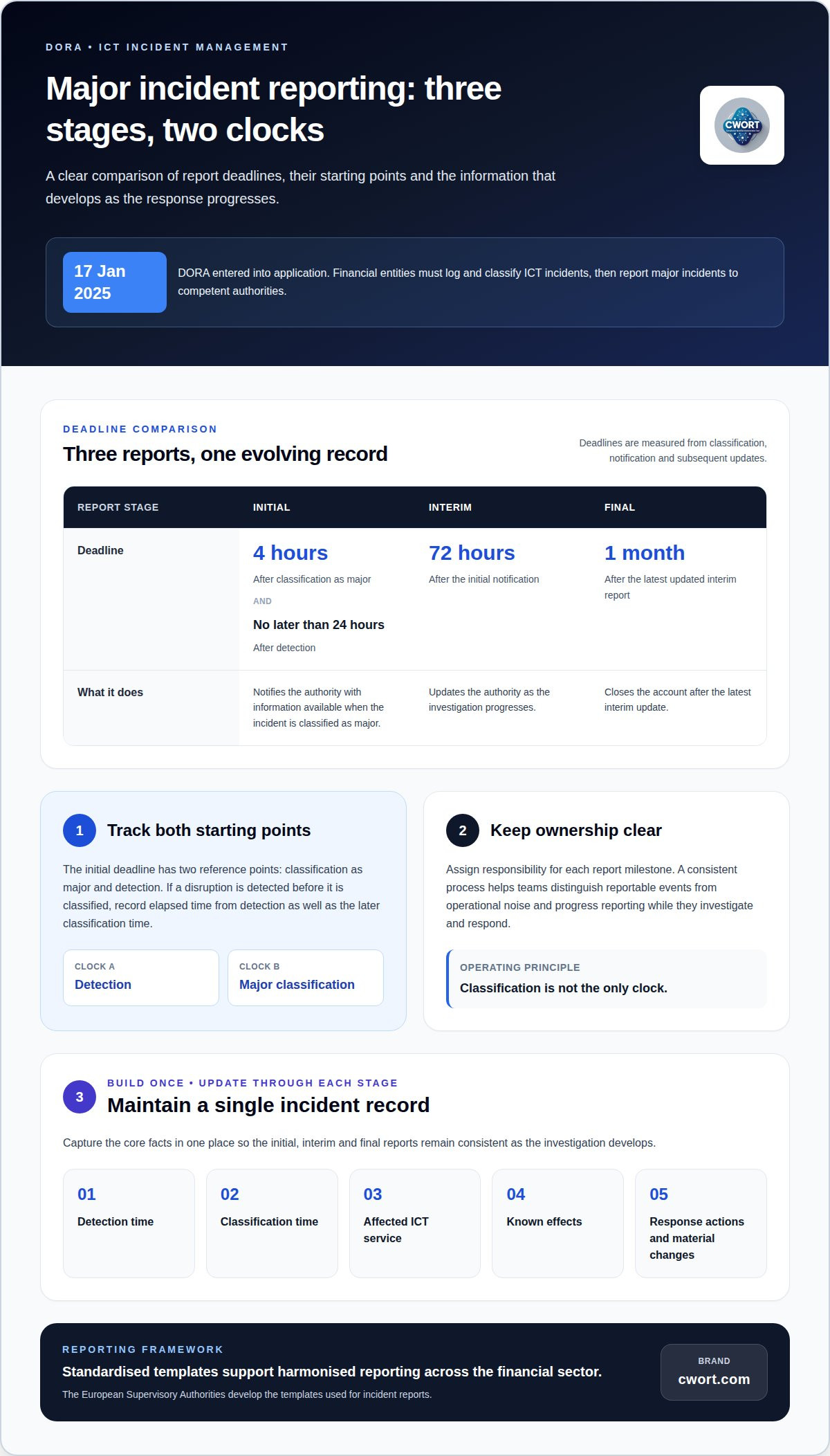
DORA sets deadlines for initial, intermediate and final reports, measured from classification, notification and subsequent updates. Reporting must progress through these stages while the entity investigates and responds.
The initial notification is due within 4 hours of classification as major, and no later than 24 hours after detection. The interim report follows within 72 hours after the initial notification. A final report is due no later than one month after the latest updated intermediate report.
Build the incident workflow around both starting points: detection and classification. If a team detects a disruption before deciding it meets the major-incident criteria, for example, it should track elapsed time from detection as well as the later classification time. Assign responsibility for each milestone so teams do not treat classification as the only clock.
Incident Report Information
Incident reports communicate the event’s classification and the information required by standardised reporting templates. The European Supervisory Authorities develop these templates to harmonise reporting across the financial sector.
Initial, intermediate and final reports serve different purposes as a response develops. The initial notification records the information available when the incident is classified as major. Intermediate reports update the authority as the investigation progresses. The final report closes the account after the latest interim update, with a deadline one month after that update.
Maintain a single incident record to support all three reporting stages. Capture detection and classification times, the affected ICT service, known effects, response actions and material changes as the investigation proceeds. This helps teams provide consistent updates without reconstructing the incident narrative from separate operational records. Use the applicable template for each submission, distinguishing confirmed facts from developing information.
Authority Notifications and Threat Reporting
A DORA-covered entity reports a major ICT-related incident to its competent authority. The authority depends on the entity’s supervisory route. Significant institutions under ECB Banking Supervision submit their Register of Information to the ECB; other entities submit it to their national competent authority.
DORA’s incident classification also addresses cyber threats. Delegated Regulation (EU) 2024/1172 specifies criteria for determining significant cyber threats under Article 10. Chapter VI, Article 45 provides for voluntary sharing of cyber threat information among financial entities. That sharing is distinct from mandatory reporting of major incidents.
Near misses still need disciplined internal recording and assessment. DORA requires entities to log and classify ICT incidents, while external reports concern incidents that meet the applicable major-incident criteria. Assess each near miss against those criteria: the label alone does not establish whether external reporting is required.
For a more controlled reporting process, structured compliance validation can help connect obligations, control ownership and supporting evidence.
Critical ICT third-party provider oversight
DORA combines entity-level oversight of ICT providers with direct EU supervision of providers designated as critical. Financial entities need to understand both responsibilities and keep provider dependencies visible in their risk records.
Critical Provider Reporting Obligations
Critical ICT third-party providers have reporting and information duties within DORA’s Union-level oversight framework. This matters to financial entities because a provider’s response to oversight can affect visibility of risks tied to outsourced services.
The European Supervisory Authorities designated 19 critical ICT third-party providers on 18 November 2025. Under DORA, a designated provider must submit a reasoned statement to its Lead Overseer within 6 weeks of notification. It must also provide requested additional information within 30 calendar days.
Further deadlines apply during oversight. A critical provider must respond to Lead Overseer recommendations within 60 calendar days of receiving them. These duties belong to the designated provider, not the financial entity using its services. The entity still needs to assess how provider oversight findings affect its own ICT risk and service continuity.
Third-Party Registers and Concentration Risk
DORA requires financial entities to maintain a Register of Information covering contractual arrangements for ICT services. The register must distinguish providers supporting critical or important functions, giving the entity and its supervisors a structured view of dependencies.
Article 28(9) provides for standard templates for the register. Use a consistent record for each contractual arrangement, linking the provider to the service and the business function it supports. For example, a register should make clear when separate services rely on the same provider, rather than treating each contract as an isolated exposure.
That relationship helps reveal concentration risk: several important services may depend on one provider or a connected set of providers. If one disruption could affect multiple functions, the entity’s risk assessment should reflect that shared dependency. DORA Article 30(5) also mandates technical standards specifying elements to assess when subcontracting ICT services supporting critical or important functions.
Keep register quality under active control. Reconcile records against contractual arrangements, identify missing or outdated entries, and preserve evidence of corrections. In the 2024 DORA reporting-register dry run, 6.5% of submitted registers passed all data-quality checks. That result underlines why completeness and consistent classification matter before submission, especially where subcontracting obscures the service chain.
Missed or inaccurate reporting can leave competent authorities without timely information and weaken evidence of compliance. It can also delay supervisory follow-up and reveal gaps in provider oversight or resilience planning.
DORA’s applicability to EU and UK-connected financial entities
DORA entered into application on 17 January 2025, following its entry into force on 16th January 2023. For UK-connected groups, the first task is to map each legal entity and its regulated activities against DORA’s scope, rather than assume the whole group shares one status.
DORA identifies in-scope entities in Article 2(1), covering 20 types of financial entities and ICT third-party service providers. The regulation applies to more than 22,000 financial entities and ICT service providers operating within the EU. Investment firms are included as defined by Article 4(1)(1) of the MiFID II Directive. Article 2(3) sets out exclusions, including persons exempted under Articles 2 and 3 of MiFID II.
A UK group should map its EU subsidiaries, branches and regulated operations against the relevant entity definitions. For each entity, record its legal form, regulated activity, jurisdiction and supervisory authority, then link the scope assessment to its ICT risk records and reporting responsibilities. A UK parent’s location alone does not determine the position of every EU-regulated entity in the group.
UK-based ICT service providers also form part of the assessment. Record each provider relationship against the service and function it supports. This makes the dependency visible for risk management and contractual oversight, without treating the provider’s location as a substitute for assessing the financial entity’s obligations.
Ireland offers a practical example of national supervision within DORA’s EU framework. The Central Bank of Ireland uses firms’ ICT self-assessment responses to tailor supervision to their size and complexity. An Irish financial entity should maintain a clear link between its self-assessment, ICT risk framework and evidence in its register.
DORA also interacts with the NIS 2 Directive. For covered financial entities, DORA is treated as a sector-specific EU legal act when applying Article 4 of that directive. This matters for EU-connected groups assessing overlapping regulatory frameworks: identify which entity is covered, then map the relevant obligations without assuming that one framework replaces every other requirement.
Digital resilience testing provides another scope-related obligation. DORA requires testing for regulated financial service providers, including annual resilience testing of critical ICT systems and applications. Chapter IV, Articles 24-27 sets out testing requirements, including advanced testing for identified entities. A group should therefore link each covered entity to its testing arrangements and evidence, rather than rely on a group-wide label alone.
For UK leadership, the practical output is an entity-by-entity scope map. Record each relevant EU entity, its activities, supervisory authority, ICT dependencies and testing evidence. This gives the group a defensible basis for applying DORA alongside UK operational resilience regulation, without assuming the requirements are interchangeable.
Relationship between DORA and UK operational resilience regulation
DORA and UK operational resilience regulation both address resilience, but they are separate regulatory frameworks. The UK regime was introduced in 2021 by the Bank of England, FCA and PRA. DORA is an EU regulation, so UK-connected groups must assess which entities fall within its scope rather than assume one framework replaces the other.
For a group operating in both markets, start with an entity-level map. Identify each UK and EU legal entity, its regulated activities, supervisory relationships and ICT dependencies. Then record the requirements that apply to each. For example, a UK parent with an EU-regulated subsidiary should not treat the parent’s UK arrangements as automatic evidence of the subsidiary’s DORA compliance.
The two frameworks can draw on some of the same operational evidence, but shared evidence does not mean compliance requirements are identical. A service disruption record, continuity test or governance paper may support more than one assessment. Its relevance depends on the requirement, the entity and the evidence’s scope. Map each item to the applicable control and record where separate analysis or reporting is still needed.
Use a crosswalk to make differences visible. For each control, record the framework it addresses, the accountable owner, the evidence source and any entity-specific gap. A group-wide resilience test, for instance, may support an operational resilience review, while a DORA assessment must also consider the EU entity’s ICT risk management and applicable testing requirements. Do not mark both regimes satisfied solely because a group document exists.
Supervisory accountability also needs clear separation. The Bank of England, FCA and PRA introduced the UK operational resilience regulation in 2021; DORA establishes requirements for covered financial entities operating within its scope. Maintain distinct records of regulatory decisions, reporting routes and control assessments. This structure helps prevent an incident process designed for one framework from being treated as sufficient for another without assessment.
Review the relationship when group structures, services or provider dependencies change. Compare the current entity map with the operational resilience control set, then check whether each EU-connected entity has appropriate DORA evidence. Record overlaps, differences and remediation owners. This gives boards a clearer view of shared controls without obscuring separate obligations or accountability.
The key distinction is straightforward: coordinate the work, but assess each framework against its own scope and requirements. A structured comparison can help identify control overlaps and gaps across DORA and UK operational resilience. Explore a structured resilience assessment to organise that mapping and its supporting evidence.
CWORT: DORA Compliance Readiness and Assessment
CWORT’s DORA Compliance Readiness and Assessment helps organisations translate regulatory requirements into structured activities, mapped controls and evidence. Use it to identify readiness gaps, clarify control ownership and organise remediation across ICT risk, incident reporting and provider oversight.
CWORT is an enterprise compliance validation platform that links evidence to control outcomes and supports auditable compliance proof. This gives teams a more structured basis for assessing whether obligations are addressed, rather than relying on disconnected tracking records. Its wider framework work also includes UK NIS Compliance Management, NIS2 Readiness and Compliance Management, and ISO 27001 Readiness and Control Mapping.
To discuss how CWORT can support your DORA readiness work, visit cwort.com.
Build DORA readiness into ongoing governance
Use your next governance review to make regulatory ownership explicit. Assign responsibility for keeping control decisions current, escalating unresolved gaps and preserving the rationale behind key assessments. When business structures, services or technology dependencies change, reassess whether existing evidence still reflects how the organisation operates. This makes readiness an ongoing management discipline, not an exercise prompted only by an audit or incident.
The DORA reporting obligations for financial entities are easier to manage when decision-makers can trace requirements to accountable owners and defensible evidence. Set a clear review rhythm, align risk and compliance teams, and give senior leaders a concise view of outstanding actions. This supports informed decisions without treating a completed assessment as a permanent guarantee of compliance.
If your organisation needs to translate DORA requirements into a clearer readiness and remediation approach, speak with CWORT about the next steps. Arrange a discussion about DORA readiness and move forward with a more structured view of your obligations.
Frequently Asked Questions
Why is DORA needed?
DORA exists because financial services rely on interconnected digital systems and external ICT services. A disruption can affect customers, counterparties and connected services, not just one organisation’s internal operations. The regulation sets common digital resilience expectations for covered financial entities. It brings technology risk into operational risk management, linking resilience planning for internal systems with critical provider dependencies.
What is the Digital Operational Resilience Act (DORA)?
The Digital Operational Resilience Act is an EU regulation setting digital operational resilience requirements for covered financial entities. It treats ICT resilience as a regulatory concern across the financial sector, not simply an internal technology matter. In practice, firms assess how technology services support their activities, how disruption could affect those activities, and how governance and controls address the resulting exposure.
What does DORA mean for the UK financial sector?
DORA does not automatically apply to every UK financial firm just because it operates in the UK. UK-connected groups should assess whether an EU entity falls within DORA’s scope and identify the requirements that apply to it. A UK provider’s services may also form part of an in-scope entity’s ICT dependencies. Keep the EU entity’s obligations distinct from UK operational resilience requirements.
What does DORA cover?
DORA covers ICT risk management, incident handling and reporting, digital resilience testing, and ICT third-party risk. It also addresses oversight of designated critical ICT providers and voluntary cyber threat information sharing. These areas connect: when assessing a technology service, an organisation considers its business importance, the effects of disruption, and the controls and evidence relevant to the dependency.
What does DORA require?
DORA requires covered financial entities to establish ICT risk management arrangements and manage, classify and report ICT-related incidents. It also requires resilience testing and management of ICT third-party risk. In practice, this means assigning clear control ownership, maintaining evidence and keeping records aligned with actual services and dependencies. The precise requirements depend on the entity’s scope and activities.
What is the DORA regulation?
DORA is the common name for the EU regulation on digital operational resilience in financial services. It is a regulation, not a certification or voluntary code of practice. It sets obligations for covered financial entities and provides for oversight of designated critical ICT third-party providers. These requirements sit alongside each entity’s wider governance and risk management responsibilities.
When will DORA be enforced?
DORA entered into application on 17 January 2025, so covered entities should treat its requirements as current obligations. The relevant question is now whether each entity has identified its applicable duties and can demonstrate how its controls operate. For a group with EU and UK operations, scope assessments should distinguish EU entities subject to DORA from UK entities assessed under UK requirements.
Who needs to comply with DORA?
Compliance applies to financial entities within DORA’s scope, as identified in Article 2(1), subject to the exclusions in Article 2(3). The regulation covers categories including investment firms, trading venues, market operators, central counterparties and central securities depositories. An organisation should assess each legal entity and its regulated activities separately, since a group-wide designation does not determine every subsidiary’s regulatory status.
Disclaimer
The content on this site is provided for general information and educational purposes only. It does not constitute legal, regulatory, financial, or professional advice. CWORT provides AI-assisted insights and workflow automation, but all compliance decisions remain the responsibility of your organisation and its management. Always seek qualified legal or regulatory guidance for decisions relating to the UK NIS Regulations, CAF, DORA, NIS2, ISO 27001, or other obligations.
Related posts
DORA Technical Standards Compliance: Moving from Regulatory Theory to Validated Execution
Struggling with DORA technical standards compliance? Move beyond spreadsheets to a validated framework that provides real-time, auditable evidence for regula...
DORA Compliance Validation Software: Orchestrating Defensible Proof in 2026
Is your DORA strategy audit-ready for 2026? Learn how DORA compliance validation software provides defensible proof and protects board members from liability.
DORA Obligation Mapping Tool: Orchestrating Defensible Compliance in 2026
Stop manual DORA tracking. A DORA obligation mapping tool orchestrates compliance, automates reporting, and creates a defensible audit trail for central banks.
Article by
Michael Iyiola
Co-Founder, CWORT
Michael Iyiola is a co-founder of CWORT and a Cyber and AI Security Engineer with deep experience in vulnerability management, detection engineering and operational resilience across UK critical national infrastructure, including rail, energy and financial services. At CWORT, he designs scalable, evidence-driven workflows that help teams meet modern regulatory and security demands.
Build Your Foundation of Auditable Certainty
Take control of your regulatory obligations and secure your infrastructure with CWORT.