5 ways to reduce compliance task stress and manage risks

Michael Iyiola
Co-Founder, CWORT
Discover 5 practical ways for making regulatory compliance less stressful. Automate repetitive tasks, manage risks, and maintain control across your teams.

Compliance should create control, not constant firefighting. Regulatory compliance means meeting the laws, regulations and standards that apply to your organisation; making regulatory compliance less stressful starts with turning those obligations into clear responsibilities, workable controls and reliable evidence. In the UK, the data protection framework includes UK GDPR and the Data Protection Act 2018.
Changing requirements, repetitive administration and uncertainty about compliance gaps can put real pressure on teams. Treating every task as urgent, however, often adds work without improving oversight.
This article explains what regulatory compliance involves and sets out five practical ways to manage the workload: automate repetitive tasks, track regulatory changes systematically, assess risks proportionately, make controls easier to evidence and use practical stress-management habits. You’ll also see how compliance can strengthen organisational processes, as well as where gaps in control can expose an organisation to harm.
Key Takeaways
- Identify the obligations that apply to your organisation and translate them into clear controls, owners and evidence.
- Automate repetitive documentation and monitoring tasks so teams can focus on reviewing exceptions and control effectiveness.
- Prioritise compliance work by assessing the likelihood and impact of risks, then evaluating how well existing controls reduce them.
- Track regulatory changes systematically and update relevant policies, processes and employee training when requirements shift.
- Build practical stress-management habits into the working day, while improving how compliance responsibilities are organised and shared.
Table of Contents
- 1. What is regulatory compliance?
- 2. Automation of repetitive compliance tasks
- 3. Benefits and risks of compliance
- 4. Keeping up with regulatory changes
- 5. Stress management for compliance professionals
- CWORT: DORA Compliance Readiness and Assessment
1. What is regulatory compliance?
Regulatory compliance means meeting the laws, rules and standards that apply to an organisation. It turns external obligations into internal policies, accountable roles, working controls and evidence. According to UK Parliament, the UK’s data protection framework includes UK GDPR and the Data Protection Act of 2018. A business must identify which requirements affect its activities, then translate each into practical actions employees can follow.
International activity can widen that scope. According to the European Union, the GDPR applies to organisations outside the EU that handle personal data of EU residents. UK businesses should map where customer and employee data is collected, stored and accessed, then identify relevant privacy and cybersecurity frameworks. DORA, NIS2, UK NIS and ISO 27001 may feature in an organisation’s obligations or assurance work, depending on its activities and applicable requirements.
Before adding processes, review the ones already in place. For each policy and control, identify the obligation it addresses, its accountable owner and the evidence it produces. Remove duplicated approvals and obsolete steps, while retaining safeguards that manage genuine risks. When regulatory wording is open to interpretation, record the wording, your organisation’s interpretation, the rationale and the control that follows. This gives teams a consistent basis for decisions and helps prevent unnecessary bureaucracy.
Employees may resist compliance when they see it as a blocker or cannot connect a procedure to their work. Explain the risk behind each requirement and involve affected teams when redesigning processes. Compliance teams can work with HR and Communications to build understanding and cooperation. For instance, explain how an access review protects sensitive records instead of presenting it as administration without purpose.
What makes regulatory compliance stressful for UK businesses? Changing requirements, unclear interpretations, competing responsibilities and repetitive evidence work can all create uncertainty and pressure. Making regulatory compliance less stressful starts with clear ownership, proportionate controls and a defined way to escalate unresolved questions.
How can UK businesses choose between in-house compliance support and an external consultant? In-house support can work well when employees understand the organisation’s operations and can maintain its controls. External expertise can help when a specific framework gap calls for an independent assessment or specialist knowledge. Whichever approach you use, define the scope and decision rights so accountability stays clear.
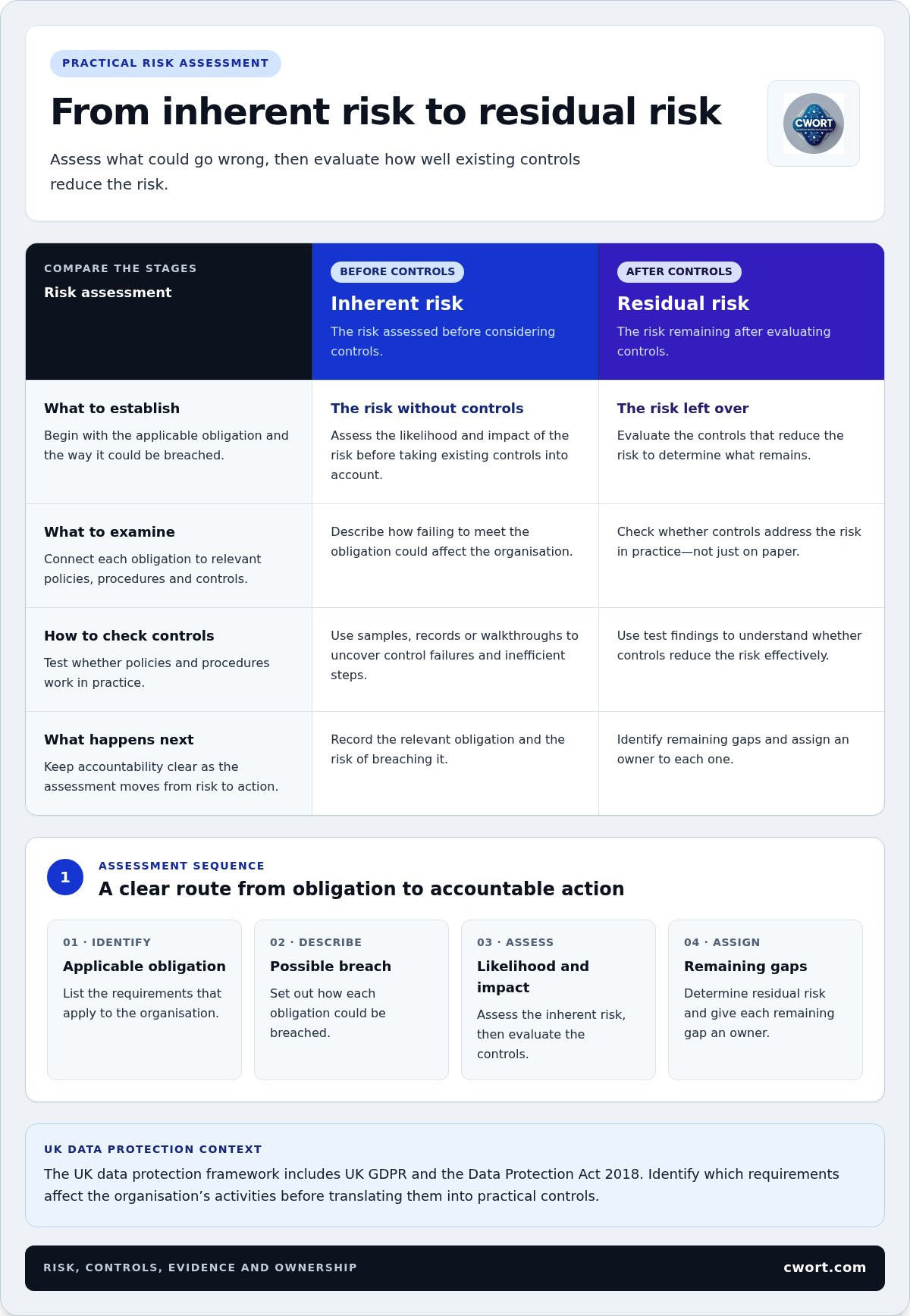
For a practical risk assessment, list the applicable obligations and identify how each could be breached. Assess likelihood and impact as inherent risk, then evaluate the controls that reduce each risk to determine residual risk. Assign owners to any remaining gaps. Internal control testing checks whether policies and procedures work in practice: use samples, records or walkthroughs to uncover failures and inefficient steps.
How should a business prepare for a UK regulator inspection or audit? Assign a coordinator, organise current policies and control evidence, and give every record an accountable owner. Check that employees can explain the procedures they follow and that the evidence supports the recorded outcomes.
Role-specific training and clear procedures help employees turn obligations into practical actions. Tailor training to each person’s responsibilities, document completion and update guidance when a policy or control changes. Internal audits can identify procedures that conflict with new requirements or have become obsolete, improving efficiency and the reliability of compliance evidence.
2. Automation of repetitive compliance tasks
Compliance work becomes harder to control when teams manage many obligations and repeat the same tasks across spreadsheets, emails and project tools. Re-entering control status in multiple places can also create inconsistencies. Start by listing the recurring tasks in each review cycle, such as assigning control owners, requesting evidence, recording approvals and following up overdue actions. Link each task to its source requirement and define what a complete record contains. Automate stable, repeatable steps first, while keeping decisions about interpretation and risk with accountable people.
A compliance management system can bring requirements, policies, processes, owners and evidence into a consistent workflow. For example, linking a control to a policy can prompt an evidence request to its owner, record the response and preserve the result for review. Set permissions so employees can access the work relevant to their roles while reviewers retain oversight. Before implementation, define how the system handles exceptions, incomplete evidence and changes of ownership. Automation should make unresolved work visible, not silently mark it complete.
Automated monitoring can compare submitted records with defined control requirements and flag missing or overdue evidence. A rule might identify an access review with no recorded approval and route it to the responsible owner. Configure alerts for meaningful exceptions rather than every routine change to avoid notification overload. Check alert logic against actual control outcomes: an inaccurate rule can create false confidence or unnecessary follow-up. Human review remains essential when context determines whether evidence shows that a control operated effectively.
Automate compliance reviews by creating a repeatable sequence: select the control, request relevant records, test the evidence, document findings and assign remediation. For financial institutions, independent external auditors or automated scanning can reduce resources required for periodic audits. Use consistent review criteria so that separate teams assess comparable evidence in the same way. Preserve the reviewer, date, decision and supporting record. This creates a traceable review history and helps identify recurring gaps, rather than leaving findings scattered across email threads.
Measure whether automation improves the process, not simply whether tasks move faster. Track overdue evidence, repeated control failures and time spent resolving exceptions, then use those findings to refine workflows. Keep a named owner for every automated process and review its rules when a policy or control changes. Organisations seeking a structured way to connect obligations, execution and evidence can explore compliance validation workflows. Automate administration; retain human accountability for risk judgements and remediation decisions.
Compliance software can automate documentation and monitoring, reducing opportunities for human error. Use that capability to clarify which records the software should create or maintain and what reviewers must still verify. Check that monitoring rules reflect agreed requirements and that flagged items reach an accountable person for assessment. Distinguish completed automation steps from evidence that the underlying control worked as intended. Keep the process focused on accurate records and useful follow-up, and adjust it when documentation or monitoring no longer supports a reliable review.
3. Benefits and risks of compliance
Compliance adds value when controls improve how work gets done, not just how paperwork is completed. A documented approval path, for example, may reveal duplicate checks between procurement and finance. Internal audits can test whether those checks prevent errors and where responsibilities overlap. Teams can then simplify hand-offs, clarify ownership and apply consistent evidence standards. The result is operational insight, provided the controls address genuine risks and work in day-to-day practice.
Both weak and excessive controls create risks. Weak controls can expose an organisation to violations, regulatory censure and reputational harm. Excessive controls can slow decisions, duplicate work and distract teams from material challenges. A compliance officer can compare each control’s purpose with the effort it takes and the results it produces. If repeated access reviews identify no actionable issues, for example, assess whether the scope or evidence method needs refinement. Don’t remove a control simply because it takes effort: first establish whether it manages a relevant risk.
For severe violations, the GDPR fine framework can impose a maximum fine of 4% of annual global turnover, according to the European Union. What are the penalties for non-compliance with UK regulations? They depend on the applicable regulation and the nature of the breach; consequences can include regulatory censure, financial penalties and required corrective action. A business should identify the relevant enforcement framework, document its controls and address gaps promptly, rather than assume one penalty applies across every sector.
Use a proportionate assessment to decide where further mitigation is worthwhile. Record the obligation, the activity that could breach it and the potential impact. Assess inherent risk before considering existing safeguards, then evaluate residual risk after those controls. For a low-impact issue with reliable safeguards, further measures may add little value. A high-impact exposure with weak evidence calls for clearer ownership, stronger controls or a defined remediation plan. This helps teams focus audit effort where significant consequences and control weaknesses coincide.
Compliance can also improve products and services. Requirements may prompt better safety, sustainability or reliability, while cross-department reviews can expose weak processes. For example, a product team reviewing a data-handling control with information security and customer support might uncover an unclear hand-off. Agree an owner and record the revised process to turn that finding into an operational improvement. Then check whether the change resolved the issue: completion alone does not prove the control works.
Measure both assurance and workload. Review audit findings, repeat issues, overdue remediation and employee feedback together. Recurring findings may point to a failing policy, training approach or control design. If a process takes effort without reducing a material risk, redesign it and record the rationale. This disciplined review helps organisations protect their reputation and improve efficiency without treating every obligation as equally urgent. Compliance is most defensible when decisions, evidence and risk priorities align.
4. Keeping up with regulatory changes
Regulatory horizon scanning helps organisations spot changes before existing controls become outdated. Assign an owner to monitor relevant legislation, regulator communications and standards for each business activity. Filter updates by jurisdiction, service, data handled and operational impact. A change affecting customer data may require a different response from one affecting supplier assurance. Record the source, publication date, affected obligation and initial assessment to distinguish material changes from background commentary.
Turn each relevant update into a controlled assessment. First, identify the obligation and its effective requirements. Then compare them with current policies, processes, evidence and accountable owners. Document any gap, the compliance risk, the decision and the required action. A change affecting supplier oversight, for example, could prompt a review of supplier records, contract controls and escalation routes. This traceable method helps explain why a control changed and who approved its implementation.
Prioritise changes by relevance and potential impact, not by the prominence of an announcement. Financial institutions can use CWORT horizon scanning to identify changes and gaps in compliance controls, then update relevant policies and processes making regulatory compliance less stressful. Record the rationale, affected teams and evidence needed to show completion. Schedule an annual or semi-annual review of requirements, as recommended in the research, to identify controls that need improvement or removal.
How can a business create a simple compliance calendar and track deadlines? List each obligation, its accountable owner, due date, preparatory tasks and evidence location in one shared calendar or register. Add reminders for review and approval stages, record completion and escalate overdue actions through a defined route. Include regulatory publications and internal policy reviews, not just submission dates.
For UK guidance, consult GOV.UK publications for government requirements and sector guidance, the Information Commissioner's Office (ICO) for data protection, and the National Cyber Security Centre (NCSC) for cyber security guidance. Sector regulators, including the Financial Conduct Authority, also publish guidance for the firms they oversee. Treat each source as an input to your assessment: identify the affected activity, record your interpretation and map it to controls.
External updates only reduce risk when teams can turn them into timely action. Give affected employees a concise explanation of what changed, which procedure applies and where to record evidence. Include role-specific training in the control plan, and track completion rather than relying on a single annual session. Ongoing education helps staff adapt as requirements evolve. Review whether the updated control works through evidence checks and internal audits; revise the process if it creates conflicting instructions or fails to address the identified compliance risk.
Compliance officers in many sectors report spending over a third of their week tracking regulatory changes, and compliance officers may spend 40+ hours a week reading about regulatory compliance without finding all the answers. Appropriate compliance tools can help financial institutions implement necessary changes quickly and with limited impact on daily operations.
Training can form part of compliance controls, helping employees adapt to new regulations. Ongoing education is preferable to relying on once-a-year training, so teams can respond as requirements change.
5. Stress management for compliance professionals
Compliance stress often reflects how work is organised, not individual weakness. Professionals must identify risks, prevent misconduct, implement new requirements and manage controls across an organisation. Pressure grows when responsibilities conflict, evidence is scattered or every request seems urgent. Start by logging recurring sources of strain, such as repeated evidence requests or unclear approvals. Use the record to separate urgent risks from tasks that can be scheduled, delegated or redesigned.
Give the compliance department a clear working rhythm. At the start of each cycle, review deadlines, unresolved control issues and available capacity. Assign an owner to every action and prioritise it according to potential impact and the decisions required. For example, escalate an unresolved control failure affecting sensitive information ahead of routine document formatting. A visible programme of work helps colleagues understand trade-offs and reduces last-minute demands caused by uncertainty.
Set shared expectations for how the team works together. Agree how members raise concerns, challenge decisions and request support, then document those expectations. Invite colleagues to record common objections to compliance in a shared document. Prepare clear, risk-based responses; for example, explain how an approval step prevents unauthorised access. This helps staff prepare for difficult discussions and keeps disagreements focused on evidence rather than personal frustration.
Work with HR and Communications to improve cooperation across the organisation. Understand each group’s challenges before updating guidance. Customer-support staff may need a concise procedure for handling a data request, while procurement may need clear supplier-assessment responsibilities. Explain the business reason for each action and make the correct process accessible. This helps employees see compliance as practical guidance, not an obstacle to operations.
Build recovery into the working day. Compliance professionals can practise conscious breathing and take moments of stillness between demanding tasks. Step away from the screen, breathe deliberately and return with one defined next action, such as reviewing a control record. Outside work, prioritise sleep, healthy eating and exercise in nature. These habits can support stress management, but they do not replace addressing the workload or unclear processes behind persistent pressure.
Managers should treat recurring strain as operational information. Review repeated overtime requests, growing backlogs and unresolved ownership with the same discipline as control findings. Identify which processes generate avoidable work, then remove duplication or clarify decision rights. If regulatory updates create conflicting instructions, coordinate one approved update and communicate it to affected teams. This makes the programme more manageable while preserving accountability and evidence.
For a more structured view of compliance work and control evidence, explore a compliance validation approach.
CWORT: DORA Compliance Readiness and Assessment
CWORT’s DORA Compliance Readiness and Assessment helps organisations turn regulatory obligations into structured activities, with evidence linked to control outcomes. It can be a practical next step when teams need clearer visibility of assessment work, control gaps and supporting evidence. CWORT also offers UK NIS Compliance Management, NIS2 Readiness and Compliance Management, and ISO 27001 Readiness and Control Mapping. These offerings support organisations working across those frameworks without treating compliance as disconnected spreadsheets and task lists. To discuss your compliance requirements, contact CWORT or visit cwort.com.
Make your next compliance decision count
Choose one operational pressure point for your next improvement cycle. It could be an unclear control owner, a recurring evidence gap or a process that consumes effort without addressing a material risk. Define the outcome, assign accountability and review whether the change improves both assurance and day-to-day work. This makes reducing compliance stress a practical management priority, rather than another broad programme competing for attention.
Where external support would help structure that work, CWORT offers DORA Compliance Readiness and Assessment, UK NIS Compliance Management and NIS2 Readiness and Compliance Management. Each is relevant to organisations assessing or managing requirements within those frameworks. Set out the framework and challenge you need to address, then contact CWORT to discuss compliance.
Set a clear priority, keep decisions traceable and build on evidence. A more controlled compliance programme starts with the next action your organisation can own.
Frequently Asked Questions
What compliance tasks can be automated with software, and what does it cost in the UK?
Software can automate evidence requests, control-status updates, approval routing, deadline reminders and audit-trail recording. For example, a system can link an uploaded policy review to its control, record the reviewer and flag missing approval. CWORT’s pricing depends on the regulatory frameworks managed and organisational scale; implementation fees depend on control-model configuration and onboarding requirements. The price depends on the case and is given after a quote request.
Disclaimer
The content on this site is provided for general information and educational purposes only. It does not constitute legal, regulatory, financial, or professional advice. CWORT provides AI-assisted insights and workflow automation, but all compliance decisions remain the responsibility of your organisation and its management. Always seek qualified legal or regulatory guidance for decisions relating to the UK NIS Regulations, CAF, DORA, NIS2, ISO 27001, or other obligations.
Related posts
Streamlining Regulatory Compliance Processes: From Manual Tracking to Orchestrated Validation
Stop wasting money on manual compliance. Learn about streamlining regulatory compliance processes to reduce personal liability under DORA & NIS2 and gain aud...
Real-Time Compliance Dashboards for Executive Decisions
See how real-time compliance dashboards for executives turn trusted data into clear risk signals, accountable actions and stronger regulatory oversight.
The Evolution of the Enterprise GRC Validation Tool: From Tracking to Orchestration in 2026
Stop chasing compliance ghosts in spreadsheets. Create a single source of truth for compliance with GRC orchestration to master NIS2, DORA, and UK audit dema...
Article by
Michael Iyiola
Co-Founder, CWORT
Michael Iyiola is a co-founder of CWORT and a Cyber and AI Security Engineer with deep experience in vulnerability management, detection engineering and operational resilience across UK critical national infrastructure, including rail, energy and financial services. At CWORT, he designs scalable, evidence-driven workflows that help teams meet modern regulatory and security demands.
Build Your Foundation of Auditable Certainty
Take control of your regulatory obligations and secure your infrastructure with CWORT.