Automated Compliance Evidence Collection: From Data to Defensible Proof

Michael Iyiola
Co-Founder, CWORT
Learn how automated compliance evidence collection turns raw data into audit-ready defensible proof, improves speed, and maintains rigorous accountability.

Automation can collect evidence without proving compliance. Automated compliance evidence collection can retrieve records from operational systems faster and reduce repeated requests, but a file without context, an accountable owner or a clear link to a control is not defensible proof. The challenge is to improve speed without weakening accuracy, accountability or audit value.
That concern is well founded. Evidence is often spread across teams and platforms, while recurring requests can turn assurance into a cycle of chasing documents. This article explains what automation can collect, where validation remains essential, and how to connect obligations, execution activities, evidence and control outcomes in a repeatable process.
You’ll also see how controlled checkpoints, evidence binding and role-based accountability support a clearer assurance position. A compliance validation system such as CWORT binds evidence to activity state and control outcomes, enforces separation of duties by design, and generates regulator-ready and audit-ready outputs without manual reconstruction. The result is a more explainable view of compliance for auditors, regulators and senior leadership.
Key Takeaways
- Assess automated compliance evidence collection by checking source coverage, provenance, completeness, ownership and control linkage.
- Separate evidence from the activity it records and the control outcome it is meant to support.
- Use a governed sequence to scope obligations, map controls, prioritise evidence sources, assign ownership and pilot the approach.
- Combine system integrations with structured checkpoints to capture different evidence types within the same workflow.
- See how CWORT connects requirements to controls and execution activities, with separation of duties enforced by design.
Table of Contents
- What automated compliance evidence collection does, and what it cannot prove alone
- How automated evidence collection becomes traceable, control-linked proof
- How to assess automated evidence collection for quality and auditability
- How to implement automated compliance evidence collection in a governed sequence
- How CWORT turns automated evidence collection into continuous compliance validation
What automated compliance evidence collection does, and what it cannot prove alone
Software can gather or organise evidence from connected systems and controlled inputs, making relevant records easier to assemble and review. But collection is only one part of assurance. A file can be genuine and still fail to show whether a defined control was performed effectively, by the right person and within the right scope.
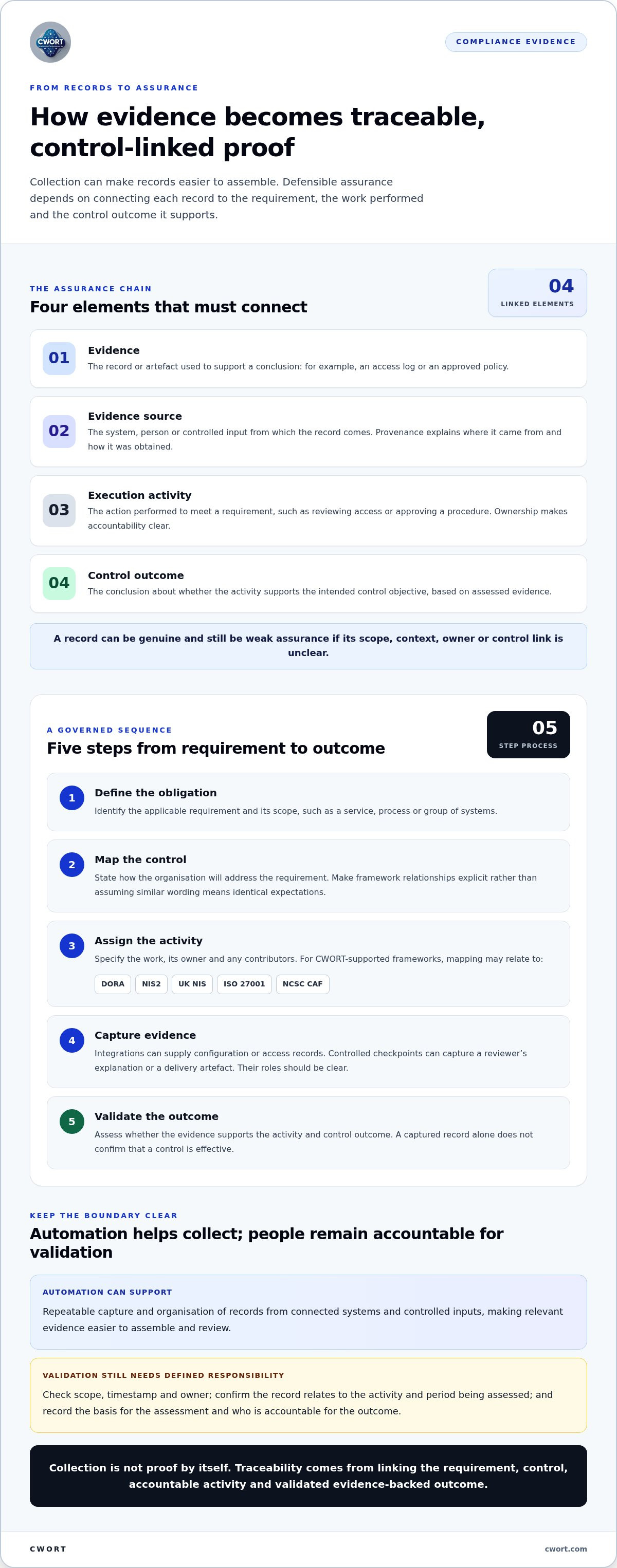
Automated compliance evidence collection gathers and organises records; it does not, by itself, establish that an obligation has been met. To understand the distinction, separate four elements:
- Evidence: the record or artefact used to support a conclusion, such as an access log or approved policy.
- Evidence source: the system, person or controlled input from which that record comes.
- Execution activity: the action performed to meet a requirement, such as reviewing access or approving a procedure.
- Control outcome: the conclusion about whether the activity supports the intended control objective.
These elements need to connect. An access record may show that permissions changed, but not why the change was authorised or whether the review covered the required systems. Scope identifies what the evidence relates to; provenance explains where it came from and how it was obtained; ownership identifies who is accountable for the activity or review; context explains why the evidence matters. Without these links, a record can be accurate yet weak as assurance.
This distinction reflects a broader principle in compliance management. Guidance on compliance management systems addresses how organisations establish and evaluate a compliance management system. Evidence collection supports that discipline, but records still need to be assessed against the relevant obligation and control.
What counts as compliance evidence?
Evidence may include access records, configuration data, approved policies or delivery artefacts showing that a defined activity took place. Its value depends on its relationship to a specific obligation, control or execution activity, not simply on its presence in a repository. A policy can document an intended process; it cannot alone demonstrate that the process was followed.
Keep source data distinct from an assessor’s judgement. A system record is an input. An assessor evaluates whether it is complete, relevant and sufficient to support a conclusion about control effectiveness. That judgement should be traceable to the evidence and the criteria applied.
Where does automation stop?
Automation can support repeatable capture and organisation. Interpretation, approval and accountable control decisions still require defined responsibility. Before relying on an automated record, establish its scope, timestamp and owner, then check whether it relates to the activity and period being assessed.
A record that lacks this context cannot support a stronger conclusion simply because it was collected automatically. Automation can make assurance more consistent, but it cannot make unsupported inferences reliable. Validate the evidence, record the basis for the assessment and make clear who is accountable for the outcome.
How automated evidence collection becomes traceable, control-linked proof
Collection becomes useful for assurance when each record can be followed back through the work it supports. That requires a defined sequence: start with the obligation, establish the control, identify the activity, then capture and assess its evidence. Integrations can bring system records into the process, whilst structured checkpoints capture explanations, decisions or delivery artefacts that a system record alone may not show.
Traceable compliance follows a clear path: requirement to control, control to accountable activity, and activity to validated evidence-backed outcome.
- Define the obligation. Identify the applicable requirement and the scope it covers, such as a particular service, process or group of systems.
- Map the control. State how the organisation will address that requirement. Make framework relationships explicit rather than assuming similar wording means identical expectations.
- Assign the activity. Specify the work that must happen, who owns it and who contributes. For CWORT-supported frameworks, mapping may relate to DORA, NIS2, UK NIS, ISO 27001 or NCSC CAF.
- Capture evidence. An integration may supply configuration or access records, while a controlled checkpoint can capture a reviewer’s explanation or a delivery artefact. Both can support one activity, provided their roles are clear.
- Validate the outcome. Assess whether the evidence supports the activity and control outcome. A captured record is not, by itself, confirmation that the control is effective.
Map obligations to activities before connecting evidence sources
Begin with the requirement, not with whichever data source is easiest to connect. Define the control and its observable execution activity first. For example, if a control requires a review, specify what is reviewed, the scope of that review and what completion should demonstrate. Then assign the accountable owner and any contributors before evidence is requested or ingested. This prevents a stream of records with no defined purpose.
Keep framework mapping visible. Where one activity supports more than one framework, record each relationship and its rationale. A crosswalk can help identify overlap, but it should not erase differences in scope or expected outcomes.
Bind evidence to activity state and control outcomes
Evidence context should show which activity produced or used it, which control it supports and what outcome is being assessed. Record the source reference and timestamp alongside the responsible role and relevant audit history. These details help reviewers understand what changed, when it changed and who was accountable, rather than asking them to infer a trail from disconnected files.
Keep the record distinct from the activity’s status. Evidence may be captured while review or approval remains outstanding; completion should reflect validation, not mere receipt. CWORT binds evidence to activity state and control outcomes, assigns roles and enforces separation of duties by design. Learn more about this evidence-to-outcome relationship through a CWORT demonstration.
How to assess automated evidence collection for quality and auditability
Assess the evidence workflow, not just the number of systems it connects to. A broad integration catalogue may increase source coverage, but it does not show whether records are complete, attributable or linked to the control they are meant to support. Use consistent criteria across the workflow, from source capture to review and audit output.
The following comparison table sets out what to examine and what a reliable process should make visible:
Test evidence quality, provenance and scope
Sample evidence across different activities. Check that each item identifies its source, relevant period, scope and related activity. Then test how the process handles a missing record, conflicting entries or data that falls outside the defined scope. These cases reveal whether exceptions remain visible for investigation or disappear within a reassuring summary.
Completeness is not the same as effectiveness. A full set of records may still fail to demonstrate that a control operated as intended. Assess whether validation is repeatable: reviewers should be able to apply clear criteria, understand unresolved activities and see the basis for a conclusion.
Evaluate accountability, governance and audit outputs
Trace a sample from initial capture through review and approval. Confirm who can provide evidence, who is responsible for the activity and who makes the control decision. Check access controls and whether separation of duties is enforced, rather than relying on informal expectations. A reviewable history should make changes and decisions attributable, so an auditor can understand how the record and its status developed.
Finally, inspect an exported output. It should preserve the links between obligations, activities, evidence and outcomes, along with enough audit context for another reviewer to follow the reasoning. In automated compliance evidence collection, integration count is a starting measure of coverage, not a proxy for evidence quality or defensible assurance.
How to implement automated compliance evidence collection in a governed sequence
Implement automated compliance evidence collection as a controlled programme, not a race to connect every available system. Begin with a bounded scope and a clear purpose for each source. The sequence below helps teams establish governance before expanding coverage, so collection remains tied to real activities and reviewable outcomes.
- Scope obligations. Select the relevant framework requirements and operational boundaries, such as the services, processes or systems in scope. Record what the programme is intended to demonstrate.
- Map controls. Define the control response for each obligation and the execution activity that makes it observable. Clarify what completion should mean before deciding which evidence to collect.
- Prioritise sources. Start with evidence that supports important, repeatable activities and comes from reliable, accessible sources. Include controlled checkpoints where system records alone cannot capture the required explanation or delivery artefact.
- Define ownership. Assign accountable owners, contributors and reviewers for each activity. Set out who can submit evidence, who assesses it and who approves the outcome.
- Pilot the workflow. Test a representative activity from requirement through capture and validation. Keep the pilot narrow enough to examine records, roles, exceptions and audit history in detail.
- Review and refine. Resolve findings, adjust unclear activity definitions and refine evidence requirements before extending the programme. Expand only when the workflow is understandable and repeatable.
Scope the programme and prioritise evidence sources
Make the boundary explicit: which obligations apply, what operational scope is included and which activities will produce evidence. Rank candidate sources by assurance importance, repeatability and access to dependable information, rather than by ease of integration alone. For each activity, document the owner, contributors and review point. This gives teams a defined route for collecting evidence and a clear person responsible for its assessment.
Agree how the programme handles exceptions before they arise. Specify how teams flag missing or conflicting evidence, record why a source has changed, and route unresolved items for review. A changed record should not silently replace the context on which an earlier validation relied.
Pilot, review and improve the evidence workflow
Choose a representative control and follow its evidence from source to outcome. Check that the record has the right scope and context, permissions are appropriate, separation of duties is maintained, and changes remain attributable in the audit history. Ask a reviewer unfamiliar with the activity to follow the trail; difficulty doing so can expose unclear definitions or missing information.
Measure traceability, evidence completeness and the number and nature of unresolved validation activities, not the volume of records collected. Use pilot findings to correct the workflow, then review those measures as coverage expands. This keeps gaps visible instead of disguising them as successful collection. Explore how CWORT supports structured compliance validation in a product demonstration.
How CWORT turns automated evidence collection into continuous compliance validation
Automated evidence collection becomes more valuable when it sits inside a governed execution model. CWORT is a compliance validation system, not a task manager or traditional GRC tool. It translates regulatory requirements into controls and structured execution activities, then connects assigned roles, activity progress and supporting evidence to the control outcomes they are intended to demonstrate.
This shifts the focus from assembling records for a later review to maintaining an ongoing view of whether execution supports the required outcome. Evidence is bound to activity state and control outcomes, so a record is not treated as proof simply because it exists. Its relationship to the work and the control remains visible for review.
From structured checkpoints to continuous validation
Integrations can contribute system-generated records, while structured checkpoints capture subject matter expert input and delivery evidence within the execution workflow. Together, these sources can support an activity from different angles. Role assignment makes responsibility visible, and separation of duties is enforced by design, helping distinguish the person completing an activity from the role responsible for review.
As activities progress, CWORT provides a continuous validation state. This gives teams an ongoing view of execution and outstanding validation, rather than limiting insight to a periodic report. If an activity lacks supporting evidence or has not reached a validated outcome, that status remains part of the assurance picture. The aim is not to conceal gaps, but to connect execution and evidence to an explainable control position.
See the evidence-backed workflow in practice
CWORT’s stated framework scope includes DORA, NIS2, UK NIS, ISO 27001 and NCSC CAF. Within that scope, the system connects regulatory requirements to controls and activities, assigns roles, and binds evidence to activity state and control outcomes. This structure helps preserve the rationale behind an assurance position, rather than leaving reviewers to reconstruct relationships from separate records.
Regulator-ready and audit-ready PDF outputs are generated automatically, without manual reconstruction. The outputs draw on the structured execution and validation state, giving reviewers an organised account of how evidence relates to activities and control outcomes. They support scrutiny by making the evidence trail more coherent, while accountability remains anchored in defined roles and validated work.
See how this workflow could support your compliance assurance approach. Request a CWORT demonstration to explore the evidence-backed validation process.
Make assurance part of the way work gets done
The next step is to move assurance closer to execution. Choose a bounded area of compliance, identify the decisions leaders need to make, and establish how evidence will inform those decisions as work progresses. That shifts automated compliance evidence collection from a way to assemble records into a disciplined means of understanding whether obligations are being met.
CWORT supports this approach as a compliance validation system. Its continuous validation state gives teams an ongoing view of execution, whilst evidence remains connected to activity and control outcomes. Separation of duties is enforced by design, and regulator-ready and audit-ready PDF outputs are generated automatically, without manual reconstruction.
Build assurance that can be explained, reviewed and sustained. Request a CWORT demonstration to explore how the workflow could support your organisation’s compliance objectives.
Frequently Asked Questions
What is automated compliance evidence collection?
Automated compliance evidence collection uses software to gather or organise records from connected systems and controlled inputs for compliance activities. For example, an organisation might collect configuration records from an operational system and pair them with a reviewer’s documented assessment. The key is to define the purpose and scope of each record: automation can make evidence easier to retrieve, but the organisation still needs a clear basis for assessing what it demonstrates.
Can automated evidence collection prove that a control is effective?
Not by itself. An automated record can show that an event occurred, but effectiveness depends on whether the activity addressed the control’s purpose and operated within the intended scope. For instance, a record showing a change was approved may not establish that the approval followed the organisation’s defined review process. A responsible reviewer must assess the evidence against the control criteria, record the rationale and identify any gaps before reaching a conclusion.
How do integrations collect evidence for compliance activities?
Integrations connect a compliance workflow with relevant operational systems, allowing selected records to be retrieved or organised for defined activities. A source might provide configuration details, while a controlled checkpoint captures a specialist’s explanation of what those details mean. Set a clear scope for each connection and establish how records will be identified and reviewed. An integration should support a defined assurance need, not simply create another stream of data.
What happens if an automated evidence source is incomplete or out of date?
Mark the evidence as unresolved and investigate before relying on it. Check the record’s relevant period, source and scope; then determine whether the source omitted data, has stopped reflecting current operations or supplied information outside the activity being assessed. Record the exception, assign follow-up responsibility and retain the validation status as unresolved until it has been reviewed. Don’t treat a missing or stale record as evidence that the control has passed.
Is automated compliance evidence collection suitable for multiple frameworks?
Yes, provided each framework obligation is mapped explicitly to the activities and evidence intended to support it. One activity may contribute to more than one framework assessment, but the mapping should preserve differences in scope and expected outcomes rather than assume that similar wording means equivalent requirements. CWORT supports DORA, NIS2, UK NIS, ISO 27001 and NCSC CAF. Keep the rationale for each mapping available for reviewers.
How can an organisation assess the quality of automated compliance evidence?
Test a sample against its original source and the activity it is meant to support. Confirm the record is attributable, relevant to the period under review and within the defined scope. Then inspect how the workflow handles missing, conflicting or changed information, and whether a reviewer can identify who assessed it and on what basis. A useful quality review records exceptions and corrective actions, not just the number of items collected.
Can CWORT generate audit-ready evidence outputs automatically?
Yes. CWORT automatically generates regulator-ready and audit-ready PDF outputs without manual reconstruction. As a compliance validation system, it connects regulatory requirements with controls, execution activities and the evidence associated with their outcomes. Assigned roles and separation of duties are enforced by design. The generated output is based on that structured validation context, helping reviewers examine how execution supports the organisation’s compliance position.
Disclaimer
The content on this site is provided for general information and educational purposes only. It does not constitute legal, regulatory, financial, or professional advice. CWORT provides AI-assisted insights and workflow automation, but all compliance decisions remain the responsibility of your organisation and its management. Always seek qualified legal or regulatory guidance for decisions relating to the UK NIS Regulations, CAF, DORA, NIS2, ISO 27001, or other obligations.
Related posts
How to Demonstrate Control Effectiveness to Regulators: A Strategic Guide
Learn how to demonstrate control effectiveness to regulators with our guide. Shift from chaos to an evidence-based, audit-ready compliance programme today.
Reducing Audit Preparation Time and Costs: A Strategic Guide for UK Enterprises
Tired of costly audit seasons? Our guide for UK enterprises shows you how to stop the manual scramble, reducing audit preparation time and costs with automat...
UK NIS Audit Readiness Tool: Orchestrating Compliance for 2026
Master your 2026 audit with our guide to UK NIS compliance orchestration. Move from fragmented evidence to a single source of truth for NCSC CAF 4.0 readiness.
Article by
Michael Iyiola
Co-Founder, CWORT
Michael Iyiola is a co-founder of CWORT and a Cyber and AI Security Engineer with deep experience in vulnerability management, detection engineering and operational resilience across UK critical national infrastructure, including rail, energy and financial services. At CWORT, he designs scalable, evidence-driven workflows that help teams meet modern regulatory and security demands.
Build Your Foundation of Auditable Certainty
Take control of your regulatory obligations and secure your infrastructure with CWORT.