Compliance Management System Benefits for Better Oversight

Michael Iyiola
Co-Founder, CWORT
Explore the benefits of an orchestrated compliance system, from clearer accountability and consistent controls to stronger audit evidence and better oversight.

A compliance programme that can’t show who owns each control, what evidence supports it and whether gaps are being resolved leaves oversight incomplete. The benefits of an orchestrated compliance system are clearer accountability, more consistent control execution and a traceable record of compliance activity. According to the International Organization for Standardization, ISO 37301:2021 is the international standard specifically designed for compliance management systems.
Maintaining policies or collecting evidence before an audit is not enough. Leaders need a coherent view of how obligations translate into controls, how those controls operate and where action is needed. That distinction is central to understanding what a Compliance Management System is and what it can deliver.
This article explains how an orchestrated approach connects policies, controls, responsibilities and audit evidence, and why that matters for oversight. It examines how integrated workflows can reduce fragmentation, support monitoring and make compliance activity easier to assess. It also clarifies where a structured system helps and why it cannot replace sound judgement.
Key Takeaways
- Connect monitoring to clear control ownership so emerging gaps lead to accountable action.
- Use a GRC platform to organise regulatory obligations and assess how changes affect existing controls.
- Bring compliance data into a coherent view to support more consistent analysis and reporting.
- Orchestrate workflows to reduce fragmented hand-offs and give teams clearer oversight of outstanding work.
- Link policies and control outcomes to supporting evidence to strengthen audit readiness and decision-making.
Table of Contents
- Continuous monitoring of systems, processes and controls
- GRC platforms and regulatory intelligence
- Data collection, analysis and reporting
- Operational efficiency and cost reduction
- Policies, controls, and audit evidence
- CWORT: DORA Compliance Readiness and Assessment
Continuous monitoring of systems, processes and controls
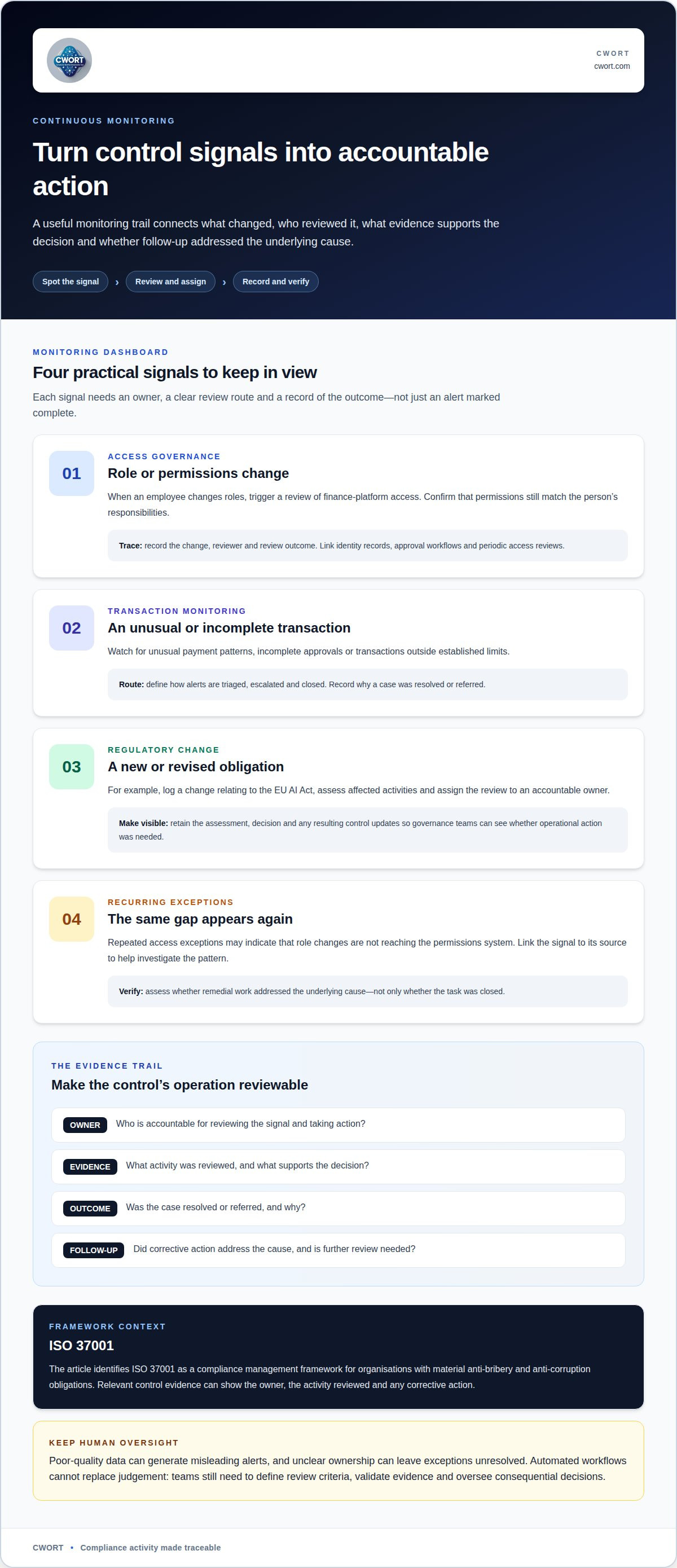
Continuous monitoring links control activity to observable signals across systems, processes and accountable owners. For example, a permissions change in a finance platform can trigger a review when an employee changes roles. The review confirms whether access still matches that person’s responsibilities. Recording the change, reviewer and outcome creates a traceable record. Without that sequence, an access list may look complete while concealing outdated permissions.
Access governance should connect identity records, approval workflows and periodic access reviews. A manager’s approval, for example, can be linked to the account granted, its business purpose and the control governing that access. Transaction monitoring provides a different signal, such as unusual payment patterns, incomplete approvals or transactions outside established limits. Each alert needs a defined route for triage, escalation and closure. That route should record why a case was resolved or referred, not merely mark the alert complete.
Control monitoring also needs to cover risks that cross business processes. ISO 37001 provides a compliance management framework for organisations with material anti-bribery and anti-corruption obligations, according to the International Organization for Standardization. An organisation using that framework can monitor the operation of relevant controls, such as approval records for sensitive transactions. The evidence should show the control’s owner, the activity reviewed and any corrective action. A policy alone cannot demonstrate that the relevant process operated as intended.
Regulatory change monitoring helps organisations identify when a new or revised obligation may affect existing controls. A technology business tracking the EU AI Act, for example, can log the change, assess affected activities and assign a review to an accountable owner. For anti-bribery controls, the UK Bribery Act may also be relevant to an organisation’s obligations. Recording the assessment, decision and resulting control updates makes the response visible to governance teams. It also helps distinguish a regulatory update from a change that requires operational action.
Ongoing monitoring relies on reliable inputs and clear escalation rules. A control owner can review exceptions, record supporting evidence and assign remedial work through a defined workflow. The next review should assess whether the action addressed the underlying cause, not just whether someone closed the task. Repeated access exceptions, for example, may indicate that role changes are not reaching the permissions system. Linking a signal to its source helps teams investigate patterns and refine controls.
What risks or limitations should organisations consider when adopting compliance orchestration? Poor-quality data can generate misleading alerts, while unclear ownership can leave exceptions unresolved. Automated workflows cannot replace judgement. Teams need to define review criteria, validate evidence and retain human oversight for consequential decisions.
GRC platforms and regulatory intelligence
A GRC platform connects governance, risk and compliance information so teams can relate obligations to business controls. Look for an obligation register, control mapping, accountable owners, change tracking and reports that show how decisions were reached.
Adapting to regulatory requirements
Adapting compliance means translating an organisation’s applicable obligations into relevant controls, owners and evidence requirements. This matters because a business may face different expectations across its activities, markets and operating entities.
A platform should let teams record each obligation’s scope, affected processes and linked controls. For example, an organisation assessing the EU AI Act can identify relevant activities, assign an assessment owner and document its control response. It can separately map environmental, social and governance disclosure obligations under the CSRD to the teams responsible for reporting inputs. This structure helps leaders see which obligations affect which operations, rather than treating every requirement as a generic checklist.
Useful tools also reveal where frameworks overlap. A control supporting access governance may relate to several obligations, but its evidence and accountable owner should remain identifiable. Teams can map shared controls once and record framework-specific gaps separately. This can prevent duplicate work while preserving the rationale for each compliance decision. For organisations operating across jurisdictions, record scope and applicability alongside the control mapping.
Managing regulatory updates
Managing updates means recording a regulatory change, assessing its impact and assigning any resulting work. An unassessed change can leave existing control mappings out of step with an organisation’s current obligations.
A defined workflow can capture an update, identify affected obligations and route an impact assessment to the relevant owner. The owner records whether controls, evidence requirements or internal guidance need revision, then assigns follow-up actions. For example, a change affecting a technology activity can be logged against the EU AI Act assessment, with the decision and its rationale retained for review. A status view can distinguish an update awaiting analysis from one that has led to completed control changes.
Choose a platform that preserves change history, links decisions to affected controls and flags overdue assessments. It should support clear reporting without treating an alert as proof that an obligation applies. People must still assess scope and interpret consequences. Software can organise that work, not replace professional judgement. These features help teams adapt as requirements evolve without rebuilding their entire compliance process.
Data collection, analysis and reporting
Compliance analysis is only as reliable as the records behind it. An orchestrated approach brings data from relevant business systems and control activities into a coherent view. For example, a control record can link a process owner, review outcome and supporting document. Centralising compliance data can reduce errors and help keep information current across compliance activities. It also gives reviewers a clearer basis for understanding what a report represents.
Start with consistent data definitions. If one team records a control as “under review” and another as “in progress”, a combined report may obscure its true status. Shared fields for owner, status, evidence and review outcome make records easier to compare. A data steward can resolve conflicting entries and document the correction. This is especially important when a board report draws on different teams, systems or business units.
Analysis should reveal patterns, not just count completed tasks. A recurring exception across departments may point to a process weakness, while an isolated issue may call for a different response. Teams can group findings by control, owner or business activity, then assess whether actions address the cause. A useful report distinguishes open issues from completed work and records the rationale behind material decisions.
How does an orchestrated system support audit trails and regulatory reporting? It links control outcomes to evidence, owners and recorded decisions, creating a traceable history for review. It can then organise relevant records into reports showing compliance activity and outstanding gaps.
Keep the reporting trail connected to the underlying record. A reviewer, for example, should be able to move from a summary of overdue assessments to the relevant control, its owner and the submitted evidence. The record should also show how an exception was assessed and what action followed. This connection helps internal reviewers test a conclusion without relying on disconnected spreadsheets or recollections.
Blockchain data can contribute transparency, but only when an organisation can interpret it. A record’s visibility does not, by itself, explain its relevance to a compliance control. Analysts need to connect the data to the activity being assessed, identify meaningful patterns and document their interpretation. This prevents raw information from being mistaken for a verified compliance conclusion.
Reporting should support different decisions without changing the underlying facts. Operational teams may need task-level exceptions, while senior leaders need a concise view of control outcomes, unresolved gaps and assigned actions. Use consistent source records, clear definitions and documented analysis for both. When a reporting period closes, preserve supporting evidence and the decision trail so later reviewers can understand how conclusions were reached.
Operational efficiency and cost reduction
Disconnected compliance work creates repeated hand-offs. A team might record a control in a spreadsheet, assign actions in Jira and store evidence elsewhere. Each transfer creates another opportunity for duplicate entry, inconsistent status or missed follow-up. Orchestration coordinates records and workflows so staff can see the task, owner and next decision together. The practical benefit is less time spent reconciling administration and more capacity to review exceptions.
How does compliance orchestration compare with separate compliance tools or manual processes? Separate tools can support individual tasks, but people may still need to connect records and chase progress across systems. An orchestrated process links workflows and decisions, giving teams a shared view of ownership, status and outstanding actions.
Automation can reduce manual data entry and streamline approvals. A low-risk activity, for example, can follow a defined approval route, while an exception goes for further review. Automation should apply agreed criteria consistently, not remove human judgement from complex decisions. Compliance staff can then focus on unusual cases, recurring control failures and remediation priorities instead of repeatedly transferring information.
To assess efficiency, map the work before changing it. Identify where teams re-enter information, wait for approvals or assemble reports manually. Then define the intended workflow, owners and escalation points. For a control review, this might mean assigning evidence collection to its owner, routing exceptions to a reviewer and recording closure against the original task. Compare the new process with the previous hand-offs to identify remaining delays or duplicated work.
Implementation usually involves documenting current obligations and processes, mapping controls, assigning owners, configuring workflows, connecting relevant data and validating results. Teams then train users and refine the process as operational needs emerge. The sequence matters: automating a poorly understood workflow can preserve its inefficiencies. Start with a defined compliance area, test that evidence and approvals follow the intended route, and address process gaps before expanding.
For a UK implementation, cost depends on the case and is provided after a quote request. Factors include scope, integrations, data migration, workflow configuration and training. They also shape the implementation plan: connecting existing systems may require more coordination than configuring a workflow around well-organised records. Treat the operating model and technical work as related decisions, not separate projects.
Financial repercussions of non-compliance are approximately 2.71 times greater than the costs of maintaining a robust compliance programme. This comparison reinforces the value of assessing both operational effort and exposure. It doesn’t mean every organisation will achieve the same savings. Instead, review where manual work consumes capacity, where repeated errors create rework and whether stronger coordination supports more consistent control execution.
Policies, controls, and audit evidence
A policy states the organisation’s intended approach; a control makes that approach operational. Audit evidence shows whether the control operated and what happened when it did not. For example, a supplier onboarding policy may require approval before engaging a new supplier. The related control records the approval, its owner and the evidence supporting the decision. Linking these elements makes oversight more reliable than keeping policy documents, control records and audit files apart.
Map each policy requirement to a defined control and accountable owner. Record the control’s purpose, scope, operating activity and expected evidence. For a supplier approval control, evidence might include the completed assessment, recorded approval and date of the decision. A reviewer can compare that evidence with the control’s stated purpose. If a file is missing or approval happened outside the process, the gap becomes visible and can be assigned for action.
Version control matters. When a policy changes, identify affected controls, review whether existing procedures remain aligned and record who approved the update. A revised approval threshold, for example, may require changes to workflow guidance and staff responsibilities. Keeping the previous version and the change rationale helps reviewers understand which requirements applied when a decision was made. Without that history, an audit trail may show a document but not its operational relevance.
Consistent records also support meaningful control testing. A reviewer can select an activity, inspect its attached evidence and compare the result with the control criteria. The record should capture the test performed, the reviewer’s conclusion and any exception. If testing identifies a gap, link the resulting action to the relevant control and retain evidence of closure. This preserves the connection between a finding and the response, rather than presenting them as unrelated tasks.
Evidence quality matters as much as volume. A folder of documents may still fail to show who performed a control, when it operated or what decision followed. Define evidence requirements for each control, then reject records that do not demonstrate the relevant activity. An approval policy alone, for instance, does not prove that a particular supplier was approved. A dated approval record linked to that supplier provides a clearer basis for review.
Before an audit, use the control register to identify missing evidence, overdue reviews and unresolved findings. Assign each gap to an owner, record the expected corrective action and retain evidence of completion. This gives internal reviewers a route from policy to control, test, exception and resolution. A clear chain helps leaders distinguish documented intent from demonstrated performance, strengthening oversight without treating a completed checklist as proof of compliance.
To see how structured compliance validation can connect controls with their supporting evidence, explore compliance validation.
CWORT: DORA Compliance Readiness and Assessment
CWORT helps organisations translate regulatory obligations into structured activities, control outcomes and auditable evidence. Turn to its DORA Compliance Readiness and Assessment when you need to organise DORA-related compliance work and identify where readiness requires attention. The same approach supports UK NIS Compliance Management, NIS2 Readiness and Compliance Management, and ISO 27001 Readiness and Control Mapping.
Use this support when regulatory requirements, control ownership and evidence are difficult to coordinate across existing processes. The work focuses on connecting obligations to execution, making progress and gaps easier to assess. For a practical next step, visit CWORT online to explore how its compliance offerings relate to your oversight needs.
Set a clear direction for your next compliance cycle
Make the next step a focused decision, not another layer of administration. Select the compliance area where clearer ownership, stronger validation or more structured evidence would most improve leadership oversight. Define the intended outcome, who will own the work and how progress will inform future priorities. The benefits of an orchestrated compliance system become practical when its processes support the decisions your organisation needs to make.
CWORT offers DORA Compliance Readiness and Assessment, UK NIS Compliance Management, and NIS2 Readiness and Compliance Management. These offerings give organisations a route to structure work around relevant frameworks and assess readiness. The right starting point is the obligation that matters most to your current oversight needs.
Take that next step with a clear view of your priorities. Discuss your compliance requirements with CWORT and move towards a more deliberate, evidence-led approach to oversight.
Frequently Asked Questions
What is a Compliance Management System?
A Compliance Management System is the organised framework an organisation uses to manage its compliance responsibilities. It brings together policies, assigned roles, processes for assessing obligations and methods for reviewing performance. For example, a company can use one system to assign a policy owner, record related controls and schedule internal reviews. The system provides structure for managing compliance, while accountable people remain responsible for decisions and actions.
What is an orchestrated compliance system?
An orchestrated compliance system coordinates compliance work across people, processes, evidence and tools. Rather than leaving teams to connect separate records manually, it links activities to responsibilities and decisions. For example, an assessment can move from scope definition to evidence gathering, analysis and approval, with each stage recorded. This governed workflow helps teams understand how a compliance conclusion was reached and who contributed to it.
What are the main benefits of an orchestrated compliance system?
The main benefits of an orchestrated compliance system include clearer ownership, more consistent execution and better visibility of unresolved issues. For example, a senior leader reviewing a programme can distinguish an approved control from one awaiting evidence or further assessment. A connected record also helps teams trace a finding to its decision and follow-up. These advantages support informed oversight, although their value depends on accurate inputs and meaningful control design.
How does compliance orchestration reduce manual work and compliance costs?
Compliance orchestration reduces repetitive work by connecting information and routing tasks through defined workflows. Staff spend less effort copying control details between spreadsheets, chasing approval status or reconstructing reports from separate records. For example, a single assessment record can support review by operational owners and assurance teams. The actual cost effect depends on existing processes, implementation requirements and how much work can be standardised.
How can compliance orchestration improve risk monitoring and control effectiveness?
It can improve monitoring by linking risk indicators to specific controls, owners and review actions. For example, repeated exceptions in a control can prompt an assessment of whether its design or operation needs attention. Teams can record the evidence considered, the reviewer’s reasoning and any resulting action. This supports consistent scrutiny, but automated alerts still require people to interpret context, validate evidence and judge the significance of a finding.
Which UK regulations can a compliance orchestration system help organisations meet?
For organisations with relevant obligations, compliance orchestration can support work relating to UK NIS, DORA, NIS2 and ISO 27001. It can help structure assessments, map controls and organise evidence for review. Which frameworks apply depends on the organisation’s activities and regulatory context. A system can support compliance management and readiness, but it does not itself determine legal applicability or replace the organisation’s responsibility for meeting its obligations.
Disclaimer
The content on this site is provided for general information and educational purposes only. It does not constitute legal, regulatory, financial, or professional advice. CWORT provides AI-assisted insights and workflow automation, but all compliance decisions remain the responsibility of your organisation and its management. Always seek qualified legal or regulatory guidance for decisions relating to the UK NIS Regulations, CAF, DORA, NIS2, ISO 27001, or other obligations.
Related posts
Regulatory Scrutiny Management Tool: Orchestrating Defensible Compliance in 2026
Facing DORA & NIS2? A regulatory scrutiny management tool orchestrates defensible compliance, ending manual evidence chaos for permanent audit-readiness in 2...
Compliance Evidence Management Software: Proving Regulatory Readiness in 2026
Prepare for DORA & NIS2. See how compliance evidence management software replaces chaotic audit trails with a single, defensible source of truth.
ISO 27001 Control Effectiveness Proof: Moving Beyond Static Certification to Defensible Validation
Move beyond static ISO 27001 certification. Discover how an ISO 27001 compliance validation tool delivers continuous, defensible proof for UK regulators.
Article by
Michael Iyiola
Co-Founder, CWORT
Michael Iyiola is a co-founder of CWORT and a Cyber and AI Security Engineer with deep experience in vulnerability management, detection engineering and operational resilience across UK critical national infrastructure, including rail, energy and financial services. At CWORT, he designs scalable, evidence-driven workflows that help teams meet modern regulatory and security demands.
Build Your Foundation of Auditable Certainty
Take control of your regulatory obligations and secure your infrastructure with CWORT.